AI Marketing
Key Takeaways
- Answer Engine Optimization is becoming an important part of search visibility as users increasingly use AI platforms such as ChatGPT, Gemini, and Perplexity for recommendations and comparisons.
- Blogs and listicles remain highly valuable for AI visibility, accounting for 62.1% of the cited page types in the analysis referenced in the content.
- Content should focus on context, not just keywords. Use-case, persona, industry, and problem-specific content can better match detailed AI prompts.
- Content structure matters for AI citations. Question-based headings, FAQ sections, descriptive H1s, statistics, and structured content are highlighted as important factors.
- Fresh and regularly updated content can improve AI visibility. The article recommends maintaining visible “last updated” dates and refreshing important pages instead of publishing content and leaving it unchanged.
- Backlinks alone do not reliably predict AI visibility. The analysis presented shows little to no correlation between backlink volume and AI citations, although backlinks still support traditional SEO.
- Third-party presence and brand consensus matter. The content highlights platforms such as Reddit, LinkedIn, and YouTube as important sources for building broader brand signals and authority.
- AI visibility is dynamic. Citations can change significantly over time, so brands should track mentions and citations continuously rather than relying on a single snapshot.
- A practical 30-day AEO plan includes tracking buyer prompts, updating the top pages, creating use-case/persona pages, building third-party authority, and monitoring AI visibility month over month.
Introduction
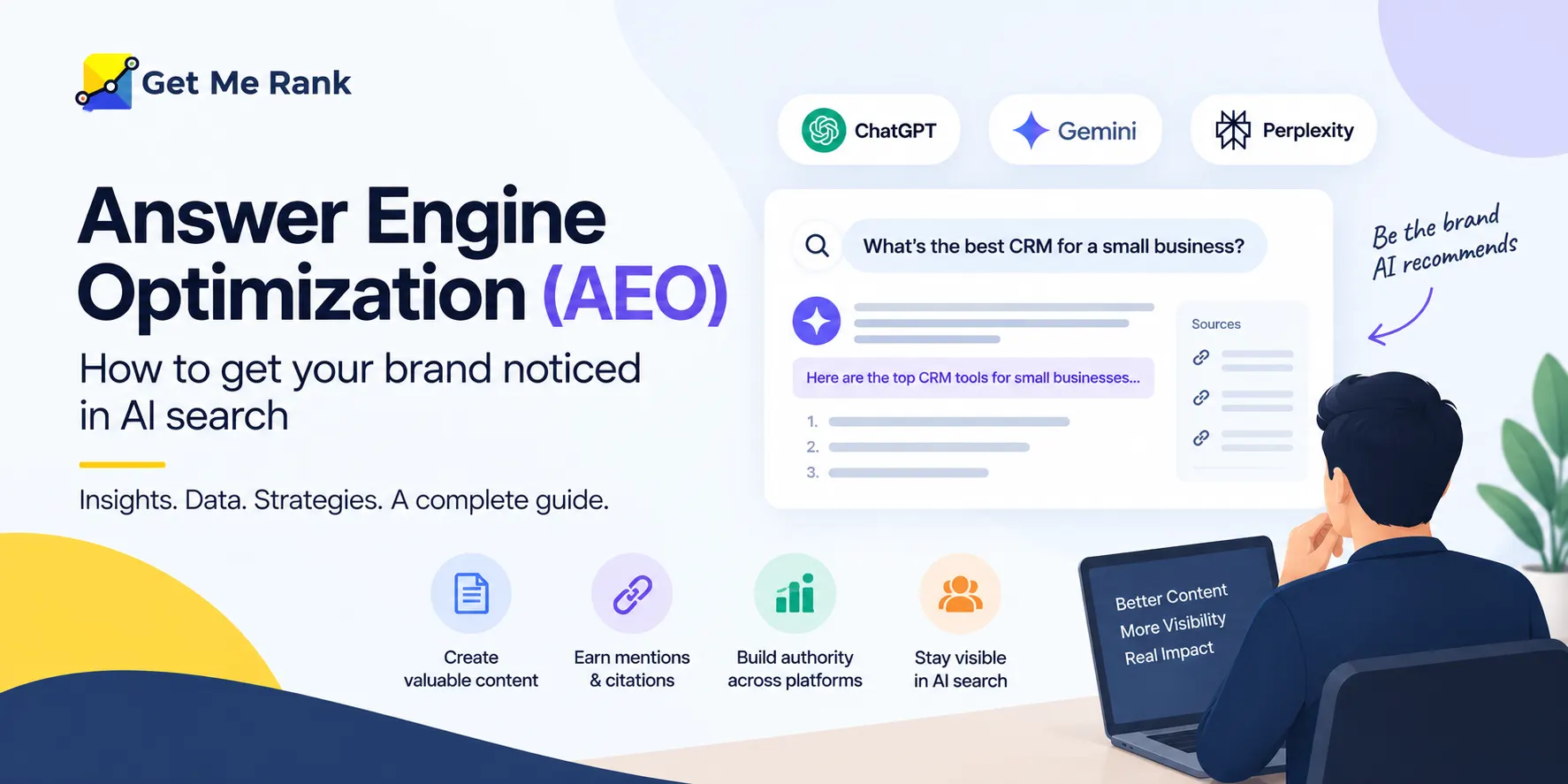
Ask your customers “How did you hear about us?” and a new answer is showing up more and more often: “ChatGPT.” People are no longer just Googling — they’re asking AI answer engines like ChatGPT, Gemini, and Perplexity for recommendations, comparisons, and buying advice.
The scale is real. Recent industry data suggests monthly AI sessions are now roughly 56% the size of search worldwide — and the trajectory points to AI rivalling, even surpassing, traditional search. When a buyer asks an answer engine “What’s the best CRM for a small business?” the brands that get named win the consideration — often before the buyer ever visits a website.
That shift has created a new discipline: Answer Engine Optimization (AEO). Here’s what the data says actually drives AI visibility, and how to act on it.
A quick AEO vocabulary
Know these four termsAEO — Answer Engine Optimization: how you get your business to show up in relevant AI answers. Visibility — how often your brand shows up across AI platforms. Mentions — when your brand appears in an AI answer without a link. Citations — clickable sources the AI links to.
Traditional SEO tries to rank a page. AEO tries to get your brand mentioned and cited inside the answer itself. The tactics overlap, but the target is different.
Insight 1: The blog isn’t dead — it’s the most-cited page type
If you assumed AI would kill the blog, the data says otherwise. Large-scale analysis of AI citations — more than 14 million of them across AI Mode and AI Overviews — shows blog posts and listicles dominate the pages AI cites:
AEO Explained: What Actually Drives Brand Visibility in ChatGPT, Gemini & Perplexity
Most-cited page types in AI answers
Blog posts & listicles
62.1%
Other sources
18.4%
Product pages
16.0%
User reviews
3.5%
Based on analysis of the most-cited pages across AI Mode & AI Overviews (14M+ citations).
Why do LLMs lean on blog posts? Because a good article is structured, scannable, and information-dense — exactly the format an answer engine can pull a clean snippet from. A product page sells; a blog post explains, and explanation is what answer engines are assembling.
The catchDon’t spin down your blog — but don’t approach it the way you did pre-AI. Publishing more keyword-stuffed posts won’t help. Structuring posts so a machine can extract a direct answer will (more on that in Insight 3).
Insight 2: The shift from keywords to context
Search and AI behave very differently. A typical Google search is about 5 words. A typical ChatGPT conversation is around 350 words. People give answer engines full context — their industry, their constraints, their use case — and expect a tailored recommendation back.
What this means for your contentOptimising for a short head keyword isn’t enough. You need content that matches the context of a real buyer’s question — their role, industry, and situation.
The highest-leverage move here is building use-case and persona pages: “How insurance companies convert more leads,” “A CRM for automotive dealerships,” “[Your product] for logistics teams.” These pages line up with the long, specific prompts buyers actually type into AI — and they give the engine a precise passage to cite.
Insight 3: Content structure matters — a lot
This is the biggest practical lever. Analysis of ~10,000 pages across 10 companies and 8 AI engines shows which on-page factors correlate most strongly with getting cited. The standouts:
| On-page factor | AI Overviews | AI Mode | Gemini | ChatGPT | SearchGPT |
|---|---|---|---|---|---|
| Question-style headings | +28 | +7 | +19 | -3 | 0 |
| FAQ schema | +24 | +7 | +8 | -1 | 0 |
| External links (20+) | +19 | +6 | +17 | -3 | 0 |
| FAQ section | +18 | +4 | +4 | -3 | +1 |
| Descriptive H1 | +16 | +6 | +16 | +3 | +5 |
| Statistics / data | +13 | +2 | +3 | +7 | +5 |
Based on analysis of ~10,000 URLs across 8 AI engines. Values are relative citation-likelihood points per engine.
A few things jump out. Google-owned surfaces (AI Overviews, AI Mode, Gemini) reward classic answer-engine structure hardest — question headings, FAQ schema, external links. ChatGPT is the odd one out, where statistics and descriptive H1s matter more than FAQ formatting. So structure for the engines you care about, and don’t assume one recipe fits all.
Turn that into four concrete habits:
- Frame your H2s, H3s, and H4s as questions. “How much does X cost?” beats “Pricing.” It mirrors the prompt and gives the engine a clean question–answer pair.
- Add a real FAQ section that answers the exact questions your prospects are asking AI — with direct, 40–60 word answers at the top of each section.
- Mark it up with FAQ schema (FAQPage structured data) so engines can parse the question/answer pairs unambiguously.
- Incorporate unique data — ideally data that speaks to your own product or customers. Original numbers get cited because nobody else has them.
The pattern to rememberLLMs favour content that is structured, scannable, and data-dense. Write for a reader first, then format so a machine can lift a clean, self-contained answer from any section.
Insight 4: Freshness matters more than ever
Answer engines have a strong recency bias. Analysis of 17 million citations found the content AI cites is about 25% more recent than what ranks in classic Google search:
1,064 vs 1,432
avg. days since publication (answer engines vs Google)
909 vs 1,047
avg. days since last updated (answer engines vs Google)
~25%
more recent content, on average, in AI citations
Practically, one of the simplest wins is showing a visible “last updated” date. Pages that show a last-updated date get cited more often across most engines:
| Engine | With “last updated” date | Without | Difference |
|---|---|---|---|
| AI Overview | 38% cited | 30% cited | +8 pts |
| Perplexity | 78% | 73% | +6 pts |
| Gemini | 71% | 66% | +5 pts |
| Copilot | 59% | 55% | +4 pts |
| Grok | 90% | 87% | +3 pts |
| Google AI Mode | 83% | 81% | +1 pt |
| SearchGPT | 91% | 90% | +1 pt |
| ChatGPT | 83% | 83% | 0 pts |
Based on analysis of ~10,000 URLs across 10 companies.
Recency is a re-entry ticketIn AEO, refreshing and re-dating a strong page can push it back into the citation pool. Build a refresh cadence for your best pages — don’t just publish and forget.
Insight 5: Backlinks don’t predict AI visibility
This is the one that surprises SEOs most. Across a ~10,000-URL dataset, there is little to no correlation between citations and backlinks on any major engine:
| Engine | Correlation between citations & backlinks |
|---|---|
| AI Overview | +0.06 |
| SearchGPT | +0.05 |
| Gemini | −0.02 |
| Google AI Mode | −0.04 |
| Perplexity | 0.00 |
| ChatGPT | 0.00 |
| Grok | +0.01 |
| Copilot | +0.01 |
Based on analysis of ~10,000 URLs. Correlation coefficients (roughly 0 = no relationship).
One striking example: a “top CRM tools” affiliate listicle was cited 85 times despite having just one backlink. The reason is a fundamental difference in what each system is looking for:
Google vs answer enginesGoogle search tries to find the most authoritative page on the web (and links are a big authority signal). Answer engines try to find the best snippet to answer the question — so relevance, structure, and freshness can beat raw link authority.
This doesn’t mean links are worthless for your business — they still help classic SEO, which still feeds AI. It means you shouldn’t rely on a big backlink profile to carry you in AI answers. Structure and consensus (next) do more of the work.
Insight 6: Answer engines look for consensus
Answer engines don’t just read your website — they cross-check what the wider web says about you. When a brand shows up consistently across trusted third-party platforms, engines treat that as consensus and are more likely to recommend it.
Three platforms punch above their weight for AI authority: Reddit, LinkedIn, and YouTube. And they dominate citations exactly where it matters most — late-stage, high-intent questions:
| Phase of buyer’s journey | Share of citations |
|---|---|
| Solution evaluation + final research | 55% |
| Solution comparison | 19% |
| Problem exploration | 14% |
| Solution education | 12% |
Reddit, LinkedIn & YouTube dominate citations for high-intent questions, based on analysis of AI citations by buyer-journey phase.
If you can only pick one, pick YouTubeVideo is heavily cited and hard for competitors to replicate quickly. Reddit rewards genuine community participation (not spam), and LinkedIn rewards named experts posting substantive takes. Choose one, commit to a real cadence, and build presence where AI is already looking.
Insight 7: AI results are volatile — play the trend, not the snapshot
AI citations churn fast. Research shows roughly 4 in 10 citations drop within a month, and 7 in 10 are gone after six months. A page cited today may vanish from answers by next quarter.
The mindset shiftAEO is a trend game, not a snapshot game. Checking your visibility once tells you almost nothing. Tracking it over time — and continuously refreshing and expanding — is the whole discipline.
Your 30-day AEO checklist
You don’t need to boil the ocean. Here’s a focused month-one plan drawn from the same playbook:
- Track the prompts your buyers are asking AI. Map the real questions across awareness, consideration, and evaluation — these become your content targets.
- Rewrite your top 5 pages for AEO: question-style headings, direct 40–60 word answers, an FAQ section, FAQ schema, and a visible last-updated date.
- Publish 5 use-case / persona pages that match the specific, contextual prompts buyers type (by industry, role, or job-to-be-done).
- Pick one of YouTube, Reddit, or LinkedIn and create a content plan to build third-party authority and consensus.
- Measure visibility over time — track brand mentions and citations across engines month over month, not as a one-off.
Final thoughts
The core insight underneath all seven: your buyers are already asking answer engines for advice. The real question isn’t whether your customers will use answer engines — it’s whether they’ll find you when they do.
The brands that win won’t be the ones with the biggest backlink profiles. They’ll be the ones publishing structured, data-rich, regularly-refreshed content that matches how people actually ask — and building authority where AI already looks for consensus.
Get found in AI answers
Want your brand cited in ChatGPT, Gemini & Perplexity?
Get Me Rank builds AEO-ready content, structures your key pages for citation, and tracks your AI visibility over time — alongside the SEO that still feeds it. Book a free AI visibility review.
Frequently asked questions about AEO
What is Answer Engine Optimization (AEO)?
AEO is the practice of getting your business mentioned and cited in the answers produced by AI engines like ChatGPT, Gemini, Perplexity, and Google’s AI Overviews. Where SEO aims to rank a page, AEO aims to get your brand into the answer itself.
What’s the difference between mentions and citations?
A mention is when your brand name appears in an AI answer without a link. A citation is a clickable source the AI links to. Both build visibility; citations also drive referral traffic.
Is AEO different from SEO?
They overlap but aren’t identical. Classic SEO still feeds AI answers, so it matters. But AEO leans harder on content structure (question headings, FAQ schema), freshness, original data, and third-party consensus — and much less on backlinks.
Do backlinks help with AI visibility?
Large-scale analysis of AI citations shows little to no direct correlation between backlinks and AI citations. Links still help traditional SEO (which feeds AI), but they don’t reliably predict whether an answer engine will cite you. Structure, relevance, and freshness matter more.
How do I get started with AEO?
Start by tracking the prompts your buyers ask AI, then rewrite your top pages with question-style headings, direct answers, an FAQ + FAQ schema, and a last-updated date. Add use-case/persona pages, build authority on one of YouTube/Reddit/LinkedIn, and measure your visibility over time.
How is AEO measured?
By tracking how often your brand appears (visibility), how often it’s named without a link (mentions), and how often it’s linked as a source (citations) across engines — and, crucially, how those trend month over month, since AI results are volatile.