Digital Strategy
Key Takeaways
- CRO helps turn more website visitors into leads, customers, or other valuable actions.
- Traffic alone isn’t enough—businesses should also focus on what visitors do after reaching the website.
- A good conversion rate depends on the industry, audience, traffic source, search intent, business model, and conversion goal.
- Clear CTAs, strong value propositions, simple forms, trust signals, and good UX can reduce friction and support conversions.
- SEO and CRO work together: SEO attracts relevant visitors, while CRO helps convert them into business opportunities.
- Use GA4, Google Search Console, behavioural data, and testing to identify pages and user journeys that need improvement.
- Focus on qualified leads and meaningful business outcomes, not just increasing the number of conversions.
- CRO should follow a continuous process of research → hypothesis → testing → measurement → improvement.
- With changing search behaviour and AI-powered search, businesses should optimise the full journey from search visibility to website engagement to conversion.
Introduction
Getting visitors to your website is only one part of digital marketing. The bigger question is: what happens after they arrive?
A website can attract thousands of visitors every month and still generate fewer leads or sales than expected. Visitors may leave because they cannot find the right information, the CTA is unclear, the form is too complicated, the page loads slowly, or they simply do not trust the business enough to take the next step.
This is where Conversion Rate Optimization (CRO) comes in. CRO focuses on improving the percentage of website visitors who complete a valuable action — such as submitting a form, booking a consultation, requesting a quote, signing up for a service, or making a purchase. Instead of relying only on increasing traffic, businesses can use CRO to generate more value from the traffic they already have.
The core questionWith AI-powered search changing how people find answers, businesses need to think beyond “How do we get more visitors?” and also ask: “How can we turn more of our existing visitors into customers?”
What Is Conversion Rate Optimization?
Conversion Rate Optimization (CRO) is the process of improving a website or digital experience so that a higher percentage of visitors complete a desired action. A conversion could be:
- Filling out a contact form
- Requesting a quote
- Booking an appointment
- Scheduling a demo
- Making a purchase
- Calling a business
- Signing up for a newsletter
- Downloading a resource
- Starting a free trial
For example, imagine a website receives 10,000 visitors and generates 200 leads. Its conversion rate would be:
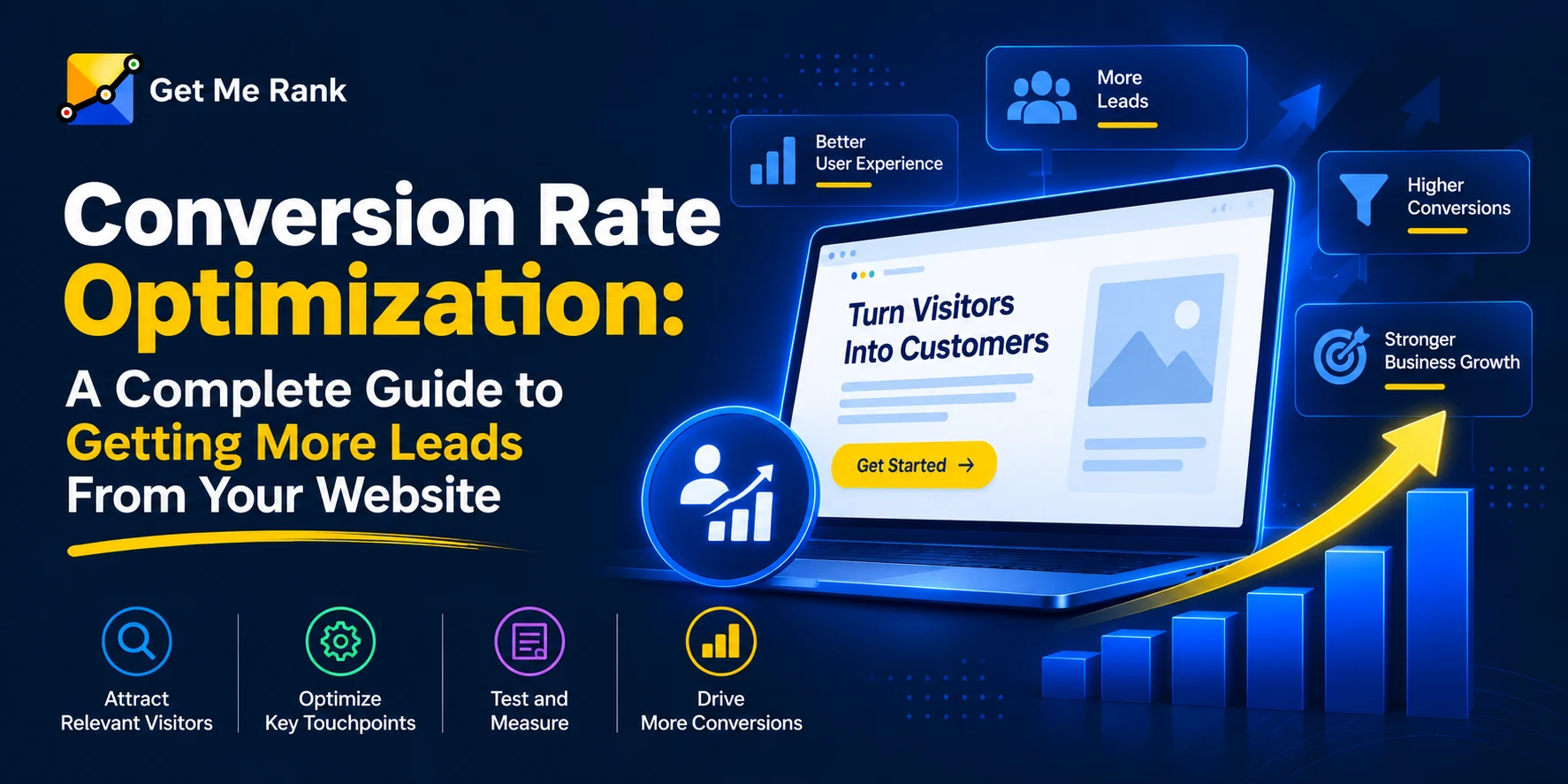
Conversion Rate Optimization: A Complete Guide to Getting More Leads From Your Website
200 ÷ 10,000 × 100 = 2%
If CRO improvements increase conversions to 300 without increasing traffic, the conversion rate becomes 3% — that additional 100 leads came from improving the website experience rather than acquiring another 5,000 or 10,000 visitors.
Why Is CRO Important for Businesses?
SEO, paid advertising, social media, email marketing, and other channels can bring visitors to your website — but traffic alone doesn’t generate revenue. A visitor needs to take an action that moves them further into the customer journey. CRO can help businesses:
- Generate more leads from existing traffic — improve the conversion rate to increase leads without the same level of traffic growth.
- Get more value from marketing spend — a low conversion rate on paid visitors is an opportunity to improve efficiency.
- Improve the user experience — understand where users struggle and remove unnecessary friction, not just change button colours.
- Improve lead quality — focus on attracting relevant, qualified leads, not just more conversions.
- Support revenue growth — more qualified leads and purchases strengthen the sales pipeline.
What Is a Good Conversion Rate?
There is no single conversion rate that every website should aim for. A reasonable rate depends on factors such as industry, business model, product or service, traffic source, search intent, audience, geographic market, price point, conversion type, and sales cycle.
For example, a visitor searching “buy running shoes online” has a different level of purchase intent from someone searching “best running shoes for beginners.” Comparing their conversion rates without considering intent can be misleading.
Ask a better questionInstead of “Is my conversion rate high enough?” ask: “Is my website converting qualified visitors effectively for this particular page, channel and conversion goal?”
How to Calculate Conversion Rate
The basic formula is:
Conversion Rate = (Conversions ÷ Visitors) × 100
Example – with 25,000 monthly visitors and 500 leads: 500 ÷ 25,000 × 100 = 2%. You can also calculate conversion rates for individual pages, traffic sources, campaigns, forms, or conversion actions.
Conversion Rate vs. Lead-to-Customer Rate
These two metrics should not be confused. Website conversion rate measures how many visitors convert (Conversions ÷ Visitors × 100). Lead-to-customer rate measures how many leads become customers (Customers ÷ Leads × 100).
| Metric | Example | Result |
|---|---|---|
| Website visitors | 20,000 | — |
| Leads | 400 | Website conversion rate = 400 ÷ 20,000 × 100 = 2% |
| Customers | 40 | Lead-to-customer rate = 40 ÷ 400 × 100 = 10% |
This distinction matters because getting more leads isn’t necessarily enough — businesses also need to understand lead quality and sales outcomes.
10 Practical Conversion Rate Optimization Strategies
1. Make your value proposition clear
Visitors should quickly understand what you offer, who you help, why they should choose you, and what to do next. Your headline should communicate the primary value rather than forcing users to read several paragraphs first.
ExampleInstead of “Welcome to Our Digital Marketing Website,” try something specific like “SEO Services That Help Businesses Increase Qualified Organic Leads.” The exact wording should depend on the business and its audience.
2. Use clear and relevant CTAs
Your CTA should tell users what happens next. Generic CTAs such as “Submit,” “Click Here,” or “Learn More” provide little context. Depending on the page, stronger alternatives include: Get a Free SEO Consultation, Request a Strategy Call, Get a Quote, Book a Consultation, or Download the Guide. Match the CTA to the user’s intent and the page’s purpose.
3. Reduce form friction
Long forms discourage completion. Review every field and ask: do we really need this information at this stage? For a simple consultation request you may only need Name, Email, Phone, Website, and Requirement — collect more later if necessary. For complex businesses, test multi-step forms against single-page forms.
4. Build trust before asking for the conversion
Visitors may hesitate if they aren’t confident about the company. Trust elements can include:
- Customer reviews and testimonials
- Case studies
- Client logos
- Certifications
- Industry experience
- Clear contact information
- Privacy information
- Results and examples
For service businesses, a strong case study often provides more context than a generic claim such as “We’re the best agency.”
5. Match content with search intent
This is where SEO and CRO overlap. Someone searching “What is technical SEO?” needs educational information; someone searching “technical SEO agency” is closer to a commercial decision. If both land on the same page with the same CTA, the experience isn’t ideal. Create content and CTAs based on the user’s stage in the buying journey:
Informational intent
Guides, checklists, templates, educational resources
Commercial intent
Case studies, service info, comparisons, consultation
Transactional intent
Purchase, quote, booking, demo
6. Improve page speed and mobile experience
A visitor cannot convert if the experience is frustrating. Review mobile usability, page loading performance, Core Web Vitals, navigation, form functionality, button accessibility, image sizes, and JavaScript issues. Don’t treat technical performance and CRO as separate activities — a faster, easier site removes friction from the conversion journey.
7. Use social proof at the right moment
Testimonials are more useful when they appear close to the decision point. On a service page you could place: CTA → customer result → testimonial → CTA. A testimonial becomes more meaningful when it addresses a concern the visitor is likely to have — for example, “We struggled to generate qualified leads from organic search. After the new SEO strategy, our organic leads increased significantly.” It should be genuine and supported by the customer’s actual experience.
8. Add relevant internal links
Internal linking supports both SEO and conversions. A blog about “How Technical SEO Works” could link naturally to Technical SEO Services, SEO Audit Services, SEO Case Studies, or an SEO Consultation — letting an informational visitor move toward commercial content without interrupting their reading.
9. Test important page elements
CRO should be based on evidence, not assumptions. You can test headlines, CTAs, form length, images, testimonials, page layouts, offers, pricing presentation, navigation, and content placement.
ExampleVersion A: “Get Started” vs. Version B: “Get Your Free SEO Audit.” Instead of deciding by personal preference, run a controlled test when traffic and measurement support it.
10. Use behavioural data to find friction
Analytics tells you what happened; behavioural tools help you understand where users struggled — scroll depth, click behaviour, form abandonment, page engagement, user recordings, exit pages, and conversion paths. For example, if many users reach 70% of a service page but few click the CTA at the bottom, test a relevant CTA earlier on the page.
How SEO and CRO Work Together
SEO and CRO have different primary functions: SEO brings qualified organic visibility, and CRO helps turn that traffic into actions. Think of the relationship as a chain:
Visibility → Traffic → Landing page → Engagement → CTA → Lead → Customer
If one stage is weak, improving another alone may not solve the problem. Suppose SEO doubles traffic from 10,000 to 20,000 but the conversion rate stays at 1% — that’s ~200 leads. Keep traffic at 20,000 but lift the conversion rate from 1% to 2%, and leads rise to 400. This is why SEO teams should look beyond rankings and traffic to what happens after the click.
CRO for SEO landing pages
When creating SEO landing pages, consider four things: Search intent (does the page answer what the visitor searched for?), Content relevance (enough information to decide?), Trust (is the business credible?), and Conversion path (is the next step obvious?). A page can rank well but still underperform commercially if these are weak.
Where Should You Implement CRO?
Not every page needs the same CRO strategy. Start with pages that already have meaningful traffic or business value.
- Homepage — clear positioning, primary CTA, trust signals, key services, simple navigation.
- Service pages — service benefits, proof/results, FAQs, relevant CTAs, conversion-focused content.
- Landing pages — keep focused on one objective; remove distractions and make the action obvious.
- Blog posts — find blogs with high traffic + low conversions and add text CTAs, content upgrades, service links, related resources, and consultation offers.
- Pricing pages — pricing clarity, feature comparison, FAQs, trust signals, CTA placement, form friction.
- Contact & lead forms — number of fields, error messages, mobile usability, CTA wording, confirmation experience.
How to Build a CRO Strategy
A practical CRO process can follow these steps:
- Identify your conversion goals — decide what counts as a conversion.
- Analyse your existing data — use GA4 and Google Search Console to understand traffic, landing pages, queries, engagement, and conversion paths.
- Identify high-opportunity pages — high traffic, strong rankings, high commercial intent, low conversion rates.
- Identify friction — forms, CTAs, content, navigation, page speed, mobile experience.
- Create a hypothesis — e.g. “Reducing the consultation form from eight fields to five may increase submissions because users enter less information.”
- Test the change — run an A/B test where appropriate.
- Measure the results — conversion rate, number of conversions, lead quality, revenue, cost per lead, cost per acquisition.
- Continue improving — CRO is an ongoing loop of research → hypothesis → test → measurement → improvement.
CRO in the Age of AI Search
Search behaviour is changing — users increasingly receive answers directly within search experiences, so earning a click is only part of the challenge. That makes every qualified website visit more valuable, and creates a connection between SEO + AEO + CRO. Your content needs to be visible for relevant searches, provide useful information once users arrive, establish trust, and give users a clear next step.
The real objectiveA business might optimise an article to answer a question appearing in AI-powered search while adding relevant internal links and a contextual CTA for readers who need professional help. The objective isn’t simply traffic — it’s a journey from visibility to value to conversion.
Common CRO Mistakes to Avoid
- Focusing only on button colours — changing blue to green isn’t a CRO strategy by itself.
- Copying competitors — a change that works for another site may not work for your audience.
- Optimizing for quantity over quality — 100 low-quality leads may be worth less than 20 qualified ones.
- Testing too many things at once — simultaneous changes make it hard to know what caused the result.
- Ignoring mobile users — a page can work on desktop and still create friction on mobile.
- Making decisions without enough data — small samples can mislead; use meaningful data and appropriate testing periods.
CRO Example
Consider a B2B service website where traffic stayed exactly the same and the improvement came entirely from converting a higher percentage of visitors:
| Metric | Before CRO | After CRO |
|---|---|---|
| Monthly visitors | 20,000 | 20,000 |
| Conversion rate | 1.5% | 2.5% |
| Leads | 300 | 500 |
| Additional leads | — | +200 |
The business should also examine whether those additional leads are qualified and capable of becoming customers.
Final Thoughts
Conversion Rate Optimization isn’t about making random changes to a website. It’s about understanding why visitors behave the way they do, identifying friction, testing improvements, and measuring the impact on meaningful business outcomes. A strong CRO strategy combines search intent, useful content, clear value propositions, trust signals, strong CTAs, simple forms, good UX, fast performance, behavioural data, and continuous testing.
Most importantly, CRO should work alongside SEO rather than separately from it. SEO helps bring the right visitors to your website; CRO helps you make better use of those visitors. For businesses investing in organic search, paid advertising, content marketing, and AI search visibility, improving the conversion journey turns that visibility into measurable business opportunities.
Turn traffic into leads
Get a free CRO & SEO review from Get Me Rank
We find where your best pages lose visitors, prioritise the highest-impact fixes, and turn more of your existing traffic into qualified leads. Book a free consultation.
Frequently Asked Questions
What is a good conversion rate?
There’s no universal number. It depends on your industry, business model, traffic source, search intent, audience, price point, and conversion type. A better question is whether your site converts qualified visitors effectively for that specific page, channel and goal.
How do I calculate my conversion rate?
Divide conversions by visitors and multiply by 100. For example, 500 leads from 25,000 visitors is 500 ÷ 25,000 × 100 = 2%. You can calculate it per page, source, campaign, or form.
What’s the difference between conversion rate and lead-to-customer rate?
Website conversion rate is conversions ÷ visitors × 100 (how many visitors take action). Lead-to-customer rate is customers ÷ leads × 100 (how many leads become customers). Both matter — more leads only help if they’re qualified.
How are SEO and CRO connected?
SEO brings qualified visitors; CRO turns them into actions. Doubling traffic won’t help much if the page doesn’t convert — and a great conversion rate needs relevant traffic to work on. They’re most effective together.
Where should I start with CRO?
Start with pages that already have meaningful traffic or commercial value — typically high-traffic, high-intent pages with low conversion rates — then identify friction, form a hypothesis, test, and measure.