AI Marketing
Key Takeaways
- ChatGPT Ads introduce a new conversational advertising channel for reaching users during research and decision-making.
- Ads are separate from AI-generated responses, ensuring sponsored content does not influence ChatGPT’s answers.
- Context-driven targeting is a key advantage, allowing brands to connect with users based on their broader conversation and intent.
- ChatGPT Ads complement Google and Meta Ads rather than replacing traditional paid advertising channels.
- Businesses should combine ChatGPT Ads with AI SEO and focus on high-intent audiences, strong messaging, and measurable conversions.
Introduction
ChatGPT Ads are becoming a new advertising channel for businesses that want to reach consumers while they research, compare, and make decisions with AI. Learn how ChatGPT advertising works, where ads are available, how much they cost, how targeting works, and how businesses can get started.
ChatGPT has evolved from an AI chatbot into a platform people use to research products, compare options, plan purchases, solve problems, and make decisions. That shift has created a new opportunity for advertisers: ChatGPT Ads.
OpenAI began testing ads in ChatGPT in the United States in February 2026. Since then, OpenAI has expanded the program to additional markets, introduced self-service Ads Manager capabilities, and added CPC bidding. In August 2026, OpenAI also began rolling out ads to users in India, one of its largest ChatGPT markets.
Unlike traditional search advertising, ChatGPT Ads appear within an AI-powered conversation. This gives advertisers an opportunity to reach people at moments when they are actively researching a product, service, solution, or idea.
But how exactly does ChatGPT advertising work? Who can advertise on ChatGPT? How much does it cost? And how is this different from Google or Meta advertising?
ChatGPT Ads: How Advertising on ChatGPT Works in 2026
Here’s what marketers and businesses need to know about ChatGPT Ads in 2026.
What Are ChatGPT Ads?
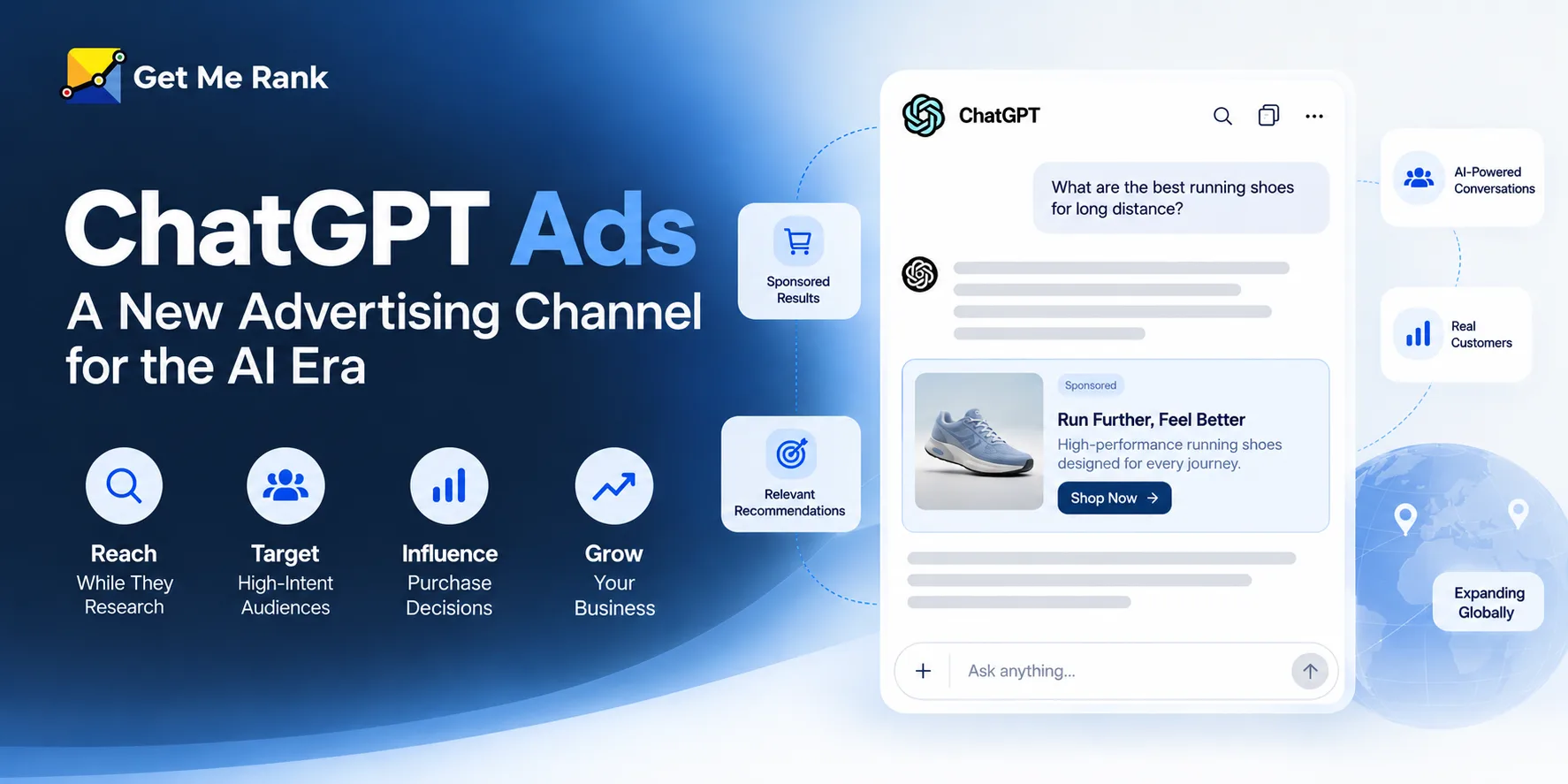
ChatGPT Ads are sponsored advertisements displayed within the ChatGPT experience when they are relevant to a user’s conversation.
OpenAI designed the ads to appear separately from ChatGPT’s generated response. An advertisement may appear below a response when there is a relevant sponsored product or service, and it is clearly labeled as sponsored content.
The distinction is important: advertisers do not pay to change ChatGPT’s answers.
OpenAI says ads do not influence the responses generated by ChatGPT. The AI response is intended to remain independent of an advertiser’s interests.
For marketers, this creates a fundamentally different advertising environment.
Instead of targeting someone solely because they searched a keyword such as “best running shoes,” advertisers can potentially reach people while they are having a broader conversation about what they need, what they are comparing, or what solution they are considering.
Does ChatGPT Have Ads?
Yes.
ChatGPT now has an advertising program, although not every ChatGPT user will see ads.
OpenAI’s current policy states that ads may appear for eligible logged-in users on the Free and Go plans. The Plus, Pro, Business, Enterprise, and Edu accounts do not have ads. OpenAI also does not show ads to accounts identified as belonging to people under 18.
The availability of advertising also varies by market.
The program originally launched as a U.S. test and has since expanded internationally. India began receiving ChatGPT Ads in August 2026, with more than 50 brands expected to participate during the initial rollout.
Because OpenAI is still expanding the program, advertisers should check the latest availability information before planning a campaign.
Where Are ChatGPT Ads Available?
ChatGPT advertising is expanding beyond the United States.
OpenAI’s Ads Manager availability currently lists several markets with self-service access, including:
- United States
- United Kingdom
- Canada
- Australia
- New Zealand
- Japan
- South Korea
- Mexico
- Brazil
India is also part of OpenAI’s advertising rollout, although the consumer ad experience and advertiser self-service availability are separate questions. OpenAI’s current Ads Manager availability page lists India as “Coming Soon” for self-service access.
This distinction matters for businesses.
A market can have ChatGPT Ads appearing to users while self-service advertiser access is still being rolled out.
OpenAI says availability can continue to evolve as its advertising program expands.
ChatGPT Ads in India
India is particularly significant for OpenAI because of the size of its ChatGPT audience.
OpenAI has said India is one of its most dynamic ChatGPT markets, with weekly active users growing substantially year over year. During the August 2026 launch, more than 50 brands were expected to begin advertising on ChatGPT in India, with WPP and Omnicom serving as initial agency partners.
For Indian businesses, this makes ChatGPT advertising a channel worth watching closely.
However, advertisers should not assume that the U.S. pricing or availability automatically applies to India. Local availability, buying options, minimum budgets, and auction dynamics can differ as the market develops.
How Do ChatGPT Ads Work?
ChatGPT Ads are designed around the context of the conversation.
When a user has a conversation with ChatGPT, the system can determine whether an advertisement is relevant to that interaction. If there is a suitable sponsored product or service, the ad can appear separately below the response.
The process can be simplified into four steps:
- A user starts a conversation with ChatGPT.
- ChatGPT determines the appropriate response to the user’s request.
- The advertising system determines whether a relevant ad can be shown.
- If eligible inventory is available, the sponsored ad appears separately from the AI response.
The key point is that the advertisement and AI-generated answer remain separate.
This creates an advertising environment that is different from a traditional search results page.
How Is ChatGPT Advertising Different From Google Ads?
Google Ads and ChatGPT Ads can both reach people with commercial intent, but the user experience is fundamentally different.
Google Search generally starts with a query. The user enters keywords, receives search results, and then chooses where to click.
ChatGPT often starts with a conversation.
A user might ask:
“I’m planning a two-week trip to Japan. What should I budget for hotels, transportation, and food?”
That conversation can evolve into questions about hotels, flights, luggage, travel insurance, restaurants, and activities.
The user’s intent can become clearer as the conversation develops.
This makes conversational advertising particularly interesting for brands.
| Google Ads | ChatGPT Ads |
|---|---|
| Primarily keyword-driven | Conversation-driven |
| Search results page | AI conversation |
| User searches for information | User discusses a need |
| Strong keyword intent | Strong contextual intent |
| Multiple search results | AI-generated response plus sponsored placement |
| Mature advertising ecosystem | New and rapidly evolving advertising channel |
ChatGPT Ads aren’t necessarily a replacement for Google Ads.
Instead, marketers should think of them as a new layer in the paid media funnel.
How Does ChatGPT Ad Targeting Work?
Targeting is one of the most important differences between traditional advertising and conversational advertising.
OpenAI describes ChatGPT Ads as being relevant to the user’s current conversation and says advertisers can use contextual signals to reach relevant audiences.
This means advertisers can potentially reach users based on the context of what they are discussing, rather than relying solely on a predefined keyword.
For example, conversations such as:
- “best laptop for video editing”
- “how to choose a CRM for a small business”
- “best running shoes for marathon training”
- “where should I stay in New York?”
- “how can I reduce my company’s cloud costs?”
can carry significantly more context than a short keyword search.
For advertisers, the opportunity is to create ads that align closely with those situations.
Does ChatGPT Use Private Conversations to Target Ads?
OpenAI says advertisers do not receive users’ conversations, chat history, memories, or personal details.
The company also says it does not sell users’ conversations or personal data to advertisers. Advertisers receive aggregated campaign information, such as performance metrics, rather than individual conversations.
This distinction is important for both advertisers and users.
ChatGPT’s advertising model is built around relevance while maintaining separation between user conversations and advertiser access to personal information.
What Do ChatGPT Ads Look Like?
ChatGPT Ads are designed to be visually distinct from the AI-generated answer.
OpenAI says advertisements are clearly labeled as sponsored and separated from the response generated by ChatGPT.
The goal is to prevent users from confusing an advertisement with ChatGPT’s organic response.
This is particularly important in AI search because users may otherwise assume that a product recommendation came directly from the AI.
For advertisers, the implication is straightforward:
Your ad needs to stand on its own.
It cannot depend on ChatGPT presenting your brand as the answer.
What Is ChatGPT Ads Manager?
ChatGPT Ads Manager is OpenAI’s platform for creating, launching, managing, and measuring advertising campaigns on ChatGPT.
OpenAI describes Ads Manager as a beta product that allows advertisers to manage campaigns and monitor performance from one place.
The platform supports campaign management functions such as:
- Campaign creation
- Ad groups
- Ad creation
- Budget management
- Bidding
- Performance monitoring
- Campaign updates
- Bulk uploads
- Measurement
OpenAI also provides a dedicated advertising portal where advertisers can sign up and access Ads Manager resources.
Because the platform is still evolving, advertisers should expect capabilities and availability to change.
How to Advertise on ChatGPT
If you’re wondering how to advertise on ChatGPT, the basic process is becoming similar to other self-service advertising platforms.
1. Check advertiser availability
First, confirm that ChatGPT Ads are available for advertisers in your country.
User access to ads and advertiser access through Ads Manager are not necessarily the same thing.
2. Create your Ads Manager account
Where self-service access is available, advertisers can sign up through OpenAI’s advertising platform and create an Ads Manager account.
3. Create a campaign
Set your campaign objective, budget, and other campaign settings.
OpenAI’s current Ads Manager provides tools for creating campaigns, ad groups, and ads.
4. Build your ads
Create ad copy and select the appropriate creative assets.
Your messaging should be concise and closely aligned with the user’s likely intent.
5. Set your bidding strategy
Depending on availability and campaign type, advertisers can use different buying models.
OpenAI introduced CPC bidding in May 2026 after initially testing advertising through CPM-based buying.
6. Set up measurement
Use campaign reporting and appropriate tracking parameters to understand what happens after someone interacts with your ad.
7. Monitor and optimize
Review metrics such as impressions, clicks, CTR, CPC, CPM, and conversions where available.
Then adjust creative, targeting, bids, and landing pages based on actual performance.
How Much Do ChatGPT Ads Cost?
There is no single universal price for ChatGPT Ads.
Pricing depends on the market, buying model, campaign configuration, competition, and other auction factors.
OpenAI initially tested ChatGPT advertising through CPM buying. It later introduced CPC bidding, allowing advertisers to align spending more directly with clicks and user actions.
OpenAI’s current advertiser guidance has recommended starting bids of approximately $3 to $5 per click in the markets where that guidance applies.
However, marketers should not automatically convert that U.S. benchmark into an expected price for India or another market.
ChatGPT Ads Pricing in India
India is a new advertising market for ChatGPT, so advertisers should be careful with third-party claims about long-term Indian CPC or CPM benchmarks.
During the initial Indian rollout, reporting indicated that self-service Ads Manager access was scheduled to open with daily budgets starting at ₹725.
That figure should be treated as a minimum budget threshold, not as the cost of each click or impression.
Actual campaign costs will depend on the available buying model, auction competition, campaign settings, and advertiser demand.
As more advertisers enter the Indian market, reliable CPC and CPM benchmarks should become easier to establish.
What Metrics Can Advertisers Track?
Performance measurement is essential because ChatGPT Ads are a new channel and advertisers need to determine whether the traffic is incremental and valuable.
OpenAI’s advertising documentation describes measurement around metrics such as:
- Impressions
- Clicks
- Click-through rate (CTR)
- Cost per click (CPC)
- Cost per thousand impressions (CPM)
- Conversions
Advertisers should also connect ChatGPT Ads performance to their own analytics platform wherever possible.
For example, a campaign might generate a strong CTR but weak conversions.
That could indicate a problem with:
- Ad messaging
- Audience relevance
- Landing page experience
- Product-market fit
- Offer
- Pricing
- Conversion flow
The goal should not be to maximize clicks.
The goal should be to generate valuable actions from qualified users.
How Should Businesses Prepare for ChatGPT Ads?
Simply creating an advertisement isn’t enough.
ChatGPT is a conversational environment, so businesses should think carefully about how their ads fit into the user’s decision-making process.
1. Focus on the user’s problem
Avoid generic messaging.
Instead of:
“We’re a leading software company.”
Try:
“Automate monthly reporting without rebuilding your analytics stack.”
The second message gives the user a reason to care.
2. Match the landing page to the ad
If your ad promises a specific solution, the landing page should deliver that solution immediately.
A disconnect between the ad and landing page can waste expensive traffic.
3. Test multiple creative variations
OpenAI recommends experimenting with different creative variations rather than relying on a single ad.
Test different:
- Headlines
- Value propositions
- Calls to action
- Offers
- Product benefits
- Creative concepts
4. Use strong calls to action
Make the next step obvious.
Examples include:
- Shop now
- Compare plans
- Get a quote
- Book a demo
- Start free
- Learn more
- See pricing
5. Track conversions
Don’t evaluate a campaign based solely on impressions or clicks.
Measure the actions that matter to the business.
6. Start with high-intent use cases
Early campaigns should focus on situations where the user is already demonstrating a clear commercial need.
This can make it easier to determine whether ChatGPT Ads are driving incremental business value.
ChatGPT Ads vs. Meta Ads
- Meta advertising is heavily centered around audience targeting and social discovery.
- ChatGPT Ads are more closely associated with intent and conversation.
- Someone scrolling Instagram may discover a product they weren’t actively looking for.
- Someone discussing a product category with ChatGPT may already be researching a solution.
That difference makes the platforms complementary.
A brand could use:
- Meta Ads for discovery
- Google Ads for active search
- ChatGPT Ads for conversational research and consideration
The best channel will ultimately depend on the product, audience, campaign objective, and economics.
ChatGPT Ads vs. Google Ads
Google remains one of the strongest channels for capturing explicit search intent.
ChatGPT offers a different type of intent.
Google might capture:
“best accounting software for small business”
ChatGPT might capture a longer conversation such as:
“I run a 20-person company and need accounting software that integrates with payroll and can handle multiple entities. What should I consider?”
The second interaction contains substantially more context.
That does not automatically make ChatGPT Ads better.
But it creates a new opportunity for advertisers to reach consumers during research and consideration, rather than only after a conventional search query.
Are ChatGPT Ads Worth It?
For some businesses, yes—but ChatGPT Ads are still too new for a universal ROI benchmark.
Businesses should consider testing ChatGPT Ads if they sell products or services that people commonly research, compare, or discuss before purchasing.
Potentially strong categories include:
- Software
- Financial services
- Travel
- Consumer products
- Education
- Professional services
- Healthcare-related products and services, subject to applicable advertising policies
- B2B services
- E-commerce
- Technology
The strongest opportunity may be products with a high-consideration purchase journey.
If customers need to research options before buying, conversational advertising could become particularly valuable.
What Makes ChatGPT Ads Different From Traditional Search Advertising?
The biggest difference is the amount of context available around the user’s intent.
Traditional search often gives advertisers a short query.
Conversational AI can involve multiple questions, constraints, preferences, and follow-up requests.
That creates a potential shift from:
keyword → advertisement
to:
conversation → context → commercial intent → advertisement
This is one reason marketers should pay attention to ChatGPT advertising even while the platform is still developing.
ChatGPT Ads and SEO: Are They Connected?
Yes-but not in the traditional sense.
Buying a ChatGPT Ad does not mean a website will automatically rank organically in ChatGPT or Google.
Paid advertising and organic visibility remain separate.
However, the rise of ChatGPT Ads reinforces a broader shift in search behavior: consumers are increasingly using AI platforms to research brands, products, and services.
That makes AI search visibility, brand authority, structured content, and strong first-party information increasingly important.
Businesses should therefore treat paid ChatGPT advertising and AI SEO as complementary strategies rather than substitutes.
What Should Marketers Watch Next?
ChatGPT Ads are still evolving rapidly.
The areas worth watching include:
- Self-serve expansion: OpenAI is continuing to expand Ads Manager availability across countries.
- New bidding models: CPC bidding has already been introduced, and additional optimization options could change how advertisers manage campaigns.
- More sophisticated measurement: As advertisers spend more money on the platform, better conversion measurement and attribution will become increasingly important.
- Shopping and product advertising: Product-focused advertising could become a significant area as users increasingly use ChatGPT for product research and recommendations.
- International expansion: India’s launch demonstrates that OpenAI is moving beyond its original U.S. advertising test.
Additional markets could follow.
- Competition among AI platforms: ChatGPT is not the only AI platform exploring advertising.
As AI search becomes more commercially valuable, advertisers will likely compare ChatGPT Ads with Google, Meta, Microsoft, Perplexity, and other emerging AI advertising environments.
Frequently Asked Questions About ChatGPT Ads
- What are ChatGPT Ads?
ChatGPT Ads are sponsored advertisements that can appear separately from ChatGPT’s AI-generated responses when they are relevant to a user’s conversation.
- Does ChatGPT have ads?
Yes. OpenAI has launched ChatGPT Ads for eligible users on the Free and Go plans in supported markets. Paid plans such as Plus and Pro do not receive ads.
- Can you advertise on ChatGPT?
Yes. Businesses can advertise through OpenAI’s advertising program where advertiser access is available. OpenAI provides Ads Manager for campaign creation and management.
- How do I advertise on ChatGPT?
Check whether advertiser access is available in your market, sign up through OpenAI’s advertising platform, create a campaign, set your budget and bidding strategy, build your ads, and configure measurement.
- How much do ChatGPT Ads cost?
There is no universal ChatGPT Ads price. OpenAI has introduced CPC bidding, and its advertiser guidance has cited a $3–$5 starting CPC bid in applicable markets. Costs can vary based on auction conditions and campaign settings.
- Are ChatGPT Ads available in India?
Yes. OpenAI began rolling out ChatGPT Ads to eligible users in India in August 2026. Self-service advertiser access is a separate rollout and should be checked against OpenAI’s current Ads Manager availability information.
- Who sees ads on ChatGPT?
Ads may appear to logged-in adult users on Free and Go plans in supported markets. The Plus, Pro, Business, Enterprise, and Edu accounts do not have ads.
- Do ChatGPT Ads influence ChatGPT’s answers?
No. OpenAI says advertisements are separate from ChatGPT’s responses and do not influence the answers generated by the model.
- Does OpenAI give advertisers access to conversations?
No. OpenAI says advertisers do not receive users’ conversations, chat history, memories, or personal details. Advertisers receive aggregated campaign information instead.
- Is ChatGPT Ads Manager available globally?
Not yet. Ads Manager availability varies by country and continues to expand. OpenAI maintains a current list of markets where self-service advertising is available or coming soon.
The Future of ChatGPT Advertising
ChatGPT Ads are still in the early stages of development, but the direction is clear: advertising is moving into conversational search.
Google built a massive advertising business around users entering queries into a search box.
ChatGPT is creating a different environment where users can explain what they want, ask follow-up questions, compare alternatives, and make decisions through a conversation.
- That creates a new opportunity for advertisers.
- For businesses, the immediate priority shouldn’t be to move their entire advertising budget to ChatGPT.
- Instead, start by understanding where conversational AI fits into your customer journey.
- Identify the questions your customers ask before they buy.
- Understand the problems they are trying to solve.
- Create messaging that answers those needs.
Then test ChatGPT Ads against measurable business outcomes.
As OpenAI expands advertising into markets such as India and continues developing Ads Manager, bidding, targeting, and measurement, ChatGPT advertising could become an important part of the next generation of paid search and AI marketing.
The marketers who start learning how the channel works now will be better positioned as the advertising ecosystem matures.