Paid AdvertisingSEO
Key Takeaways
- A google ads for doctors seo outline is a single plan that connects paid search, organic SEO, and — new for 2026 — your visibility inside AI Search.
- Practices that run ads and SEO together lower their cost per lead over time as Quality Scores and organic authority compound.
- High-intent, location-based keywords and dedicated landing pages are what turn clicks into booked appointments — not broad targeting.
- AI Max, ads in AI Overviews, and Answer Engine Optimisation (AEO) are the fastest-moving levers for google ads for medical practices this year.
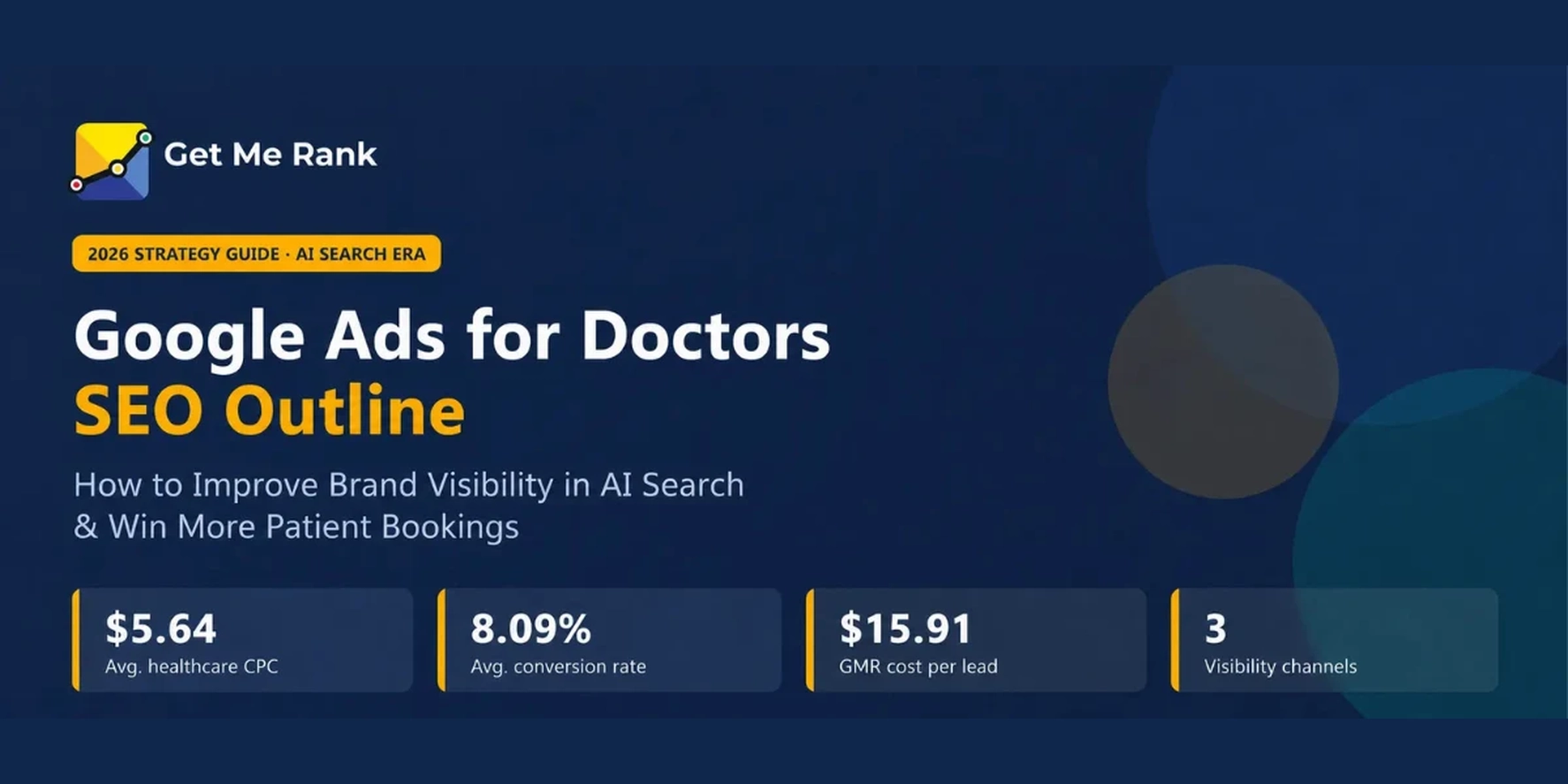
- GetMeRank generated 40+ patient conversions at just $15.91 per lead for a plastic-surgery practice using exactly this framework.
Introduction
Your next patient is searching right now — and increasingly, they’re not only typing into Google. They’re asking an AI assistant, “who’s the best dermatologist near me?” A google ads for doctors seo outline is the structured plan that makes sure your practice shows up at that moment, whether the answer comes from a paid ad, an organic listing, or an AI-generated overview.
Most guides still frame this as a two-channel game: paid ads for speed, SEO for the long game. That’s no longer the full picture. In 2026, there’s a third surface — AI Search — and the practices winning new patients are the ones showing up across all three. This guide gives you the complete outline: the framework, the 7 steps, real budgets, the mistakes to avoid, and how to get seen inside AI answers. Whether you’re a solo GP or running google ads for medical practices across several locations, you’ll leave with a plan you can act on.
DID YOU KNOW
Around 77% of patients search online before booking, and the average healthcare click costs about $5.64 with an 8.09% conversion rate.
Small improvements in targeting and landing pages move real revenue.
Small improvements in targeting and landing pages move real revenue.
The Model: A Triple-Visibility Patient Growth Framework
Before the steps, here’s the model everything hangs on. Competitors optimise two channels. We optimise three — because a patient’s journey now runs across paid search, organic search, and AI-generated answers.
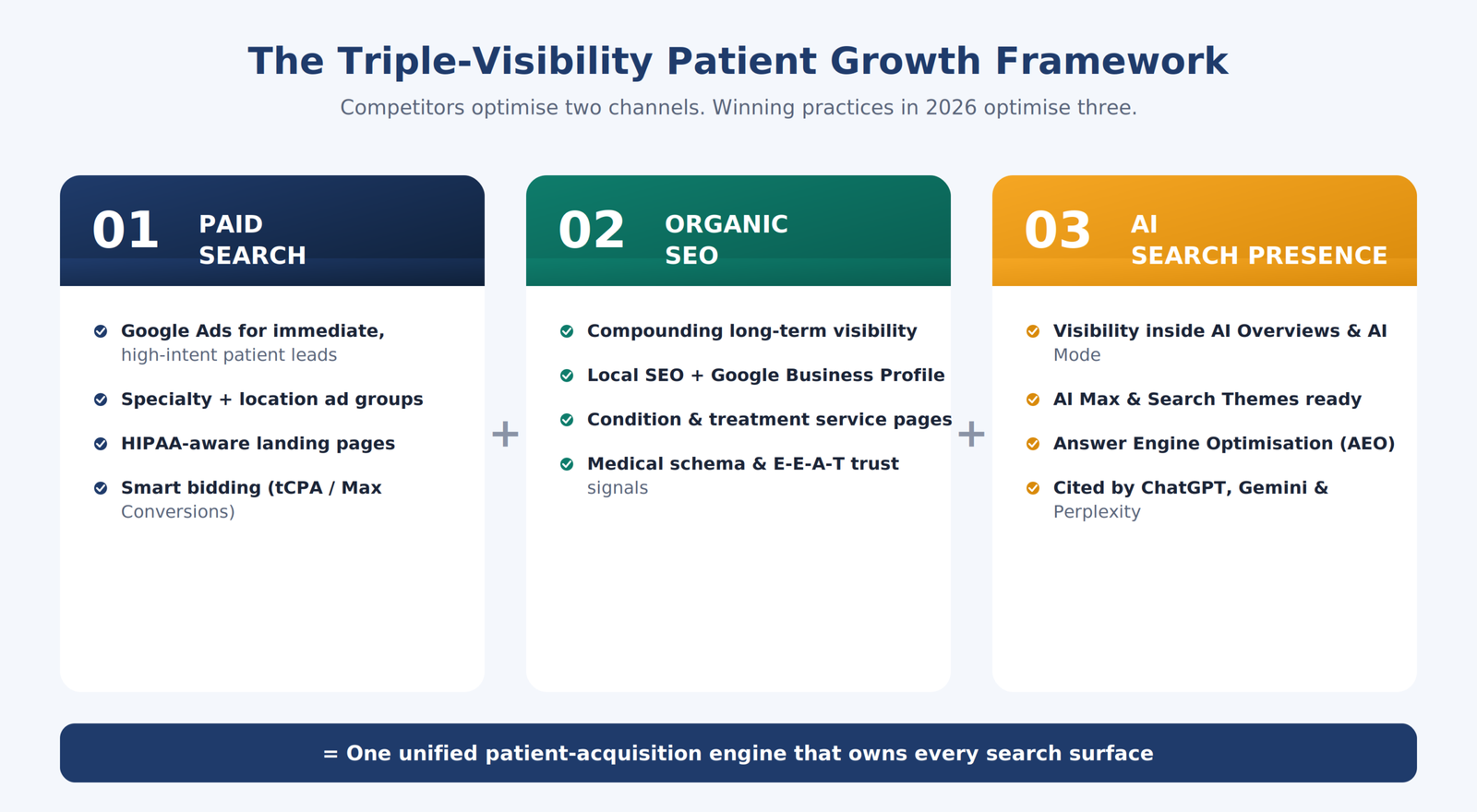
Read the rest of this outline as the build order for that engine: define goals, capture demand with paid, compound it with SEO, and make yourself the answer in AI Search.
Google Ads for Doctors SEO Outline: How to Improve Brand Visibility in AI Search (2026)
What Is a Google Ads for Doctors SEO Outline?
A google ads for doctors seo outline is a structured roadmap that plans every part of a medical practice’s search strategy in one place: campaign objectives, keyword-to-intent mapping, campaign architecture, landing pages, conversion tracking, bidding, and — in 2026 — how you appear in AI Search. Think of it as the blueprint that keeps your paid and organic efforts pulling in the same direction instead of competing for the same budget.
Why paid, SEO and AI have to work together
Run ads with no SEO and you rent patients forever — the moment you pause spend, the leads stop. Do only SEO and you wait months while competitors’ ads take the bookings. And ignore AI Search entirely and you’re invisible on the surface that’s growing fastest. When the three connect, they reinforce each other: strong organic pages lift ad Quality Scores (which lowers your cost per click), and both feed the structured, trustworthy content that AI engines quote.
GETMERANK TIP
Your ad landing pages and your SEO service pages should be the same high-quality pages wherever possible. That single decision improves Quality Score, conversion rate, and AI-Overview eligibility at once.
Google Ads Strategy Planning for Doctors and Medical Practices
Strategy starts with a number, not a keyword. Decide what a new patient is worth and how many you want each month, then work backwards to a target cost per acquisition (CPA). That single figure keeps every later decision — keywords, bids, budget — honest.
• Set measurable booking targets — e.g. 40 new patients/month, not “more traffic.”
• Anchor to revenue — if a patient’s value is high, a higher CPA is justified; know your ceiling.
• Track holistically — forms, calls and chats, all tied back to the keyword and channel.
• Review monthly — adjust for seasonal demand (flu season, resolutions, procedure cycles).
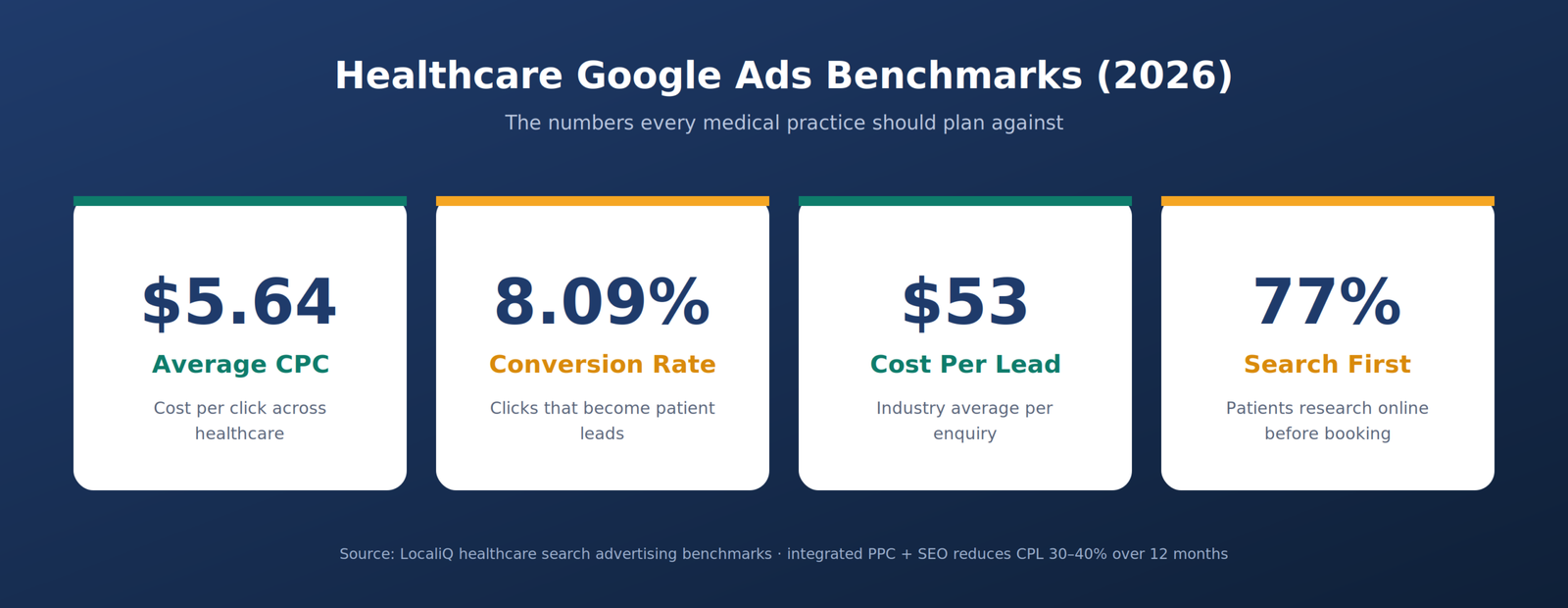
Use these industry benchmarks as a planning baseline, then beat them with tight targeting and better pages. Specialty matters: cosmetic and surgical niches carry higher clicks but far higher patient value.
Traditional Doctor Marketing vs. Integrated Google Ads + SEO in 2026 (the AI Era)
The old playbook — referrals, print, and hoping the phone rings — can’t be measured or scaled. The integrated model can, and the AI era widens the gap further.
Winning Brand Visibility in AI Search (2026’s New Battleground)
This is where you can leapfrog competitors who are still fighting over the same ten blue links. Patients now ask AI assistants to shortlist doctors for them, and Google is answering more queries with AI Overviews and AI Mode. Your job is to be the practice those systems surface and cite.
1. Get AI Max–ready
AI Max is a suite of AI features layered on top of your existing Search campaigns — expanded query matching (Search Themes), automatically generated text, and landing-page expansion. It keeps your keyword control while letting Google find incremental, high-intent searches you’d otherwise miss. Google reports campaigns using the full AI Max suite see roughly 7% more conversions at a similar CPA, and from September 2026 legacy features like Dynamic Search Ads are auto-upgrading to AI Max. Turn it on deliberately, keep brand exclusions in place, and watch your search-terms report so messaging stays on-brand.
2. Show up inside AI Overviews and AI Mode
Ads now appear directly within AI-generated answers across a growing list of markets. The price of entry is the same thing that helps everything else: structured, genuinely relevant landing pages. Poor page quality is a disqualifier here — thin or vague pages simply won’t be shown.
3. Optimise for Answer Engines (AEO)
To be quoted by ChatGPT, Gemini and Perplexity when someone asks for a doctor, make your content easy to lift: clear FAQ and how-to schema, self-contained answers, unambiguous entity signals (who you are, where you are, your specialty), and strong review and E-E-A-T trust signals. This is the organic complement to paid AI placements — and it’s where google ads for medical practices strategies that ignore AI will fall behind.
HIGHLIGHT
Balanced take: independent tests show AI Max gains are real but uneven, and some of the “new” traffic can cannibalise existing campaigns. Roll it out in stages on a campaign with history, measure at account level, and keep human oversight. AI expands your reach — it doesn’t replace strategy.
How GetMeRank Generated 40+ Patient Conversions at Just $15.91 Per Lead
A plastic-surgery practice came to GetMeRank spending on Google Ads that wasn’t turning into booked consults — high cost per conversion, weak local visibility, and traffic landing on a generic homepage.
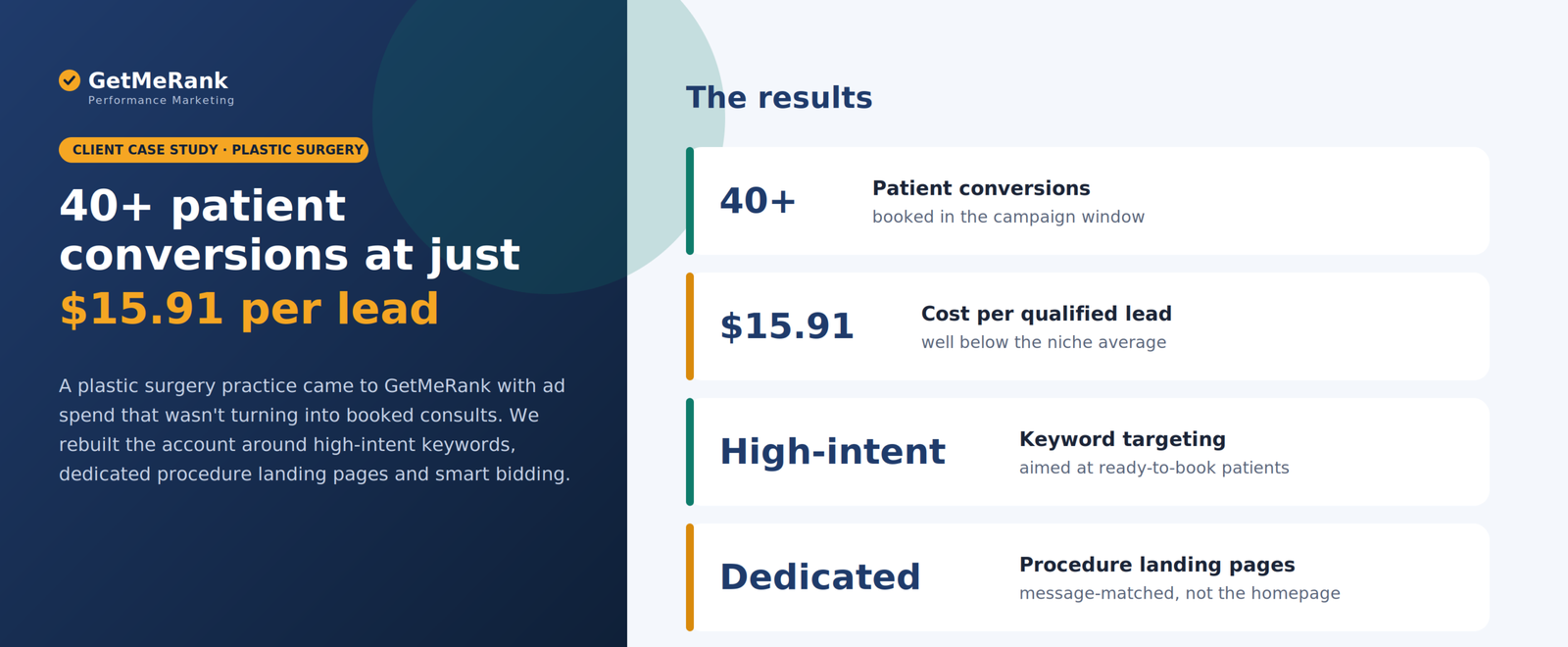
We rebuilt the account around the outline in this guide: high-intent, procedure-level keywords; dedicated message-matched landing pages instead of the homepage; tight negative-keyword lists; and smart bidding aligned to a target CPA. The result was 40+ patient conversions at just $15.91 per lead — a cost per booking well below the norm for such a competitive cosmetic niche.
The 7-Step Google Ads for Doctors SEO Outline
Here’s the full workflow, in build order. Follow it once and you have a repeatable system from search query to booked appointment.
Step 1 — Set patient-acquisition goals
Define bookings per month, a target CPA, and the revenue value of a patient. Goals in numbers keep the whole campaign focused.
Step 2 — Map keywords to patient intent
Prioritise high-intent, local terms (“cardiologist near me accepting patients”), map condition and procedure queries, and build a strong negative-keyword list from day one.
Step 3 — Structure specialty campaigns
Separate brand, service, and condition campaigns, add Performance Max for retargeting, and segment by location so budget follows demand.
Step 4 — Build HIPAA-aware landing pages
Match the ad’s promise, keep forms to three fields, make click-to-call obvious, add trust signals (credentials, reviews), and load in under three seconds on mobile.
Step 5 — Layer AI Search visibility
Enable AI Max/Search Themes, and optimise the same pages for AI Overviews and AEO so you’re visible in AI answers, not just the blue links.
Step 6 — Track every conversion to revenue
Use call tracking, GTM events, and offline conversion import to tie each lead back to its keyword and channel.
Step 7 — Optimise, scale and compound
Pause weak keywords, feed winning PPC search terms into your SEO content, and reallocate budget to the services that convert.
Budget Planning: How Much Should Doctors Spend on Google Ads?
There’s no single right number — it depends on your specialty, city competition, and how many patients you can handle. The principle is the same at every level: start conservative, prove what converts, then scale the winners.
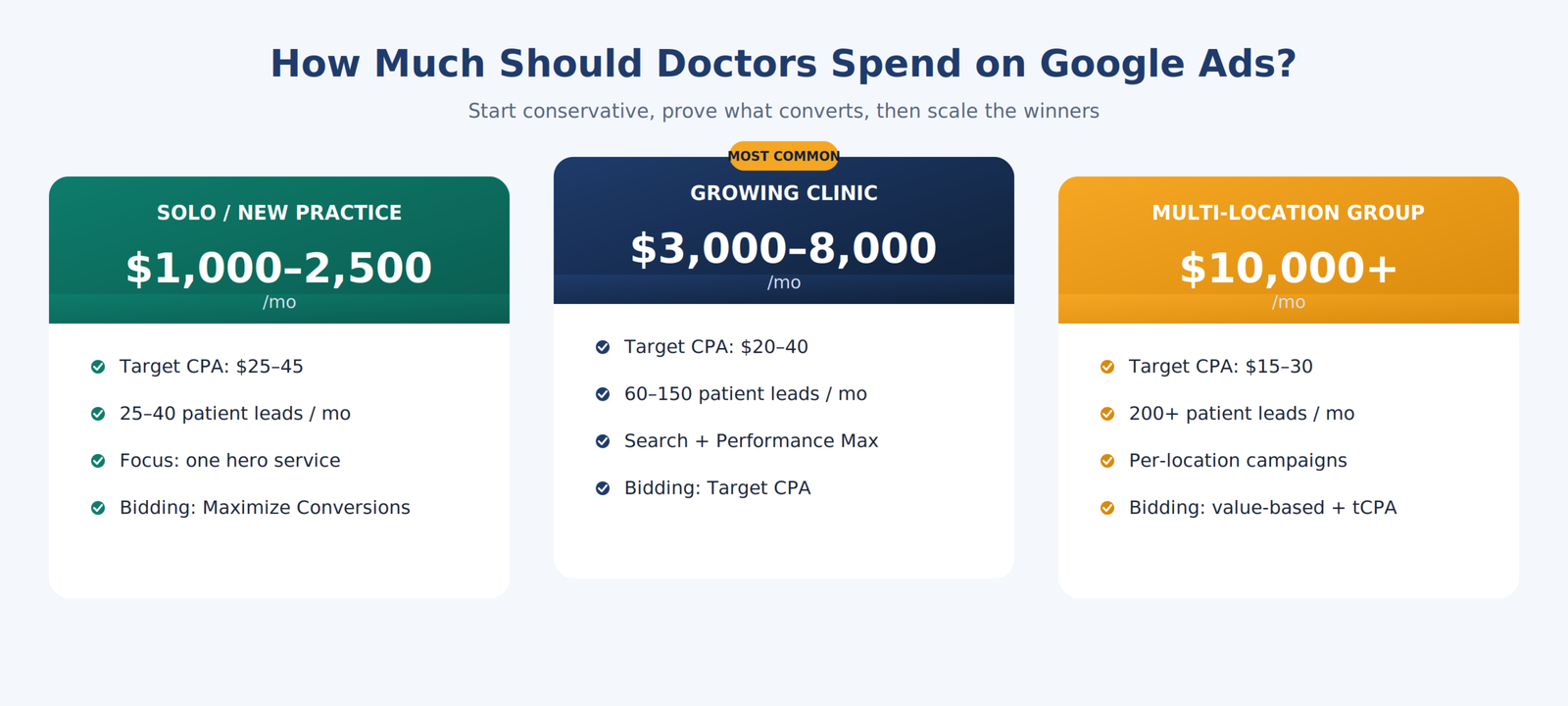
Smart bidding strategies to match
- Maximize Conversions — ideal for new accounts filling the schedule and gathering data.
- Target CPA — best once you know a patient’s value; holds cost per booking steady.
- Value-based bidding — points budget at high-value procedures (surgery, implants) over routine visits.
PRO TIP
Give the algorithm room. Run a 30-day testing budget, let it gather conversion data, then scale spend into the specific services and keywords that proved out. Don’t judge automated bidding on week one.
Common Google Ads Mistakes Doctors and Medical Practices Make
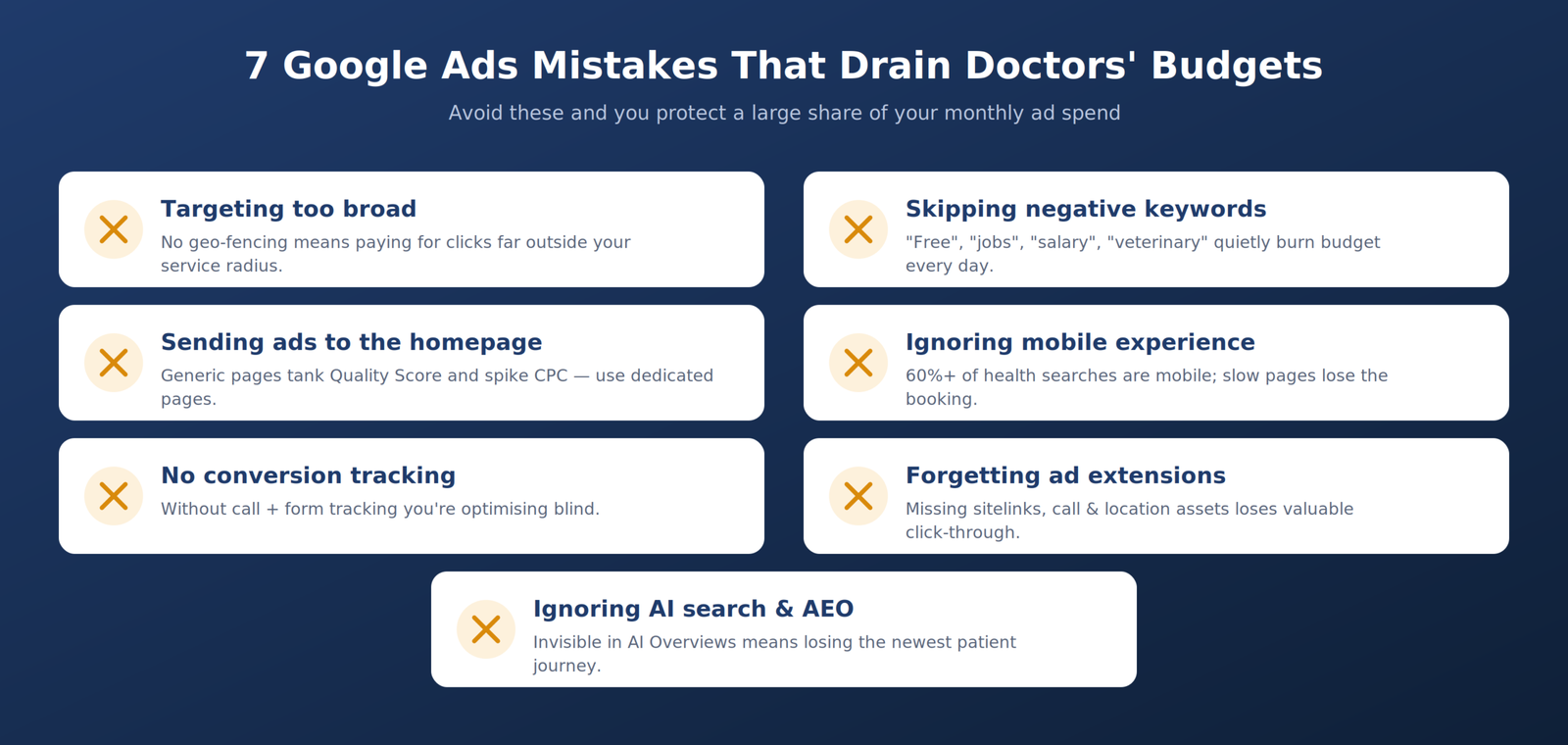
Most wasted healthcare ad spend traces back to a short list of avoidable errors. Fix these and you protect a large share of your monthly budget.
- Targeting too broad. Without a tight radius or ZIP targeting, you pay for clicks from people who will never visit. Geo-fence every campaign to your real service area.
- Skipping negative keywords. Terms like “free,” “jobs,” “salary” and “veterinary” quietly drain budget. Build and maintain a shared negative list.
- Sending ads to the homepage. Generic pages tank Quality Score and spike CPC. Send each ad to a dedicated, message-matched page.
- Ignoring mobile. Most health searches happen on phones. A slow page or a hard-to-tap call button loses the booking.
- No conversion tracking. If you can’t see which keyword produced a call or form, you’re optimising blind. Track calls and forms and tie them to revenue.
- Forgetting ad extensions. Missing sitelink, call and location assets costs you click-through you’ve already paid to earn.
- Ignoring AI search & AEO. Being invisible in AI Overviews and chatbot answers means missing the newest — and fastest-growing — slice of the patient journey.
How to Choose a Google Ads Agency for Doctors
Healthcare marketing isn’t generic marketing. The right partner understands medical search intent, compliance, and how to connect spend to actual bookings. When evaluating performance marketing services, doctors should look for an agency that understands the unique demands of healthcare advertising—not just one that specializes in generating clicks.
What to look for
- Healthcare case studies with real cost-per-lead and booking numbers.
- HIPAA awareness in tracking, forms, and remarketing.
- Integrated paid + SEO + AI under one roof, not siloed teams.
- Transparent reporting tied to appointments, plus Google Partner status.
Questions to ask before hiring
- Can you show doctor campaigns averaging a low cost per lead?
- How do you keep tracking and remarketing HIPAA-compliant?
- How will you make my practice visible in AI Overviews and AI Search?
- How do you handle ad disapprovals under Google’s healthcare policy?
- What does your reporting tie back to — traffic, or booked patients?
Let GetMeRank Build Your Google Ads Strategy
A google ads for doctors seo outline only works when paid, organic and AI Search are built as one system — and kept optimised. That’s exactly what GetMeRank does for medical practices: high-intent campaigns, conversion-ready landing pages, healthcare SEO, and AI-search visibility that turns clicks into booked patients.
READY TO GROW?
Stop running ads without a strategy. Book a free strategy call and we’ll map your Triple-Visibility plan — paid, organic and AI search — around your specialty and city.
FAQs About Google Ads for Doctors
1. How much do Google Ads cost for doctors?
Costs vary by specialty, city, and competition. The average healthcare click is around $5.64 and the average cost per lead near $53, so most practices start at roughly $1,000–$3,000 per month for meaningful data, and scale from there as campaigns prove out.
2. Are Google Ads effective for medical practices?
Yes. When structured well — high-intent keywords, dedicated landing pages, and conversion tracking — Google Ads for medical practices deliver predictable, measurable patient inquiries and a clear return on spend.
3. What is the best Google Ads strategy for doctors?
Combine high-intent local keyword targeting, tightly themed campaigns, message-matched landing pages, and continuous optimisation — all connected to SEO and AI-search visibility so the channels reinforce each other.
4. How do I target local patients with Google Ads?
Use radius or ZIP-code targeting limited to your service area, add city-specific keywords and location assets, and keep your Google Business Profile fully optimised so you also win the local map results.
5. What is a google ads for doctors seo outline?
It’s a single structured plan covering objectives, keywords, campaign structure, landing pages, tracking, budget and AI-search visibility — so your paid ads, SEO and AI presence work together to book more patients.
6. How does AI Search change Google Ads for doctors?
Patients now use AI assistants and Google’s AI Overviews to shortlist providers. AI Max expands your reach on high-intent queries, ads can appear inside AI answers, and AEO helps chatbots cite your practice — so AI visibility is now part of the outline, not an afterthought.
7. Are Google Ads HIPAA compliant for doctors?
Google Ads can support HIPAA-friendly campaigns when configured correctly: avoid collecting protected health information in ads, don’t build remarketing lists on health conditions, use secure landing pages, and follow Google’s Healthcare and Medicines policy.
8.How long before Google Ads deliver results for a practice?
Many practices see inquiries within the first week or two, but plan on 60–90 days of optimisation to stabilise performance and reach a strong, predictable cost per booked patient.
6.Should doctors use Google Ads or SEO?
Both. Ads deliver immediate, high-intent leads; SEO builds compounding organic authority that lowers your ad costs over time; and AI-search optimisation captures the newest patient journeys. The strongest results come from running them as one system.
7. Do I need an agency to run Google Ads for my practice?
You can start in-house, but an experienced healthcare agency reduces costly mistakes, keeps you compliant, and connects spend to booked appointments — often paying for itself through a lower cost per patient.
Conclusion
Digital visibility is no longer optional for doctors — and in 2026 it means being present on three surfaces, not two. A clear google ads for doctors seo outline ties paid search, organic SEO and AI Search into one patient-acquisition engine: immediate leads today, compounding authority tomorrow, and a presence inside the AI answers patients increasingly trust. Build it once, keep it optimised, and the question stops being “will patients find us?” and becomes “how many can we take?”
When you’re ready to put it in motion, GetMeRank can build and run the whole system for you.