Real Estate
Key Takeaways
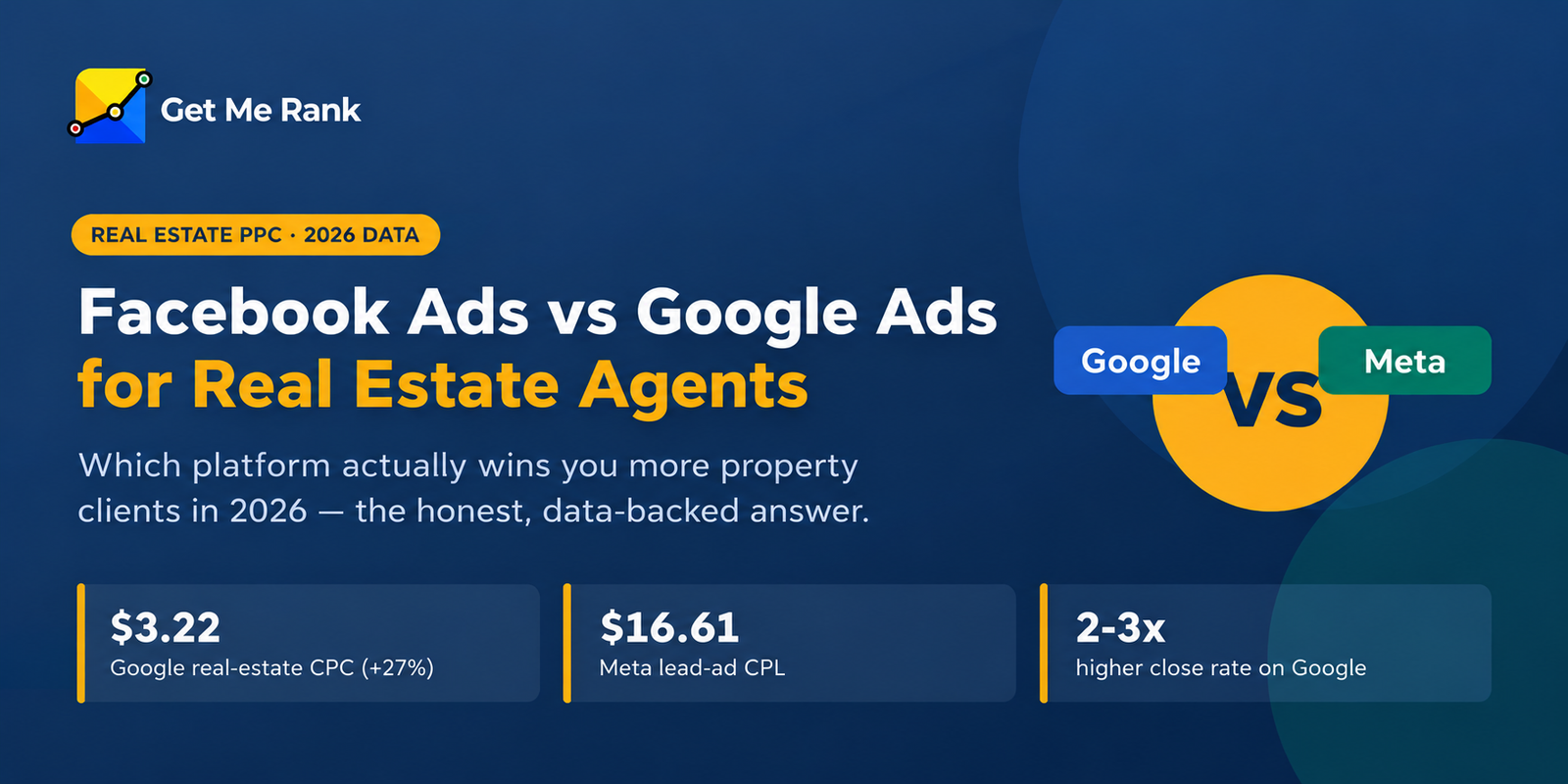
- The Facebook Ads vs Google Ads for Real Estate Agents debate has no single winner — they do different jobs in the buyer journey.
- Google captures high-intent buyers who are already searching; Meta creates demand and awareness among buyers who aren’t looking yet.
- Google leads cost more (a real-estate CPL around $100+) but close 2–3x better; Meta leads are cheap (~$16.61) but need more nurturing.
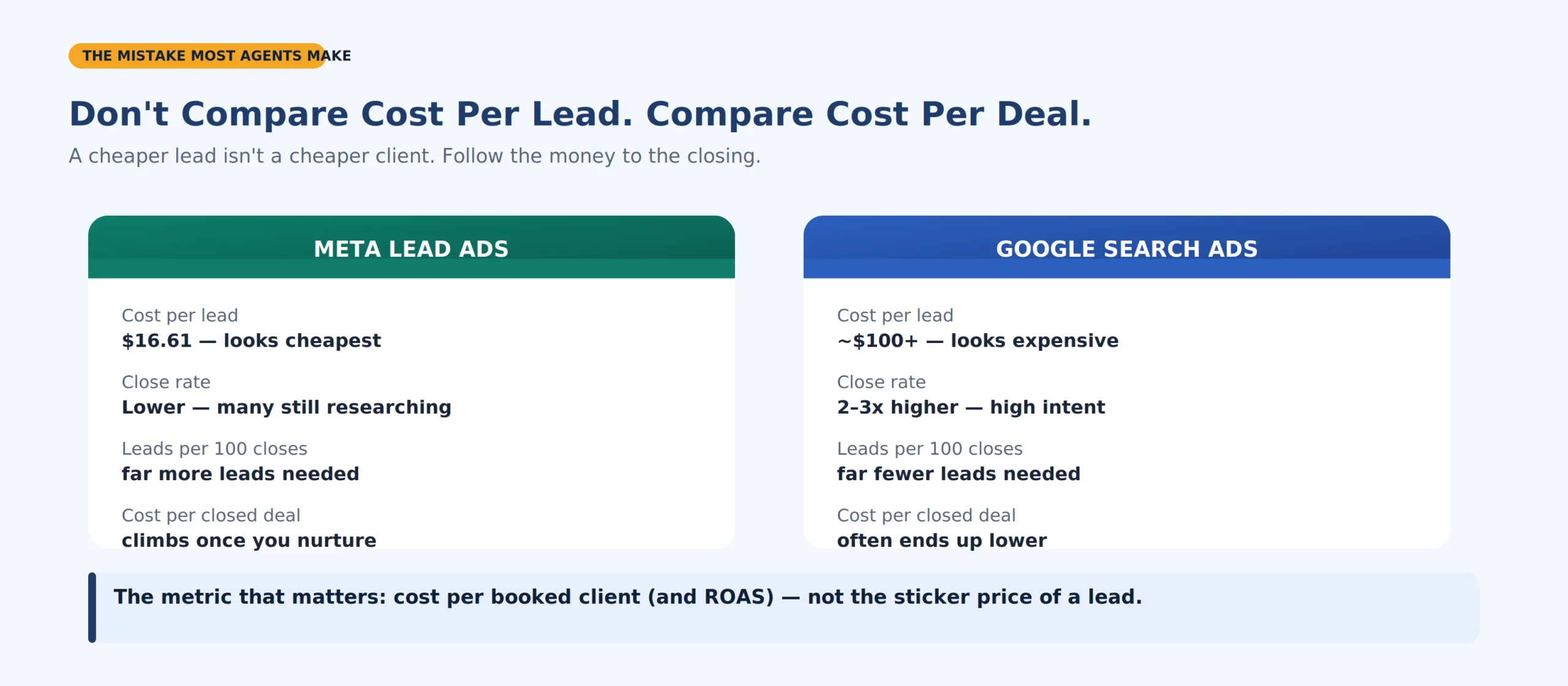
- Judge platforms on cost per closed deal and ROAS — not the sticker price of a lead.
- The strongest results come from running both in one funnel: Meta for awareness and retargeting, Google for intent capture.
Introduction
Ask any developer or agent where to put their ad budget and you’ll hear the same question: should we run Google Ads or Facebook Ads? It’s the right question and the wrong framing. These platforms aren’t rivals fighting over the same job — they’re two different tools that shine at different moments in a buyer’s journey. Getting the Facebook Ads vs Google Ads for Real Estate Agents decision right is less about picking a winner and more about knowing which one to use, when, and how to make them work together.
Short answer: Google Ads wins when buyers are actively searching and ready to act, delivering fewer but higher-intent leads that convert faster. Meta (Facebook & Instagram) Ads win at building awareness and demand with cheaper, higher-volume leads that need nurturing. For most real estate businesses, using both together delivers the best ROI.
Below, we’ll settle the Google Ads vs Facebook ads real estate question with real 2026 numbers, show you exactly when each platform pulls ahead, and share the funnel that combines them. No fluff — just what actually moves booked site visits.
PRO TIP
Real estate had the biggest cost-per-click jump of any industry in 2026 — up 27% year over year to about $3.22. Rising costs make channel choice and lead quality matter more than ever, not less.
Facebook Ads vs Google Ads for Real Estate Agents: Which Wins in 2026?
What’s the Real Difference Between Google Ads and Meta Ads?
Short answer: Intent. Google Ads reaches people who are already searching for a property (“3 BHK flats near me”), so you meet demand that already exists. Meta Ads reach people based on who they are and what they like, so you create demand before they start searching.
That single difference explains almost everything else — cost, lead quality, speed, and the kind of creative that works. On Google, someone typing “ready-to-move flats in [area]” has already decided to buy; you just have to be there. On Instagram, a newly married couple scrolling reels isn’t looking for a home yet — but a stunning walkthrough might plant the idea. One harvests intent; the other plants it — and that contrast is the heart of the Meta ads vs Google ads for real estate comparison.
Here’s the same comparison as a quick-reference table you can keep:
| FACTOR | Google Ads (Search) | Meta Ads (FB / Instagram) |
|---|---|---|
| Buyer intent | High — actively searching | Lower — you create the demand |
| Avg cost per click | ~$3.22 (higher) | ~$0.60–$1.60 (lower) |
| Avg cost per lead | ~$100+ on search | ~$16.61 on lead ads |
| Lead quality | Stronger, ready to act | Higher volume, more nurturing |
| Speed to leads | Fast | Builds over time |
| Visual storytelling | Limited | Excellent |
| Best for | Ready-to-buy searchers | Launches, awareness & retargeting |
Google Ads vs Facebook Ads for Real Estate: The 2026 Numbers
Short answer: Google search leads in real estate cost around $100+ each at a ~$3.22 CPC, while Meta lead-ad campaigns average about $16.61 per lead. But the two use different objectives — cheaper Meta leads usually convert at a lower rate, so the real comparison is cost per closed client.
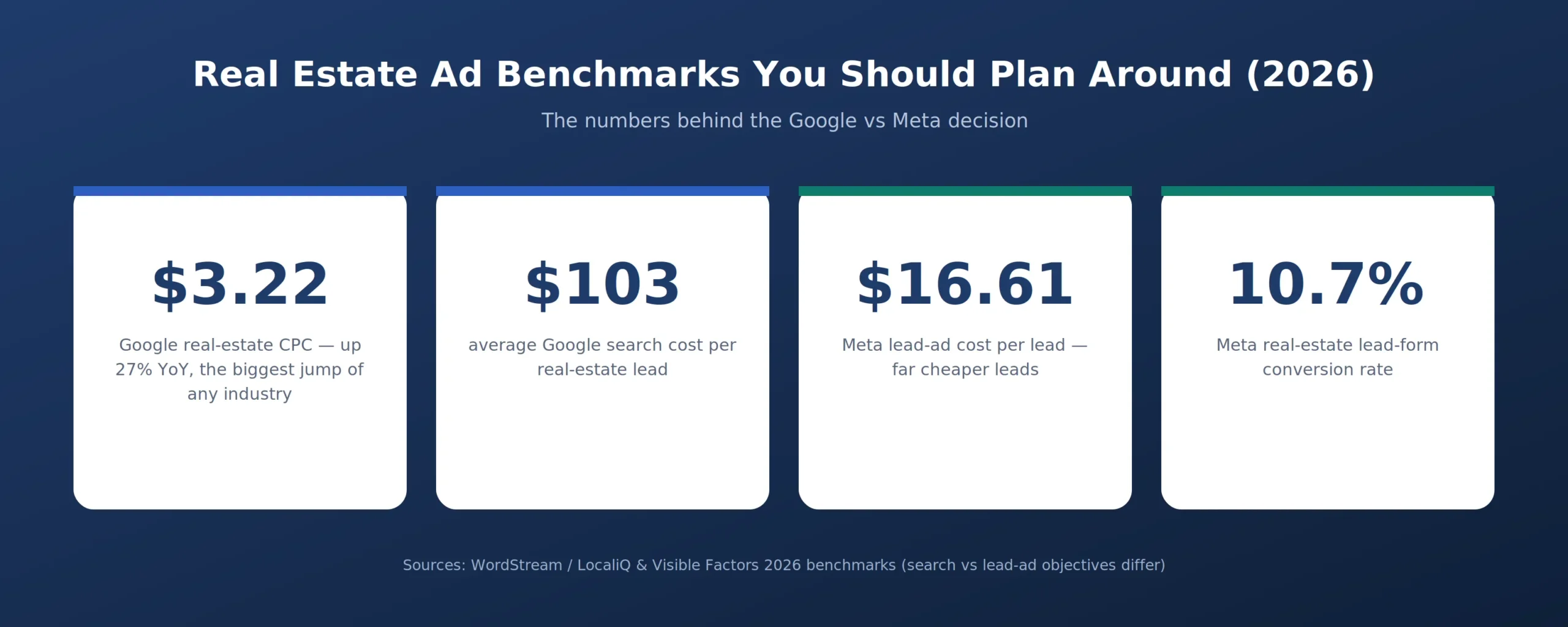
When you weigh Facebook Ads vs Google Ads for Real Estate Agents on raw cost alone, Meta looks like the runaway winner — but that’s exactly the trap, as the next section shows. A quick note on context first: these are US benchmarks. In India the same Google Ads vs Facebook ads for real estate pattern holds, just at lower numbers — Google real-estate CPCs often run ₹12–15 with CPLs around ₹80–150, while Meta leads can come in at ₹50–100. Wherever you operate, the best ad platform for real estate is the one whose strengths match your current goal.
Which Platform Gives Better Quality Leads?
Short answer: Google, on lead quality. Because searchers have active buying intent, Google leads typically convert two to three times better than Meta leads. Meta wins on volume and cost per lead, but those leads sit earlier in the journey and need more follow-up.
This is where most advertisers go wrong. They see a $16.61 Meta lead next to a $100 Google lead and declare Meta the winner — but cost per lead is a vanity metric. What actually matters is what it costs to book a client. If Google leads close two to three times more often, far fewer of them are needed to sign the same number of deals, and the “expensive” channel quietly becomes the cheaper one.
GETMERANK TIP
Stop optimising to cost per lead. Feed your close data back into the platforms and optimise to cost per acquisition instead — the algorithms then learn to find people who buy, not just people who click.
When Should Real Estate Agents Choose Google Ads?
Short answer: Choose Google Ads when buyers are ready to act — for ready-to-move and premium or commercial properties, location-based searches, and any time you need fast, high-intent enquiries you can measure straight to a booking.
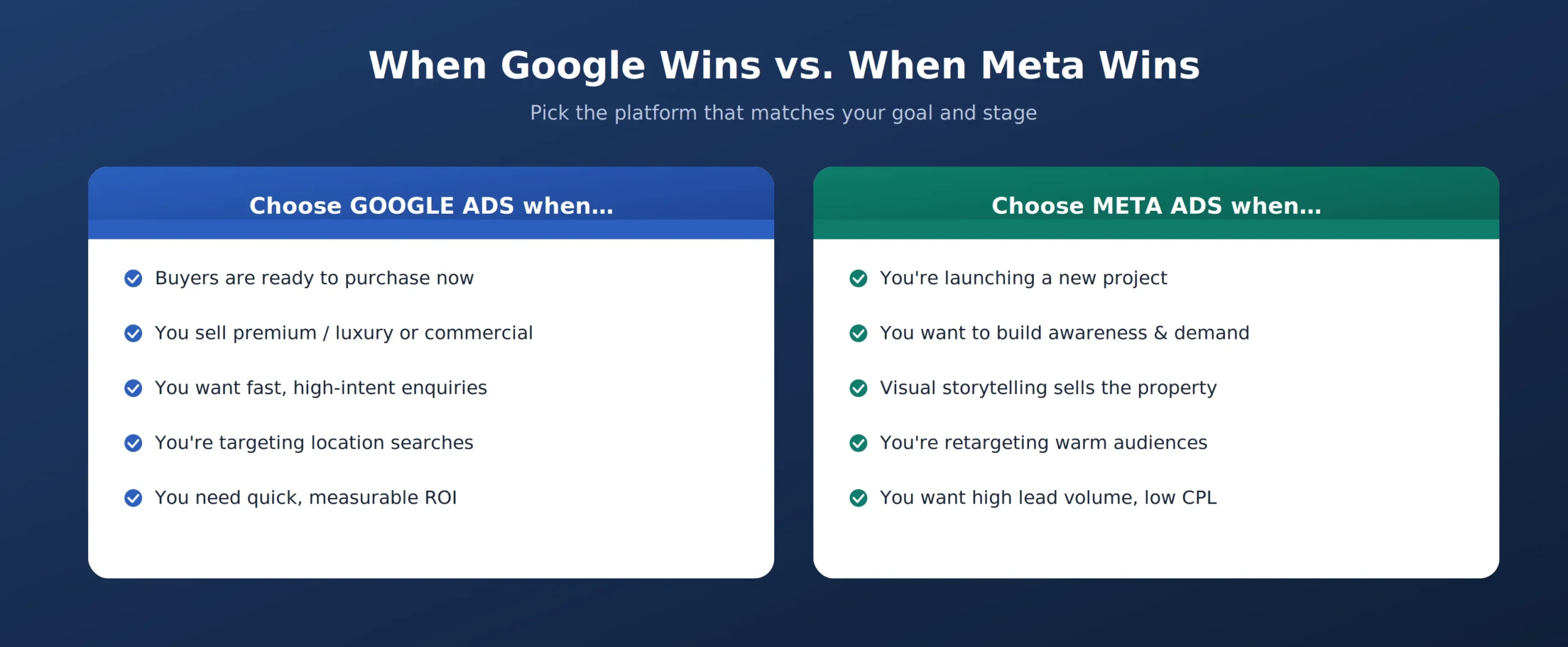
Google is your harvesting tool. When someone searches “luxury flats near the metro” or “ready possession 3 BHK in [area],” they’ve done their thinking and want options now. For premium and commercial projects especially, that intent is worth the higher click cost, because a single closing dwarfs the ad spend.
When Should You Choose Meta Ads Instead?
Short answer: Choose Meta Ads for new project launches, awareness campaigns, visual storytelling, and retargeting. When demand doesn’t exist yet, Meta’s targeting and creative formats create it — cheaply and at scale.
Meta is your demand-generation and nurturing engine. A pre-launch project has no search volume yet, so there’s nothing for Google to capture — but a well-targeted reel or carousel can build a waitlist before the first brick is laid. Meta also handles the follow-up brilliantly: most people who click an ad won’t enquire the first time, and retargeting them with site-visit reminders and launch offers is where a lot of real estate deals are actually won. This is also why a strong Meta – Facebook Ads for real estate strategy pairs so naturally with search.
The Smartest Approach: Use Both in One Funnel
Short answer: Run Meta and Google together. Use Meta to create awareness and retarget, a fast landing page to capture interest, and Google to catch high-intent searches — then feed every lead into your CRM for follow-up. This full-funnel approach beats either platform alone.
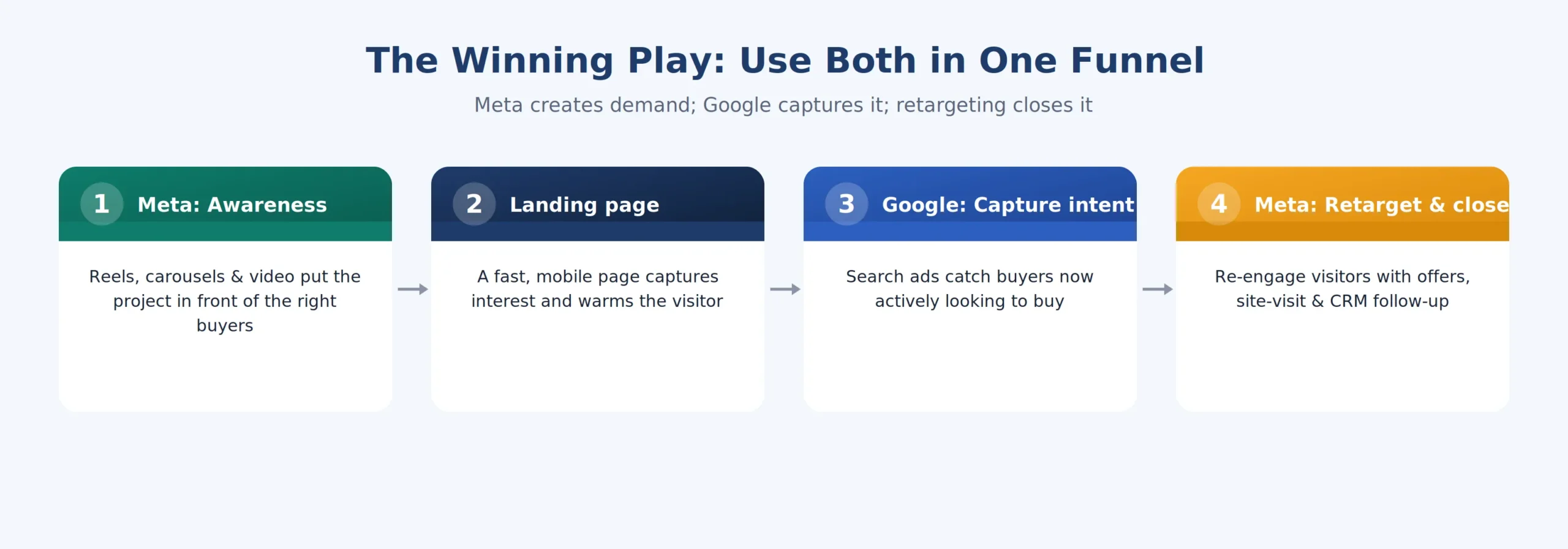
The best-performing real estate accounts we run don’t choose sides. Meta introduces the project and warms cold audiences; a dedicated landing page turns that interest into a tracked visitor; Google search ads catch those same people (and new ones) at the exact moment they’re ready to enquire; and Meta retargeting brings back everyone who hesitated. Each platform does the job it’s best at, and the funnel compounds. Seen this way, the Meta ads vs Google real estate debate dissolves — they’re stages in one journey, not rivals.
Is Real Estate Advertising Still Worth It at These Costs?
Short answer: Yes — comfortably. Real estate commissions are large, so even a high cost per lead produces a strong return. A $26 lead at a 25% close rate is about $104 per client; against a $5,000 commission, that’s roughly a 48x return on ad spend.
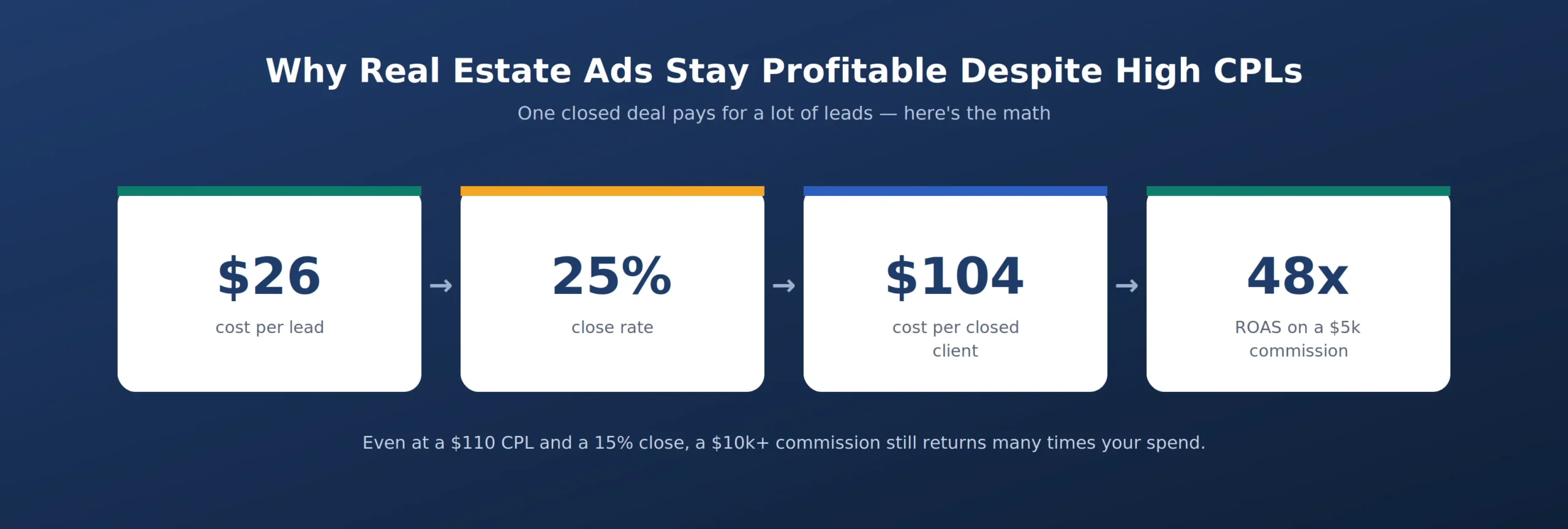
This is the reassurance every agent needs before they judge a campaign on click costs alone. Property is a high-value sale, so the math forgives expensive leads in a way most industries can’t. Even at the pricey end — say a $110 cost per lead on seller-intent keywords with a 15% close rate — a single $10,000-plus commission still returns many times over. The question is rarely “are ads worth it?” and almost always “are we tracking to revenue so we can scale the winners?”
HIGHLIGHT
Advertisers using clean first-party data (Conversions API + CRM) report cost per lead 15–25% lower than those relying on pixel-only tracking — on both Google and Meta. Data quality now beats budget size.
Practical Tips to Win on Either Platform
Whichever platform you lead with, the fundamentals that lower your cost per client are the same. Get these right before you worry about which is “better.”
- Build dedicated landing pages. One page per intent — buyers, sellers, each project — never your homepage.
- Track calls and form fills. Measure real leads, not just clicks, so you can optimise to revenue.
- Optimise for CPA, not CPL. Feed close data back so the algorithm finds buyers, not cheap clicks.
- Use first-party data. Conversions API and clean CRM data cut CPLs on both platforms.
- Retarget every visitor. Most won’t convert on the first touch; re-engagement wins the booking.
- Give each channel a job. Meta for demand, Google for intent — don’t judge them on the same metric.
Get a Real Estate Ad Strategy That Actually Closes
The Google Ads vs. Facebook Ads for Estate Agent Marketing question is really a strategy question: which platform, for which project, at which stage — and how they hand off to each other. That’s exactly what our team known as best real estate PPC agency, builds and runs for property brands every day.
READY TO SPEND SMARTER, NOT JUST MORE?
GetMeRank builds and manages Google + Meta campaigns for real estate that are measured on booked clients, not vanity clicks. Book your free ad strategy session today and we’ll map the right platform mix for your projects and market.
FAQs: Facebook Ads vs Google Ads for Real Estate
Q. Which is better for real estate, Google Ads or Facebook Ads?
Neither is universally better — they do different jobs. Google Ads captures buyers who are actively searching and converts them faster, while Facebook (Meta) Ads build awareness and demand at a lower cost. In practice the best ad platform for real estate is usually a smart combination of the two, used together.
Q. Are Facebook Ads cheaper than Google Ads for real estate?
Yes, on the surface. Meta lead ads average around $16.61 per lead versus roughly $100+ for Google search leads. But Google leads usually convert two to three times better, so the cost per closed deal is often similar or lower on Google. Compare cost per client, not cost per lead.
Q. Which platform generates higher-quality real estate leads?
Google Ads generally produces higher-quality leads because searchers already have buying intent. Meta generates more leads at a lower cost, but many are earlier in their journey and need more nurturing before they book a site visit.
Q. What is a good cost per lead for real estate ads?
It depends on your market and commission, but a good cost per lead is any level where your cost per closed client stays well under about 25–30% of the commission. Because property commissions are high, even a $100+ lead can be very profitable.
Q. Should real estate agents use Meta Ads for new project launches?
Yes. For pre-launch and new projects there’s little search demand for Google to capture, so Meta’s targeting and visual formats are ideal for building awareness and a waitlist before active demand exists.
Q. How much should I budget for real estate ads?
Most real estate advertisers start somewhere between a few hundred and a few thousand dollars a month (or ₹50,000–₹5,00,000 in India), then scale once they can track leads to closed deals. Start conservative, prove what converts, and reinvest in the winning channel.
Q. Can I run Google Ads and Facebook Ads at the same time?
Absolutely — and you should. The strongest funnels use Meta for awareness and retargeting and Google for high-intent capture, with every lead flowing into a CRM for follow-up. Running them together consistently outperforms either one alone.
Conclusion
So, how do you settle Facebook Ads vs Google Ads for Real Estate Agents? Stop treating it as a contest. Google is your intent-capture engine — fewer, pricier, higher-converting leads. Meta is your demand-creation and nurturing engine — cheaper, higher-volume leads that need warming up. Judge both on the only number that pays your bills, cost per closed client, and you’ll almost always conclude the same thing: the smartest budget runs them together, each doing the job it’s built for.
Start by giving each channel a clear role and tracking every lead to revenue — and when you’re ready to scale, GetMeRank can build and manage the whole system for you.