Social MediaSocial Media Marketing
Key Takeaways
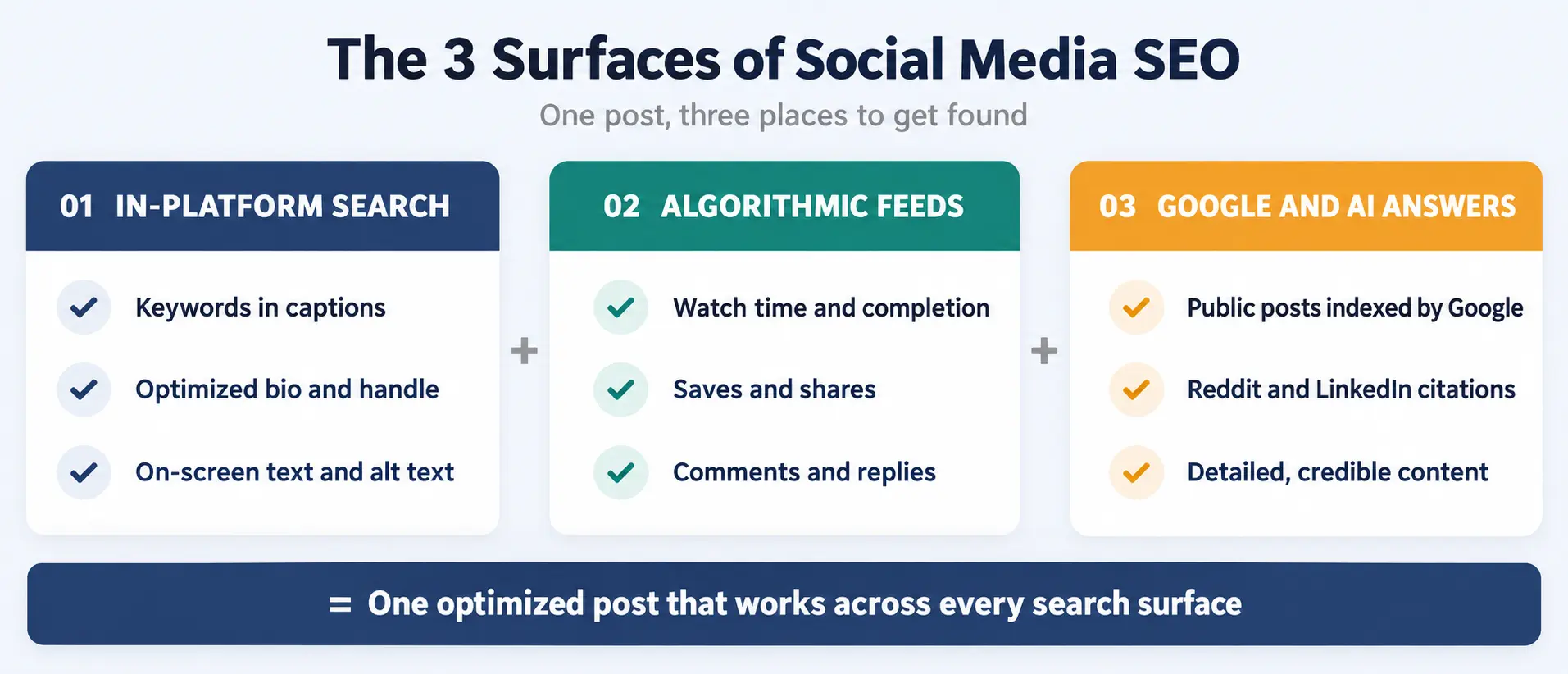
- Social media SEO now affects visibility across three surfaces at once, in-platform search, algorithmic feeds, and external search engines or AI tools.
- Each major platform ranks content differently, so a single content and keyword strategy applied identically everywhere rarely performs well.
- Captions, alt text, and on-screen text carry more weight than hashtags alone; hashtags work best as a supplement, not a primary discovery method.
- Social content increasingly shapes how AI tools describe a brand, since platforms like Reddit and LinkedIn are frequently cited sources in AI-generated answers.
- Profile fields like handle, display name, and bio function as searchable, indexable content and are commonly left under-optimized.
- Consistency and genuine engagement matter more than posting volume; a platform’s algorithm rewards content that holds attention, not just content that exists.
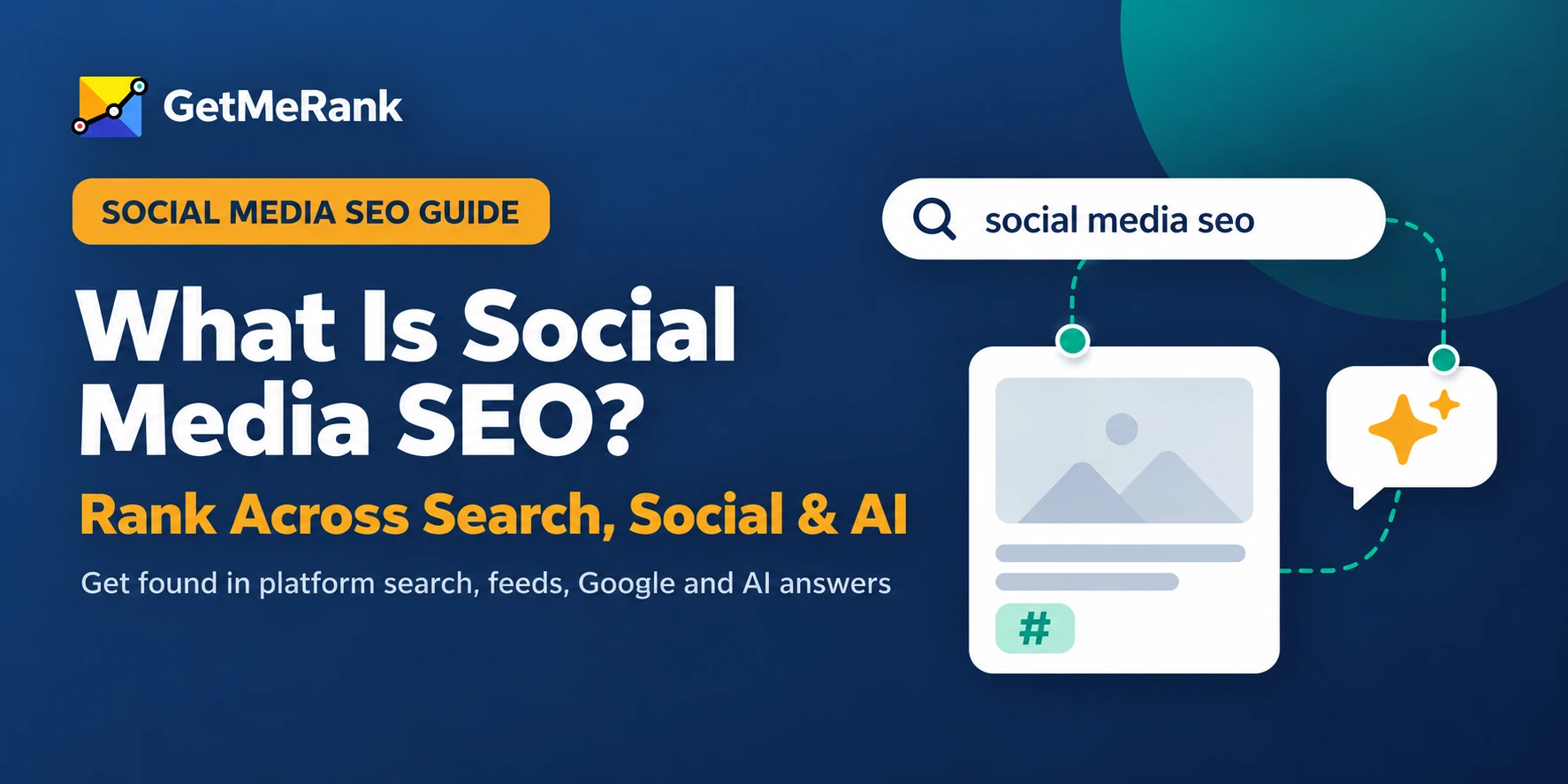
Social media SEO is the practice of optimizing profiles, captions, hashtags, and content across platforms like Instagram, TikTok, YouTube, and LinkedIn so they get found in three places at once: in-platform search, algorithmic feeds, and increasingly Google search results and AI-generated answers. It’s no longer just about ranking inside one app, a well-optimized social post can now surface in an AI Overview or get cited by an AI chatbot answering someone’s question. Getting social media SEO right means treating every caption, bio, and hashtag as searchable content, not just something meant to be scrolled past.
DID YOU KNOW
41% of Gen Z now turn to social media first when they need information, ahead of the 32% who start with a traditional search engine. Women are also considerably more likely than men to use social platforms to seek out and research brands.
What Is Social Media SEO?
Social media SEO is the process of optimizing content and profiles on social platforms so they surface when someone searches, whether that search happens inside the platform itself, on Google, or through an AI assistant. It borrows core SEO principles- relevance, keyword placement, and matching content to what someone is actually looking for, and applies them to captions, bios, hashtags, and video text instead of webpages.
This matters more than it used to because social platforms are no longer isolated ecosystems. A well-optimized Reddit thread or LinkedIn post doesn’t just perform inside that app; it can show up in Google’s search results or get referenced directly inside an AI-generated answer, extending a brand’s reach far beyond the platform where the content originally lived.
Why Social Media SEO Is Now a Bigger Part of Broader SEO
For a long time, social media SEO really just meant one thing: getting a post to rank inside a platform’s own search bar or show up in someone’s feed. That’s still worth doing, but it’s no longer the whole picture.
What Is Social Media SEO and How Do You Rank Across Search, Social, and AI?
Search itself has expanded. When someone asks an AI assistant for a product recommendation or a how-to answer, that response is often built from real posts, comments, and threads scraped from social platforms, not just from traditional websites. A well-written Reddit comment or a detailed LinkedIn post can end up shaping how an AI tool describes a brand to someone who never even visited that platform directly. This overlap between social content and AI-driven discovery is exactly the space AI SEO services are built to address.
DID YOU KNOW
Reddit is the most-cited website in AI-generated answers, followed by YouTube and LinkedIn. Social content is now one of the main raw materials AI tools use to describe brands.
This changes what “optimizing” a social post actually means. It’s no longer just about hashtags and posting times; it’s about writing content specific and credible enough that it holds up as a citation, not just a scroll-past post. Brands that treat their social presence as throwaway marketing copy are increasingly at a disadvantage compared to those writing content detailed enough to get pulled into an AI answer or a Google result days, weeks, or months later, which is part of why AI visibility work and social content strategy are starting to overlap more than most brands realize.
How Do You Find the Right Keywords for Social Media SEO?
Social platforms don’t offer the kind of dedicated keyword research tools Google does, but the signals are still there. Autocomplete suggestions in a platform’s own search bar reveal real, active search demand, and they’re free to use.
A practical approach: type a core topic into the search bar of the platform you’re focused on, note every autocomplete suggestion, then check which existing posts are already ranking for those terms. That tells you not just what people are searching, but what kind of content and caption structure the platform’s search system currently favors. Some of the broader AI-powered research tools covered in this roundup of AI SEO tools can also speed up this kind of cross-platform research.
PRO TIP
Type your core topic into a platform’s search bar followed by each letter of the alphabet (“skincare routine a”, “skincare routine b”…). Every autocomplete suggestion is a real phrase people are searching, and it costs nothing to collect.
Whether the goal is broad social SEO, social media and SEO working together as one strategy, or SEO and social media marketing treated as a combined effort, the keyword research process stays largely the same, the platform and content format are what actually shift.
GETMERANK TIP
Keep one keyword sheet with a column for each platform. The same topic is often phrased differently on TikTok, YouTube, and Google, and writing to each platform’s exact phrasing is what gets a post found.
Platform-by-Platform Social Media SEO Strategies
Each platform ranks content differently, which means a strategy built for one rarely transfers cleanly to another.
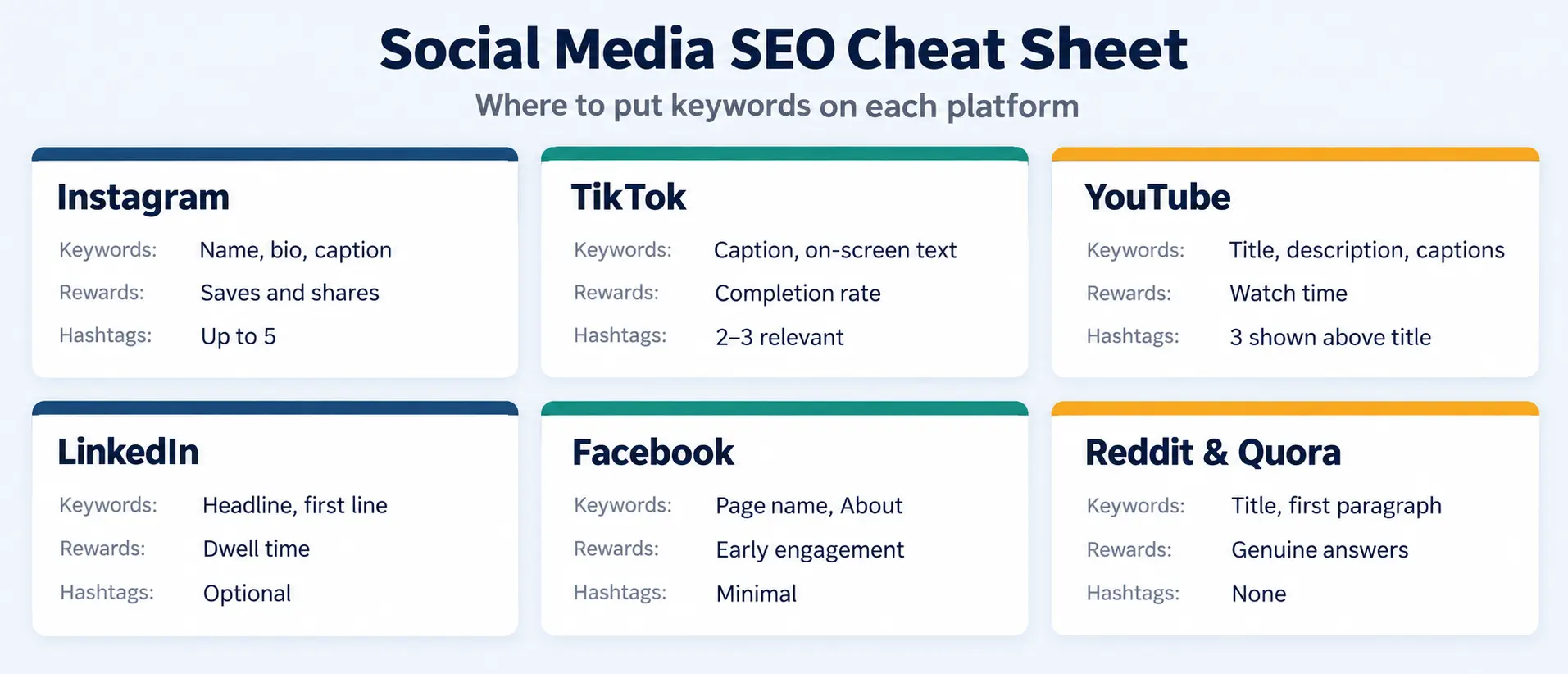
- Instagram SEO depends heavily on keywords in your username, profile name, bio, and captions, not hashtags alone. Instagram’s search matches results by text, so a target keyword needs to appear in the written caption itself, not just in a hashtag or the comments; repeating it as on-screen text in Reels reinforces what the video is about. Using an instagram seo tool to check autocomplete suggestions and Explore trends can reveal exactly which terms are worth targeting before writing a single caption.
DID YOU KNOW
Public posts and Reels from Instagram professional accounts can now appear in Google and Bing search results, including posts going back to 2020. A caption written for Instagram search may now be ranking on Google too.
- Facebook SEO leans more on Page names, Page descriptions, and About sections than on hashtags, which play a smaller role here than on Instagram. Post text still matters, since Facebook’s search matches the words in public posts, and public Page content can also be picked up by Google. Getting facebook keywords right in the Page description tends to move the needle more than hashtag strategy does.
- YouTube SEO rewards videos where the title, description, and spoken content all match how people actually search, reinforced by strong watch time and completion rate. Enabling closed captions gives YouTube’s search system another clear signal about what the video actually covers, beyond what’s implied by the title alone.
- TikTok SEO weighs captions, on-screen text, and hashtags together to determine what a video is about, alongside engagement signals like completion rate. Leading a caption with the main topic and pairing it with two or three genuinely relevant hashtags tends to outperform generic, high-volume tags stacked without context.
- LinkedIn SEO rewards posts that hold attention, not just posts that earn a quick like. Treating a LinkedIn post like a short article, with a clear hook, a real payoff, and a closing thought, tends to perform better than a short status-style update, since LinkedIn’s feed favors content people actually spend time reading.
- Reddit and Quora function more as external search plays than in-platform ones. Well-written Reddit threads and Quora answers frequently rank directly in Google, and Reddit in particular is one of the most cited sources across AI-generated answers, which makes genuine, non-promotional participation in relevant communities valuable well beyond the platform itself.
PRO TIP
On Reddit, earn trust before you mention your brand. Answer questions in your niche as a genuine community member first; cold, promotional posts get downvoted or removed and rarely reach Google or AI answers at all.
How Do Hashtags Fit Into Social Media SEO?
Hashtags still play a role, but their function has shifted from primary discovery tool to supporting signal. Rather than carrying the entire searchability burden, they now work best reinforcing the same keywords already present in a caption.
The most effective approach mixes hashtag types: one broad, high-volume tag for reach, one or two niche tags, and one highly specific or branded tag. Stacking a caption with 20 or 30 generic hashtags tends to underperform a focused set of three to five relevant ones, and some platforms now enforce this directly. Instagram caps posts and Reels at five hashtags, and YouTube ignores every hashtag on a video that carries more than 60, which shows how firmly platforms treat hashtag overload as a spam signal rather than a genuine discovery boost.
HIGHLIGHT
Hashtag limits are now enforced: Instagram allows a maximum of five hashtags per post or Reel, and YouTube ignores all hashtags on a video that uses more than 60, showing only up to three above the title. Write the keyword into the caption first and let hashtags confirm it.
How Get Me Rank Approaches Social Media SEO for Clients
At Get Me Rank, social media SEO is treated as an extension of a client’s broader search strategy, not a separate, disconnected effort. That approach shapes how the social media marketing work itself is run, starting with pulling real autocomplete and search-demand data from the specific platforms a client’s audience actually uses, rather than applying the same keyword list across every channel.
From there, the focus shifts to making sure captions, bios, and alt text are written the way a real search query would be phrased, since that’s what actually earns in-platform visibility rather than hashtags alone. For clients competing in more search-visible platforms like Reddit or LinkedIn, the strategy also accounts for how that content might get picked up externally, in Google results or an AI-generated answer, not just how it performs inside the app itself.
This connected approach tends to outperform treating social content and website SEO as separate workstreams, since the keyword research, search intent, and even some of the content itself can reinforce both at once.
GETMERANK TIP
Feed your best-performing social search terms back into your website content. A phrase that consistently drives TikTok or Instagram search traffic is a strong candidate for a blog post or FAQ, and the reverse works too.
Common Mistakes That Hurt Social Media SEO
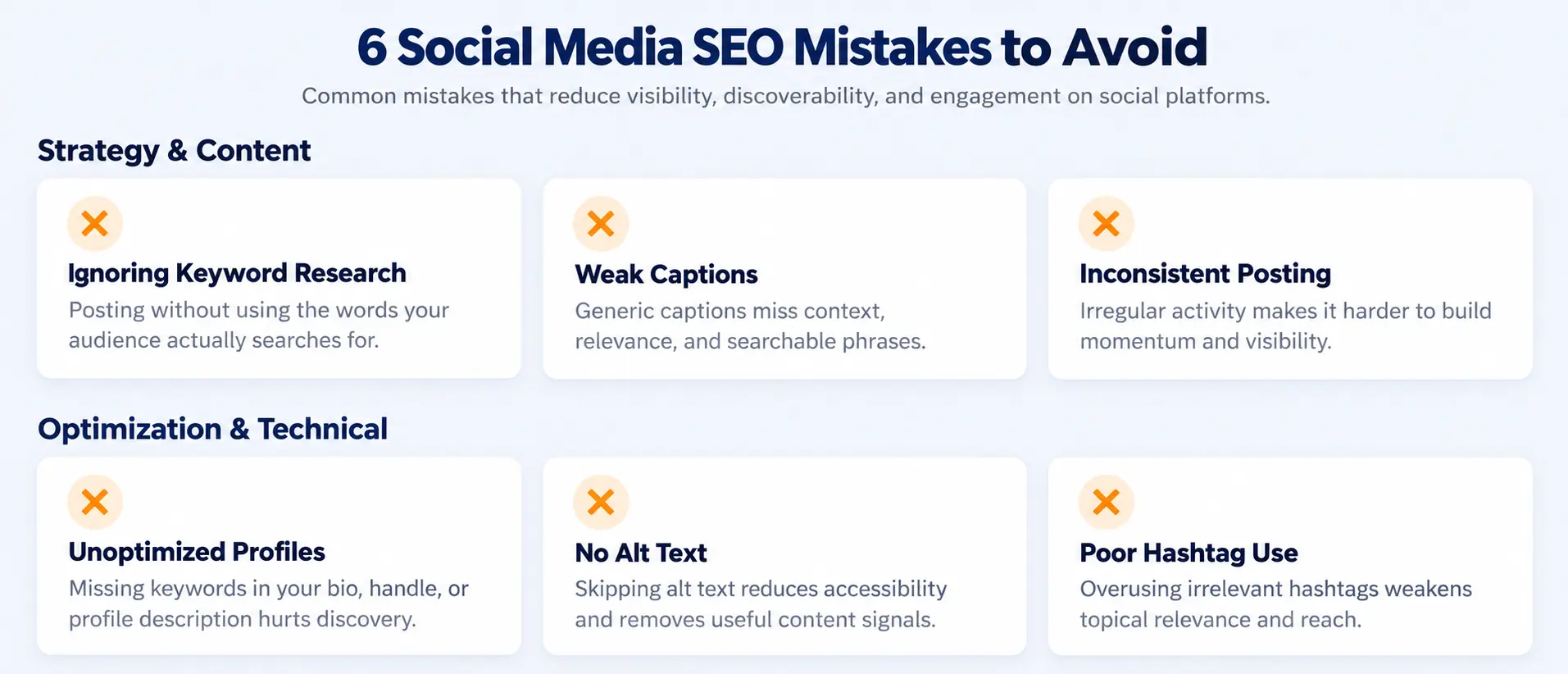
Strategic and Content Mistakes
- Writing purely promotional captions: Content that reads like a sales pitch rather than something genuinely useful tends to get skipped over by both users and the platform’s own ranking systems.
- Applying one strategy across every platform: Treating a TikTok video, a LinkedIn post, and a Pinterest pin identically ignores how differently each platform’s search and feed systems actually evaluate content.
- Posting without a clear goal: Publishing content with no consistent theme or purpose makes it harder for a platform to understand what an account is actually about, which weakens both search relevance and audience trust over time.
Optimization and Technical Mistakes
- Leaving bios and profile fields generic: A bio that reads as a tagline instead of a description misses an easy, high-visibility opportunity to include real, searchable terms.
- Overloading or underusing hashtags: Stuffing a caption with dozens of unrelated tags, or skipping hashtags entirely, both undercut discoverability compared to a focused, relevant set.
- Skipping alt text and captions on video: Leaving images without alt text or videos without closed captions removes an easy, direct signal that helps platforms understand what the content actually contains.
Social Media SEO vs Website SEO: What’s the Difference?
| Factor | Social Media SEO | Website SEO |
|---|---|---|
| Where it’s evaluated | In-platform search, feeds, and increasingly external search and AI tools | Google and other traditional search engines |
| Key signals | Captions, hashtags, alt text, engagement, dwell time | Backlinks, content quality, technical performance |
| Content lifespan | Often shorter, though some posts (Reddit, LinkedIn) can surface long-term | Longer, pages can rank for years with maintenance |
| Optimization unit | Individual posts and profile fields | Individual pages and overall site structure |
| Best for | Reaching audiences actively searching within a platform, and increasingly shaping AI-generated answers | Building long-term, compounding organic visibility |
These aren’t competing strategies. Social media SEO captures attention happening inside platforms an audience already spends time in, and increasingly feeds into how AI tools describe a brand, while website SEO builds the long-term foundation that social traffic and citations eventually reinforce.
HIGHLIGHT
Balanced take: social search adds to Google rather than replacing it. Most people who search on TikTok or Instagram still use Google too. The brands that win are visible in both places, not the ones that pick one.
How to Build a Social Media SEO Strategy Step by Step
- Research real in-platform search terms. Use each platform’s own autocomplete and trending suggestions rather than relying only on external keyword tools.
- Write platform-specific content, not one-size-fits-all posts. A caption built for Instagram search rarely works unchanged as a LinkedIn post or a TikTok script.
- Treat profile fields as searchable real estate. Bios, handles, and Page descriptions should include real keywords, not just brand taglines.
- Add alt text and captions to every visual and video. This remains one of the easiest, most consistently overlooked optimization steps available.
PRO TIP
Say your main keyword out loud in the first few seconds of every video. Auto-generated captions turn spoken words into text, giving the platform one more clear signal about what the video covers.
- Track engagement and search performance together. A post can perform well in the feed and still be invisible in search, or vice versa, so both need monitoring.
READY TO GROW?
Make every post searchable. Book a free strategy call and we’ll map a social media SEO plan that gets your brand found in platform search, feeds, Google, and AI answers.
Frequently Answered Questions For Social Media SEO
1. What is social media SEO?
Social media SEO is the practice of optimizing captions, hashtags, bios, and alt text on social platforms so content surfaces in in-platform search, algorithmic feeds, and increasingly external search engines and AI-generated answers.
2. How is social media SEO different from website SEO?
Social media SEO focuses on platform-specific signals like captions, hashtags, and engagement, while website SEO relies more heavily on backlinks, technical site performance, and long-term content authority.
3. Do all social platforms rank content the same way?
No, each platform weighs different signals. Instagram and TikTok lean on keywords in captions, profile fields, and on-screen text, with hashtags as support; LinkedIn rewards content that holds attention, and Reddit and Quora function more as external search plays than in-platform ones.
4. Do hashtags still matter for social media SEO?
Yes, but they work best as a supplement to keyword-rich captions rather than the primary discovery method, and a focused, relevant set tends to outperform hashtag-stuffing. On Instagram, posts and Reels are now limited to five hashtags, so three to five relevant tags is a sensible default across most platforms.
5. Can social media content affect how AI tools describe a brand?
Yes, platforms like Reddit and LinkedIn are frequently cited sources in AI-generated answers, which means well-written, genuinely useful social content can shape how a brand gets described well beyond the platform it was posted on.
6. Can Instagram posts show up in Google search?
Yes. Public posts and Reels from Instagram professional accounts (run by users aged 18 or over) can now be indexed by Google and Bing, unless the account owner turns this off in settings. Stories, highlights, and bios are not included, so caption keywords matter more than ever.
Conclusion
Social media SEO has moved past being just about winning a platform’s own search bar. Content posted today can influence what shows up in Google, in an AI Overview, or in a chatbot’s answer months later, which raises the bar for what “good” social content actually looks like. Brands that write with real search intent in mind, across bios, captions, and hashtags, and that adapt their approach per platform rather than copying and pasting the same strategy everywhere, are the ones best positioned to benefit from how much search itself has expanded.
Ready to get found in search, feeds, and AI answers? GetMeRank can plan, optimize, and manage your social media SEO from start to finish.