SEO
Key Takeaways
- The advantages of SEO compound over time — a page that ranks well can keep earning traffic for years with minimal ongoing investment.
- SEO-generated leads convert at a meaningfully higher rate than outbound marketing, since they come from people already searching for a solution.
- Organic search drives a significant share of overall website traffic — more than most other individual channels combined.
- Local SEO specifically helps nearby customers find and choose a business, often driving calls and visits, not just clicks.
- The same core SEO practices that help a page rank in traditional search also help it get surfaced in AI-generated answers.
- Businesses that delay investing in SEO are often competing against years of accumulated authority their competitors have already built.
What Are the Advantages of SEO?
At its core, SEO gives a business sustained visibility to people who are actively searching for what it offers. That’s a meaningfully different kind of marketing from advertising, where visibility exists only as long as the budget does. The advantages of SEO stem directly from that distinction: organic rankings keep working in the background, generating traffic, leads, and brand exposure without a per-click cost attached to every visitor.
This matters because search itself hasn’t slowed down. People still turn to Google, and increasingly to AI-powered search tools, before making almost any purchase or decision — researching options, comparing providers, and looking for answers. A business absent from that research process is effectively invisible to a large share of its potential customers.
DID YOU KNOW
A widely cited BrightEdge study puts organic search at over half of all trackable website visits. That traffic carries real intent – someone searching “roof repair near me” or “best CRM for small business” already has a specific need.
How Do SEO Service Benefits Compare to Paid Advertising?
One of the clearest SEO service benefits shows up when you compare it directly to paid search. Paid advertising can generate traffic almost immediately, but that traffic disappears the moment the budget runs out. SEO works differently: the content and technical improvements a business invests in continue attracting visitors long after the initial work is complete.
This doesn’t mean SEO and paid advertising are competitors. Many businesses use paid ads for immediate visibility while SEO builds toward long-term, lower-cost traffic that doesn’t depend on continuous spend. The real advantage is that SEO reduces how dependent a business becomes on paid channels for every new visitor over time.
GETMERANK TIP
Use paid and organic data to inform each other — PPC results show which messaging converts, while organic performance reveals which topics already resonate. The strongest strategies run both together, not one instead of the other.
What Are the Real Advantages of SEO for a Business?
1. It drives high-intent organic traffic
Organic search accounts for a substantial share of overall website traffic, with one widely cited BrightEdge study putting organic search at over half of all trackable website visits. That traffic carries real intent behind it — someone searching “roof repair near me” or “best CRM for small business” already has a specific need, which is very different from an ad interrupting someone mid-scroll.
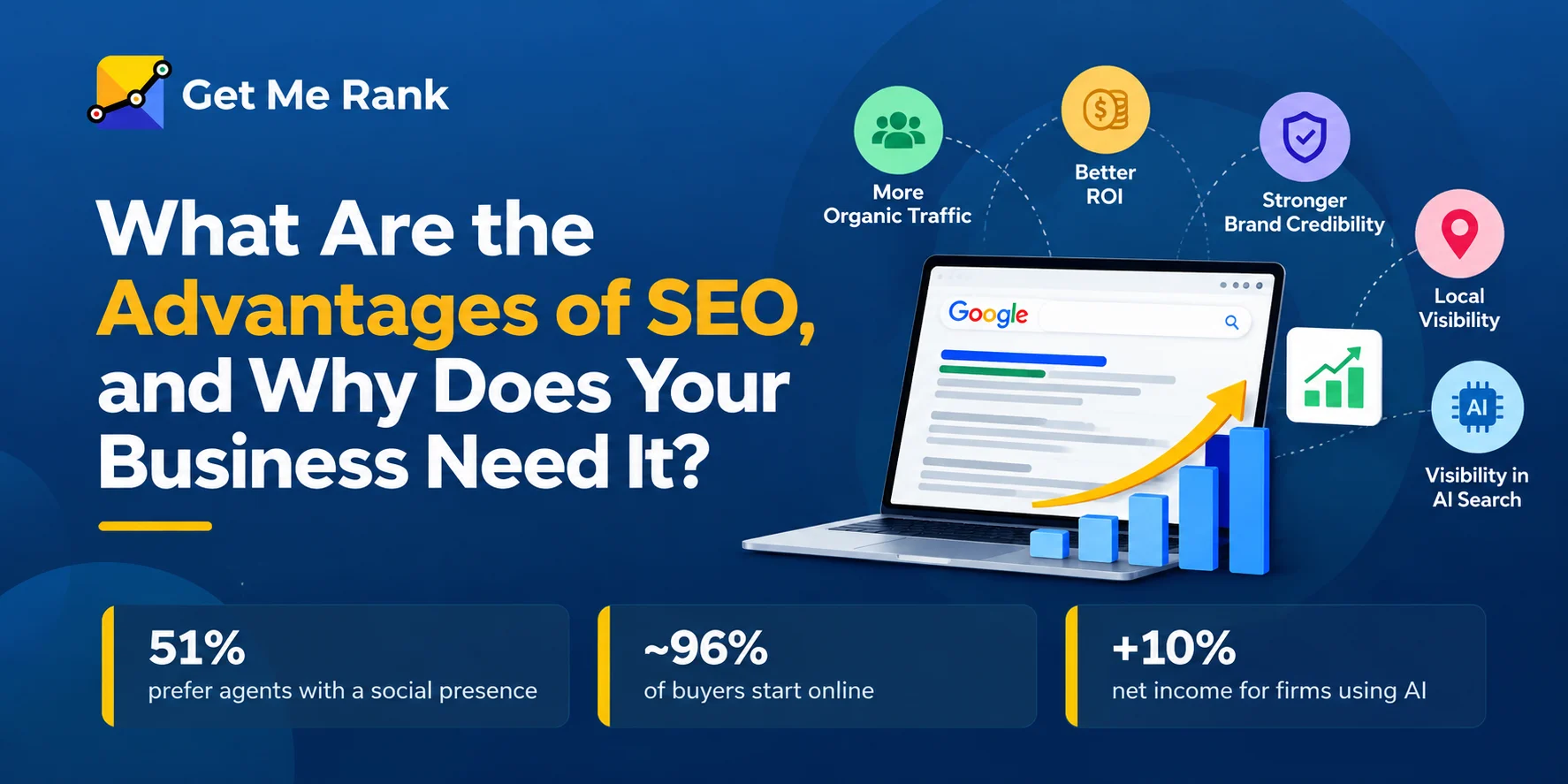
What Are the Advantages of SEO, and Why Does Your Business Need It?
2. It earns higher-quality leads than outbound marketing
SEO doesn’t just bring more visitors — it tends to bring better ones. Industry benchmarks have shown SEO-generated inbound leads closing at notably higher rates than outbound leads, since organic search connects a business with people already researching a solution, not people being cold-pitched one.
3. It builds long-term, compounding ROI
A well-optimized page or article can continue earning visibility for months or years with periodic updates, rather than needing continuous new spend to keep performing. As more pages gain visibility, those results tend to reinforce each other, building a compounding advantage that paid campaigns alone don’t produce.
4. It builds brand credibility and trust
Consistently appearing in relevant search results — especially when that content genuinely demonstrates expertise — builds familiarity that can turn into trust over time. Google’s own guidance around content quality, built around experience, expertise, authoritativeness, and trustworthiness, reflects how closely credibility and strong SEO are connected.
5. It helps local businesses get found
For businesses serving a specific area, local SEO puts them in front of nearby customers at the exact moment they’re searching. Backlinko’s research on local search behavior found that a meaningful share of users click directly into Google’s Local Pack results — the small cluster of businesses shown at the top of local search — which makes strong local SEO a direct path to calls, direction requests, and in-person visits.
6. It strengthens every other marketing channel
SEO research rarely stays contained to SEO alone. Keyword research reveals the exact language customers use, which can sharpen paid search campaigns, social content, and email messaging. Paid and organic data can also inform each other — PPC results show which messaging converts, while organic performance reveals which topics already resonate.
7. It expands visibility across both search and AI answers
This is one of the advantages of SEO that’s changed the most recently. Google has stated that the same foundational SEO practices used for traditional search results remain relevant to AI Overviews and AI Mode — meaning strong, well-structured, genuinely useful content has a real chance at visibility in both traditional rankings and AI-generated answers. For businesses that want to actively build toward that kind of dual visibility rather than hoping for it, dedicated AI SEO services focus specifically on the structural and content choices that help a page get recognized and cited by AI search tools, not just traditional search engines.
HIGHLIGHT
The same core SEO practices that help a page rank in traditional search — clear structure, genuine expertise, direct answers — also help it get surfaced in AI-generated answers. Traditional SEO and AI search visibility aren’t separate disciplines; they’re deeply connected.
What Do the Advantages of SEO Look Like in Practice?
Consider a regional home services company that’s historically relied on paid ads and word of mouth. After investing in SEO, service-area pages targeting specific neighborhoods start ranking within a few months, and a handful of detailed how-to guides begin attracting organic traffic from people researching problems before they’re even ready to hire anyone.
A year in, those pages are still generating leads without additional spend — something the company’s paid campaigns never did once the budget stopped. The compounding nature of that traffic, built once and still working months later, is where the advantages of SEO become most tangible for a business watching its numbers over time.
SEO vs PPC: Which Delivers Better Long-Term Value?
| Factor | SEO | PPC (Paid Ads) |
|---|---|---|
| Time to see results | Typically months | Immediate |
| Cost structure | Upfront investment, no per-click cost once ranked | Ongoing cost per click |
| Traffic longevity | Continues after the work is done | Stops when spend stops |
| Trust and credibility | Builds over time through consistent visibility | Doesn’t inherently build organic trust |
| Best for | Long-term, compounding visibility | Immediate, campaign-specific traffic |
Most mature marketing strategies use both. PPC fills the immediate pipeline while SEO builds the long-term foundation that eventually reduces how much a business needs to spend to stay visible.
What Mistakes Do Businesses Make When Evaluating SEO’s Value?
- Expecting PPC-level speed from SEO. SEO is a long-term investment, and expecting results within weeks leads many businesses to abandon it before it has a chance to compound.
- Measuring only rankings, not business outcomes. Ranking well for a keyword that doesn’t drive leads or revenue isn’t a meaningful win on its own.
- Treating SEO and paid search as competitors instead of complements. The strongest marketing strategies use both together, not one instead of the other.
- Ignoring local SEO despite serving a local market. Businesses with a physical location or service area often underinvest in the one channel most likely to drive calls and visits.
- Assuming AI search makes traditional SEO irrelevant. The same fundamentals that help a page rank traditionally also help it get surfaced in AI-generated answers — the two aren’t separate disciplines.
How Do You Measure Whether SEO Is Actually Working for Your Business?
Knowing the advantages of SEO in theory is different from confirming they’re actually showing up for your business. A few metrics matter more than rankings alone.
- Organic traffic growth, tracked in Google Analytics, shows whether visibility is translating into actual visits over time – not just improved positions for a handful of keywords.
- Search Console’s query data reveals which searches are driving impressions and clicks, including terms you never deliberately targeted – often the first sign that a page is building broader topical authority.
- Conversion rate from organic traffic matters more than traffic volume alone – a page attracting visitors who never take action isn’t delivering the business value SEO is supposed to produce.
- Local engagement metrics – calls, direction requests, and profile views from Google Business Profile – matter specifically for businesses relying on local SEO, since these actions often happen without a website click at all.
The common mistake is checking only one of these in isolation. A page can gain traffic without converting, or convert well without much traffic yet, and neither number alone tells the full story of whether SEO is delivering real advantages for the business.
PRO TIP
Don’t measure SEO by rankings alone. Track organic traffic growth, conversion rate from organic visitors, and local engagement metrics (calls, direction requests) together – that’s what tells you whether SEO is actually moving the business, not just moving positions.
How Can Professional SEO Services Help You Capture These Advantages?
Capturing the real advantages of SEO — compounding organic traffic, stronger leads, and visibility across both traditional and AI-powered search — takes consistent, strategic work most in-house teams don’t have the bandwidth for alongside everything else on their plate. At Get Me Rank, a dedicated SEO services engagement is built around exactly this: research, technical fixes, content strategy, and ongoing optimization, so a business captures these advantages systematically rather than hoping for them.
READY TO GROW?
Stop leaving organic traffic on the table. Book a free strategy call and we’ll show you where your biggest SEO opportunities are – across traditional search and AI-powered answers.
Conclusion
The advantages of SEO aren’t abstract – they show up as compounding organic traffic, higher-quality leads, and a business that’s easier to find and trust over time, across both traditional search and the AI-powered tools increasingly shaping how people search. Businesses that treat SEO as a long-term asset rather than a short-term campaign tend to be the ones still benefiting from the work they did months or years earlier, while competitors who skipped it are left trying to catch up from scratch.
When you’re ready to start building that compounding advantage, Get Me Rank can build and run the whole system for you.
Frequently Asked Questions
1. What are the advantages of SEO?
The advantages of SEO include higher-intent organic traffic, stronger long-term ROI than paid advertising, improved brand credibility, better local visibility, and the ability to be found in both traditional search results and AI-generated answers.
2. What are the benefits of SEO compared to paid advertising?
SEO builds lasting visibility that continues generating traffic after the work is done, while paid advertising stops producing traffic the moment spending stops — making SEO a stronger long-term investment even though it typically takes longer to show results.
3. What are the advantages of SEO for business growth specifically?
For growing businesses, SEO compounds over time — pages built once can continue generating leads for months or years, reducing how dependent the business becomes on continuous ad spend to maintain visibility and growth.
4. What is the biggest SEO service benefit for a small business?
For most small businesses, the biggest benefit is access to local customers actively searching nearby, since local SEO can drive phone calls, direction requests, and in-person visits — not just website clicks.
5. What are the benefits of search engine optimization for AI search visibility?
Strong SEO fundamentals — clear structure, genuine expertise, and direct answers to real questions — are the same qualities that help content get surfaced and cited in AI-generated answers, making traditional SEO and AI search visibility deeply connected rather than separate goals.
6. How long does it take to see the advantages of SEO?
Most businesses start seeing meaningful results within three to six months for competitive terms, though some local or lower-competition opportunities can show movement sooner.