SEO
Key Takeaways
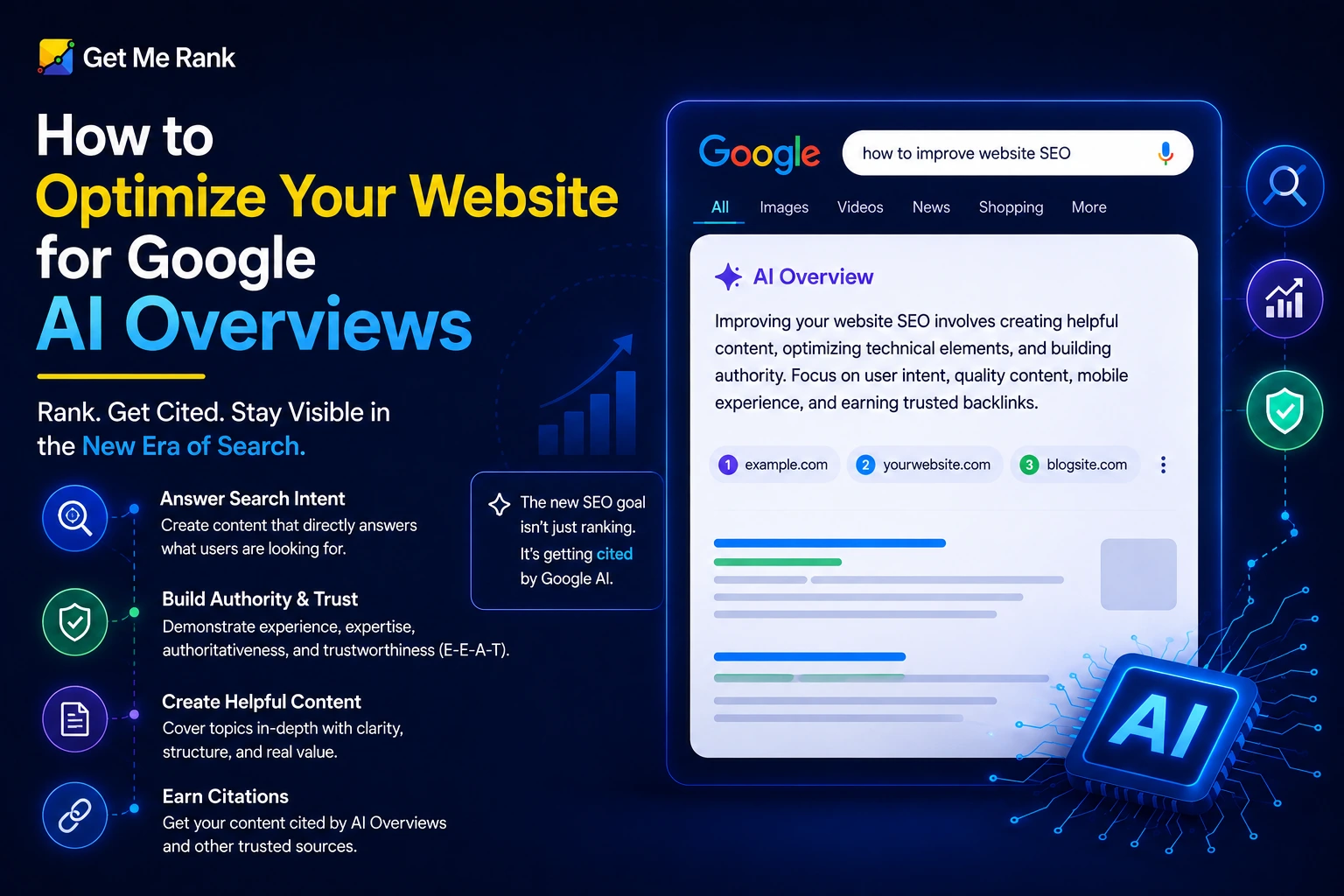
- Google AI Overviews are AI-generated answer summaries that sit at the very top of search results, above the traditional organic listings.
- In 2026, the real SEO goal has shifted from simply ranking to becoming a cited source inside the AI Overview box.
- Google says there is no special trick for AI Overviews – strong, people-first SEO fundamentals are what earn a citation.
- Answer-first structure, topical authority, E-E-A-T, and clean technical SEO are the biggest levers you can pull.
- Measuring success now means tracking citations and brand mentions alongside your usual rankings and clicks.
The New Era of Search Has Arrived
Search is changing faster than it has in a decade. Google now answers a growing share of queries directly on the results page with AI Overviews – AI-generated summaries that pull information from across the web and present it before a user ever clicks a link. For searchers, that means faster answers. For anyone who publishes content, it means the rules of visibility have quietly moved.
Ranking in the top three is no longer the only prize. The new question is whether Google’s AI chooses your page as one of the sources it summarizes and links to. This guide to SEO AI Overviews breaks down exactly what AI Overviews are, why they matter for SEO in 2026, how Google decides what to include, and – most importantly – the practical steps you can take to give your content the best possible chance of being cited. Master these SEO AI Overviews fundamentals, and you turn a threat to your organic traffic into a fresh visibility channel.
What Are Google AI Overviews?
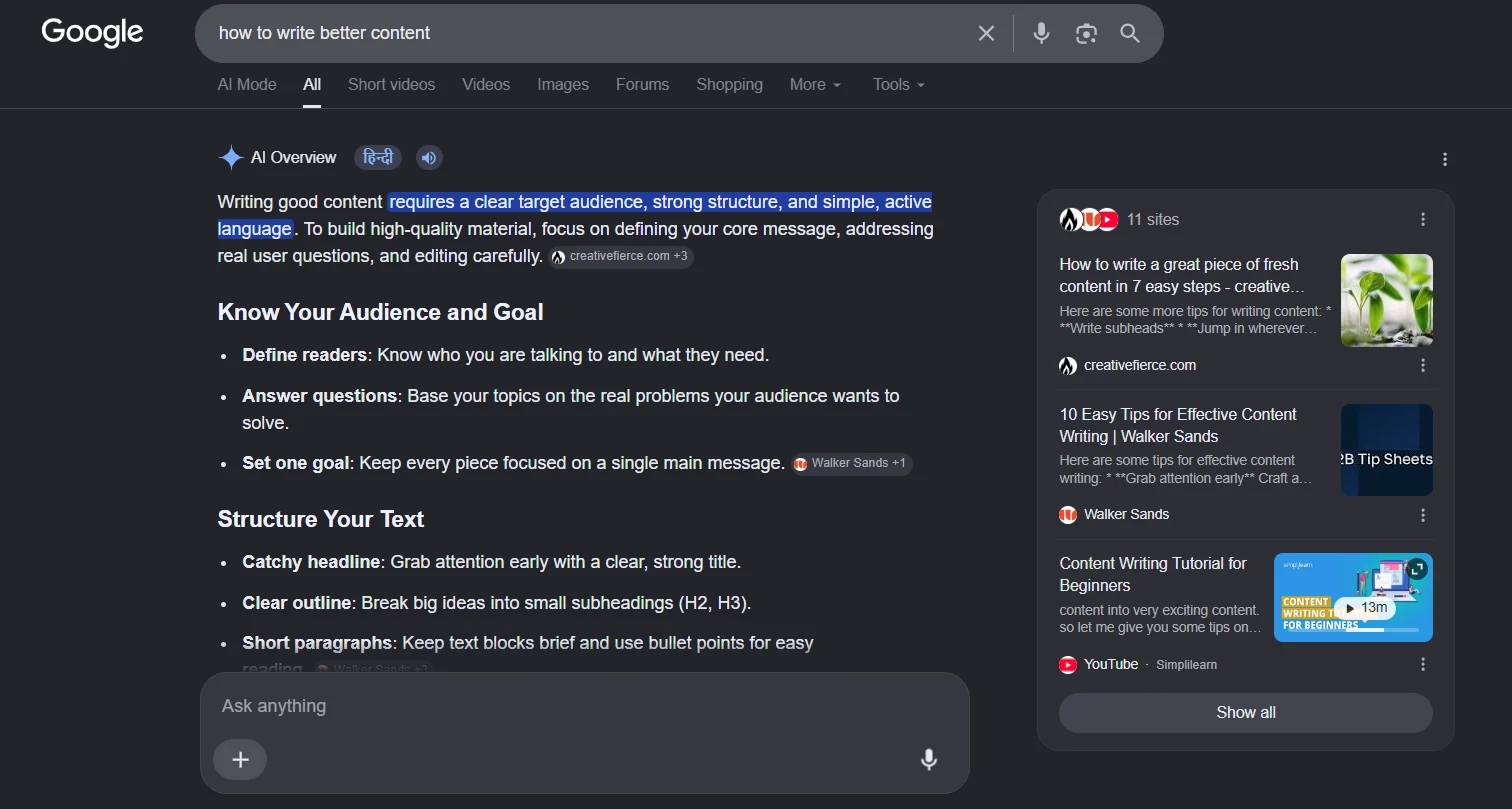
Google AI Overviews are AI-generated answer summaries that appear at the top of the search results for certain queries. Instead of showing only a list of blue links, Google uses its Gemini models to read across multiple web pages, synthesize the key information, and present a short, direct answer – usually with a set of source links the user can click for more detail.
For example, if you search “how to write better content,” Google will automatically generate an answer for you.
The feature began as an experiment within Google’s Search Generative Experience (SGE) and became widely available in the United States in 2024. Since then, it has expanded to more than 200 countries and 40-plus languages, and now appears for a much broader range of query types than at launch.
How Do AI Overviews Work?
When you type a query, Google’s systems decide whether an AI-generated summary would genuinely help. If so, Gemini gathers relevant passages from pages across the web, evaluates them for quality and relevance, and assembles a concise answer. Behind the scenes, Google often runs a process known as query fan-out: it breaks your single question into several related sub-questions, searches for each, and blends the results into one comprehensive response.
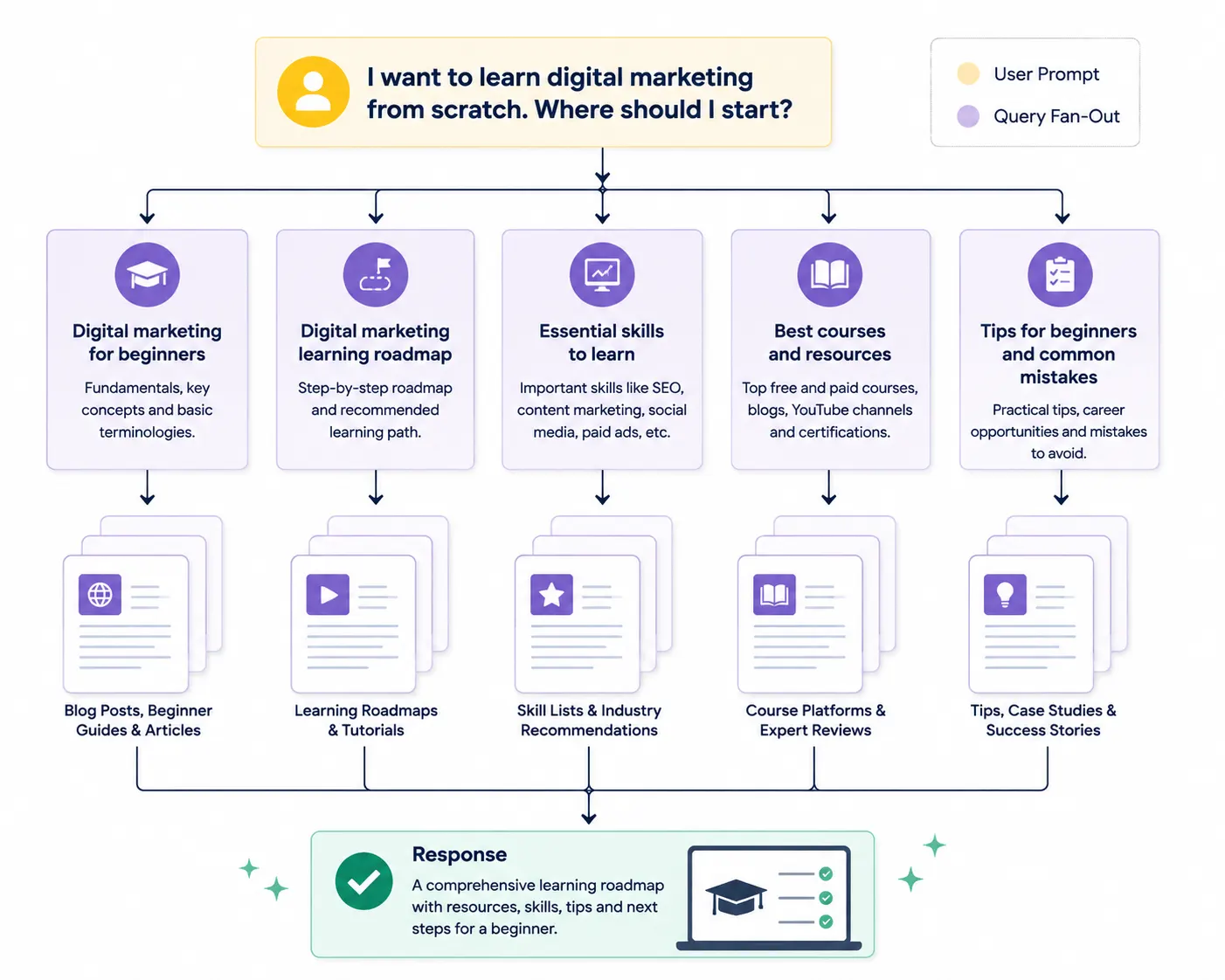
This is why content that thoroughly covers a topic – and its related sub-questions – tends to surface more often than content built around a single exact-match keyword.
Difference Between Featured Snippets and AI Overviews
Featured snippets and AI Overviews look similar because both appear near the top of the page, but they work very differently. A featured snippet lifts a single passage from one ranking page and displays it word for word. An AI Overview is generated: it synthesizes information from several sources into new phrasing and can cite multiple pages at once. The table below makes the distinction clear.
When Do Google AI Overviews Appear?
Not every search triggers an AI Overview. Google shows one when its systems judge that a summarized, multi-source answer would help the user more than a plain list of links. In practice, they appear most often for:
- Informational queries – questions where the user wants to understand a topic, such as “what is topical authority.”
- Comparison searches – queries like “X vs Y” where the user is weighing options.
- How-to searches – step-by-step or instructional questions.
- Multi-step questions – complex queries that require reasoning across several pieces of information.
One important 2026 trend: AI Overviews are no longer limited to purely informational searches. Google’s own data shows the mix of triggering queries has shifted sharply toward commercial, navigational, and transactional intent over the past year, which means more of the searches that drive real business now surface an AI Overview.
Why Google AI Overviews Matter for SEO?
AI Overviews matter because they change both how Google delivers answers and how websites earn visibility. Understanding the impact – good and bad – helps you plan a strategy instead of reacting to it.
- Declining Organic CTR
When an AI Overview answers the question on the page, fewer people click through to websites. A widely cited Pew Research Center analysis found that users click a traditional search result only about 8% of the time when an AI Overview is present, compared with roughly 15% when there is none – and they click a link inside the AI Overview itself only around 1% of the time. For queries that used to send steady informational traffic, that is a meaningful drop.
- More Zero-Click Searches
AI Overviews accelerate the rise of zero-click searches, where the user gets what they need without visiting any site. This is not entirely new – featured snippets and knowledge panels started this trend years ago – but AI Overviews push it further because they can answer complex, multi-part questions in one place.
- Brand Visibility Opportunities
The flip side is genuine upside. Being named or cited in an AI Overview puts your brand at the very top of the page, often above every organic result. Even without a click, that visibility builds recognition and positions you as an authority. When Google labels your page as a source for its answer – or mentions your brand as a recommended option – you gain credibility that a normal rank-four listing simply cannot match.
- From Ranking to Being Cited
The strategic shift is this: the win is no longer only about ranking, it is about being the source Google chooses to summarize. For context, Semrush Sensor data suggests AI Overviews appear for roughly 13% of U.S. searches on average, and that share keeps moving as Google tunes the feature. Treating citation as a first-class goal – not an afterthought – is what separates content that thrives in this environment from content that quietly loses traffic.
How Google Selects Content for AI Overviews?
Google has been clear that there is no separate checklist for AI Overviews. Its official guidance is to follow the same foundational SEO best practices you already use for Search, because helpful, reliable, people-first content is what the system rewards. That said, several signals consistently matter for whether your content gets pulled into an Overview.
- Relevance to Search Intent
Google first has to match your content to what the user actually wants. Content that answers the precise question – and the related sub-questions behind it – is far more likely to be selected than content that is loosely on-topic but never directly addresses the query.
- Content Quality & E-E-A-T
Experience, Expertise, Authoritativeness, and Trustworthiness (E-E-A-T) run through everything Google evaluates. Accurate, original content written or reviewed by people with real knowledge of the subject earns more trust – and trusted sources are the ones an AI summary wants to lean on.
- Topical Authority
Sites that cover a subject deeply and consistently build topical authority. When you have a well-linked cluster of content around a theme, Google is more confident that you are a reliable voice on it, which improves your odds of being cited across the many sub-queries an Overview draws from.
- Structured Content
Clean structure makes your content easy for Google to parse and extract. Clear headings, short answer-first paragraphs, lists, and tables help the system identify the exact passage that answers a question – the passage it can lift into an Overview.
- Fresh & Accurate Information
AI Overviews favor current, correct information. Outdated statistics, broken claims, or stale advice reduce trust. Regularly updating your key pages with accurate, verifiable data signals that your content can be relied on.
- Technical SEO Signals
None of the above matters if Google cannot crawl and index the page in the first place. Crawlability, indexability, fast load times, mobile-friendliness, and secure (HTTPS) delivery are the baseline that makes everything else possible.
The takeaway: Google states there are no AI-specific requirements beyond strong SEO fundamentals. Helpful, reliable, people-first content remains the foundation – the tactics below simply help you present that content in the way AI Overviews reward.
How to Optimize Content for Google AI Overviews?
This is the practical core of the guide. When you optimize content for Google AI Overviews, every step below builds on the last – moving from understanding intent to structuring, strengthening, and polishing your content until it is genuinely citation-ready. Done well, AI overview optimization is less about chasing an algorithm and more about presenting genuinely helpful content in a way both people and machines can use.
1. Start with Search Intent
Before writing a word, get clear on why someone is searching. Intent shapes the format, depth, and angle of your content. Broadly, you are serving one of these:
- Informational – the user wants to learn or understand something.
- Commercial – the user is researching before a purchase decision.
- Comparison – the user is weighing two or more options.
- Problem-solving – the user needs to fix or accomplish a specific task.
Match your content to the dominant intent behind your target query. A comparison query needs a comparison table and clear verdicts; a problem-solving query needs actionable steps. Mismatched intent is one of the quietest reasons good content never gets cited.
2. Answer the Main Question Immediately
AI Overviews reward content that gets to the point. Lead with a direct, self-contained answer in the first paragraph, then expand with detail, nuance, and examples underneath. To do this well:
- Give the answer in the first two or three sentences.
- Use concise, plain language a machine can easily extract.
- Avoid long warm-up introductions that bury the answer.
A useful test: if someone read only your opening paragraph, would they have a correct, usable answer? If yes, you have written something an Overview can quote.
3. Create Helpful, Comprehensive Content
Depth wins. Once you have answered the core question, cover the topic thoroughly enough that a reader – and Google’s query fan-out – finds every related sub-answer on your page. Strong, comprehensive content typically includes:
- Clear definitions of key terms
- Concrete examples
- Relevant statistics and data
- Real-world experiences
- Case studies
- Expert opinions or quotes
4. Build Topic Clusters Instead of Individual Articles
Isolated articles rarely build authority. Topic clusters do. Instead of publishing one-off posts, organize your content into a hub-and-spoke structure that signals genuine expertise on a subject:
- Pillar pages – broad, comprehensive guides that cover a core topic (like this one).
- Supporting articles – focused pieces that dive deep into individual sub-topics.
- Internal linking – deliberate links between the pillar and its supporting articles that tie the cluster together.
This structure helps Google understand the relationship between your pages and reinforces that you are a reliable source across an entire topic, not just a single query.
5. Optimize for Semantic Search
Modern search understands concepts, not just keywords. To align with how Gemini interprets meaning, write for context rather than exact-match phrases. Make sure your content covers:
- Related entities – the people, brands, tools, and concepts naturally connected to your topic.
- NLP keywords – the natural language variations and phrasings people actually use.
- Contextual relevance – surrounding detail that clarifies what your content is about.
- People Also Ask questions – the follow-up questions searchers commonly have.
6. Improve Readability
Readable content is extractable content. Formatting that helps humans skim also helps machines identify quotable passages. Prioritize:
- Short paragraphs (two to four sentences)
- Bulleted and numbered lists
- Comparison and data tables
- A clear, logical H2 / H3 heading structure
7. Use Schema Markup
Structured data (schema markup) helps Google understand the context and type of your content. While it is not a magic switch for AI Overview inclusion, it removes ambiguity and makes your pages easier to interpret. The most useful types include:
- Article schema
- FAQ schema
- Organization schema
- Author schema
- Breadcrumb schema
Important: schema helps Google understand your page, but it is not a standalone shortcut for getting into AI Overviews. Treat it as a supporting signal on top of genuinely helpful content, never a replacement for it.
8. Strengthen E-E-A-T Signals
Trust is earned, and Google looks for concrete signals of it. Make your expertise visible and verifiable by including:
- Detailed author bios
- Relevant credentials and qualifications
- References to authoritative sources
- Original research
- Demonstrated first-hand experience
9. Add Original Data
Original information is one of the strongest ways to stand out in a web increasingly full of similar, AI-generated content. Data that only you can provide gives Google a reason to cite you specifically. Consider adding:
- Original examples
- Surveys you have run
- Internal research and findings
- Anonymized client data
- Annotated screenshots
- Custom graphs and charts
10. Optimize Images
Visuals support comprehension and can appear alongside AI-generated answers. Give every image the context it needs:
- Descriptive, keyword-relevant alt text
- Helpful captions where appropriate
- Compression for fast loading
- Genuinely relevant visuals, not filler stock images
11. Improve Page Experience
Page experience is a quality signal that underpins everything else. A page that loads slowly or breaks on mobile undermines even the best content. Focus on:
- Core Web Vitals – healthy loading, interactivity, and visual stability scores.
- Mobile responsiveness – content that works cleanly on any screen size.
- HTTPS – secure, encrypted delivery for every page.
- Fast loading speed – pages that render in a few seconds or less.
Technical SEO Best Practices for AI Overview Optimization
If Google cannot crawl, index, and understand your site, none of your content optimization can pay off. These technical fundamentals make your pages eligible for AI Overviews in the first place.
- Crawlability – ensure Googlebot can reach your important pages without being blocked.
- XML sitemap – maintain an up-to-date sitemap so Google can discover new and updated content quickly.
- Robots.txt – check that this file is not accidentally blocking pages you want indexed.
- Canonicals – use canonical tags to consolidate duplicate or near-duplicate pages and avoid confusion.
- Internal linking – connect related pages so Google can understand your site structure and content hierarchy.
- Structured URLs – keep URLs short, descriptive, and keyword-relevant.
- Indexing – confirm your key pages are actually indexed, and watch for accidental noindex tags or 4XX errors.
A quick technical audit – using Google Search Console or a tool like Semrush Site Audit – will surface most crawlability and indexability issues so you can fix them before they cost you visibility.
Content Formats That Perform Well in Google AI Overviews
Some content formats are naturally easier for AI Overviews to parse and summarize because their structure maps cleanly onto how the system extracts answers. When it fits the topic and intent, lean toward:
- Step-by-step guides – clear, ordered instructions that answer how-to queries.
- Comparison articles – side-by-side breakdowns with tables and verdicts.
- Checklists – scannable, actionable lists a reader can follow.
- FAQs – direct question-and-answer pairs that mirror real search queries.
- Statistics pages – well-sourced, current data that others want to reference.
- Glossaries – concise definitions of key terms in a field.
- Case studies – original, evidence-backed stories that demonstrate real experience.
Common Mistakes That Prevent Content from Appearing in AI Overviews
Most AI Overview failures come down to a handful of avoidable mistakes. If your content is not getting cited, check for these first:
- Thin content – pages that skim the surface without answering the question in depth.
- Keyword stuffing – unnatural repetition that hurts readability and trust.
- Unedited AI-generated content – published without human review, fact-checking, or original insight.
- Lack of topical authority – isolated articles with no supporting cluster around them.
- Poor internal linking – orphaned pages Google struggles to connect and contextualize.
- Outdated information – stale stats and advice that erode trust.
- No supporting evidence – claims made without data, sources, or examples to back them up.
How to Measure AI Overview Performance
Measuring AI Overview visibility is harder than tracking classic rankings because the data is less transparent – but a combination of tools and manual checks gives you a workable picture.
- Google Search Console – your baseline for impressions, clicks, and queries. Note that GSC currently bundles AI Overview data in with regular organic performance rather than breaking it out separately.
- Semrush AI Toolkit – tracks whether your domain appears in AI Overviews and related SERP features, and surfaces terms you could target.
- Ahrefs Brand Radar – monitors where and how your brand is mentioned across AI-driven search results.
- Manual SERP tracking – regularly searching your priority queries to see who is being cited and why.
The mindset shift here is important: measuring your SEO AI Overviews performance increasingly means monitoring citations, branded mentions, and engagement alongside – not instead of – traditional rankings. Adopt an always-on approach, review performance often, and refine the pages that are close to breaking into an Overview.
Conclusion
AI Overviews are reshaping how people find information, but they have not rewritten the fundamentals of good SEO – they have raised the stakes on getting them right. The sites that win in this environment are the ones that answer real questions clearly, demonstrate genuine expertise, and make their content easy for both people and machines to understand.
Successful AI overview optimization comes down to a few durable habits: people-first, authoritative content, technical excellence, and real topical depth. Lead with the answer, back it with evidence and original insight, and structure everything so the key passage is easy to lift. Then keep watching how your content performs and refine it as AI search continues to evolve. Do that consistently, and you position yourself not just to rank – but to become the source Google chooses to cite.
Frequently Asked Questions
- How do you get AI Overviews on Google?
There is no button or setting that guarantees inclusion. You improve your chances by publishing helpful, people-first content that answers the query directly, structuring it clearly with headings and lists, building topical authority, and making sure the page is technically sound and easy for Google to crawl and index.
- Why am I not getting an AI Overview?
Common reasons include thin or loosely relevant content, weak topical authority, technical issues that block crawling or indexing, an answer that is buried too far down the page, or simply that Google has not judged an AI Overview to be helpful for that particular query. Auditing intent match, structure, and technical health usually reveals the gap.
- Is Google’s AI free?
Yes. AI Overviews appear automatically within standard Google Search at no cost to the user. There is no separate subscription required to see them, and they show up whenever Google’s systems decide a summarized answer would help.
- Is an AI Overview like ChatGPT?
They share the same underlying idea – generative AI producing a written answer – but they serve different purposes. ChatGPT is a standalone conversational assistant, while AI Overviews are built into Google Search, powered by Google’s Gemini models, and designed to summarize and cite live web content in response to a search query.
- Does schema markup help with AI Overviews?
Schema helps Google understand the context and type of your content, which supports overall visibility. It is a useful supporting signal, but it is not a standalone trigger for AI Overview inclusion. Genuinely helpful, well-structured content matters far more.
- How long does it take to appear in Google AI Overviews?
There is no fixed timeline. It depends on how quickly Google crawls and indexes your updates, how competitive the query is, and how strong your content and authority are. Some pages surface within days of a meaningful update; others take longer as topical authority builds.
- What is the difference between featured snippets and AI Overviews?
A featured snippet copies a single passage directly from one ranking page. An AI Overview is generated by Gemini, synthesizes information from several sources into new wording, and can cite multiple pages in a single answer.