
Paid Advertising
Most D2C brands don’t fail because they can’t get clicks — they fail because they scale spend before the machine underneath is built to turn that spend into profit. The performance marketing strategies for D2C that actually compound in 2026 aren’t a list of ad hacks; they’re a connected system where unit economics, measurement, conversion, channels, creative, retention and scaling all reinforce each other.
This guide gives you that system: a repeatable D2C performance marketing framework you can run whether you’re spending ₹50,000 a month or ₹50 lakh. It’s the same operating model our team uses as a D2C performance marketing agency across 250+ brands and 3,500 Cr+ in managed ad spend — the platforms change every year, but this sequence doesn’t.
Key Takeaways
- Profit is the strategy. Every D2C acquisition rupee has to earn its return — so you build backwards from your max-allowable CAC, not forwards from a budget.
- A framework beats tactics. Seven connected building blocks — economics, measurement, conversion, channels, creative, retention, scaling — outperform one-off campaign wins.
- Measure blended, not just platform-reported. MER (marketing efficiency ratio) and contribution margin tell the truth that a 4x in Ads Manager can hide.
- Creative is the real targeting lever in 2026. As platforms automate audiences, your win rate is decided by the volume and quality of angles you test.
- Retention is a profit multiplier. A repeat-purchase lift raises LTV without adding a rupee of acquisition cost — and lowers your effective CAC.
- Scale on rules, not vibes. Increase spend in controlled steps against an MER guardrail; most ROAS crashes are self-inflicted by scaling too fast.
Why D2C changes the performance marketing playbook
Generic performance marketing services optimise for a conversion. D2C performance marketing optimises for a profitable customer — a different, harder goal. Three structural traits of the direct-to-consumer model are what make a dedicated strategy necessary:
- Full-margin, full-risk. With no retailer taking a cut, you keep more margin to reinvest in acquisition — but there’s also no distributor absorbing inefficiency. Waste shows up directly in your P&L.
- End-to-end attribution. You own the path from ad click to checkout, so every rupee is traceable — if your measurement is built properly (Strategy 2).
- First-party data ownership. Purchase history, on-site behaviour and CRM data are yours — the raw material for targeting that survives cookie deprecation and signal loss.
That combination is why the tactics below are sequenced the way they are: get the economics and data right before you touch a bid.
The D2C performance marketing Strategies – Proven Results
We run every performance marketing engagement for D2C brands through the same seven-part model — the Profit-First D2C Framework. Think of it as a flywheel in three acts, not a checklist. The Foundation act determines whether spend can ever be profitable; the Growth act turns validated spend into demand; the Compound act makes each customer worth more over time and recycles that margin into more scale.
Performance Marketing Strategy for D2C Brands: A 2026 Growth Playbook
The rest of this guide is one section per building block, with the concrete strategy for each. Work them in order — a brilliant creative testing engine can’t save broken unit economics.
Strategy 1 — Lock your unit economics (find your profit ceiling)
Our first strategy to begin with as a D2C performance marketing agency is – find your profit ceiling. Before a single ad goes live, you need one number: the maximum you can pay to acquire a customer and still make money. Everything downstream — bids, budgets, target ROAS — is just a way of respecting or beating that ceiling.
The numbers to calculate
- Average Order Value (AOV): total revenue ÷ orders.
- Contribution margin per order: AOV − COGS − shipping − payment fees − packaging. This, not gross revenue, is what funds acquisition.
- Break-even CAC: your per-order contribution margin. Spend exactly this to acquire a customer and you break even on the first order.
- Max-allowable / target CAC: break-even CAC × 0.6–0.7, so there’s room for overheads and profit on order one.
- LTV:CAC: lifetime contribution ÷ CAC. Below ~3:1 you’re under-monetising; you can often afford a higher first-order CAC if repeat behaviour is strong.
The unlock most brands miss: if customers reliably reorder, you can lose a little on the first order on purpose and still win on LTV — as long as your payback period stays inside ~60–90 days.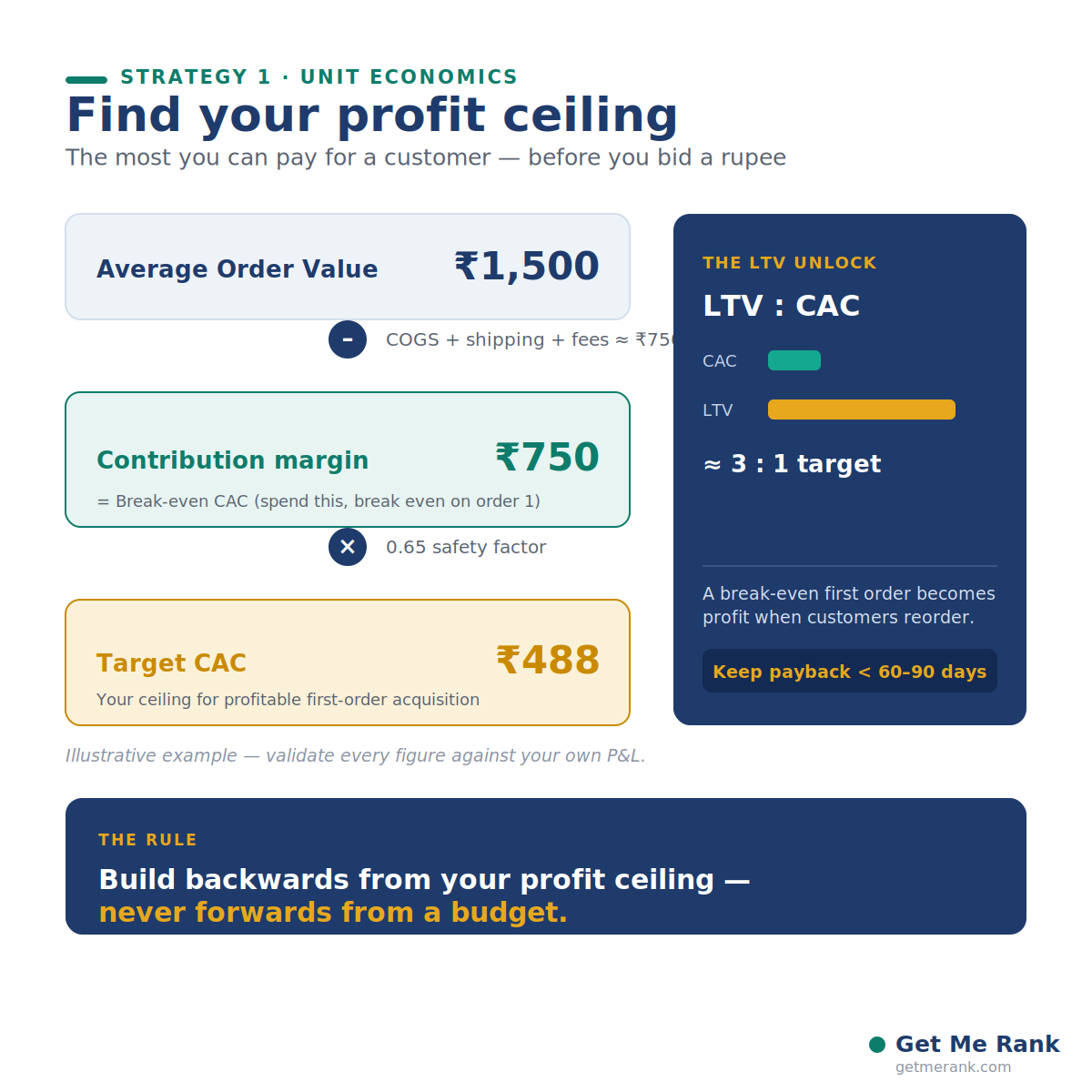
Strategy 2 — Build measurement & first-party data infrastructure
You can’t optimise what you can’t trust. After iOS signal loss and third-party cookie decline, browser pixels alone under-report conversions and mis-assign credit. Fixing measurement is the highest-ROI “boring” work in D2C.
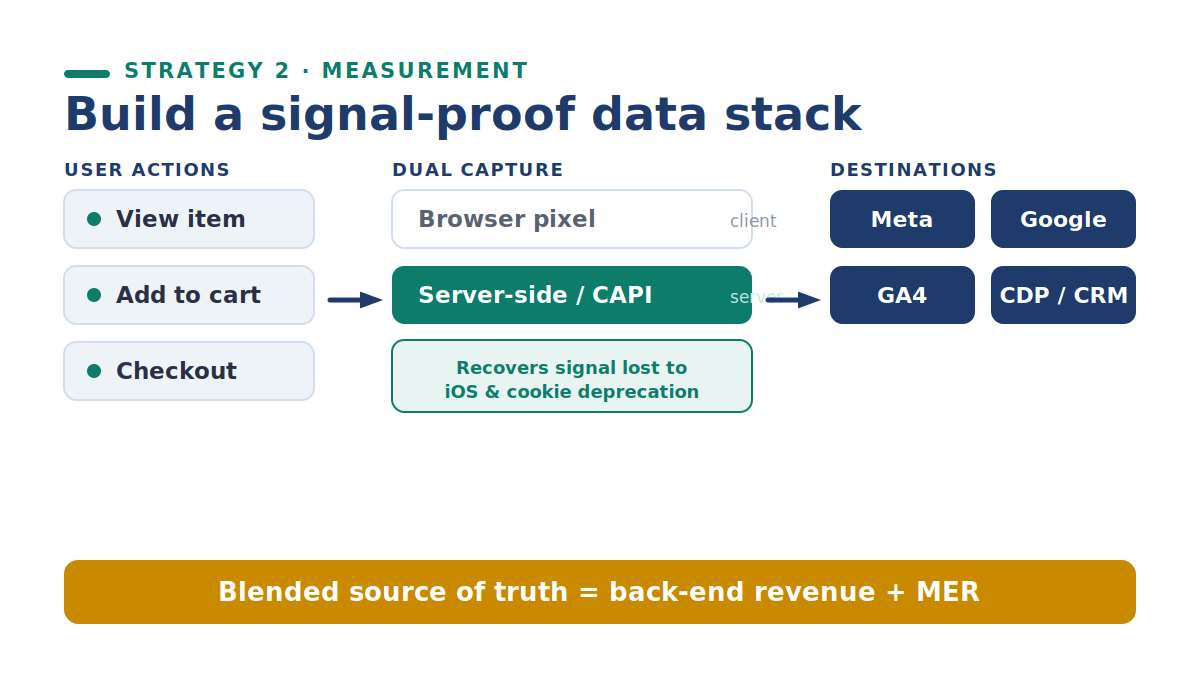
- Server-side tracking (Conversions API / server GTM): send events server-to-server alongside the pixel so the platforms can still learn and attribute despite blocked browser signals.
- GA4 with enhanced e-commerce: full-funnel visibility from view item to purchase, so you can see where drop-off actually happens.
- A single, enforced UTM convention: consistent source/medium/campaign naming across every channel — messy UTMs quietly corrupt every report after them.
- First-party data capture + CDP: email/phone at capture points, unified into a customer profile so segments are built on real behaviour, not demographics.
- Consent + a blended source of truth: respect consent, then reconcile platform numbers against GA4 and your Shopify/back-end revenue. When they disagree, back-end revenue wins.
Strategy 3 — Make the store convert before you scale spend
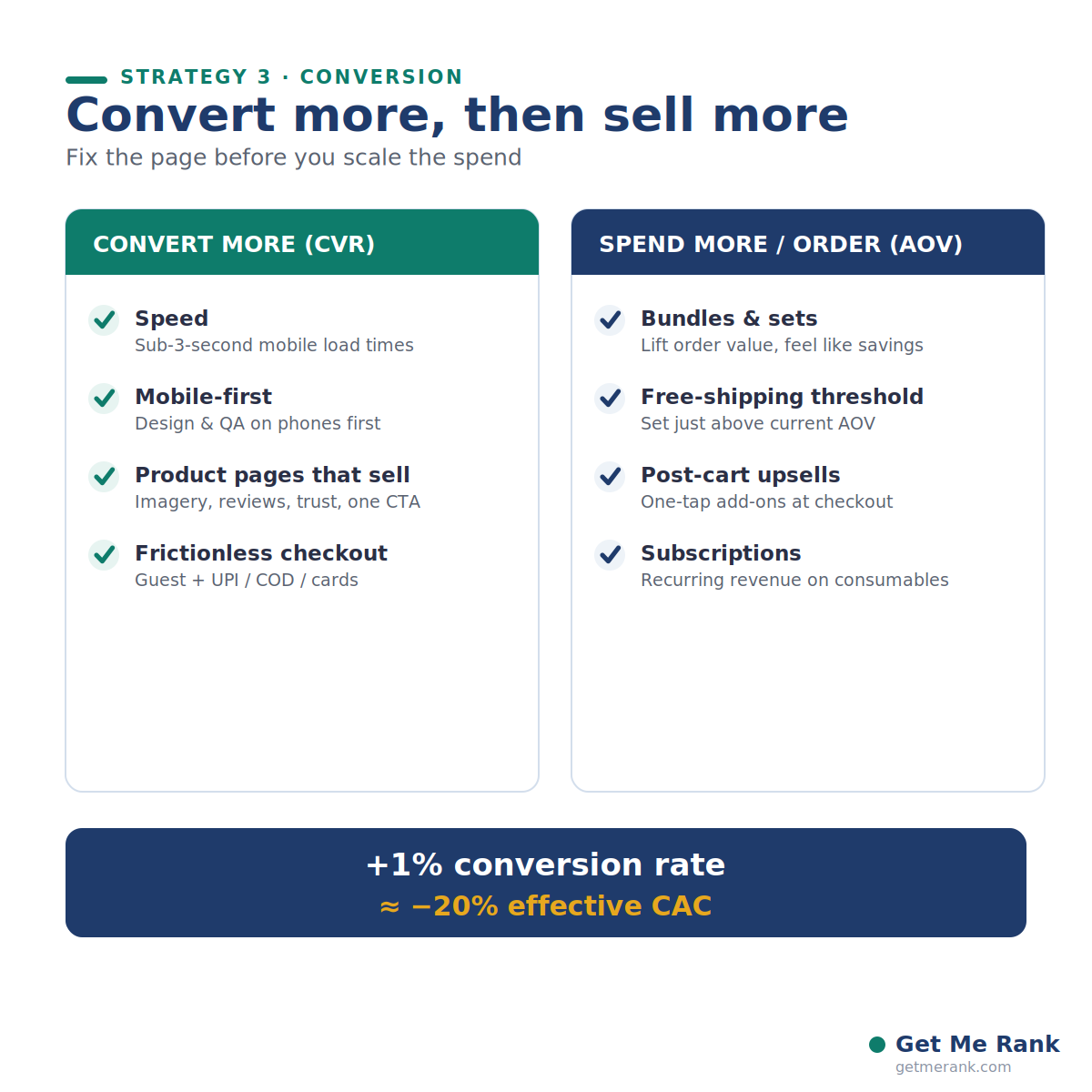
Paid traffic only turns into revenue on the page. A one-point lift in conversion rate can cut your effective CAC by ~20% — cheaper than buying your way out of a weak funnel. Two levers matter: conversion rate (CVR) and average order value (AOV).
Conversion levers
- Speed: sub-3-second loads on mobile; every extra second bleeds conversions.
- Mobile-first everything: the majority of D2C traffic is mobile — design and QA on phones before desktop.
- Product pages that sell: strong imagery, honest social proof/reviews, clear pricing, trust badges, and a single obvious CTA.
- Frictionless checkout: guest checkout, UPI/COD/cards, wallet options, minimal fields.
AOV levers (raise your profit ceiling directly)
- Bundles & sets that lift order value while feeling like savings.
- Tiered free-shipping / gift thresholds set just above AOV to nudge basket size.
- Post-add-to-cart upsells and subscription options for consumables.
Strategy 4 — Architect your channels around the funnel
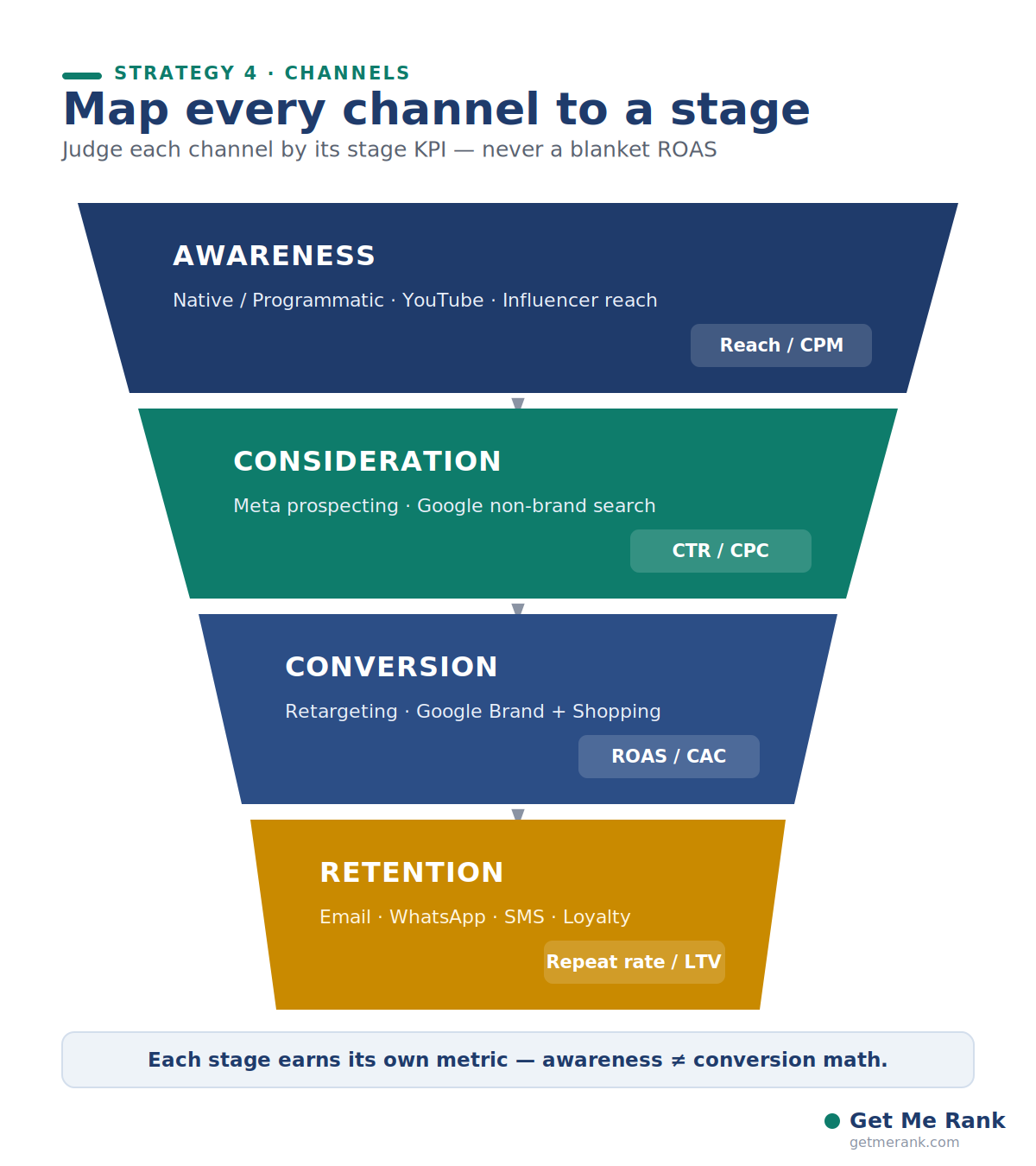
Channels aren’t interchangeable — each earns its place at a stage of the customer journey. Assign every platform a job (create demand, capture demand, or recover it) and judge it by the metric that fits that job, not by a blanket ROAS.
The channel roster
- Meta (Facebook + Instagram) — primary discovery/prospecting. The engine that creates demand from people who didn’t know they wanted you. Lean on Advantage+ shopping, broad targeting fed by strong creative, catalog retargeting and Reels. Run it as social media advertising with a relentless creative pipeline.
- Google Ads — high-intent capture. Search, Shopping, Performance Max and brand-defence campaigns catch people already looking. This is where Google Ads / PPC management earns the highest ROAS because intent is already there.
- Native & programmatic — scalable awareness. Introduce the brand inside trusted content at the top of the funnel via native & programmatic advertising.
- Influencer & affiliate — trust + content + performance. Micro-creators on base-plus-commission deals give you social proof and a library of ad-ready content; affiliate pays only on the sale.
Map them to stages so you never judge an awareness channel by decision-stage metrics:
- Awareness → Native/programmatic, YouTube, influencer reach.
- Consideration → Meta prospecting, Google non-brand search.
- Conversion → Retargeting, Google brand + Shopping.
- Retention → Email, WhatsApp, SMS (Strategy 6).
Strategy 5 — Run a creative testing engine
In 2026 the algorithms handle most of the targeting. That shifts the real work to creative: your win rate is now a function of how many strong angles you test and how fast you replace fatigued winners. Treat creative as a production line, not a project.
Test angles, not just assets
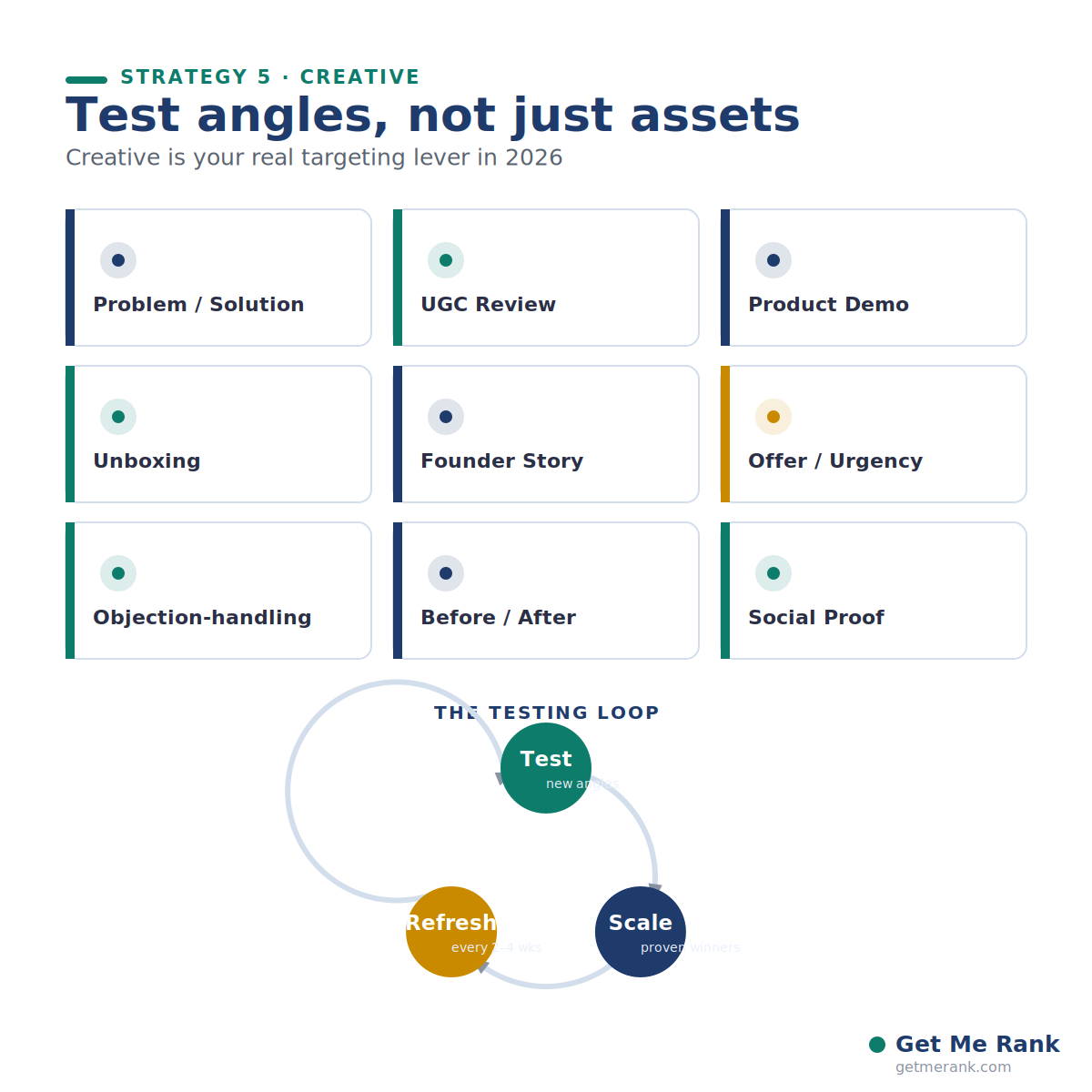
An “angle” is the reason-to-buy you’re testing — not the format. Build a matrix and rotate through it:
- Problem/solution, before/after, founder story, social proof/UGC review, product demo, unboxing, offer/urgency, and objection-handling angles.
- UGC outperforms polished brand films for prospecting — native, honest, phone-shot content wins on cost and trust. Feed it with a steady UGC ad production pipeline and sharpen concepts with creative services.
The testing loop
Keep the line always moving: a few new concepts in test, your proven winners scaling, and the next batch in production — so you’re never one fatigued ad away from a bad week. Refresh creatives every ~2–4 weeks to fight fatigue before it drags performance down.
Strategy 6 — Turn first orders into lifetime value
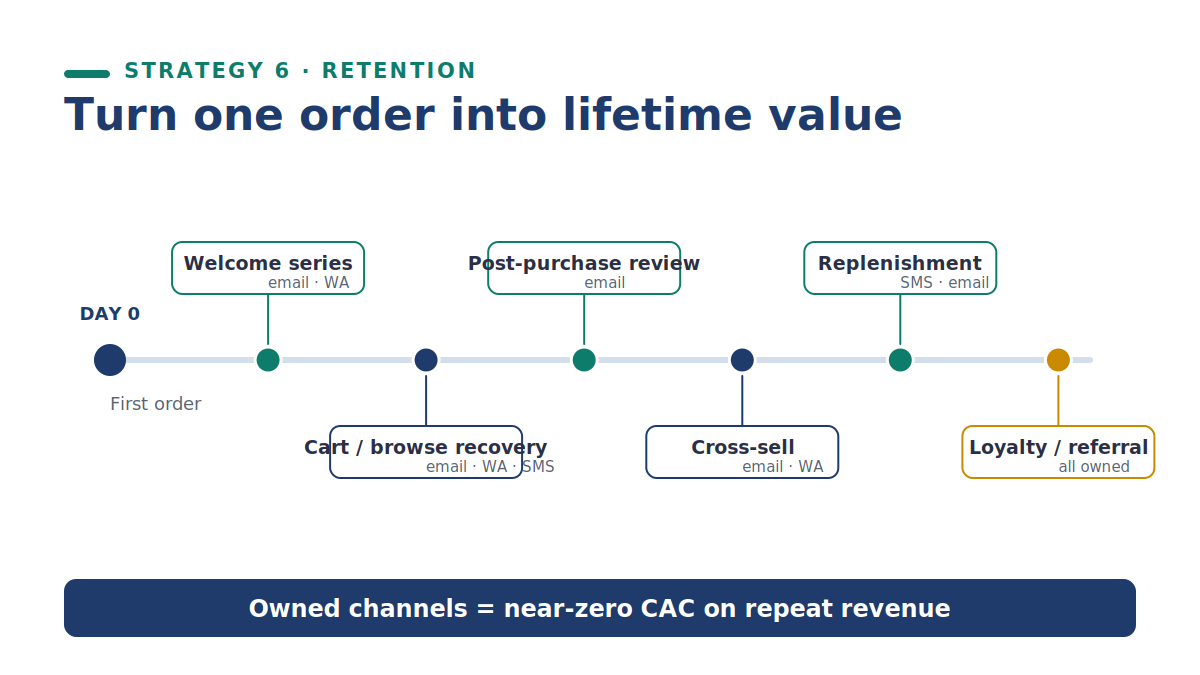
Acquisition gets a customer once; retention decides whether they were profitable. Owned channels carry no ongoing media cost, so every repeat order lifts LTV and pulls your blended CAC down. Build these flows before you pour more into the top of the funnel.
- Welcome series (email + WhatsApp): 3–5 touches that convert new subscribers and set expectations.
- Abandoned-cart / browse recovery: recover the 90%+ who leave without buying, across email, WhatsApp and SMS.
- Post-purchase flows: review requests, cross-sell, and replenishment reminders timed to product life-cycle.
Subscription & loyalty: for consumables, subscriptions turn one sale into predictable recurring revenue; loyalty/referral programs make existing customers your cheapest acquisition channel.
Strategy 7 — Scale profitably (MER-guarded scaling)
Scaling is where most D2C brands break their own ROAS. The fix is rules, not adrenaline. Grow along two axes and cap both with a single guardrail: your marketing efficiency ratio.
- Horizontal scaling (widen): new creative variations of winners, new audiences with proven creative, new placements, then new channels. Lower-risk; do this first.
- Vertical scaling (deepen): raise budgets on winners in controlled ~20–30% steps every few days, let the learning phase settle, and duplicate winning ad sets rather than editing live ones. Expect a small ROAS dip when scaling — that’s normal.
The guardrail: watch MER (total revenue ÷ total ad spend) and contribution margin, not just in-platform ROAS. Platform ROAS double-counts and flatters; MER is the honest, blended picture of whether scaling is still profitable. Push when MER holds above your target; pull back the moment it slips.
How to allocate budget by brand stage
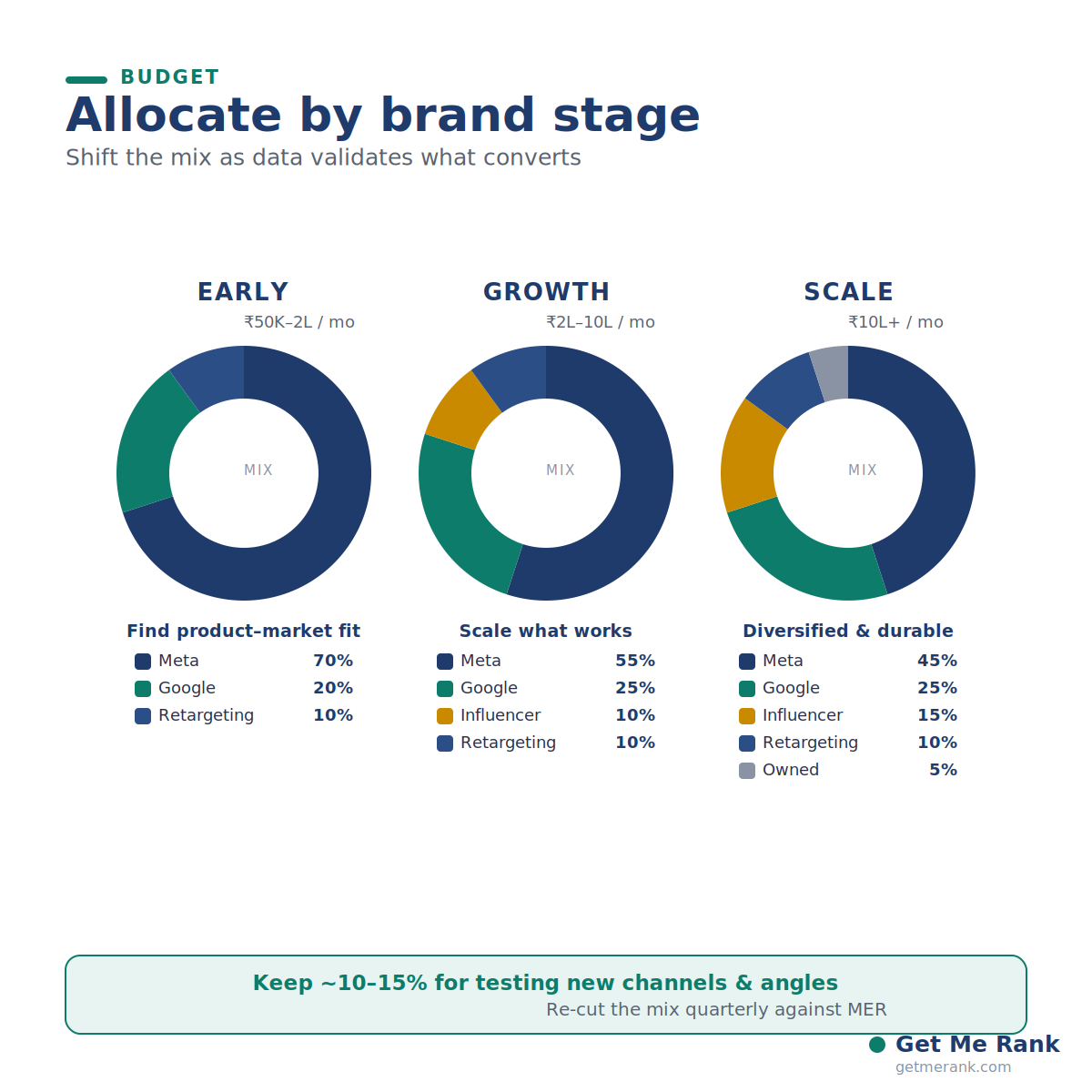
There’s no universal split — allocation should follow validated data and shift as you grow. As a practical starting point:
Whatever the stage, keep a standing ~10–15% “test budget” for new channels and angles so the core never goes stale — and re-cut the mix quarterly against MER.
The metrics that actually matter
Vanity metrics (impressions, reach, likes) look good and mean little. Judge D2C performance against revenue-centric KPIs — and treat the blended, profit-aware ones as your real scoreboard.
Common D2C performance marketing mistakes
- Scaling before the economics work. Chasing revenue while losing money per order. Fix the profit ceiling first.
- Optimising to platform ROAS alone. In-platform numbers double-count; MER and contribution margin are the truth.
- Skipping server-side measurement. Under-reported conversions starve the algorithm and hide your best campaigns.
- Creative fatigue blindness. Running the same ads for months quietly erodes performance — refresh on a cadence.
- No retargeting or retention. Only a few percent convert on first visit; ignoring the rest and ignoring repeat buyers throws away your cheapest revenue.
- Discount dependency. Training customers to only buy on sale destroys margin. Build offer and brand value instead.
What’s shaping D2C performance marketing in 2026
- AI-run buying (Advantage+, Performance Max). Automation now owns most targeting decisions — your edge moves to creative volume, feed quality and clean signals.
- AI-assisted creative. Faster concepting and variation means the brands that test the most angles win — production speed is a moat.
- First-party data as the durable asset. As signal loss deepens, owned data and server-side tracking separate brands that can still target from those that can’t.
- Visibility in AI search. Discovery is shifting into AI overviews and answer engines; pairing paid with AI SEO / AI search visibility protects top-of-funnel demand.
- Retention-led profitability. With acquisition costs high, LTV and repeat rate — not first-order ROAS — are increasingly how winners are decided.
Your 90-day execution roadmap : Get Me Rank’s Proven Workflow
Days 1–30 — Foundation
- Calculate unit economics and lock your max-allowable CAC.
- Fix measurement: server-side tracking, GA4, one UTM convention, blended reporting.
- Run a CRO + AOV pass on your top landing/product pages.
Days 31–60 — Growth
- Stand up your primary channels mapped to funnel stages.
- Launch the creative testing engine — a batch of angles, not one hero ad.
- Set your KPI dashboard (MER, contribution margin, CAC, LTV:CAC) as the scoreboard.
Days 61–90 — Compound
- Build at least two retention flows (welcome + cart recovery) before scaling spend.
- Begin MER-guarded scaling — horizontal first, then controlled vertical steps.
- Review the channel mix and re-allocate against real profit data.
Proof: What the framework looks like in the wild with Get Me Rank
This isn’t theory. Running this model as a D2C performance marketing agency, our team has delivered outcomes like a 14.91x ROAS on $11.30M in conversion value, a fashion brand scaled past ₹1.50 Cr in sales across 8,292 orders, and Shark-Tank-featured D2C names — Panda Box, Pink Polka and Indulge among 250+ brands and 3,500 Cr+ in managed ad spend.
The pattern is always the same: brands that fix economics, measurement and conversion first — then scale creative and retention against an MER guardrail — grow predictably, regardless of platform or algorithm changes.
FAQs
What are the most important performance marketing strategies for D2C brands?
Start with unit economics (your max-allowable CAC), then measurement, then conversion — before spend. Only after that do channels, creative, retention and scaling compound. Skipping the foundation is why most brands stall.
What is a D2C performance marketing framework?
A repeatable operating model — not a one-off campaign — that connects economics, measurement, conversion, channels, creative, retention and scaling so every rupee ties back to profit. The Profit-First framework in this guide is the version we run across 250+ brands.
How much should a D2C brand spend on performance marketing?
It depends on margins and goals, but a common starting point is a majority to your proven channel, a smaller share to discovery, and ~10–15% reserved for testing. The percentages matter more than the absolute figure — even a small budget can follow the same proportions.
Should I optimise to ROAS or something else?
Platform ROAS is a starting signal, but it double-counts and can hide losses. Optimise to blended MER and contribution margin — those tell you whether you’re actually profitable as you scale.
Meta or Google — which is better for D2C?
Both, for different jobs. Meta creates demand (discovery/prospecting); Google captures existing intent (search/shopping/brand). New brands usually start on Meta for scale and add Google as they grow.
Do I still need this if I already work with an agency?
Yes — it gives you the right questions to ask about economics, attribution, creative cadence and scaling rules. And if you’d rather run it with specialists, that’s exactly what our D2C performance marketing team does.
Conclusion
Winning performance marketing strategies for D2C in 2026 aren’t a bag of tricks — they’re a system. Get the economics, measurement and conversion right, turn creative into a production line, make retention do the compounding, and scale only against an honest profit metric. Do that and growth stops being a gamble.
Want this run for your brand? Our team can build your acquisition engine with us — from tracking and creative to profitable scaling. Talk to us.