Real Estate
Key Takeaways
- The best real estate marketing strategies aren’t a random list of tactics — they’re a connected system that moves a stranger from a search to a signed deal.
- Start with the foundation (a solid website, brand, and Google Business Profile), then add visibility, paid reach, content, nurture, and measurement.
- Most buyers now start online, so getting found in search and social is no longer optional.
- Blend online and offline: digital gives you scale and intent; offline builds the trust that drives referrals.
- Speed-to-lead and follow-up matter more than volume — a fast, personal reply beats a bigger ad budget.
- What gets measured gets improved: track a few KPIs and double down on what actually produces bookings.
Introduction
Ask ten agents how they market themselves and you’ll get ten different answers — postcards, Reels, Google Ads, open houses, cold calls. Most of it works a little; none of it works well on its own. The agents and developers who grow year after year aren’t doing more things; they’re doing a few of the right things, in the right order, and measuring the result. That’s the real difference between a pile of tactics and a marketing system that compounds.
Short answer: A real estate marketing strategy is the planned mix of online and offline activities — search, social, ads, content, referrals, and follow-up — that attracts buyers and sellers, builds trust, and converts them into clients. The goal isn’t more activity; it’s a repeatable system that turns attention into booked deals.
This guide gives you that system: a simple six-pillar framework, twelve proven tactics grouped by what they do, an honest online-vs-offline comparison, a five-step plan to put it together, and the mistakes to avoid. Whether you’re an individual agent or a developer marketing a project, you’ll leave knowing exactly where to start.
Real Estate Marketing Strategies: The 2026 Playbook to Win More Clients
DID YOU KNOW
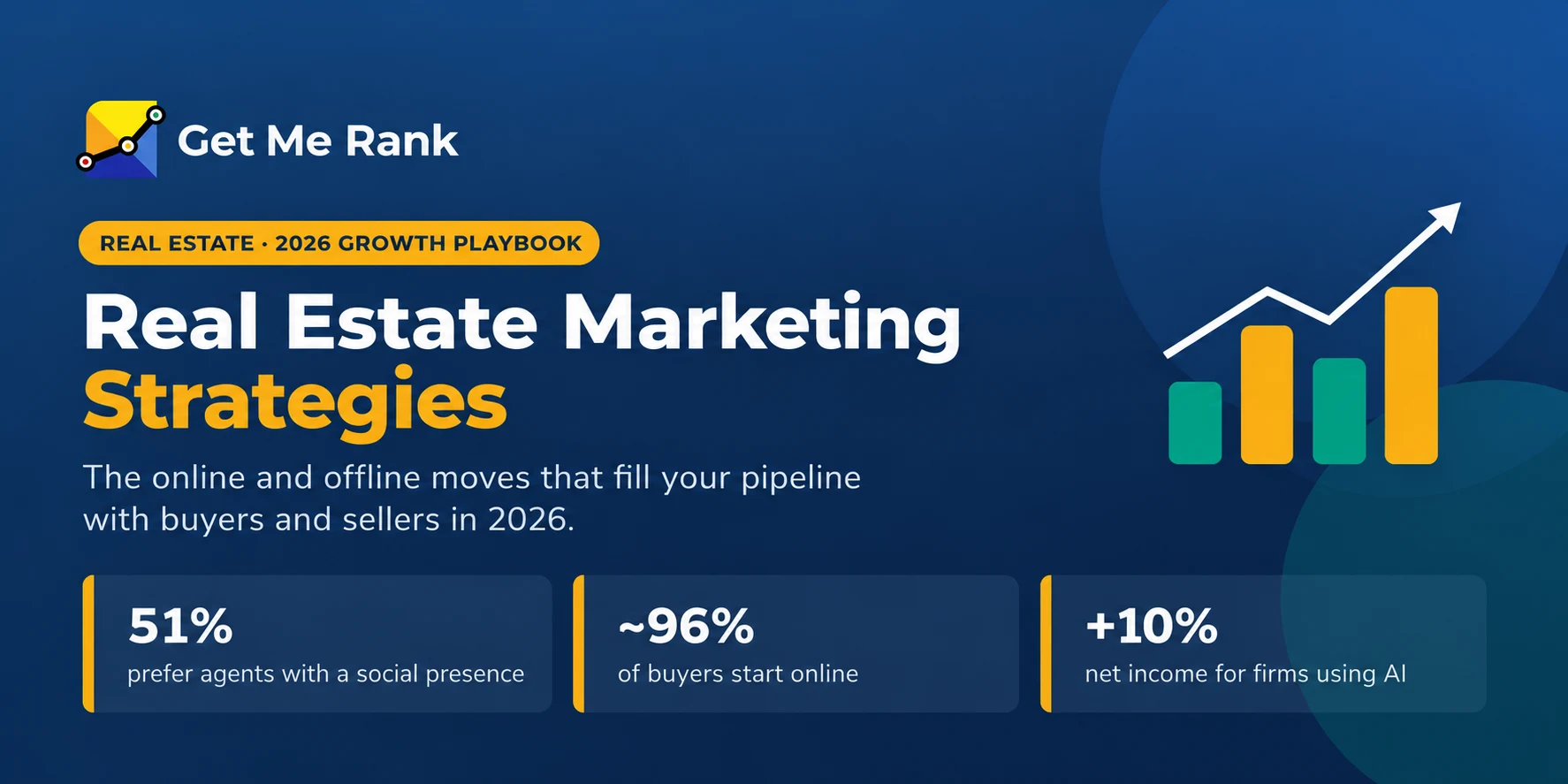
Around 96% of home buyers start their search online, and 51% of millennials say they’re more likely to hire an agent with an active social presence. Being easy to find and easy to trust online is now the price of entry.
What Is a Real Estate Marketing Strategy?
Short answer: They’re the deliberate plan behind how you attract and win clients — which channels you use, what you say, and how you follow up — rather than one-off tactics. Good strategy decides the “who, where, and why” first; the tactics (ads, Reels, postcards) are just how you execute it.
It helps to separate the two. A tactic is “post a Reel” or “send a postcard.” A strategy is “become the go-to agent for first-home buyers in this suburb by answering their questions everywhere they search.” The tactics flow from that. This is also why copying another agent’s real estate marketing ideas rarely works on its own — without the strategy underneath, you’re just borrowing their tools without their plan. In other words, learning how to market real estate starts with deciding who you serve, not with picking a channel.
Why Do Your Marketing Strategies Matter So Much in 2026?
Short answer: Because buyer behaviour has shifted online and toward AI. People research for weeks before they enquire, compare agents on social proof, and increasingly ask AI tools for recommendations. If your marketing isn’t visible and trustworthy across those touchpoints, you’re invisible at the exact moment buyers are choosing.
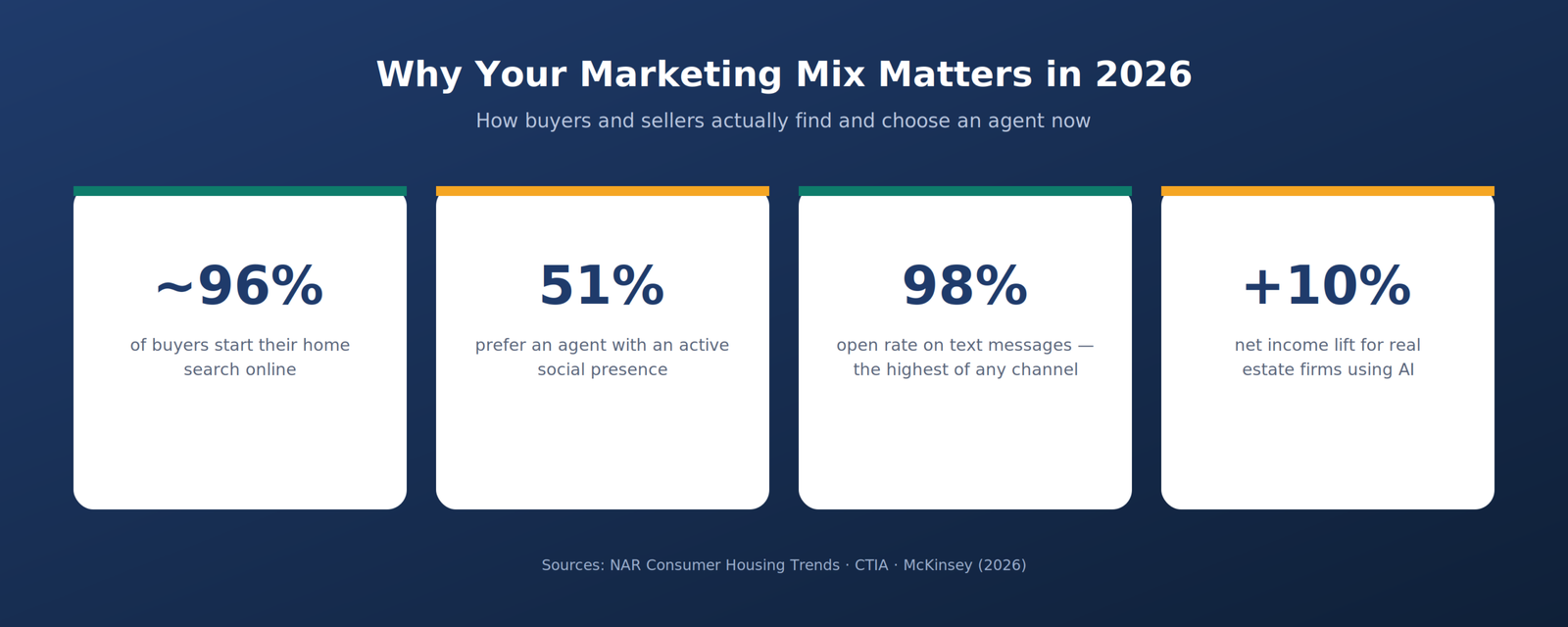
Two forces make this urgent. First, discovery has moved online — more sellers now find their agent through search and social than through a traditional referral. Second, AI is reshaping both sides: firms using it are lifting net income, and buyers are starting to ask assistants like ChatGPT where to look. Knowing how to market real estate in this environment means showing up in search, social, and AI answers — not just one of them.
The Real Estate Marketing Engine: A 6-Pillar Framework & Strategies
Before the individual tactics, here’s the system they fit into. Think of your marketing as six pillars, built in order — each one makes the next cheaper and easier.
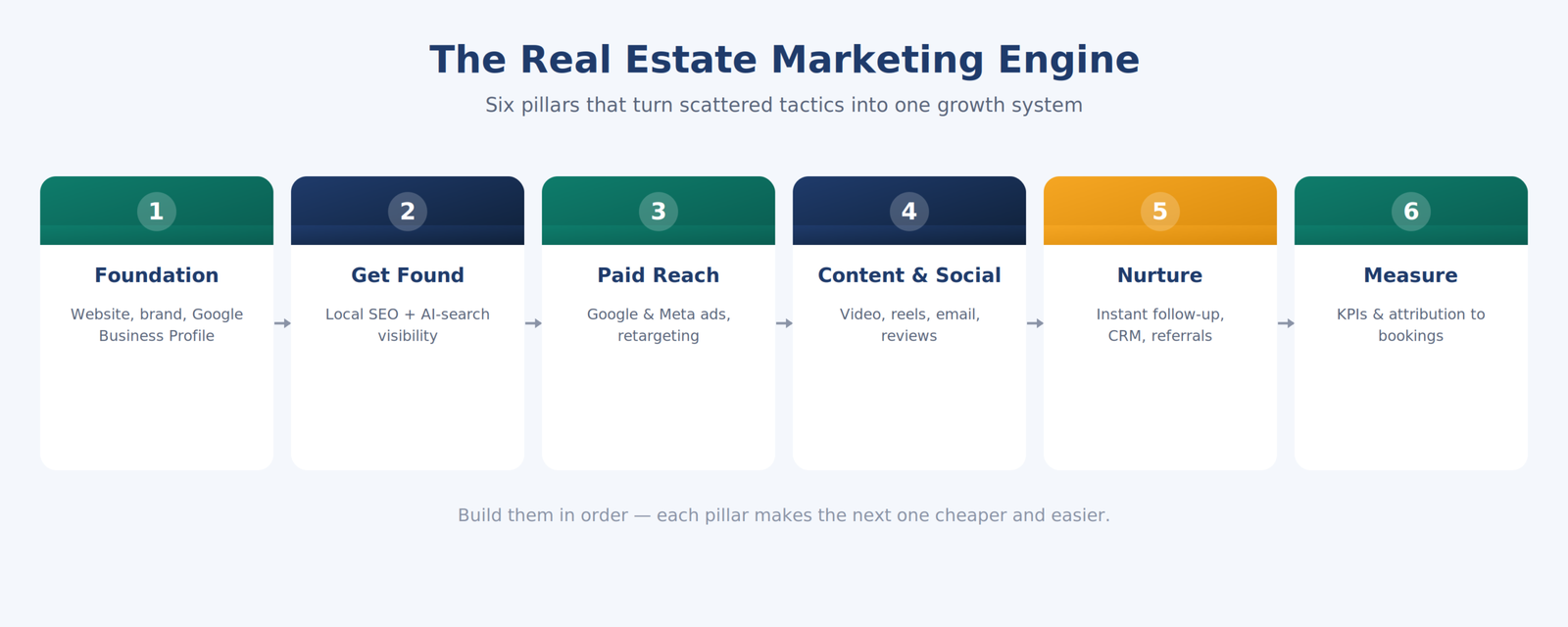
The rest of this guide follows these pillars from the ground up, so you always know what to fix first instead of chasing whatever tactic is trending this week.
The 12 Best Real Estate Marketing Strategies That Work
Short answer: Get found with local SEO, AI-search visibility, and educational content; reach buyers with Google and Meta ads plus retargeting; build trust with video, email, and reviews; and convert with instant follow-up, a CRM, and referrals. Pick a few from each group rather than trying all twelve at once.
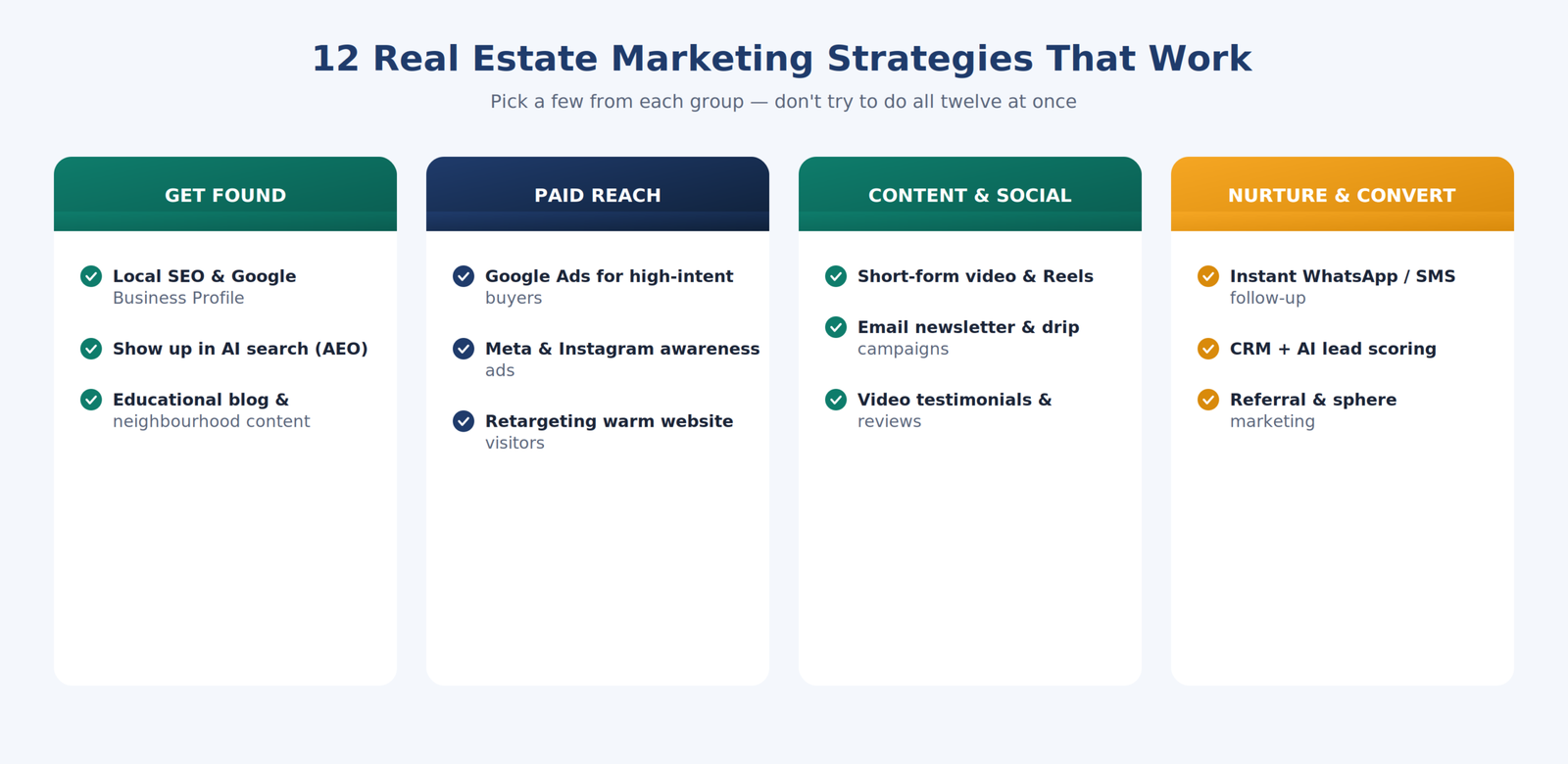
Get Found (Strategies 1–3)
These put you in front of buyers at the exact moment they’re searching — the top of every real estate funnel.
1. Local SEO & Google Business Profile
This is the highest-impact free channel there is. Optimising your site and SEO for real estate agents best practices, plus a complete, active Google Business Profile, lands you in the map pack and first-page results — where the vast majority of local property searches begin. A finished profile with steady reviews also earns far more clicks and calls than an empty one.
Example: an agent who targets “3 BHK in [suburb] ready to move” and posts weekly on their profile starts ranking above the big portals for that search, and books viewings straight from the listing — with zero ad spend.
2. Show Up in AI Search (AEO)
The newest high-impact play. Buyers increasingly ask ChatGPT, Gemini, and Google’s AI Overviews for a shortlist of agents or areas, and being the name they return is a lead your competitors never even see. Using AEO strategies for real estate — clear question-and-answer content, schema, and strong reviews — is how you get cited.
Example: a well-structured “best neighbourhoods in [city] for first-home buyers” guide gets your name surfaced when someone asks an AI that exact question, sending a pre-qualified lead your way.
3. Educational Blog & Neighbourhood Content
Content answers the questions buyers research for weeks before they ever enquire, which builds trust and compounds in search long after you hit publish. Unlike ads, it keeps working for free.
Example: a “cost of living and commute times in [suburb]” post quietly ranks and feeds a steady trickle of buyer enquiries every month, years after it went live.
Paid Reach (Strategies 4–6)
SEO compounds slowly; paid ads bring leads today. These three fill the pipeline while your organic presence grows.
4. Google Ads for High-Intent Buyers
The fastest route to leads. Well-run PPC for real estate captures people actively searching — “homes for sale in [city]” — at the exact moment of intent, which is why search leads typically convert several times better than social.
Example: a tightly-targeted search campaign on ready-possession keywords starts producing booking enquiries within days of going live, not months.
5. Meta & Instagram Awareness Ads
Where Google captures demand, Meta creates it — putting your brand in front of buyers who aren’t searching yet, cheaply, and filling the retargeting pool you’ll convert later. If you’re unsure where to weight your spend, our guide on real estate Facebook Ads vs Google Ads shows when each platform wins.
Example: a carousel of a new project shown to recently-engaged couples within a 10 km radius builds a warm, interested audience weeks before the formal launch.
6. Retargeting Warm Website Visitors
Most visitors don’t convert on the first visit, so retargeting re-engages them for a fraction of the cost of a cold click — usually the single highest-ROI slice of an ad budget.
Example: someone who viewed a listing but didn’t enquire sees a gentle “still interested?” ad two days later and comes back to book a site visit.
Content & Social (Strategies 7–9)
These earn attention and trust without paying for every click — the brand-building layer that makes every other channel cheaper.
7. Short-Form Video & Reels
Instagram and Facebook push short video to more people because it drives their ad revenue, so it’s the cheapest way to grow reach and put a human face to your brand. Consistency matters more than production value.
Example: a 30-second “which kitchen would you pick?” Reel using trending audio pulls hundreds of local views and a handful of direct messages from genuine buyers.
8. Email Newsletter & Drip Campaigns
Email keeps you top-of-mind with your sphere so referrals and repeat business come to you, and it’s consistently one of the highest-ROI channels in marketing. Lead with value — market updates and home-value news — not constant self-promotion.
Example: a monthly “what your home is worth now” update to past clients sparks a listing conversation every few sends, from people who weren’t actively planning to move.
9. Video Testimonials & Reviews
Social proof is what tips the undecided, and a video where buyers can see how happy a past client is does more to win trust than twenty text-only reviews.
Example: a 60-second clip of a delighted first-home buyer on your website noticeably lifts the rate at which new leads pick up the phone.
Nurture & Convert (Strategies 10–12)
Generating interest is only half the job — these three turn it into booked clients, and they’re where most agents leave money on the table.
10. Instant WhatsApp / SMS Follow-Up
Speed beats budget. Replying within five minutes can make a lead many times more likely to convert, and buyers now prefer to talk on WhatsApp. Automating that instant response is the backbone of real lead generation for real estate — it’s what separates a busy inbox from a full calendar.
Example: an auto-reply that books a call the second a form is submitted keeps the lead warm and interested while slower competitors are still asleep.
11. CRM + AI Lead Scoring
A CRM with AI scoring ranks your leads by intent so you work the hottest first and nothing slips through the cracks — and it can surface “cold” database contacts who are quietly ready to transact.
Example: AI flags a two-year-old contact whose property searches recently spiked; you call at the right moment, and it turns into a listing nobody else knew was coming.
12. Referral & Sphere Marketing
Still the best ROI in real estate: referred clients close at a far higher rate and cost almost nothing to acquire. The key is to ask — and to stay memorable between deals.
Example: a simple “who do you know thinking of moving?” ask after a smooth closing, paired with a thoughtful gift, keeps a steady stream of warm referrals coming for years.
PRO TIP
Text messages have about a 98% open rate — the highest of any channel. A short, personal video text that answers a buyer’s exact question will out-convert a dozen polished email blasts.
Online vs. Offline: Which Marketing Works Better?
Short answer: Neither alone — the strongest agents blend both. Online marketing (SEO, ads, social, email) gives you measurable scale and reaches buyers at the moment of intent. Offline marketing (open houses, referrals, handwritten notes) builds the deep local trust that drives word-of-mouth. Use digital to get found and offline to get remembered.
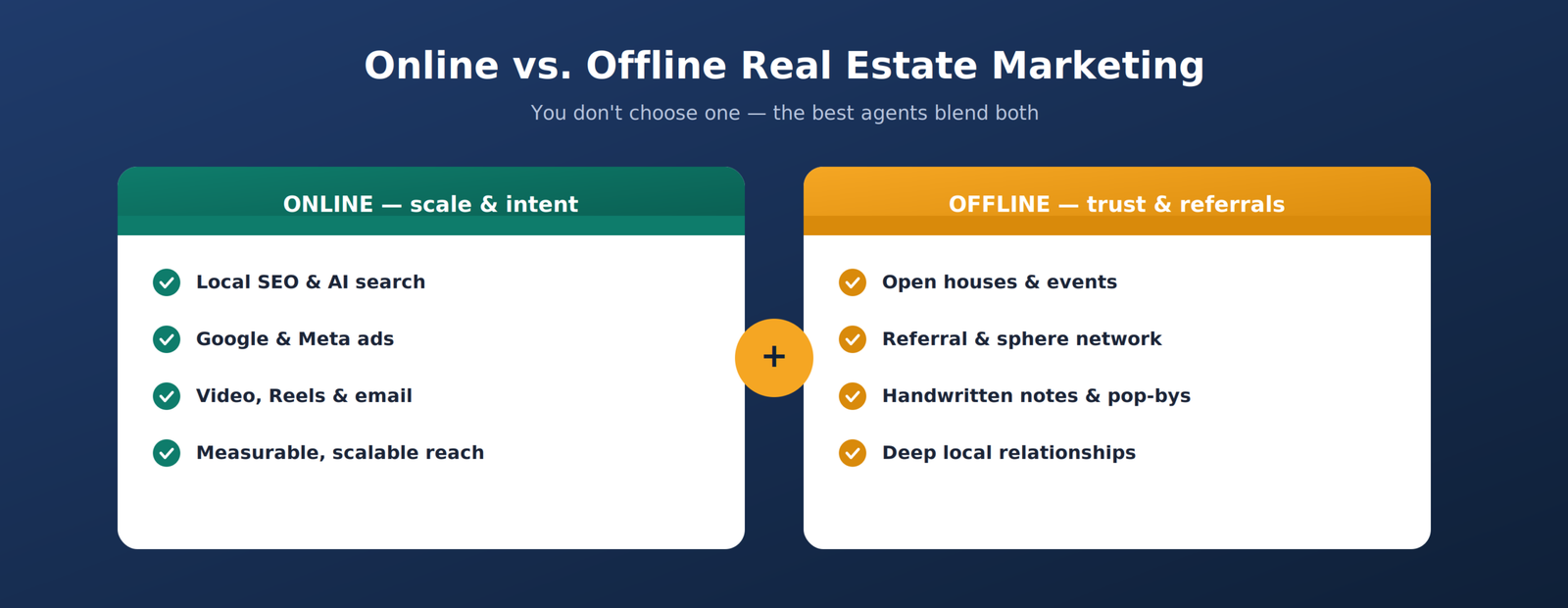
Here’s a simple way to split your effort. If you need leads and measurable reach, weight online. If you’re deepening relationships in a farm area where you’re already known, weight offline. The best online real estate marketing ideas feed the top of your funnel, while offline touches close and retain — together they cover the whole journey.
| Factor | Online Marketing | Offline Marketing |
|---|---|---|
| Reach | Wide & scalable | Local & limited |
| Cost control | Precise, measurable | Harder to track |
| Speed to leads | Fast (especially ads) | Slower, relationship-led |
| Trust built | Social proof & content | Deep, personal |
| Best for | Getting found & generating leads | Referrals & client retention |
How Do You Measure if Your Marketing Is Working?
Short answer: Track a handful of KPIs that tie to revenue — cost per lead, cost per qualified lead, lead-to-appointment rate, and cost per booking — rather than vanity numbers like likes and impressions. Review them regularly and shift budget toward whatever produces booked clients.
Marketing without measurement is just spending. Decide what a client is worth, track what each channel costs to produce one, and let the numbers guide your budget. Our deeper guide to Marketing KPIs for real estate walks through exactly which metrics to watch and the benchmarks to aim for, but the principle is simple: measure cost per booked client, not cost per click.
How to Build Your Real Estate Marketing Plan (5 Steps)
Short answer: Define your niche, set clear goals and a budget, choose a focused set of channels, launch and nurture consistently, then measure and scale the winners. Strategy first, tactics second — and start small rather than spreading yourself thin.
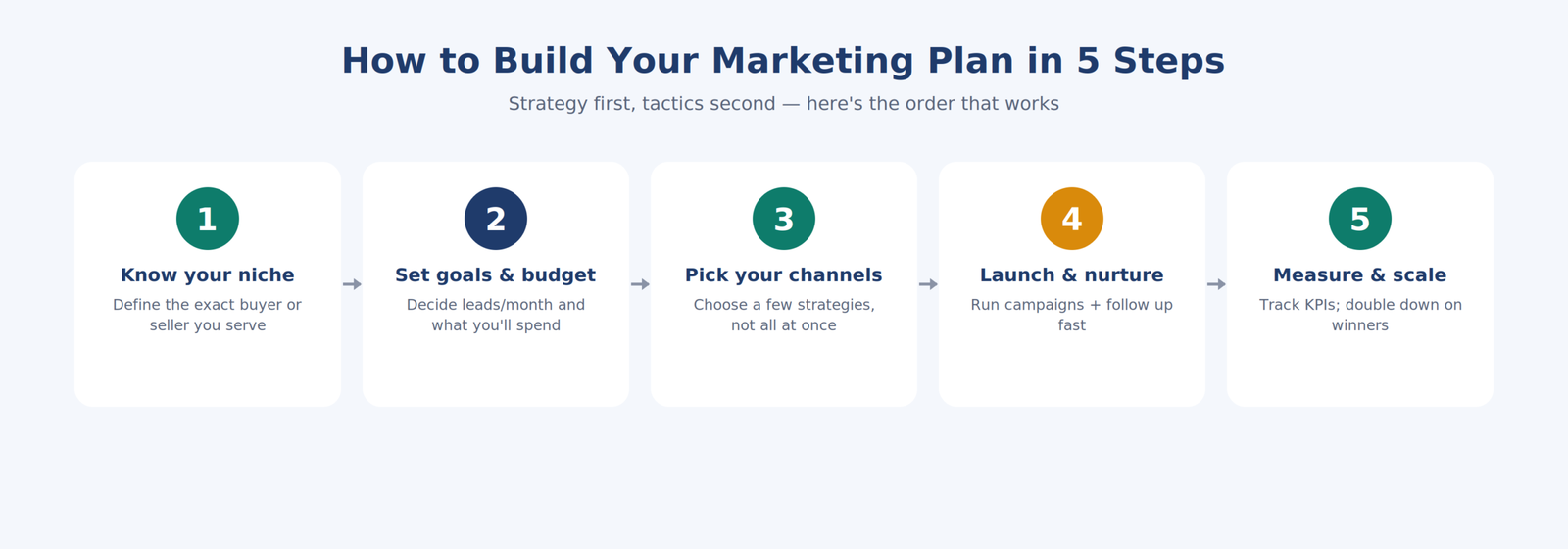
The biggest mistake is doing everything at once. Pick one or two strategies per pillar, run them long enough to get real data, and only then add more. Marketing is a long game; consistency beats intensity every time.
Common Real Estate Marketing Mistakes to Avoid
Most wasted marketing effort traces back to the same short list. Sidestep these and your results improve fast.
- Chasing tactics with no strategy. Random posts and ads without a plan rarely compound.
- Trying every channel at once. Spreading a small budget thin makes all of it ineffective.
- Ignoring your website and Google Business Profile. They’re the foundation buyers judge you on first.
- Being salesy instead of useful. Content that only promotes you gets ignored; content that helps gets shared.
- Slow follow-up. A lead answered next day is usually a lead lost.
- Not measuring anything. If you can’t see what’s working, you can’t scale it.
Where GetMeRank Fits in Your Real Estate Marketing
Knowing the strategies is the easy part; running them together, consistently, and measuring the result is where most teams get stuck. That’s exactly what we do. GetMeRank connects search, paid media, content, AI-driven lead nurture, and reporting into one engine, so your marketing stops being a pile of disconnected tactics and starts behaving like a system that grows your pipeline.
Because we treat every channel as part of one funnel, we can tie spend to booked deals rather than vanity clicks — the mindset behind true performance marketing for real estate. That’s the difference between marketing that feels busy and marketing that actually grows the business.
Build a Marketing System That Actually Grows Your Business
The agents and developers who win aren’t chasing the newest trick — they’ve built a simple, measurable system and kept at it. Start with your foundation, get found, add paid reach and content, nurture every lead fast, and measure what matters. If you’d rather have that whole engine built and run for you, our team is ready to help.
FAQs About Marketing Strategies for Real Estate Agents
Conclusion
The most effective real estate marketing strategies aren’t about doing more — they’re about building a connected system and running it with discipline. Get your foundation right, become easy to find in search and social, reach buyers with smart paid campaigns, earn trust with useful content, answer every lead fast, and measure what actually produces bookings. Do that consistently and your marketing stops feeling like guesswork and starts feeling like a growth engine.