AI Marketing
By the GetMeRank Performance Team · Updated 2026
Quick Summary: AI analytics combines artificial intelligence, machine learning, automation, and marketing data to help businesses identify patterns, understand customer behaviour, measure campaign performance, and make faster decisions. In digital marketing, it can be used for traffic analysis, conversion tracking, customer segmentation, attribution, forecasting, campaign optimization, and identifying unusual changes in performance. The key is not simply using AI tools, but connecting reliable data with clear business goals and human decision-making.
What Is AI Analytics in Digital Marketing?
AI analytics in digital marketing refers to the use of artificial intelligence and machine learning to analyse marketing data, identify patterns, generate insights, and support business decisions. Instead of relying only on manually created reports, marketers can use AI-powered analytics to process large volumes of information and identify trends that may be difficult to spot through traditional analysis.
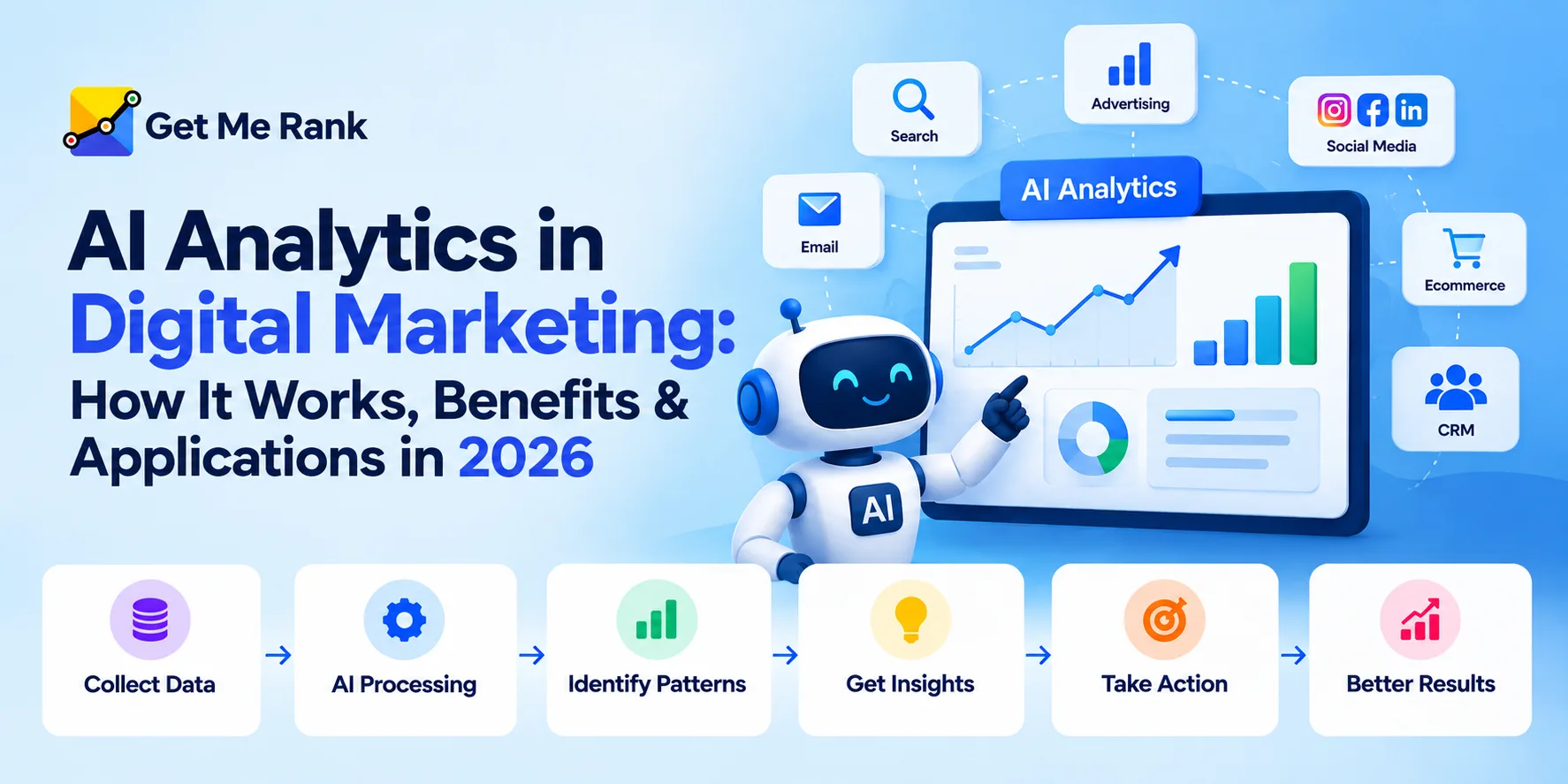
Digital marketing produces data from many sources, including websites, search engines, advertising platforms, social media, email campaigns, CRM systems, ecommerce platforms, and customer interactions. AI analytics can bring these signals together and help marketers understand what is happening, why it may be happening, and what action should be considered next.
KEY INSIGHT
AI analytics does not replace marketing strategy. It helps marketers turn large amounts of data into more usable insights so that people can make better-informed decisions.
Traditional Analytics vs. AI Analytics
| Traditional Analytics | AI Analytics |
|---|---|
| Often relies on predefined reports | Can identify patterns and generate insights from large datasets |
| More manual analysis | More automated analysis and anomaly detection |
| Primarily explains what happened | Can help identify drivers, patterns and potential next actions |
| Limited by the reports created | Can analyse relationships across multiple dimensions |
How Does AI Analytics Work?
AI analytics generally works by collecting data, processing it, identifying relationships or patterns, and presenting the resulting insights in a way marketers can use. The exact process depends on the platform, data sources, model, and business objective.
AI Analytics for Digital Marketing: Applications, Benefits & Best Practices
1. Data Collection
Data is collected from sources such as analytics platforms, advertising accounts, CRM systems, ecommerce platforms, search tools and customer interactions.
2. Data Processing
The data is cleaned, organized and analysed so that different signals can be compared consistently.
3. Pattern Detection
Machine learning models can identify trends, relationships, unusual changes and recurring patterns.
4. Insight Generation
The system presents findings through dashboards, alerts, summaries, forecasts or recommendations.
For example, if website conversions suddenly decline, an AI analytics system may help identify that the change is concentrated in a particular traffic source, landing page, device category, campaign or period. The marketer can then investigate the underlying cause instead of manually checking every report.
Why AI Analytics Matters for Digital Marketing
Digital marketing decisions are increasingly based on data. However, having more data does not automatically make decision-making easier. Marketers may have thousands of keywords, campaigns, landing pages, audience segments, events and customer interactions to analyse.
AI analytics helps reduce the manual effort involved in analysing this information. It can bring attention to important changes, group similar patterns, identify potential relationships and make complex datasets easier to interpret.
GETMERANK TIP
Do not start with the question, “What can AI analyse?” Start with, “What marketing decision do we need to make?” The second question usually leads to more useful analytics.
Key Applications of AI Analytics in Digital Marketing
1. Website and Traffic Analysis
AI analytics can help marketers understand how visitors reach and interact with a website. Instead of reviewing traffic numbers in isolation, marketers can analyse acquisition sources, landing pages, engagement, device types, user journeys and conversion behaviour together.
2. Customer Segmentation
AI can help identify groups of users with similar behaviours. For example, one segment may frequently visit product pages but rarely purchase, while another may return through email and have a higher purchase rate. These patterns can help marketers create more relevant campaigns and customer journeys.
3. Conversion Analysis
Conversion analysis is one of the most useful applications of AI analytics. It can help marketers identify where users drop out of a funnel, which pages are associated with successful journeys, and which campaign or audience characteristics correlate with conversions.
4. Predictive Analytics
Predictive analytics uses historical and current data to estimate what may happen next. In marketing, it can support demand forecasting, customer churn analysis, lead scoring, sales forecasting and campaign planning.
Predictions should be treated as estimates rather than guaranteed outcomes. Their usefulness depends heavily on data quality, model design and whether market conditions remain similar to the patterns represented in the historical data.
5. Anomaly Detection
A sudden drop in organic traffic, unusual advertising spend, a spike in conversions or a change in engagement can indicate an important event. AI-powered anomaly detection can bring these changes to a marketer’s attention faster than a manual reporting process.
6. Marketing Attribution
Customers often interact with multiple marketing channels before completing an important action. AI and machine learning can support attribution models that analyse these touchpoints and distribute credit based on their estimated contribution.
7. Campaign Performance Optimization
AI analytics can compare campaigns across metrics such as cost, clicks, conversions, revenue, engagement and customer value. This can help marketing teams identify where performance is changing and where additional investigation may be useful.
8. AI Search and Referral Analysis
As users increasingly interact with AI assistants, marketers also need to understand whether these sources are sending visitors to their websites. Analytics platforms are beginning to provide dedicated ways to identify and analyse traffic from AI assistants, making AI-driven discovery another source marketers can include in their reporting.
Important Metrics to Track With AI Analytics
AI analytics is most useful when it is connected to meaningful business metrics. Tracking every available metric can create more noise instead of better decisions.
| Metric | What It Helps Measure |
|---|---|
| Traffic | How many users or sessions different channels generate |
| Engagement | How users interact with website content and experiences |
| Conversion Rate | The percentage of users completing a defined action |
| Cost Per Acquisition | The cost associated with acquiring a customer or lead |
| Return on Ad Spend | Revenue generated relative to advertising spend |
| Customer Lifetime Value | The estimated value generated by a customer over the relationship |
| Revenue | Business revenue associated with marketing activity |
PRO TIP
Separate business KPIs from diagnostic metrics. Revenue and qualified leads may be business KPIs, while impressions, clicks and engagement metrics can help explain why those outcomes changed.
Benefits of AI Analytics in Digital Marketing
Faster Analysis
Automated analysis can reduce the amount of time marketers spend manually reviewing large datasets.
Better Pattern Recognition
AI can analyse many variables simultaneously and highlight relationships that deserve investigation.
Faster Response
Automated alerts and anomaly detection can help teams react more quickly when performance changes.
More Scalable Reporting
Large marketing operations can analyse multiple channels and datasets without creating every report manually.
Challenges and Limitations of AI Analytics
AI analytics can improve marketing analysis, but it does not remove the need for good data, sound measurement and human judgment.
Poor Data Quality
If tracking is incomplete, duplicate events exist, campaign parameters are inconsistent or conversion data is incorrect, AI analysis can produce misleading insights. Better algorithms cannot compensate for fundamentally unreliable input data.
Privacy and Data Governance
Marketing teams need clear rules for what data is collected, how it is stored, who can access it and how it is used. Consent requirements, platform policies and regional privacy regulations should be considered when designing analytics processes.
False Correlations
A relationship between two metrics does not automatically mean that one caused the other. Marketers should investigate context, test important assumptions and avoid treating every AI-generated insight as a proven explanation.
Over-Reliance on Automation
Automation can make analysis faster, but marketers still need to understand the business context. An algorithm may detect that conversions dropped, while the marketing team may need to investigate a website change, pricing update, seasonal trend, tracking issue or external event.
How to Implement AI Analytics in Digital Marketing?
Businesses do not need to transform their entire analytics operation overnight. A structured implementation can start with a small number of business questions and gradually expand.
Step 1: Define Business Goals
Identify the decisions you want analytics to support. These may include improving lead generation, reducing acquisition costs, increasing ecommerce revenue, improving retention or understanding marketing channel performance.
Step 2: Audit Your Data
Review analytics tracking, events, conversions, campaign parameters, CRM data, advertising data and other important sources. Fix obvious data-quality problems before introducing more automation.
Step 3: Connect Relevant Data Sources
Bring together the sources required to answer your marketing questions. Depending on the business, this could include website analytics, search data, paid media, CRM, ecommerce and customer-support information.
Step 4: Select Useful AI Capabilities
Choose capabilities based on the problem. For example, anomaly detection may help with performance monitoring, segmentation may help with audience analysis, while predictive models may support forecasting.
Step 5: Validate the Insights
Compare AI-generated findings against your existing reports and business knowledge. Investigate important changes before taking action.
Step 6: Turn Insights Into Actions
The final goal is not another dashboard. Use the findings to guide practical actions such as improving landing pages, adjusting campaigns, fixing tracking, testing new audiences or reviewing budget allocation.
DID YOU KNOW?
Modern analytics platforms increasingly combine automated insights, machine learning, attribution analysis and conversational interfaces. This means marketers can spend less time locating information and more time interpreting it.
Best Practices for Using AI Analytics
| Best Practice | Why It Matters |
|---|---|
| Start with a business question | Keeps analytics focused on decisions rather than data for its own sake |
| Maintain clean tracking | Improves the reliability of the insights produced from the data |
| Use consistent naming | Makes campaigns and traffic sources easier to compare |
| Review AI findings | Helps prevent incorrect assumptions or misleading conclusions |
| Protect customer data | Supports responsible analytics and privacy practices |
| Measure business outcomes | Connects marketing activity with meaningful results |
The Future of AI Analytics in Digital Marketing
AI analytics is moving from simple reporting toward more interactive and decision-support-oriented experiences. Marketers are increasingly able to ask questions in natural language, receive automated summaries, identify unusual performance changes and analyse customer journeys across multiple channels.
Another important development is the measurement of AI-driven traffic. As users interact with AI assistants during their research process, businesses need ways to understand whether those interactions lead to website visits, engagement and conversions.
The future of marketing analytics is therefore likely to involve a combination of automated analysis, predictive modelling, cross-channel measurement, conversational analytics and human oversight. The businesses that benefit most will be those that combine these capabilities with reliable data and clear marketing objectives.
Short Answer:
AI analytics can make digital marketing analysis faster and more scalable, but its value depends on the quality of the underlying data and the decisions it supports. The goal should be to use AI to identify meaningful insights, validate those insights with business context, and turn them into measurable marketing actions.
Frequently Asked Questions
What is AI analytics in digital marketing?
AI analytics is the use of artificial intelligence and machine learning to analyse marketing data, identify patterns, detect changes, support predictions and generate insights that can help marketers make data-informed decisions.
How is AI used in marketing analytics?
AI can be used for customer segmentation, anomaly detection, predictive analytics, conversion analysis, attribution, campaign performance analysis, forecasting and identifying patterns across marketing channels.
Can AI analytics improve marketing ROI?
AI analytics can support better marketing decisions by helping teams identify performance patterns, understand customer journeys and evaluate campaign efficiency. However, improved ROI is not automatic and depends on data quality, strategy, execution and the actions taken from the insights.
Is AI analytics the same as Google Analytics?
No. Google Analytics is an analytics platform, while AI analytics describes the use of artificial intelligence and machine learning techniques to analyse data and generate insights. Modern analytics platforms can include AI-powered features, but AI analytics can also involve other platforms and data sources.
What data is needed for AI marketing analytics?
The required data depends on the business objective. Common sources include website analytics, advertising data, search data, CRM records, ecommerce transactions, customer interactions and campaign data. The data should be accurate, consistently structured and collected responsibly.
Will AI replace digital marketing analysts?
AI can automate parts of data analysis and reporting, but marketing analysts still provide important business context, strategic thinking, validation and decision-making. AI is most useful when it supports analysts rather than being treated as a replacement for human judgment.
Turn Marketing Data Into Better Decisions
Want to understand where your marketing performance is improving, where it is falling, and which data points deserve attention? Get Me Rank can help you build a data-driven digital marketing strategy based on measurable business outcomes.