SEO
Summary: Improving your Google ranking in 2026 requires a combination of relevant content, strong on-page SEO, a technically sound website, quality backlinks, and an optimized Google Business Profile for local businesses. Search intent, crawlability, page experience, content quality, and consistent SEO efforts all contribute to long-term visibility. There is no single tactic that guarantees higher rankings — sustainable results come from fixing technical issues, creating useful content, building authority, and regularly monitoring performance.
Key Takeaways
- Google ranking depends on relevance, authority, and user experience working together, not any one factor alone.
- On-page basics like title tags, headers, and content structure still matter more than most people expect.
- Technical SEO issues like slow load times or blocked pages can undo good content work.
- Backlinks from relevant, trustworthy sites remain one of the strongest ranking signals.
- Local businesses need a separate, deliberate strategy for Google Business Profile; it doesn’t rank automatically just because your website does.
- Consistency matters more than intensity. Small ongoing improvements beat one-time overhauls.
What Actually Determines Your Google Ranking?
Google’s ranking system comes down to matching the best possible result to what someone typed into the search bar. In practice, that means Google is weighing a few things at once.
Relevance asks whether your page actually answers the search query, not just whether it contains the right words. Authority looks at whether other trustworthy sites vouch for yours through links and mentions. User experience covers whether people who click through actually stay, read, and find what they need, or bounce straight back to the results page.
Google also applies what it calls E-E-A-T, which stands for Experience, Expertise, Authoritativeness, and Trustworthiness. This matters most for topics where inaccurate information could genuinely harm someone, like health or financial advice, but it influences how Google evaluates content quality across the board. If you want a deeper breakdown of how this actually affects rankings, we’ve covered it in detail in our guide to Google E-E-A-T.
Google Ranking Optimization To Boost Organic And Local Business Visibility
KEY INSIGHT
Google ranking isn’t driven by one isolated factor. Relevance, authority, technical accessibility, and user experience work together, so improving only one area may not solve a ranking problem caused by another.
Google Ranking Factors
Key areas that can influence your website’s search visibility
📝
Content Quality
Create useful, relevant content that directly answers what users are searching for.
🔎
Search Intent
Match your content with the reason behind the user’s search query.
⚙️
Technical SEO
Keep your website crawlable, indexable, secure, and technically healthy.
🔗
Backlinks
Earn relevant, trustworthy links that help establish your site’s authority.
📱
Page Experience
Provide a fast, mobile-friendly website that is easy for visitors to use.
📍
Local SEO
For local businesses, optimize your Google Business Profile and local signals.
Key point: Google rankings are influenced by multiple factors. Focus on the overall quality, relevance, technical health, and authority of your website rather than relying on one tactic.
How Do You Increase Your Google Ranking Through On-Page SEO?
On-page SEO is the part of ranking you have the most direct control over, since it lives entirely on your own website.
Start with title tags and meta descriptions. Your title tag should clearly describe the page in under 60 characters, with your main keyword included naturally rather than forced in. Your meta description doesn’t directly boost rankings, but a compelling one increases the odds someone clicks your result over a competitor’s.
Headers matter more than most site owners realize. Using H1 for your main title and H2s and H3s to break content into logical sections helps both readers scan the page and helps Google understand what each section covers. Skipping straight from an H1 to an H4, for example, makes the structure harder for search engines to parse.
URLs should be short, readable, and include your target keyword where it fits naturally. A URL like “/increase-google-ranking” tells both users and Google what the page is about before they even click.
Here’s a practical example. If you’re writing about local bakery marketing, a weak title tag reads “Home – Best Bakery,” while a strong one reads “Best Bakery in Austin | Fresh Bread Daily.” The second version tells searchers and Google exactly what the page offers.
GET ME RANK TIP
Prioritize pages that already have search visibility. Check Google Search Console for pages receiving impressions but limited clicks, then review their titles, content alignment, headings, and search intent before creating entirely new pages.
How Does Technical SEO Affect Your Google Ranking?
You can write the best content in your industry and still rank poorly if Google can’t crawl your site efficiently or if visitors leave before the page finishes loading.
- Site speed is a direct ranking factor and a direct user experience factor. Google measures this specifically through Core Web Vitals, three metrics covering how fast your main content loads, how quickly the page responds to interaction, and how much the layout shifts while loading. Compressing images, enabling browser caching, and choosing reliable hosting all contribute to faster load times and better Core Web Vitals scores. A page that takes five seconds to load will lose a meaningful share of visitors before they see any of your content, and you can check your own scores for free using Google’s PageSpeed Insights tool.
- Mobile-friendliness isn’t optional anymore. Google indexes the mobile version of your site by default, so if your mobile experience is cramped or slow, that’s the version being evaluated, regardless of how polished your desktop site looks.
- Crawlability covers the behind-the-scenes basics: making sure your robots.txt file isn’t accidentally blocking important pages, submitting an updated sitemap through Google Search Console, and fixing broken internal links that waste crawl budget.
- Structured data (schema markup) helps Google understand exactly what type of content is on a page, whether that’s an article, a product, or an FAQ. It doesn’t guarantee better rankings, but it can earn rich results like star ratings or FAQ dropdowns in search results, which increase click-through rates.
GET ME RANK TIP
Check technical issues before publishing more content. Review indexability, robots.txt, XML sitemap, canonical tags, broken links, mobile usability, and Core Web Vitals before investing heavily in additional content.
What Kind of Content Helps You Rank Higher on Google?
Content is where most ranking potential is either built or lost. Google’s systems are built to reward content that genuinely helps the person searching, not content that’s simply optimized around a keyword.
The content that performs best tends to share a few traits. It’s specific rather than generic, answering the exact question someone searched instead of circling the topic broadly. It’s backed by real expertise or experience, which is easier to demonstrate with concrete examples, data, or firsthand detail than with general statements. And it’s structured for scanning, using short paragraphs, clear headers, and bullet points where they genuinely help rather than as filler.
A practical tip that’s easy to overlook: your main keyword only needs to show up in a few key places, your title, the opening paragraph, and maybe one header, to do its job. After that, let the language shift naturally. If someone’s searching to increase their Google ranking, they’re just as likely to phrase it as improving their search visibility or getting their site to rank higher, and writing with that variety reads like something a person actually wrote, not a page built around repeating one phrase.
KEY INSIGHT
Search intent should guide content before keyword density does. A page that clearly satisfies the reason behind a search can be more useful than one that repeatedly uses the exact target keyword.
How Do Backlinks Improve Your Google Ranking?
A backlink is essentially one website vouching for another. When a trustworthy site links to yours, Google treats that as a signal that your content is worth surfacing.
Not all backlinks carry equal weight. A link from a well-established site in your industry matters far more than dozens of links from low-quality or unrelated sites, and in some cases, low-quality backlinks can actively hurt your rankings rather than help them.
Realistic ways to earn backlinks include writing guest posts for relevant industry publications, creating original research or data that other sites want to cite, and reaching out when you notice broken links on other sites where your content could be a natural replacement. What doesn’t work anymore, and can actively get a site penalized, is buying links in bulk or joining link exchange schemes.
GET ME RANK TIP
Focus on relevance before backlink volume. A smaller number of relevant, trustworthy links can be more useful than a large number of links from unrelated or low-quality websites. Review referring domains regularly and prioritize quality over quantity.
How Do You Rank Higher on Google My Business (Local SEO)?
If you run a business with a physical location or a defined service area, your Google Business Profile (GBP) operates on a separate set of ranking factors from your website. Google renamed Google My Business to Google Business Profile back in 2021, though the older name is still what most people type into the search bar, which is why both terms show up throughout this guide. Showing up in the Local Pack, the three businesses highlighted at the top of local search results, requires its own deliberate strategy, which is exactly what our Local SEO Services team handles for clients who don’t have the bandwidth to manage it in-house.
At Get Me Rank, one of the most common patterns we see with new local clients is a GBP listing that’s been claimed but never actually optimized, missing categories, inconsistent NAP details, and zero recent posts or photos. In several cases, simply cleaning up those basics and staying consistent with weekly posts moved a client into the Local Pack within six to eight weeks, without a single change to the website itself.
- Claim and verify your profile first. An unverified listing won’t appear in Google Maps or the Local Pack at all, which makes this the foundational step before anything else matters.
- Keep your information exact and consistent. Your business name, address, and phone number (commonly abbreviated as NAP) need to match exactly across your website, your GBP listing, and any other directories you’re listed in.
- Build consistent citations beyond Google. Listing your business accurately on directories like Yelp, Bing Places, and Apple Maps reinforces the same NAP consistency Google is checking for.
- Choose your categories carefully. Google uses your primary and secondary categories to match your listing with relevant searches.
- Add real photos regularly. Listings with current, high-quality photos of the storefront, team, and products consistently get more engagement than listings with stock images or outdated photos.
- Post updates and respond to reviews. Regular posts signal that your business is active, and responding to reviews, both positive and negative, is one of the strongest trust signals available on a GBP listing.
- Check your Performance data. GBP’s built-in analytics, called Performance (formerly known as Insights), show which search terms are triggering your listing and how customers are engaging with it.
KEY INSIGHT
Local SEO and organic SEO support each other, but they require different optimization work. A strong website does not remove the need to maintain an accurate and active Google Business Profile.
Organic SEO vs Local SEO: Where to Focus First
| Factor | Organic (Website) SEO | Local SEO (Google Business Profile) |
|---|---|---|
| Primary goal | Rank in general search results | Rank in Local Pack and Google Maps |
| Key signals | Content quality, backlinks, technical SEO | NAP consistency, reviews, categories |
| Best for | Businesses targeting broad or online-only audiences | Businesses with a physical location or service area |
| Time to see results | Typically 3 to 6 months for competitive terms | Often faster, sometimes 4 to 8 weeks with an optimized profile |
| Ongoing effort | Content updates, link building, technical maintenance | Regular posts, review responses, photo updates |
Most local businesses need both working together rather than choosing one over the other. Your website builds long-term authority, while your GBP listing captures the immediate, high-intent searches happening right in your area.
GET ME RANK TIP
Keep your website and GBP information consistent. Make sure your business name, address, phone number, services, and other important business details are accurate and consistent wherever customers can find them.
Common Mistakes That Hurt Your Google Ranking
Failing to optimize for mobile devices, ignoring page speed, and stuffing keywords unnaturally into content are some of the most common mistakes that quietly hurt a site’s Google ranking.
Technical SEO Errors
- Slow page speed: Pages that take too long to load cause visitors to leave before the content even renders, which signals to Google that the page isn’t delivering a good experience.
- Broken links: Internal or external links that lead to 404 errors or dead pages disrupt the user experience and suggest the site isn’t well maintained.
- Ignoring mobile optimization: Google evaluates the mobile version of a site by default, so a cramped or slow mobile experience directly lowers ranking potential.
- Accidentally blocking pages: A misconfigured robots.txt file or a stray noindex tag can keep important pages out of Google’s index entirely.
Content and Keyword Mistakes
- Keyword stuffing: Repeating a target phrase unnaturally throughout a page makes content harder to read, and Google’s spam-detection systems are built to automatically demote pages that read this way.
- Duplicate content: Reusing the same or near-identical text across multiple pages confuses search engines about which version to rank.
- Ignoring search intent: Targeting keywords that don’t match what the audience is actually looking for brings in low-quality traffic and high bounce rates.
- Neglecting on-page tags: Missing title tags, meta descriptions, and image alt text make it harder for search engines and readers to understand what a page is about.
- Publishing thin content: Pages that only partially answer a search query tend to get outranked by competitors covering the topic more completely.
Off-Page and Local SEO Mistakes
- Buying backlinks: Paid or bulk link schemes violate Google’s guidelines and can lead to a manual penalty.
- Inconsistent NAP details: A business name, address, or phone number that doesn’t match across the website, Google Business Profile, and directory listings weakens local trust signals.
- Ignoring customer reviews: Never responding to reviews, especially negative ones, signals disengagement and can contribute to local ranking drops.
- Treating Google Business Profile as a one-time setup: A listing that’s claimed and never touched again loses ground to competitors actively posting updates, adding photos, and collecting new reviews.
KEY INSIGHT
Fixing technical and content issues together is important because strong content cannot perform properly if search engines cannot crawl, index, or understand the page.
How to Build a Ranking Strategy Step by Step
- Audit where you stand. Check your current rankings, site speed, and mobile performance before making changes, so you know what’s actually broken.
- Fix technical issues first. Crawl errors, slow load times, and broken links undermine every other effort until they’re resolved.
- Optimize your highest-priority pages. Start with the pages tied most directly to revenue or leads, not every page on the site at once.
- Claim and fully complete your Google Business Profile if you have a local presence, since this often shows results faster than organic content work.
- Build a consistent content and backlink cadence. One well-researched piece a month with genuine outreach beats ten rushed posts with no promotion behind them.
GET ME RANK TIP
Don’t make too many SEO changes at once. Fix one group of issues, monitor the results, and then move to the next priority. This makes it easier to understand which changes are actually affecting performance.
How Get Me Rank Can Help With Your Google Ranking
If you’re managing this across multiple client sites or a growing agency workload, Get Me Rank’s
White Label SEO Services
can help you deliver consistent technical, content, and local SEO improvements without building out an entire in-house team. The same fundamentals covered in this guide, on-page fixes, technical audits, content strategy, and local SEO, are handled end to end, so you get the results without managing every moving piece yourself.
How Do You Track Whether Your Google Ranking Is Actually Improving?
Making changes is only half the process, you also need a way to confirm they’re working. Two free tools cover most of what you need.
- Google Search Console shows the actual search queries your website ranks for, along with impressions, clicks, and average position for each one. It’s the most direct way to see whether your on-page and technical SEO work is translating into real visibility, and it flags crawl errors or indexing issues before they quietly hurt your rankings.
- Google Business Profile Performance does the same job for your local listing, showing which searches triggered your profile, how many people called or requested directions, and how your visibility trends over time.
Check both roughly once a month rather than daily. Rankings fluctuate constantly in the short term, and reacting to every small dip usually leads to unnecessary changes rather than real improvement.
KEY INSIGHT
SEO performance should be measured using multiple signals. Rankings alone don’t tell the full story; also review impressions, clicks, organic traffic, conversions, indexing health, and local actions where relevant.
GET ME RANK TIP
Use Google Search Console to identify pages with high impressions but low clicks. Review the title, search intent, content relevance, and SERP presentation before deciding whether the page needs a larger content update.
Frequently Asked Questions
1. How do you increase your Google ranking?
You increase your Google ranking by improving on-page SEO, fixing technical issues, earning quality backlinks, and publishing content that directly answers what your audience is searching for. For local businesses, an optimized Google Business Profile is equally important alongside the website itself.
2. How long does it take to improve Google ranking?
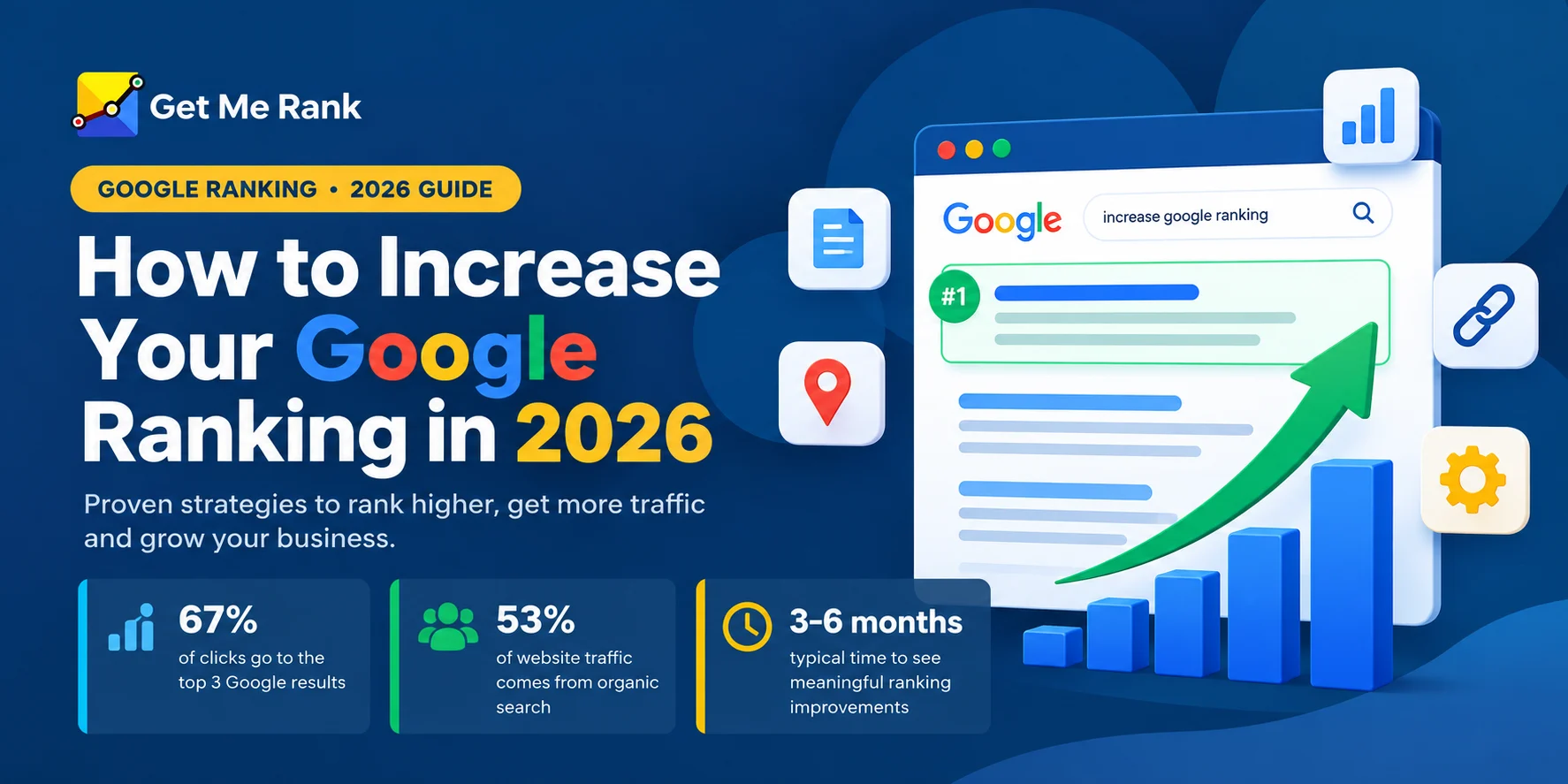
Organic ranking improvements typically take 3 to 6 months to show measurable movement for competitive keywords, while Google Business Profile changes can produce visible results in as little as 4 to 8 weeks once the profile is fully optimized and actively maintained.
3. How do you rank higher on Google My Business?
Ranking higher on Google My Business depends on claiming and verifying your listing, keeping your business information consistent everywhere it appears, choosing accurate categories, and actively collecting and responding to customer reviews.
4. Is Google ranking a one-time fix or an ongoing process?
It’s ongoing. Google’s ranking factors and competitor content both change over time, so pages and profiles that rank well need regular updates rather than a single round of optimization.
5. Does having a website help your Google Business Profile ranking?
Yes, a well-optimized website reinforces your GBP listing by providing consistent business information and demonstrating relevance and authority, both of which factor into how Google evaluates the overall trustworthiness of your business.
6. Can AI tools help improve Google ranking?
AI tools can speed up keyword research, content briefs, and technical audits, but they can’t replace the strategic decisions and genuine expertise needed to create content that actually earns rankings and trust over time.
Conclusion
Increasing your Google ranking isn’t about chasing a single tactic, it’s about consistently getting the fundamentals right: content that answers real questions, a technically sound website, credible backlinks, and, for local businesses, a well-maintained Google Business Profile. None of these pieces work in isolation, and skipping one usually means the others can’t fully deliver results either.
Start with whichever area is weakest for your business right now, whether that’s a slow website, thin content, or a neglected GBP listing, and build from there. Rankings move gradually, but businesses that stay consistent with these fundamentals are the ones that hold their positions long after a one-time optimization push would have faded.