Uncategorized
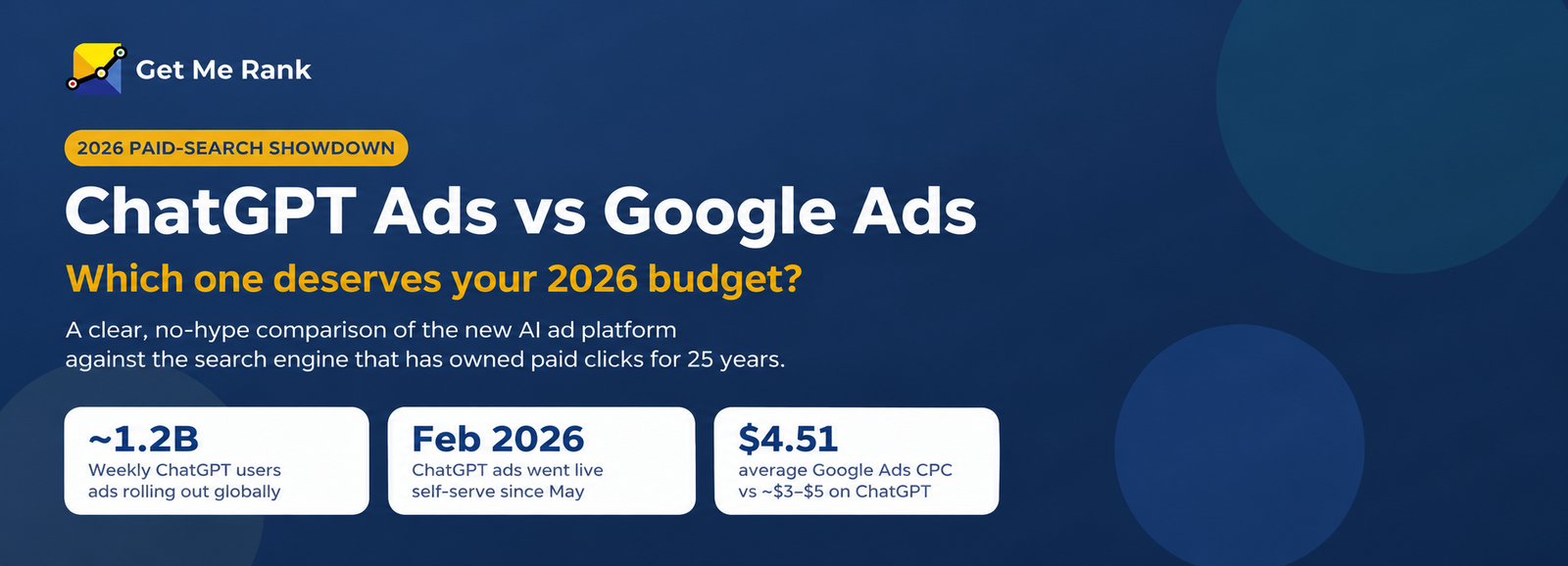
A clear, no-hype look at the brand-new AI ad platform against the search giant that has owned paid clicks for 25 years — and how to split your spend between them.
Key Takeaways
- The debate of ChatGPT Ads vs Google Ads is really about research intent vs. ready-to-buy intent — they catch people at different moments.
- ChatGPT ads are new: OpenAI began showing them in February 2026, opened a self-serve Ads Manager in May 2026, and reaches around 1.2 billion weekly users.
- Google still wins on clicks: average CTR of 4–6% versus ChatGPT’s ~0.68% — but ChatGPT reaches buyers far earlier.
- Entry costs are close — roughly $3–$5 per click on ChatGPT versus Google’s $4.51 average — but Google’s targeting and reporting are far more mature.
- For most brands the answer is not either/or — it’s using each platform for the funnel stage it does best.
Introduction
For 25 years, “running search ads” meant one thing: Google. That assumption cracked in 2026, when OpenAI started placing ads inside ChatGPT — the tool more than a billion people now use to research, compare and decide. Suddenly marketers face a genuinely new question: ChatGPT Ads vs Google Ads — where should the next dollar go?
ChatGPT Ads vs Google Ads (2026): Which One Deserves Your Budget?
This guide answers that without the hype. We’ll break down how each platform actually works in 2026, compare them side by side on cost, intent and reach, show you how to get started on ChatGPT, and give you a simple framework for splitting budget. The short version: these are not rivals so much as two different tools for two different moments in the buyer’s journey.
Quick comparison: the headline differences
| Dimension | ChatGPT Ads | Google Ads |
|---|---|---|
| Launched | February 2026 | October 2000 |
| Buyer intent | Research & comparison | Ready to buy |
| Funnel stage | Top & middle | Middle & bottom |
| Avg. CPC | ~$3–$5 (early) | ~$4.51 |
| Avg. CTR | ~0.68% | ~4–6% |
| Targeting | Conversation context | Keywords, geo, audiences |
The 30-second version — the detailed breakdown follows below.
What Are ChatGPT Ads, and How Do They Work?
Short answer: ChatGPT ads are sponsored placements shown inside ChatGPT conversations and image results. They are matched to what you’re asking about in the moment — not to keywords — and are clearly labelled so they stay separate from the AI’s actual answer.
Rather than bidding on keywords, advertisers are placed by conversation context. When someone asks ChatGPT to compare project-management tools, a relevant sponsored option can appear alongside the answer. The ads in ChatGPT come in three main forms:
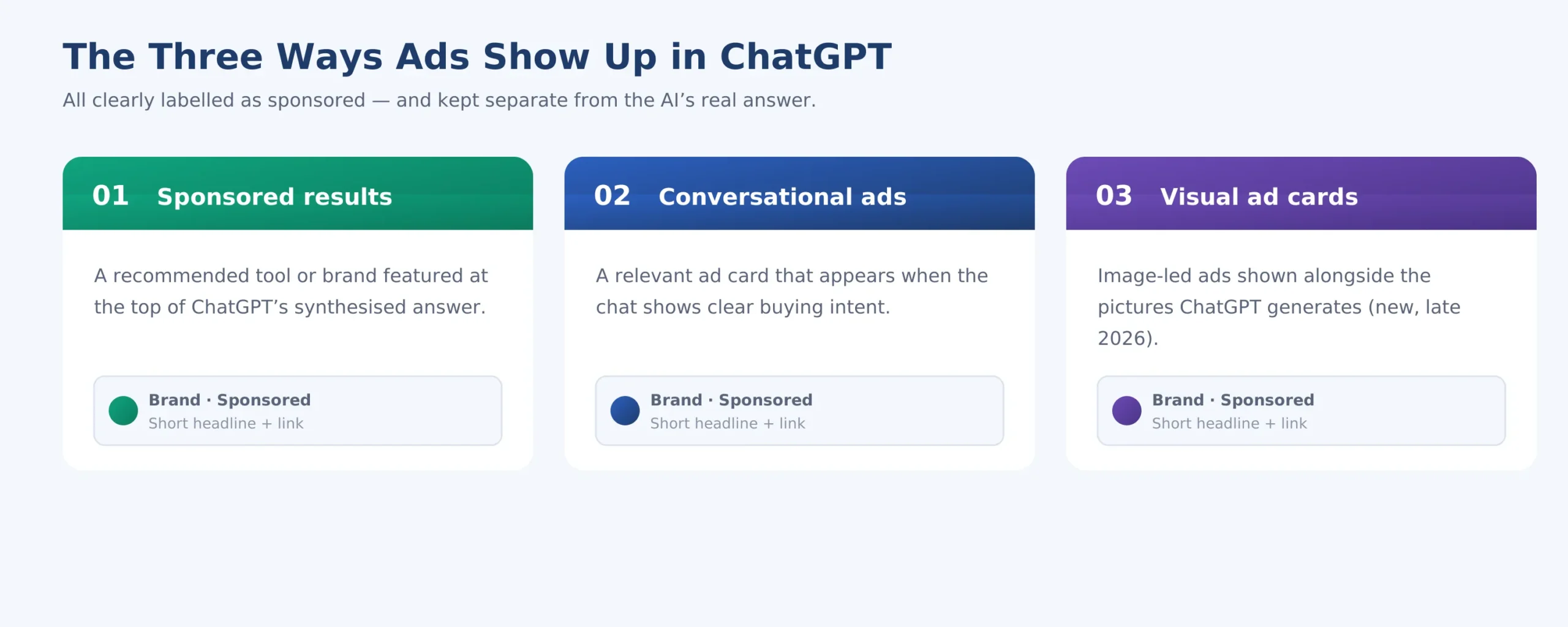
- Sponsored results — a recommended brand or tool featured within ChatGPT’s synthesised answer.
- Conversational ads — an ad card that surfaces when the chat shows clear commercial intent.
- Visual ad cards — image-led ads shown next to pictures ChatGPT generates, rolling out from late 2026.
INDUSTRY FACT
Ads in ChatGPT only show to logged-in adults on the free and low-cost tiers — Plus, Pro, Business, Enterprise and Education stay ad-free. That makes the audience large but skewed toward casual and research users.
What Are Google Ads, and How Are They Different?
Short answer: Google Ads are keyword-triggered placements on the world’s biggest search engine. Someone types a query with clear intent, and your ad appears — making Google the proven choice for capturing demand that already exists.
Google’s model is mature and deeply controllable. You bid on keywords, layer on geographic, device, time and audience targeting, exclude what you don’t want with negatives, and measure every click in granular detail. The trade-off is that you mostly reach people at the moment of purchase intent — which is powerful, but misses everyone still earlier in their research.
ChatGPT Ads vs Google Ads: The Full Side-by-Side
Short answer: Google offers scale, precise targeting and higher click-through; ChatGPT offers earlier, research-stage reach inside the conversation itself. The right choice depends on who you sell to and when they decide.
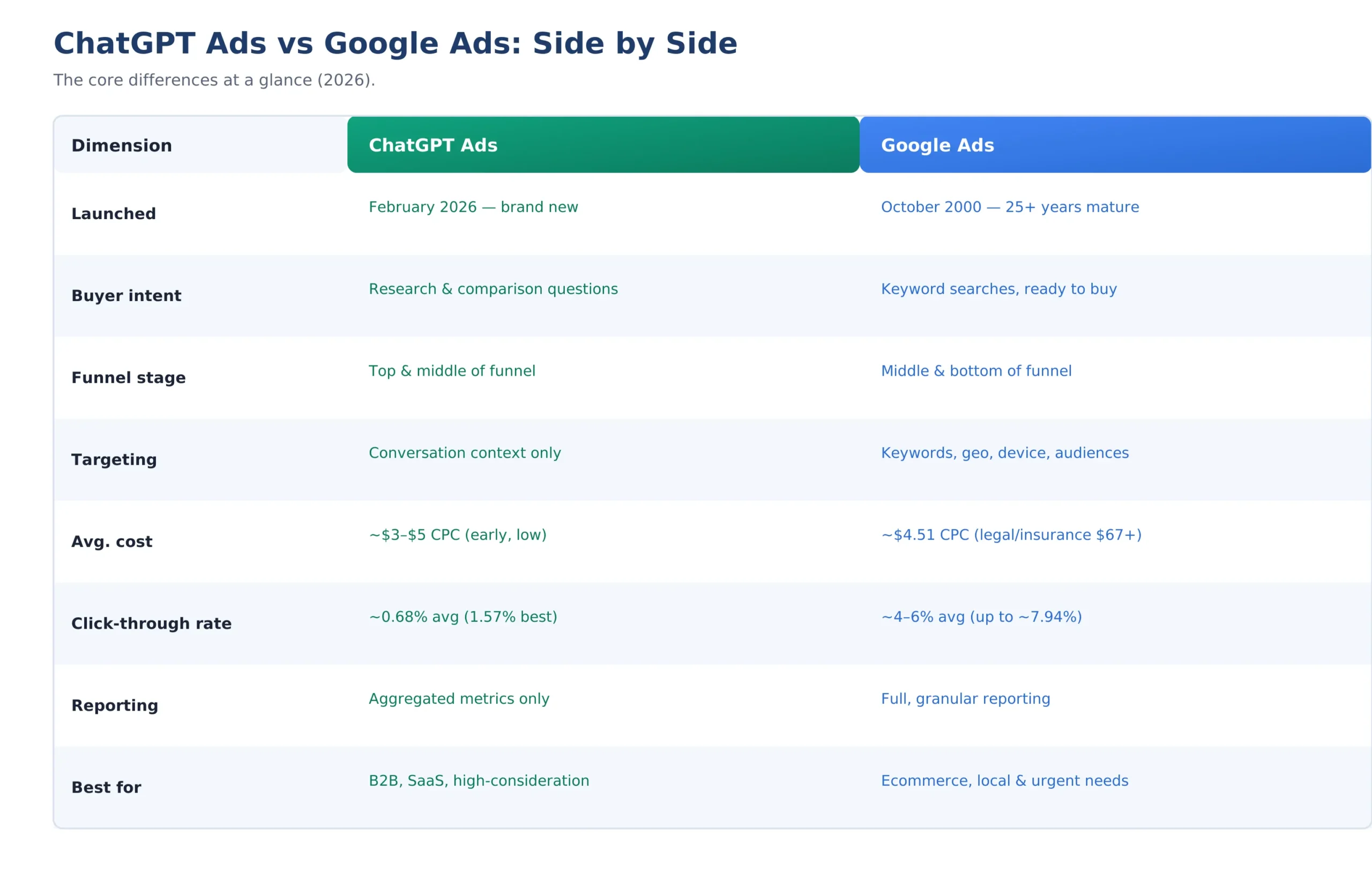
The core differences between the two platforms at a glance (2026).
A few differences matter more than the rest. Intent: Google catches people ready to act; ChatGPT catches them while they’re still weighing options. Targeting: Google gives you keywords, geo and audiences; ChatGPT places you purely by live context, with no keyword or demographic controls. Measurement: Google offers full reporting, while ChatGPT shares only aggregated impressions and clicks to protect user privacy.
Can You Run Ads on ChatGPT?
Short answer: Yes. Since May 2026, any US business can run ads on ChatGPT through a self-serve Ads Manager, with no minimum spend. The $200,000 pilot minimum has been removed, so small brands can test it too.
When ads first appeared in early 2026, access was limited to a small group of large advertisers. That has changed. The platform is now open, the entry barrier is gone, and availability is expanding market by market — it reached India in August 2026, with a wider global rollout underway.
How Do You Run Ads on ChatGPT?
Short answer: Sign up for ChatGPT Ads Manager, set a CPC or CPM bid, build a visual ad card, and let ChatGPT match you to relevant conversations. Knowing how to run ads on ChatGPT is less about keywords and more about strong creative and clear intent signals.
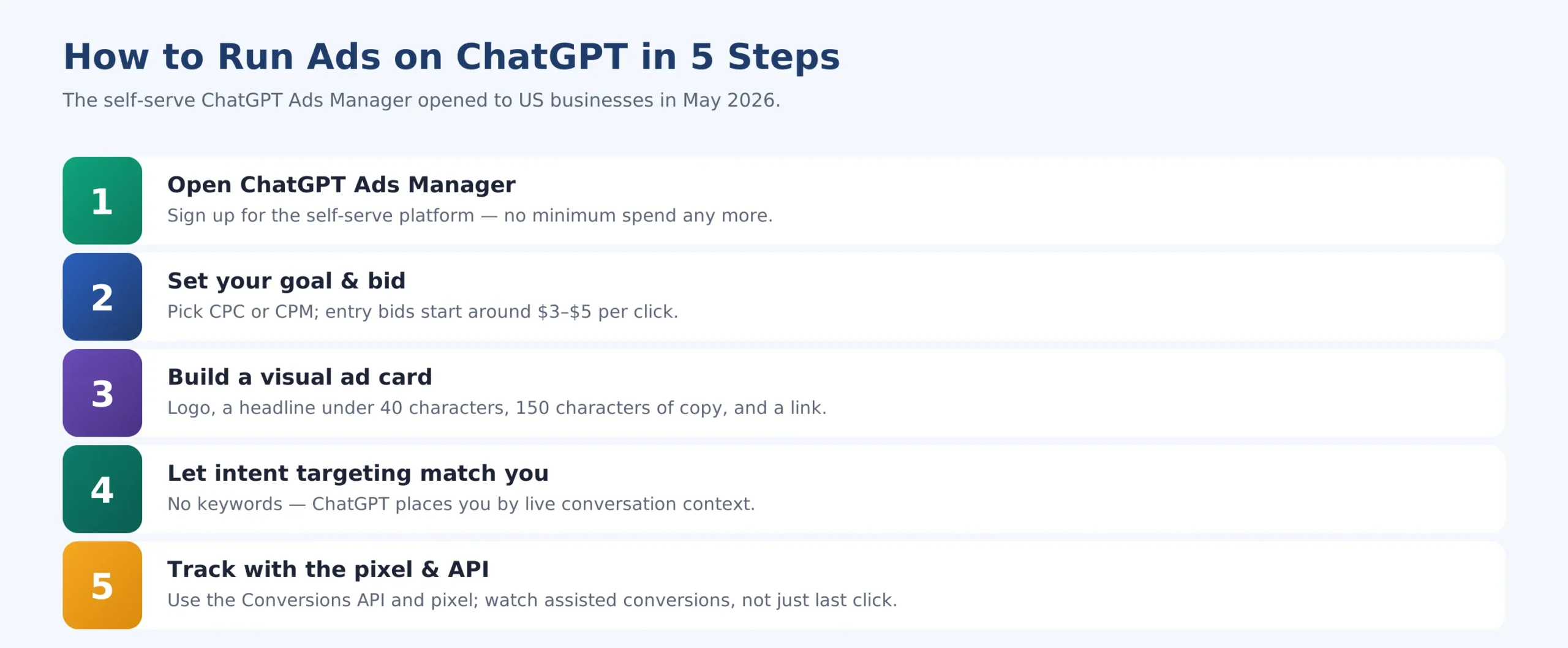
- Open ChatGPT Ads Manager. Sign up for the self-serve platform — there’s no minimum spend to get started.
- Set your goal and bid. Choose CPC or CPM; early entry bids sit around $3–$5 per click.
- Build a visual ad card. You get a logo, a headline under 40 characters, up to 150 characters of copy, and a link.
- Let intent targeting work. There are no keywords — ChatGPT places you based on live conversation context.
- Track with the pixel and API. Use the Conversions API and measurement pixel, and watch assisted conversions, not just last-click.
Where ChatGPT Ads May Add Value
Short answer: ChatGPT ads shine when your buyers research before they commit — B2B, SaaS, professional services and complex, high-consideration products where being inside the recommendation matters more than a last-click.
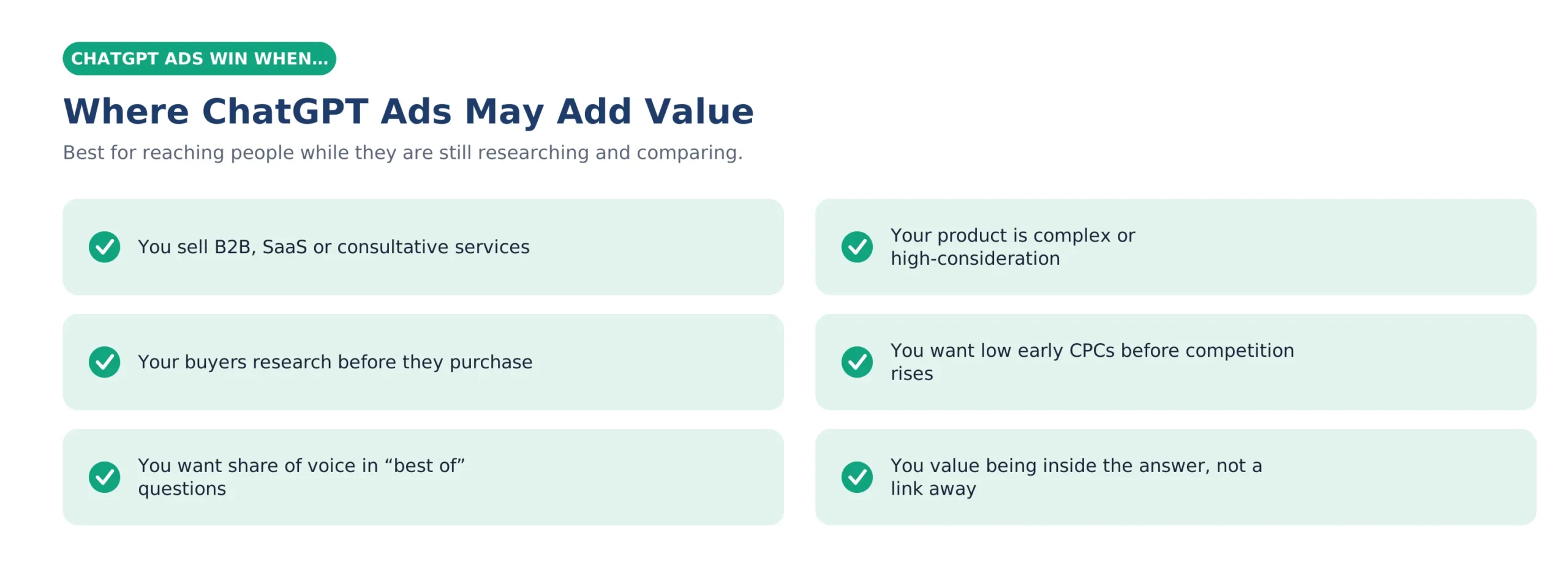
- Research-stage influence. You reach people forming a shortlist, not just those ready to checkout.
- “Best of” share of voice. You can appear in comparison and recommendation conversations where buying decisions actually form.
- Low early competition. Getting in now can lock in lower CPCs before more advertisers pile in.
- Consultative and B2B offers. Complex products benefit most from being explained inside the answer, not squeezed into a text ad.
Where Google Ads May Add Value
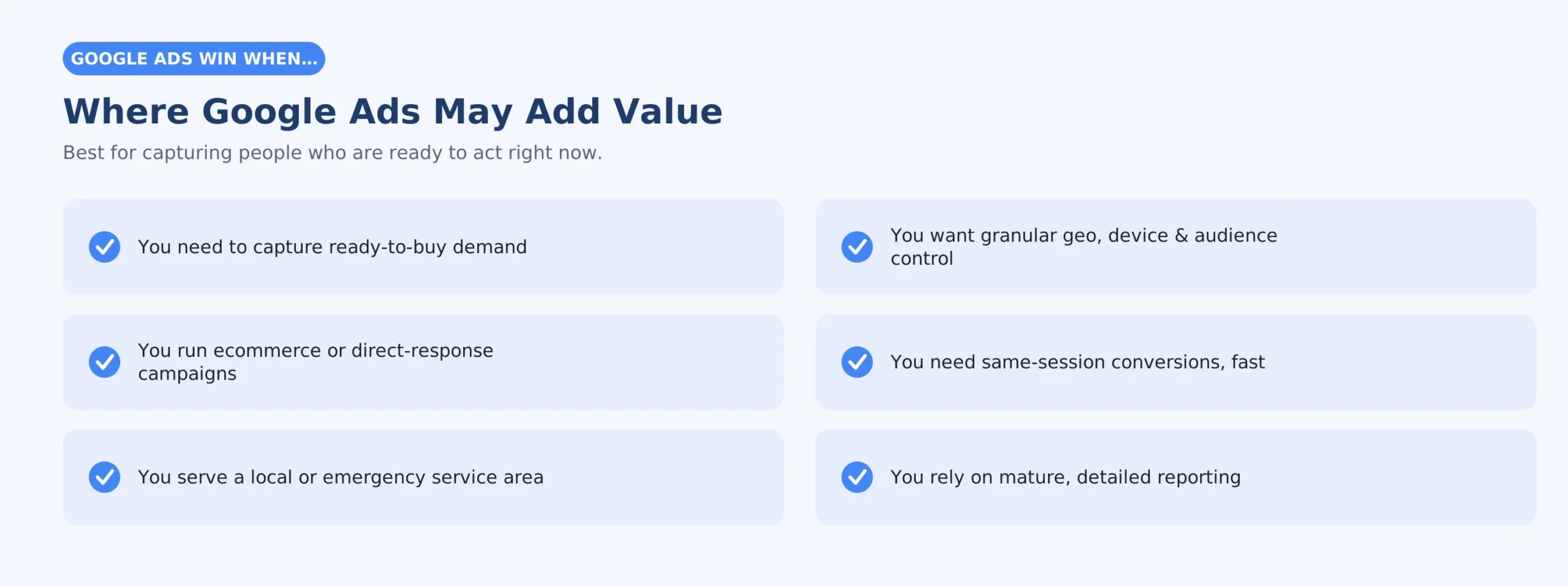
Short answer: Google ads win when you need to capture existing demand fast — ecommerce, local and emergency services, and any campaign that depends on granular targeting and proven same-session conversions.
For businesses looking to capture high-intent leads and drive measurable conversions, our performance marketing services help you build and optimize Google Ads campaigns that maximize ROI and support sustainable growth.
- Ready-to-buy capture. When someone searches “emergency plumber near me,” Google puts you in front of them at the point of need.
- Granular control. Keyword match types, negatives, geo, device and day-parting give precision ChatGPT doesn’t offer yet.
- Mature measurement. Full reporting and conversion tracking make performance easy to prove and optimise.
- Speed to conversion. Google is still the king of fast, same-session sales for ecommerce and direct response.
Google Ads vs ChatGPT Ads: Which Should You Choose in 2026?
Short answer: For most brands, both. Start with Google to capture demand you can measure, then add ChatGPT to influence research-stage buyers. The Google ads vs ChatGPT ads decision is about sequencing, not picking a side.
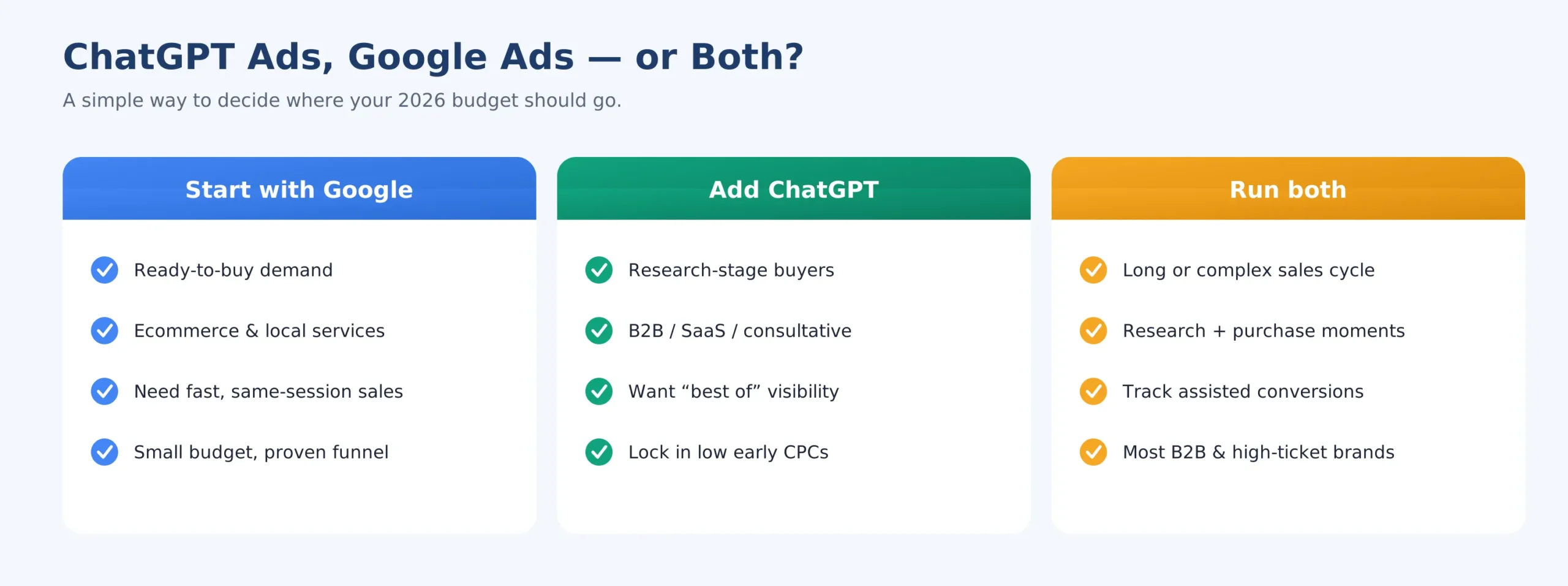
- Start with Google if you sell ecommerce or local services, need fast conversions, or have a small, proven funnel.
- Add ChatGPT if you sell B2B or consultative services, want “best of” visibility, or want to lock in early CPCs.
- Run both if your sales cycle spans research and purchase — true for most B2B and high-ticket brands.
PRO TIP
Watch for a lift in branded Google searches two to four weeks after launching ChatGPT ads. Research-stage exposure often shows up as demand captured later on Google — so measure assisted conversions, not just last-click.
How Are ChatGPT Ads Labeled and Kept Honest?
Short answer: Every ad is clearly marked as sponsored and sits separately from ChatGPT’s answer, so advertising never changes the AI’s actual recommendation. Transparency is central to how the platform is designed.
This matters for trust. OpenAI keeps the ad layer distinct from the model’s response, and each placement carries a visible chatgpt product label so users always know what is paid and what is organic. Targeting uses conversation context rather than cross-site tracking, advertisers see only aggregated metrics, and ads are not shown to users predicted to be under 18.
Where GetMeRank Fits In
At GetMeRank, we help brands build full-funnel paid strategies that don’t bet on a single platform. That means capturing ready-to-buy demand on Google today while testing and learning on emerging AI ad surfaces like ChatGPT — so you own both the purchase moment and the research moment shaping tomorrow’s decisions.
Frequently Asked Questions
Q. Can you run ads on ChatGPT as a small business?
A. Yes. Since the self-serve Ads Manager opened in May 2026 and the large minimum spend was removed, small US businesses can run ads on ChatGPT and scale up as results come in.
Q. Are ChatGPT ads better than Google Ads?
A. Neither is simply “better.” Google captures ready-to-buy demand with mature targeting; ChatGPT reaches people earlier, during research. The best results usually come from using both for what each does well.
Q. Do ChatGPT ads influence the AI’s answers?
A. No. Ads are clearly labelled and kept separate from ChatGPT’s responses, so the AI’s actual recommendations are not shaped by who is paying.
Q. How much do ChatGPT ads cost?
A. Early entry bids are around $3–$5 per click, with CPMs roughly $25–$60. There’s no minimum spend, though costs will likely rise as more advertisers join.
Q. Which should I choose if I can only pick one?
A. If you need measurable sales now, start with Google. If you sell B2B or consultative products and want to influence buyers early, ChatGPT is worth testing first.
Conclusion
The honest takeaway from any fair look at ChatGPT Ads vs Google Ads is that this isn’t a war with one winner. Google remains the most reliable way to capture demand that already exists, while ChatGPT opens a brand-new window to reach buyers while they’re still deciding. The smartest brands in 2026 aren’t choosing — they’re learning to run both, matched to the moments each does best.
Start where you can measure results fastest, test the new platform deliberately, and let real performance — not hype — guide where your budget grows.