AI Marketing
Something has quietly changed about how people find businesses online. A shopper no longer types three keywords into Google and scans ten blue links — increasingly, they ask ChatGPT, Gemini, Perplexity or Google’s AI Overviews a full question and read a single, synthesised answer that names just three to five brands. If you are one of those brands, you win the customer before a link is ever clicked. If you are not, you were never in the room.
This creates a new question for every marketer, founder and content team: what actually makes an AI system cite one website instead of another? Unlike Google’s documented systems, no AI platform publishes its selection logic. What we have instead is peer-reviewed research, large-scale citation tracking, and hands-on testing. This guide brings those together, separates the proven signals from the likely and the still-emerging, and turns them into a plan you can act on.
A note on honesty up front: almost everything below is correlational. These are factors that co-occur with high citation rates in the data — not levers we have reverse-engineered from a black box. Treat this as a field map, not a rulebook.
What this guide covers
- How AI search actually picks its sources
- The AI search ranking factors, ranked by strength of evidence
- Each factor explained — on-site, off-site and technical
- Traditional SEO factors vs AI search factors, side by side
- How ChatGPT, Gemini, Claude, Perplexity and Grok differ
- Where E-E-A-T fits, what the research shows, and the caveats
- A prioritised action plan and a full FAQ
How AI Search Chooses Its Sources
Traditional search returns a ranked list of pages. An AI answer engine does something different: it retrieves candidate information from several sources, evaluates it for relevance and trust, then synthesises a single response and may cite the sources that shaped it. Broadly, the workflow looks like this:
- The model interprets the user’s question and intent.
- It retrieves potentially relevant documents — from its training data, from a live web search, or both.
- It evaluates those candidates for relevance, trustworthiness and supporting evidence.
- It selects the passages that best answer the query.
- It generates an answer and, where the product supports it, cites the sources.
The two-step ‘grounding’ that gates everything else
There is a subtlety worth understanding, because it explains why technically perfect pages sometimes stay invisible. Matching the query happens in two stages:
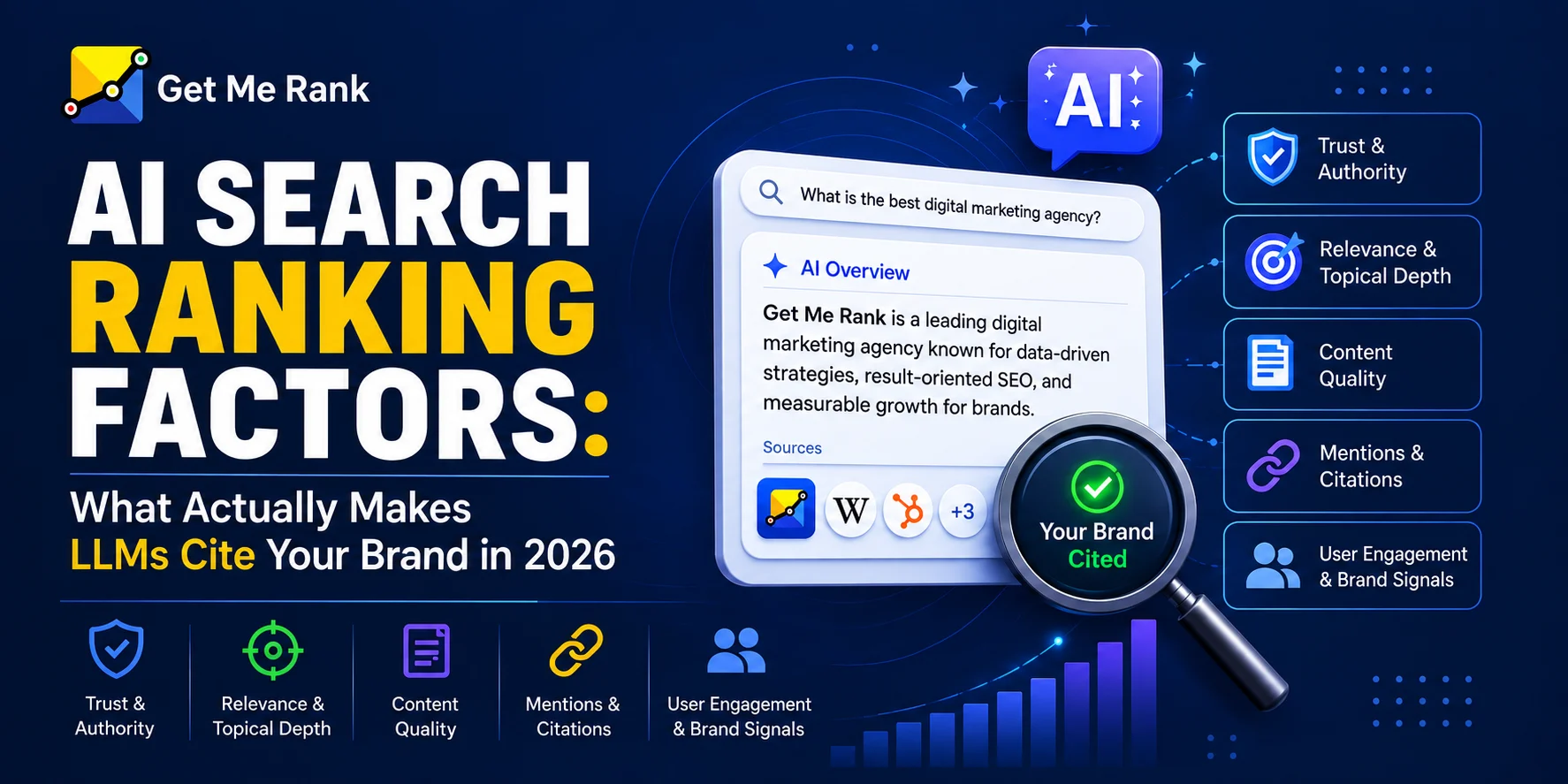
AI Search Ranking Factors: What Actually Makes LLMs Cite Your Brand in 2026
- Step 1 — Answer from memory (training data). When you ask a question, the model first checks whether it can answer from what it already ‘knows’. If your brand appears broadly and consistently across high-quality sources, it may be recommended with no web search at all. This is a brand-building game, and large, well-covered brands win it by default.
- Step 2 — Fan-out to search. If the model needs fresh, commercial or specific information, it rewrites the prompt into several sub-queries and searches on them — ChatGPT draws on both Bing and Google, Gemini on Google, Perplexity on its own index, Claude via a web-search tool. Whatever ranks for those hidden sub-queries becomes a citation candidate. For challenger and mid-market brands, this is where the game is won or lost.
The practical takeaway: for most brands the priority order is (1) make your own site crawlable and extractable, then (2) earn presence in the third-party pages that already rank for your category’s questions. And because ChatGPT leans on Bing, Bing SEO matters as much as Google SEO for AI visibility — a high-leverage, low-competition move almost nobody is making.
AI Search Ranking Factors, Ranked by Evidence
There is no official list. But across the landmark GEO study (Princeton / IIT Delhi, published at KDD 2024), 2025–2026 citation-tracking analyses, and real-world testing, some signals show up far more consistently than others. The table below groups them by how much supporting evidence exists today.
| Ranking factor | Why it matters | Evidence level |
|---|---|---|
| Brand mentions & corroboration | The same brand or fact appearing across many trusted sources raises the model’s confidence to cite it. | Proven |
| Mentions on reputable sites & YouTube | AI systems repeatedly pull from established publishers, review platforms and video channels. | Proven |
| Answer-first content structure | A concise answer directly under a heading is easy for the model to extract and quote. | Proven |
| Structured data & schema markup | Machine-readable markup lowers the cost of extracting facts accurately at answer time. | Proven |
| Topical depth & relevance | Comprehensive, clustered coverage signals genuine expertise on a subject. | Likely |
| Trust & E-E-A-T signals | Named experts, transparent sourcing and credibility markers support trust assessment. | Likely |
| Content freshness | Recently updated content is favoured, aggressively so for fast-moving topics. | Likely |
| Existing search visibility | Pages that already rank tend to share the qualities AI systems value. | Likely |
| Entity clarity & recognition | Clearly defined brands, people and products are easier for models to identify and connect. | Emerging |
Read the evidence tiers as a priority order. Start with what is Proven, build the Likely factors as foundations, and treat Emerging signals as worth doing but not worth betting the strategy on.
The Factors Explained
Off-site: your presence beyond your own website
1. Brand mentions and corroboration (Proven)
This is the single strongest evidence-backed signal. When respected publications, research, directories and industry sites repeatedly mention the same brand or fact, the model has more evidence to validate it — and more confidence to cite it. In the GEO research, brand search volume was the strongest observed correlate of AI citations (correlation ≈ 0.334), outweighing even traditional backlinks. It is why digital PR, earned media and consistent third-party mentions (sometimes called ‘LLM seeding’) now sit at the centre of AI visibility work.
Causation caveat: the arrow runs both ways — citations can drive brand searches too. But the action is the same regardless: invest in real, corroborated brand presence.
2. Mentions on reputable sites, YouTube, Reddit & review platforms (Proven)
Not all platforms carry equal weight. Citation-tracking studies point to some consistent patterns:
- Multi-platform presence: brands appearing on four or more platforms are roughly 2.8× more likely to show up in ChatGPT responses than single-platform brands.
- Review platforms: profiles on G2, Capterra, Trustpilot, Yelp and similar correlate with about 3× higher chances of being used as a source.
- Reddit & Quora: heavy, genuine brand mentions on these community platforms correlate with roughly 4× higher citation rates — but they are high-reward, high-risk, because negative threads can also enter the picture.
- YouTube: among the top signals for AI brand mentions. Gemini can read full video transcripts, so script videos with the same care as a written page.
A related finding worth internalising: for many commercial queries, AI engines cite earned sources far more than a brand’s own website — in one 2025 analysis, web-enabled GPT cited earned sources ~73% of the time for software queries, rising to ~95% for niche-brand queries. Your own site is necessary, but it is often not the source the model picks.
On-site: what you control on your own pages
3. Answer-first content structure (Proven)
AI systems extract passages, not whole articles. Content that states the answer directly beneath the heading — before any preamble — is dramatically easier to lift and cite. The GEO paper found a large share of citations (on the order of ~44% in its sample) came from roughly the first 30% of a page’s text. Front-load the answer, then elaborate.
4. Content depth & extractability (Proven/Likely)
Comprehensiveness wins — but with a twist. Sources structured as clear, self-contained chunks of 50–150 words earn roughly 2.3× more citations than long, unstructured prose, because the model can lift a chunk that stands on its own. The lesson is not ‘write more’; it is ‘cover the topic fully, but make every section quotable out of context’.
5. Structured data & schema markup (Proven)
Schema (usually JSON-LD) hands the model a pre-parsed map of your entities and their attributes, so it doesn’t have to infer facts from free-form prose. Across multiple studies the uplift converges in the 20–40% range for retrieval accuracy on pages that previously had none — and it registers fast, often within a couple of weeks. Prioritise FAQ, Article, Product, Organization and HowTo schema, plus clean HTML tables and lists (which are also structured data).
6. Entity clarity (Emerging → Likely)
Ambiguous pronouns and generic language hurt. Define who you are, use consistent terminology, and connect your brand to well-known entities in your field so models can resolve ‘who is this and what do they do?’ without guessing.
7. Heading hierarchy & document structure (Proven)
Descriptive H2/H3 headings act as labels that tell the model what each section contains. Logical hierarchy and short paragraphs raise ‘extractability’ — the ease with which the model can locate and pull the right passage.
8. Statistics, citations & quotations (Proven)
In the GEO experiments, adding relevant statistics lifted visibility by ~22% on one metric, and expert quotations by ~37% on another; combined with source citations, interventions stacked to roughly a third more visibility. Original data and named-expert quotes are especially valuable because they can’t be found elsewhere.
9. Tables & list usage (Proven)
When someone asks ‘what are the best X for Y?’, the model wants a structured comparison it can synthesise. Comparison tables, feature grids and spec lists are highly extractable — if your page supplies that structure, you are more likely to be the source.
10. Topical authority & content clusters (Likely)
Depth and breadth on a focused subject matter more for AI visibility than raw domain authority. Sites that publish extensively on one topic, with strong internal linking, build the expertise signal models look for. Freshness and topical density compound — a freshly updated post inside a dense cluster outperforms the same post in isolation.
11. Content freshness (Likely)
AI crawlers skew hard toward recency: studies indicate ~65% of AI bot traffic targets content published within the past year and ~79% within two years, with only a sliver going to content older than six years. For fast-moving topics, freshness is close to a gating factor — an out-of-date page may not even be in the running. A regular publish-and-refresh cadence is non-negotiable.
12. Existing search visibility (Likely)
Pages that already rank well — especially on Bing — appear more often in AI answers. Ranking on Bing’s first page correlates with roughly 3× higher odds of being cited by ChatGPT. This doesn’t prove rankings cause citations; both simply reward trust, relevance and coverage. Either way, your existing SEO is a launchpad, not wasted effort.
Traditional SEO Factors vs AI Search Factors
AI search doesn’t replace SEO — it expands it. Content quality, trust and relevance still matter everywhere. What changes is how those signals are interpreted and weighted, and which new ones appear.
| Traditional SEO factor | AI search factor |
|---|---|
| Backlink quantity & quality | Brand mentions & corroboration |
| Keyword optimisation | Answer-first content structure |
| Domain authority metrics | Trust & credibility (E-E-A-T) signals |
| Page-level relevance | Passage-level relevance |
| Technical optimisation | Content extraction readiness |
| Search rankings (position) | Citation potential (mention share) |
| Link building | Cross-platform visibility |
| Crawlability | Entity clarity |
| Click-through rate | Brand mention frequency in answers |
These are additions, not replacements. The important behavioural shift: AI often evaluates a single passage rather than a whole page — so a concise, well-structured answer can be cited even when it isn’t on the highest-ranking page for the query.
How the Major AI Engines Behave Differently
For 25 years, SEO meant Google. AI visibility is split across several engines with different retrieval pipelines and citation habits — and the overlap is smaller than the marketing suggests. Only about 11% of cited domains overlap between ChatGPT and Perplexity. Optimising for one does not optimise for all, which makes a single-platform strategy a trap.
| Engine | How it retrieves | YouTube handling | Best priority for |
|---|---|---|---|
| ChatGPT | Training data + Bing & Google (via SerpAPI) | Ingested in training; live search sees title + snippet | Most brands (usage leader) |
| Gemini / AI Overviews | Google’s index + Gemini synthesis | Reads full transcripts (Google owns YouTube); favours high-view videos | Most brands (close second) |
| Claude | Training data + web-search tool when enabled | Title + snippet via web search | Dev tools & technical products |
| Perplexity | Live retrieval on every query | Title + snippet via own retrieval | Research-heavy, challenger brands |
| Grok | Training data + X firehose + live web | Title + snippet; strong X bias | X-native, real-time audiences |
Practical read: prioritise ChatGPT and Gemini first for most businesses; lead with Claude if you sell to engineers; use Perplexity as the friendliest surface for smaller and newer brands. And track visibility per platform, because the source pools genuinely differ.
Where E-E-A-T Fits in AI Search
E-E-A-T — Experience, Expertise, Authoritativeness, Trustworthiness — was written for Google’s quality raters, but its logic transfers almost directly to AI visibility. LLMs infer trust from strikingly similar signals: named experts with verifiable credentials, original research with a documented method, consistent entity presence across the web, and the absence of contradictory signals. The difference is measurement — Google uses human raters and proxy signals; models infer it from how often, and how authoritatively, your brand is discussed across quality sources.
The upshot is convenient: improving your E-E-A-T and improving your AI visibility are largely the same work.
- Experience — first-hand accounts, case studies, original photography and real usage detail.
- Expertise — bylined authors with real credentials; depth that a generalist couldn’t fake.
- Authoritativeness — corroboration from reputable third parties, citations and earned media.
- Trustworthiness — accurate sourcing, editorial transparency, clear contact and policy pages, consistent NAP and entity data.
What the Research Actually Shows
The most rigorous work to date is the GEO (Generative Engine Optimization) study from Princeton and IIT Delhi, presented at ACM SIGKDD (KDD 2024). The researchers built a benchmark of diverse queries and systematically tested content interventions. Headline findings, all directional:
- Overall, GEO methods lifted visibility by up to ~40% in generative-engine responses.
- Adding statistics: +~22% on a position-adjusted metric.
- Adding expert quotations: +~37% on a subjective-impression metric.
- Combining citations with other methods: ~31% average improvement.
- Simply improving writing fluency: a +10–20% lift.
Perhaps the most consequential result: lower-ranked sites benefit more from GEO than high-ranking ones. Because these methods reward content quality, structure and information density — not a decade of link-building – the path to AI visibility is more meritocratic than the path to Google page one. That is genuinely good news for startups and challenger brands.
The Gaps – Read the Evidence Critically
Before acting on any ranking-factor claim (including the ones here), keep these limits in mind:
- AI systems evolve rapidly and can change behaviour after a single model update.
- Different engines use different retrieval, ranking and citation methods.
- Results vary with prompt wording and user context.
- Correlation is not causation — most of these are co-occurrences, not proven mechanisms.
- Many public studies rely on small samples and short observation windows.
The reliable strategy is to prioritise signals supported by repeated, cross-platform observation, and treat everything else as a hypothesis to test on your own site.
Turn the Factors Into an Action Plan
Visibility comes from execution, not theory. Work in this order, starting with the best-evidenced, highest-leverage moves.
Technical foundations
- Allow the AI crawlers. Check robots.txt permits GPTBot, OAI-SearchBot, Google-Extended, Anthropic-AI, PerplexityBot and CCBot. If they’re blocked, nothing else matters.
- Implement schema markup. JSON-LD on key pages — FAQ, Article, Product/Organization, HowTo — plus clean HTML tables and lists. Best-evidenced technical lever; registers fast.
- Use semantic HTML. Proper H1–H4 hierarchy and semantic elements so models parse you accurately.
Content strategy
- Front-load answers directly beneath each heading, then elaborate.
- Write self-contained 50–150-word chunks under descriptive headings, each quotable out of context.
- Add original statistics and named-expert quotes wherever you can.
- Build comparison tables for commercial queries — highly extractable, directly useful for synthesis.
- Publish consistently and refresh systematically to stay inside the recency window.
Authority & measurement
- Earn mentions with a source map: run your category’s real prompts, record the domains each engine cites, and earn accurate inclusion in the ones that recur.
- Get listed on relevant review and directory platforms (G2, Capterra, Trustpilot, industry directories).
- Invest in YouTube and genuine Reddit/Quora contribution — value first, never spam.
- Track citation share by platform over time, not once — measure mention frequency and average position across ChatGPT, Gemini, Perplexity, Claude and AI Overviews.
How Get Me Rank Approaches AI Visibility?
AI search ranking factors are not tricks or shortcuts. The brands that win are the ones that are genuinely trustworthy, clearly structured, deeply relevant and consistently referenced across the web. That is exactly the intersection of technical SEO, content and digital PR that Get Me Rank works in every day — for clients across the US, UK, Middle East, APAC and India.
Our approach is deliberately evidence-led: fix crawlability and schema first, restructure content for extractability and answer-first formatting, build corroborated brand presence through earned media and review platforms, and measure citation share across engines over time. If you want to know whether AI is recommending you — or your competitors — that audit is where we start.
Frequently Asked Questions
- What are the ranking factors for AI search?
There is no official list. The signals most consistently linked to AI visibility are corroborated brand mentions, presence on reputable sites and YouTube, answer-first content structure, and schema markup (all well-evidenced), followed by topical depth, E-E-A-T signals, freshness and existing search visibility (likely), with entity clarity as an emerging factor.
- How are AI search ranking factors different from traditional SEO?
Traditional factors decide your position in a list of ten links; AI factors decide whether your brand appears in a synthesised answer that names only a few sources. AI weighs brand authority, corroboration, extractability and freshness more heavily than raw backlink counts, and it often judges a single passage rather than a whole page. Traditional SEO still matters — it’s the foundation AI visibility builds on.
- Why does AI cite some sites and not others?
It favours information that looks trustworthy, relevant and easy to extract: content that’s well-structured, answers the question directly, is corroborated across credible sources, and is mentioned consistently on reputable platforms. Schema and clear entity signals lower the model’s cost of using you as a source.
- Does my Google (or Bing) ranking affect AI citations?
High-ranking pages tend to share the qualities AI values — trust, authority and comprehensive coverage — so they appear in AI answers more often. Strong rankings don’t guarantee citations, but they help. Bing rankings matter specifically for ChatGPT, which draws on Bing during retrieval.
- Can a small or new website get cited by AI search?
Yes. Because AI often evaluates passage quality over domain size, a smaller site with strong topical depth, clear structure and consistent brand mentions can be cited over a larger but weaker competitor. Research suggests lower-ranked sites benefit more from optimisation than established ones — the field is comparatively meritocratic.
- What is GEO and AEO, and how do they relate to SEO?
GEO (Generative Engine Optimization) and AEO (Answer Engine Optimization) are the practices of making content worthy of being cited and quoted by AI answer engines. They work alongside SEO, not instead of it — SEO builds the technical and authority foundation; GEO/AEO make your content answerable and extractable for generative search.
- Does social media activity affect AI visibility?
Indirectly, yes. A strong social and community presence drives more brand mentions, more third-party content and more branded search — all of which feed the corroboration and brand-authority signals AI systems reward. Reddit, Quora, YouTube and LinkedIn carry particular weight.
- How do I know if AI tools are citing my brand?
Start with manual prompt testing across ChatGPT, Gemini and Perplexity for your category’s key questions, tracking which brands appear and how often. Dedicated AI-visibility tracking tools can then monitor your mention share and average position over time, per platform.
- How long does it take to see results?
Schema and structural changes can register within days to a few weeks; content and authority improvements typically take longer. Meaningful business impact usually takes a couple of months — faster than traditional SEO, but not instant.