
SEO

Key Takeaways
- SEO content writing and an SEO content strategy are related but different: writing is the execution; strategy is the plan behind it.
- A real strategy starts with an audit of what you already have, not a blank content calendar.
- Matching the content format to search intent matters more than hitting a word count.
- Topic clusters (related content grouped around one core page) usually outperform scattered, unrelated posts.
- Writing for AI Overviews and AI search uses the same fundamentals as traditional SEO: clear structure, direct answers, and real depth, not special markup.
- A strategy without a review process goes stale, because search behavior and competitor content keep changing.
An SEO content writing strategy is a documented plan for what you publish, who it’s for, and how people will find it. It’s built on real keyword research, search intent, and a regular review of what’s working. Think of it this way: SEO content writing is the execution (the actual words on the page), while an SEO content strategy is the plan that decides what gets written, why, and in what order. You need both, but most sites that struggle with SEO have plenty of content and no real strategy behind it.
DID YOU KNOW
Only 29% of B2B marketers rate their content strategy as very or extremely effective, and 54% say a lack of resources is one of their biggest challenges. Having content isn’t the problem. Having a plan is.
What Is SEO Content Writing?
SEO content writing is the practice of creating web content (articles, blog posts, product pages, and guides) that’s built to rank in search engines while still genuinely helping the reader. If you’ve ever searched “what is SEO in content writing,” you were really asking a simple question: how do you write something that reads naturally but is also structured in a way search engines can understand and trust?
Good SEO content writing isn’t about repeating a keyword as often as possible. So what is SEO writing at its core? It’s answering the exact question someone searched, in natural language and with real expertise, while getting the structural details right: headings, internal links, and meta information that help both readers and search engines find their way around the page.
PRO TIP
Read your draft out loud. If the keyword sounds forced when you say it, it will read as forced too. Rewrite the sentence or use a natural variation instead.
What Is an SEO Content Strategy?
An SEO content strategy is the overall plan that guides what content gets created, in what order, and why. It’s based on keyword research, search intent, and business goals, rather than individual pieces written in isolation. It usually includes a documented list of target topics and keywords, a content calendar, content types mapped to each stage of the buyer journey, and a process for reviewing and updating what you’ve published.
Why does the distinction matter? Writing one well-optimized article is a tactic. A strategy decides whether that article fits into something bigger. A single blog post can rank on its own, but a strategy is what makes a whole site rank consistently, with content that supports and links to related content instead of competing with it.
How Do You Create an SEO Content Writing Strategy That Actually Ranks?
Why Do You Need a Strategy Instead of Just Writing SEO Content?

Writing SEO articles one at a time, with no plan behind them, usually leads to a familiar pattern: a few posts rank, most don’t, and nobody’s quite sure why. A strategy fixes that by making content decisions deliberate instead of reactive.
Without one, it’s easy to end up with several articles competing for the same keyword. This is called keyword cannibalization, and it happens because no one decided which page should own which term. It’s also easy to miss obvious topics altogether, because content gets created around whatever seemed interesting that week instead of what search data shows people are actually asking.
A strategy also makes your content budget easier to justify. When every piece is tied to specific keywords, search volume, and business goals, it’s much easier to explain why a topic matters and to plan the next six months of work, instead of starting from a blank page every time. That’s what separates a genuine SEO marketing strategy from a loose content wishlist: deliberate prioritization beats reactive publishing.
How Do You Build an SEO Content Writing Strategy Step by Step?
Building a real SEO marketing strategy, not just a content calendar, means working through these steps in order instead of jumping straight into writing.
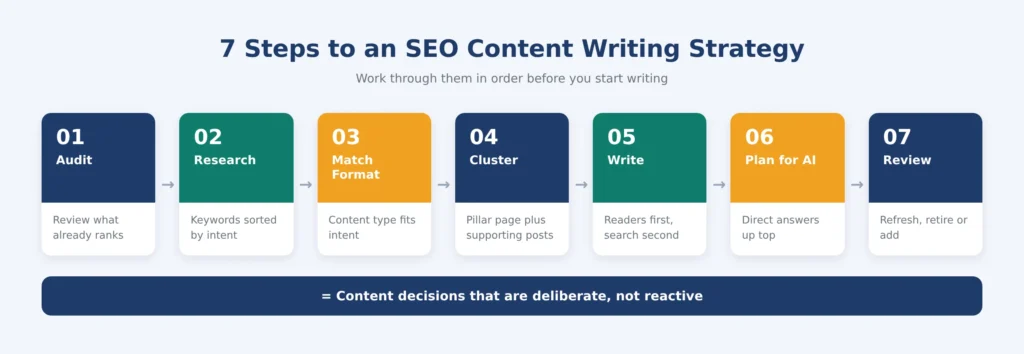
1. Audit what you already have
Before planning anything new, review the content you already have. Check what’s ranking, what’s getting traffic but not converting, and what’s outdated or thin. This stops you from duplicating work and often turns up quick wins, like pages sitting on page two that a refresh could push higher.
2. Research keywords by search intent, not just volume
Pull keyword ideas from research tools, competitor analysis, and your own Google Search Console data, then sort them by intent: informational, navigational, transactional, or commercial investigation. A high-volume keyword with the wrong intent for your business is a weaker target than a smaller one that fits.
PRO TIP
Look at what’s already ranking before you commit to a keyword. If the top results are all short listicles, a long essay probably won’t break in, and the reverse is just as true.
3. Match content type to intent
An informational search deserves a guide or explainer. A transactional search deserves a product or service page. Mix them up, for example by writing a sales page for an informational query, and the page will usually underperform no matter how well it’s optimized otherwise.
4. Build a content calendar around topic clusters
Group related keywords under one core topic instead of spreading them across unconnected posts. In a cluster, one pillar page is supported by several related articles that link back to it. This usually performs better than isolated content, because it shows search engines you cover the topic in depth rather than in scattered pieces.
GETMERANK TIP
Before writing a new post, search your own site (site:yourdomain.com plus the keyword) to check you don’t already have a page targeting it. If you do, improve that page instead of creating a competitor for it.
5. Write for readers first, structure for search engines second
Once a topic is assigned, the SEO content writing itself should focus on genuinely answering the question, in natural language and with real expertise. This is where most SEO blog writing either earns its ranking or falls flat. Headers, short-answer summaries, bullet points, and internal links support that goal; they don’t replace it.
6. Build AI Overview and AI search visibility into the plan from the start
AI Overviews and AI-powered search are now a real part of how people find content, and writing for them doesn’t need different fundamentals from writing for traditional search. Google itself says there are no special optimizations or markup required to appear in AI Overviews. Content with a direct answer near the top, a clear structure, and real depth tends to perform well in both. This guide to optimizing content for AI search engines covers the structural choices that help.
DID YOU KNOW
Google’s AI Overviews reach more than 2 billion people a month, and Google says there’s no special markup needed to appear in them. Helpful, well-structured content is what gets picked up.
Since “SEO content strategy” is itself a query that already shows AI Overview results, treating AI visibility as an afterthought is a missed opportunity. For a closer look at what AI Overview optimization looks like in practice, this breakdown of Google AI Overviews optimization is worth reading alongside your keyword plan.
7. Track performance and revisit the plan regularly
A strategy isn’t a one-time document. Review rankings, traffic, and conversions regularly (quarterly works for most teams) and use that data to decide what to refresh, what to retire, and which new topics deserve a place on the calendar.
PRO TIP
Once a quarter, check Google Search Console for pages ranking in positions 8 to 20. They’re often the quickest wins in your whole strategy, because a focused refresh can push them onto page one.
What Does Good SEO Content Writing Actually Look Like in Practice?
A few practical habits separate SEO content writing that performs from content that just sits there.
- Lead with the answer. If someone searches “what is an SEO content strategy,” the first couple of sentences should answer that directly, not three paragraphs later.
- Use headers that match real questions. Headers written like actual search queries help readers and search engines jump straight to the section they need.
- Keep paragraphs short enough to scan. Long, dense blocks of text get skipped, even when the information inside them is good.
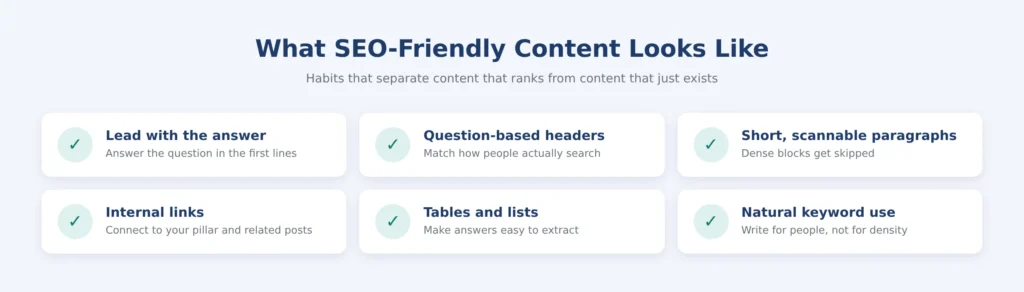
Here’s what that looks like in practice. Imagine a software company with an article on “project management best practices” written as one long essay with no subheadings. Restructure it with question-based H2s, a short, direct answer under each one, and a comparison table for tool options, and every section becomes a clear, standalone answer. That’s exactly the kind of content that tends to keep readers on the page longer and get picked up in “People also ask” results. The same principles apply to SEO blog writing in general: structure matters as much as the information itself.
HIGHLIGHT
Balanced take: structure makes good content easier to find and read, but it can’t rescue thin content. Headers and summaries help a strong answer get noticed; they won’t turn a weak one into a ranking page.
SEO Content Writing vs SEO Content Strategy: What’s the Difference?
| Factor | SEO Content Writing | SEO Content Strategy |
|---|---|---|
| What it is | The actual content creation and optimization | The overall plan guiding what gets created |
| Scope | One article, page, or piece at a time | The full content calendar and topic structure |
| Main focus | Clarity, structure, keyword usage, readability | Keyword research, intent mapping, prioritization |
| Time horizon | Per piece | Ongoing, reviewed quarterly or more often |
| Output | A published page | A documented plan and content calendar |
You need both. Strong writing without a strategy produces scattered wins. A strategy without strong writing produces well-planned content that still doesn’t rank.
What Mistakes Hurt an SEO Content Writing Strategy?
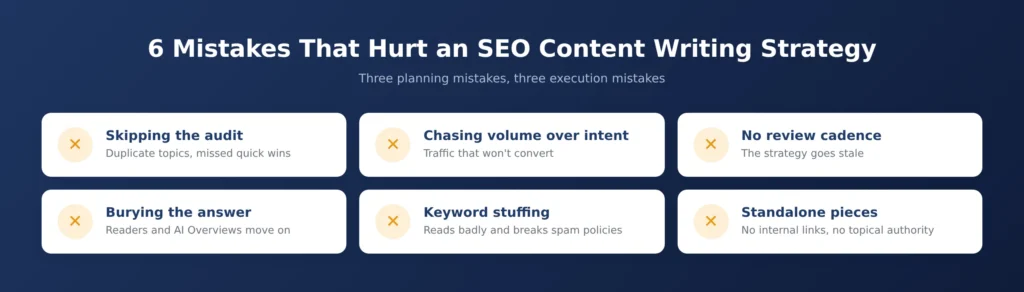
Planning Mistakes
A weak blog SEO strategy usually shows up in one of three ways.
- Skipping the audit: Planning new content without reviewing what you already have leads to duplicate topics and missed quick wins sitting on page two.
- Chasing volume over intent: A high-volume keyword with the wrong intent for your business brings traffic that won’t convert.
- No review cadence: A strategy built once and never revisited goes stale as competitor content and search behavior change.
Execution Mistakes
- Burying the answer: Making readers scroll through background before they reach the answer hurts readability and your chances of appearing in AI Overviews.
- Keyword stuffing: Repeating a target phrase unnaturally, instead of letting related, natural language carry the content, reads badly and is listed as a spam practice in Google’s own spam policies.
- Treating every piece as standalone: Publishing content with no internal links to related articles or a core pillar page throws away the topical authority a connected cluster builds.
How Get Me Rank Helps You Build an SEO Content Strategy That Ranks
Building and maintaining a real content strategy, from keyword research and intent mapping to a content calendar and ongoing performance reviews, takes steady time that most in-house teams just don’t have. At Get Me Rank, our dedicated SEO services team handles the research and strategic planning, so your content decisions are backed by real data instead of guesswork.
In practice, that means we take on the same steps covered in this guide, so your team can focus on running the business:
- Content audit: we review what you’ve already published, flag what’s ranking, what’s slipping, and what’s ready for a quick refresh.
- Keyword and intent research: every target is checked for search intent and business value, not just volume.
- Topic cluster planning: we map pillar pages and supporting posts so your content builds authority instead of competing with itself.
- Content calendar: a clear, prioritized plan with owners and deadlines, so nothing gets written without a reason.
- Writing and optimization: content that answers the question first and is structured for both search engines and AI Overviews.
- Reporting and refreshes: regular reviews of rankings and traffic, with updates scheduled before pages start to slip.
The writing matters just as much as the plan behind it. Pairing that strategy work with Get Me Rank’s dedicated content marketing services means the research turns into content that’s genuinely well written, not just technically optimized. That’s often the gap between a strategy that looks good on paper and one that actually moves rankings.
READY TO GROW?
Want content that’s planned to rank, not just published? Book a free strategy call, and we’ll map out an SEO content strategy built around your keywords, your audience, and your goals.
FAQs
1. What is an SEO content strategy?
In short, it’s the plan behind your content. An SEO content strategy sets out which topics you’ll cover, which keyword each page targets, the order you’ll publish in, and how you’ll measure results, so every piece has a job before anyone writes it.
2. How long does an SEO content strategy take to show results?
Expect months, not weeks. How long it takes depends on your site’s authority and how competitive your keywords are. Quick wins, like refreshing pages already sitting on page two, can move within weeks, while new topic clusters usually take several months to build authority.
3. How often should you publish new content?
There’s no magic number. Publishing consistently matters more than publishing often, and one well-researched post a week usually beats several thin ones. Pick a pace your team can keep up, and leave room in the calendar for refreshing older posts, not just adding new ones.
4. What is SEO content writing, and how is it different from copywriting?
SEO content writing creates content designed to be found in search, such as guides, explainers, and blog posts that answer a specific query. Copywriting is written to persuade, like sales pages, ads, and emails. The two often overlap: a strong service page needs both, so it ranks and converts.
5. How do you build a blog SEO strategy with a small team?
Focus beats volume. Pick one or two topic clusters closest to what you sell, map a handful of keywords to them and publish fewer, stronger posts. Refreshing older posts that already get some traffic is often the most efficient use of a small team’s time.
6. Do you need a different strategy for AI Overviews?
Not a fundamentally different one. Google says there are no special optimizations needed to appear in AI Overviews, so the same SEO content writing habits apply: lead with a clear, direct answer, keep the structure clean, and show real depth. That works in both traditional rankings and AI Overviews.
7. Can Get Me Rank handle both the SEO content strategy and the writing?
Yes. Get Me Rank’s SEO services team handles the research and planning, from keyword and intent mapping to the content calendar, and the content marketing team turns that plan into well-written, optimized content. Keeping both under one roof means the strategy and the writing never drift apart.
Conclusion
Writing good SEO content and having a real SEO content strategy solve different problems. One article can rank on its own, but consistent, compounding results come from a documented plan: knowing what to write, matching it to real search intent, organizing it into topic clusters, and reviewing what’s working often enough to keep adjusting. Treat writing and strategy as two separate but connected disciplines, and the gap between occasional wins and reliable traffic starts to close.