
Digital Marketing
Key Takeaways
- AI search doesn’t rank pages — it retrieves passages. ChatGPT, Google AI Overviews, and Perplexity pull small, self-contained “chunks” of your content, not your whole URL. Optimize at the paragraph level, not just the page level.
- You’re fighting two separate battles. First, your content has to be technically easy for an AI to retrieve (structure, schema, crawlability). Second, it has to be trustworthy enough for the AI to choose over competing sources (E-E-A-T, authority, freshness). Winning one without the other gets you ignored.
- Ranking #1 on Google still matters — but it’s no longer sufficient. Google’s AI Overviews lean heavily on top-10 organic rankings. Standalone tools like ChatGPT and Perplexity often cite sources that never show up on page one of Google at all.
- Clicks are no longer the only metric that matters. Track citation frequency and share of voice inside AI answers alongside your organic traffic — because a growing share of your audience will read a synthesized answer instead of visiting your page.
- The content that wins is boring, in a good way. No fluff, no throat-clearing intros, no keyword-stuffed paragraphs. Direct answers, real data, and clearly credited expertise consistently outperform “SEO-optimized” prose in AI citations.
Introduction
Type a question into Google, ChatGPT, or Perplexity today and there’s a good chance you won’t click a single blue link. You’ll get an answer — written, synthesized, and sourced from a handful of web pages the AI decided to trust.
That shift is quiet but massive. Search used to reward the page that ranked highest. Now it also rewards the passage that gets quoted. Two very different jobs, and most websites are still only doing the first one.
This guide walks through exactly how to optimize content for AI search engines – not as a theoretical framework, but as a repeatable process you can apply today, whether you’re optimizing a single article or rebuilding your content strategy around AI search optimization strategies for the long term. You’ll learn how AI systems actually decide what to cite, the content and technical changes that move the needle, and how to measure progress once clicks stop being the whole story.
How AI Search Actually Retrieves and Chooses Content
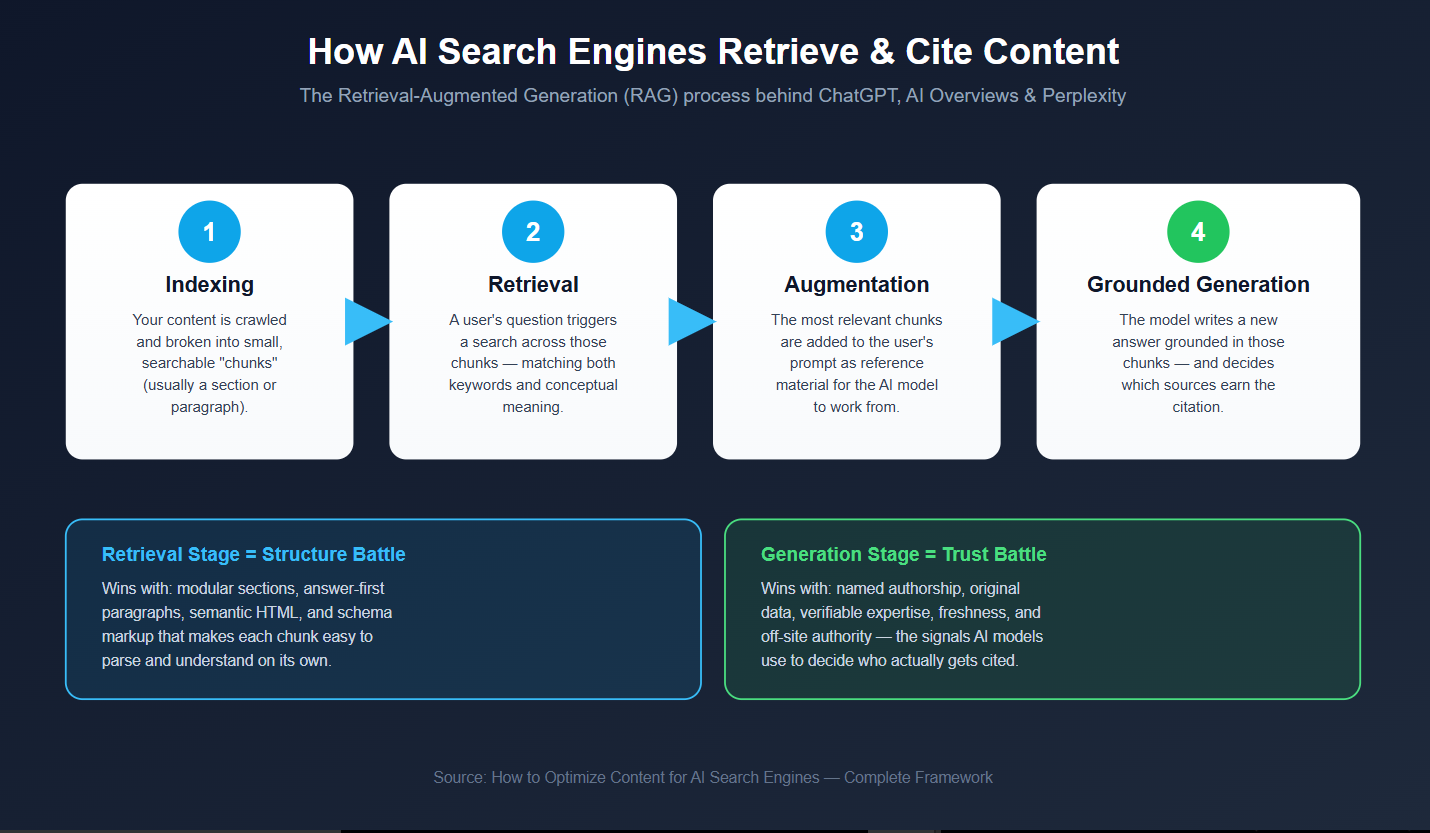
Before changing a single word on your site, it helps to understand the machinery you’re optimizing for. Most AI search tools — Google AI Overviews, ChatGPT Search, Perplexity, Claude — run on a process called Retrieval-Augmented Generation (RAG). It works in four steps:
How to Optimize Content for AI Search Engines
| Step | What Happens | Why It Matters to You |
| 1. Indexing | Your content is crawled, broken into small “chunks” (usually a paragraph or section), and converted into numerical representations stored in a searchable database. | If a section can’t stand alone as a chunk, it may never get retrieved — even if the page ranks well. |
| 2. Retrieval | When someone asks a question, the system searches that database for the chunks most relevant to the query — blending keyword matching with conceptual/semantic matching. | Your content needs to match intent and meaning, not just exact keywords. |
| 3. Augmentation | The retrieved chunks are fed into the AI model alongside the user’s original question, as reference material. | Only content the AI can confidently extract and understand makes it this far. |
| 4. Generation | The model writes a new, synthesized answer grounded in the retrieved chunks — and decides which sources to cite. | This is the “trust” stage. Structure gets you retrieved; credibility gets you cited. |
The practical takeaway: structure wins you a seat at the table (retrieval), and authority wins you the citation (generation). Everything in this guide maps to one of those two stages.
AI Search Optimization Strategies: The Full Checklist
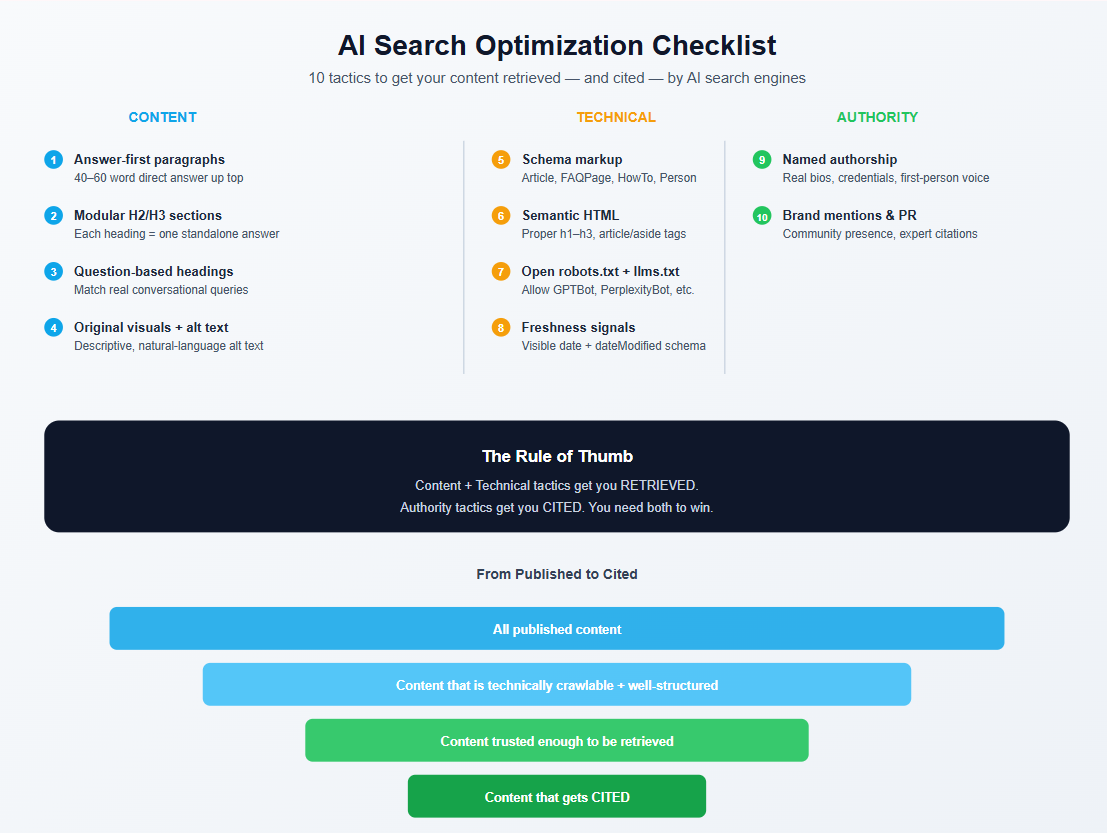
Use this as your working reference. Each row is expanded into a full section below.
| Focus Area | Tactic | Stage It Impacts |
| Content structure | Answer-first paragraphs, modular H2/H3 sections | Retrieval |
| Query targeting | Optimize for conversational, question-based intent | Retrieval |
| Technical markup | Schema (FAQPage, HowTo, Article, Person, Organization) | Retrieval |
| Semantic HTML | Clean <h2>, <ul>, <article> tags, no key info trapped in JS | Retrieval |
| Crawl access | robots.txt and llms.txt configured for AI crawlers | Retrieval |
| Trust signals | Author bios, original data, first-hand experience | Generation |
| Off-site authority | Backlinks, brand mentions, digital PR, community presence | Generation |
| Freshness | Visible “last updated” dates + dateModified schema | Both |
| Media | Original visuals, alt text, video transcripts | Both |
| Measurement | Track citation rate, not just rankings | Ongoing |
How to Optimize Content for AI Search Engines: Step by Step
1. Write Answer-First, Not Story-First
Traditional blog writing often opens with a hook, some scene-setting, and works its way to the point. AI systems don’t have patience for that — and increasingly, neither do readers.
Action:
- Lead with the definition, number, or conclusion
- Follow with supporting detail, nuance, or an example
- Save the “why it matters” framing for after the answer, not before it
This single change is often the highest-leverage edit you can make to an existing article, because it turns a paragraph into a self-contained, citable chunk.
2. Build in Modular, Passage-Level Sections
AI retrieval doesn’t care about your whole page — it retrieves the specific section that answers the query. If your H2 on “content freshness” also drifts into backlinks and schema markup, none of it is a clean, quotable unit.
Action:
- Treat every H2/H3 as a standalone answer to one specific question
- Keep each section focused on a single idea — split it if it starts covering two
- Use the heading itself as the question your reader (and the AI) is asking
Quick test: If you deleted every other section of your article, would this one still make complete sense on its own? If not, restructure it.
3. Target Question-Based, Conversational Queries
People don’t ask AI tools the same way they typed into Google. Instead of “AI SEO tips,” they ask, “How do I optimize content for AI search engines without breaking my existing rankings?”
Action:
- Mine “People Also Ask,” Reddit threads, and your own support/sales conversations for natural-language questions
- Use these questions directly as H2s and H3s wherever they fit the topic
- Cover the full question cluster around a topic — not just the head-term keyword — so your page becomes the single best answer instead of one of many partial ones
This is also where optimizing for Google AI Overviews and optimizing for standalone tools like ChatGPT start to diverge slightly: Overviews still lean on traditional ranking signals, while conversational tools reward the clearest direct answer regardless of where you rank.
4. Format for Skimmability and Extraction
LLMs extract information the way a very fast, very literal reader would — not the way a human skims a page. Long paragraphs, buried lists, and dense blocks of text slow that down and increase the odds your best insight gets skipped over.
Action:
- Keep paragraphs to 2–4 sentences
- Use numbered lists for steps and processes, bullets for characteristics or options
- Bold the specific term or number a reader (or AI) would be scanning for
- Avoid multi-column tables for anything that needs to be parsed as a single fact — a simple bullet or “label: value” pair is safer for complex data, since not every AI parser handles table structure equally well
5. Back Every Claim With Real Evidence
This is where most “AI-optimized” content quietly fails. Clean formatting gets you retrieved. It does nothing to get you cited over a competing source that says the same thing with better proof behind it.
Action:
- Cite original research, internal data, or verifiable statistics wherever possible
- Attribute expert commentary to a named, credentialed person — not “our team”
- Replace hedging language (“might,” “could,” “some believe”) with direct, evidence-backed statements
- Add a real case study or example instead of a hypothetical one
6. Make Authorship and Expertise Visible
AI systems increasingly treat authorship as a trust signal, not decoration. An anonymous, unattributed article competes at a structural disadvantage against one with a named, credentialed author.
Action:
- Add a full author bio with relevant credentials, experience, and a link to a professional profile (LinkedIn, etc.)
- Use Person schema to connect the author to the article and to their credentials
- Where relevant, write in the first person about direct experience: “In three years running paid campaigns for SaaS clients, I’ve seen…”
7. Add Structured Data That Matches Your Content Type
Schema markup doesn’t change what a human sees — it tells the AI unambiguously what each piece of content is, removing guesswork from the retrieval stage.
| Schema Type | Use It For |
| Article | Every blog post — links content to author and publisher |
| FAQPage | Genuine Q&A sections (not just for the old visual snippet — it’s still one of the cleanest formats for AI ingestion) |
| HowTo | Step-by-step processes and tutorials |
| Person | Author and expert bios |
| Organization | Brand identity, logo, and official profiles |
Note: Google retired the visual FAQ rich snippet in 2023 — but the underlying FAQPage schema is still fully useful for AI ingestion. Don’t confuse a visual UI change with a machine-readability change.
8. Refresh Content on a Schedule, Not Just When You Remember
Recency is frequently the tiebreaker between two similarly strong sources, especially in fast-moving categories like AI, finance, or health.
Action:
- Display a visible “last updated” date on evergreen content
- Update the dateModified field in your schema every time you make a substantive edit
- Set a recurring quarterly review for your highest-traffic pages instead of letting them go stale
9. Add Original Visuals — With Real Alt Text
Multimodal AI models increasingly process images, not just text, and visuals also make your content more useful to human readers arriving from an AI answer.
Action:
- Use original diagrams, screenshots, or annotated visuals instead of stock photography wherever you’re explaining a process
- Write descriptive, natural-language alt text (not a keyword dump) — describe what’s actually in the image
- Add a short transcript for any embedded video so its content is accessible as text, too
10. Earn Mentions, Not Just Backlinks
AI systems weigh your brand’s reputation across the web, not just links pointing at one page. A mention in a respected industry publication — even unlinked — still builds the kind of topical trust that influences citation decisions.
Action:
- Contribute genuine, detailed answers on relevant Reddit and Quora threads (not link drops)
- Pitch expert commentary to newsletters, podcasts, and trade publications in your niche
- Pursue digital PR and guest contributions from sites that are already topically relevant to you
- Keep your brand’s presence consistent — same bio, same credentials, same tone — across every platform
How to Optimize Your Site for AI Search Algorithms (Technical Checklist)
Great content still needs a site that lets AI systems find, crawl, and parse it. Use this checklist alongside your content work:
- Allow AI crawlers. Check your robots.txt isn’t blocking GPTBot, Google-Extended, PerplexityBot, or ClaudeBot — a blanket Disallow: / makes your entire site invisible to AI training and retrieval.
- Add an llms.txt file. Still an emerging, unofficial standard — but early adopters give AI tools a clean, prioritized map of their most valuable content. Low cost, growing upside.
- Use semantic HTML. Wrap your main content in <article>, use real <h1>–<h3> hierarchy, and keep supplementary content (ads, related-post widgets) in <aside> so AI systems know what to prioritize.
- Avoid gatekeeping key information in PDFs or images only. Both are harder for most AI parsers to extract reliably — always have the core text present in the HTML.
- Keep load speed healthy. Slow-loading pages risk timing out AI crawlers before they finish parsing the content, the same way they hurt human patience.
- Consolidate instead of fragmenting. One comprehensive guide on a topic outperforms five thin posts that each cover a sliver of it — AI tools strongly prefer a single, complete source of truth.
If this feels like a lot to audit and fix in-house, this is exactly the kind of gap our SEO Services are built to close — from technical crawlability audits through to full content restructuring.
SEO for AI Search vs. Traditional SEO: What’s Actually Different
| Traditional SEO | SEO for AI Search |
| Optimizes the page (URL-level ranking) | Optimizes the passage (chunk-level retrieval) |
| Primary KPI: rankings, CTR, organic traffic | Primary KPI: citation/inclusion rate, share of voice |
| Keyword density and placement | Semantic clarity and entity relationships |
| Backlinks as the main authority signal | Backlinks plus brand mentions, community presence, and verifiable expertise |
| One-time on-page optimization | Continuous freshness and re-optimization |
Traditional SEO isn’t obsolete — it’s the foundation. Google’s AI Overviews still correlate strongly with top-10 organic rankings, so ignoring classic SEO fundamentals to chase “AI optimization” tactics is a mistake. Think of this as an additional layer on top of solid SEO, not a replacement for it.
Common Mistakes That Quietly Kill AI Visibility
- Burying the answer under three paragraphs of preamble. If the AI has to read half the page to find the point, it will often find that point somewhere else instead.
- Publishing unedited, generic AI-written content. It reads as generic to AI ranking systems too — there’s no first-hand experience or original insight to reward.
- Treating schema as a “nice to have.” Skipping it makes your content harder to parse with zero upside.
- Letting your best content go stale. A three-year-old “last updated” date is a quiet signal to skip you in favor of something current.
- Optimizing only for Google, and only for rankings. Standalone tools like ChatGPT and Perplexity behave differently — and increasingly carry meaningful search volume of their own.
Put This Into Practice
Optimizing content for AI search isn’t a one-time project — it’s an ongoing discipline that touches content, technical SEO, and brand authority all at once. If you’d rather have that handled end-to-end, our AI SEO Optimization Services cover the full stack: content restructuring, schema implementation, technical crawlability, and authority building — so your content shows up whether someone searches on Google, asks ChatGPT, or gets an AI Overview.
Frequently Asked Questions
1. How do I optimize content for AI search engines?
Structure content around direct, answer-first sections (40–60 words), use question-based headings, back claims with real data and named expertise, and add schema markup (Article, FAQPage, HowTo) so AI systems can parse and trust what they retrieve.
2. What’s the difference between SEO for AI search and traditional SEO?
Traditional SEO optimizes whole pages to rank in a list of links. SEO for AI search optimizes individual passages to be retrieved and cited inside a synthesized answer — it depends on the same fundamentals (relevance, authority) but adds structure and trust requirements traditional ranking doesn’t need.
3. How do I optimize my site for AI search algorithms specifically?
Start technical: confirm your robots.txt allows major AI crawlers, add semantic HTML and schema markup, keep load times fast, and consider an llms.txt file. Then layer content optimization — answer-first structure, modular sections, and visible freshness — on top.
4. Do I need to abandon traditional SEO to focus on AI search optimization strategies?
No. Google’s AI Overviews still correlate closely with top-10 organic rankings, so strong traditional SEO remains the foundation. AI search optimization is an additional layer, not a replacement.
5. How do I know if AI tools are actually citing my content?
Manually test your target queries in ChatGPT, Perplexity, and Google AI Overviews to see who gets cited. For ongoing tracking at scale, dedicated AI-visibility monitoring tools can track citation frequency automatically.
6. Does adding schema markup guarantee I’ll get cited?
No single tactic guarantees citation. Schema improves how easily AI systems can parse and trust your content, which raises your odds — but authority, freshness, and answer quality still decide who actually gets cited.
Conclusion
AI search hasn’t replaced traditional search — it’s added a second, faster layer on top of it, and that layer runs on different rules. Structure gets your content retrieved. Genuine expertise, evidence, and freshness get it cited. Miss either half, and even great content stays invisible in the answers people are increasingly reading instead of clicking through to a page at all.
Start with your best-performing content, restructure it for answer-first retrieval, back it with real evidence and visible expertise, and make the technical side — schema, crawl access, semantic HTML — a standing habit rather than a one-time fix. Do that consistently, and you’re optimizing for where search is actually headed, not just where it’s been.