Digital Strategy
Key Takeaways
- Brand visibility in AI search engines is earned through three signals: mentions, citations, and recommendations — not blue-link rankings.
- AI systems pull from the whole web (reviews, forums, PR, Wikipedia) — not just your website — so owned-channel SEO alone won’t get you cited.
- Answer-first, well-structured content is easier for AI to extract, quote, and trust than long, unstructured pages.
- Third-party consensus (independent sources repeating the same facts about your brand) is one of the strongest trust signals AI models use.
- AI strategic visibility is measurable: track mention rate, citation rate, share of voice, and AI referral traffic — not vanity impressions.
- This is a compounding, ongoing practice, not a one-time optimization project.
Search Has Quietly Changed — Has Your Brand Kept Up?
Ask ChatGPT, Gemini, or Google’s AI Overviews a question your buyers would ask, and you’ll notice something: there’s no page two. There’s no list of ten blue links to scroll through. There’s one synthesized answer, and it usually names three to five brands. If yours isn’t one of them, you don’t just rank lower — you’re invisible at the exact moment someone is deciding who to trust.
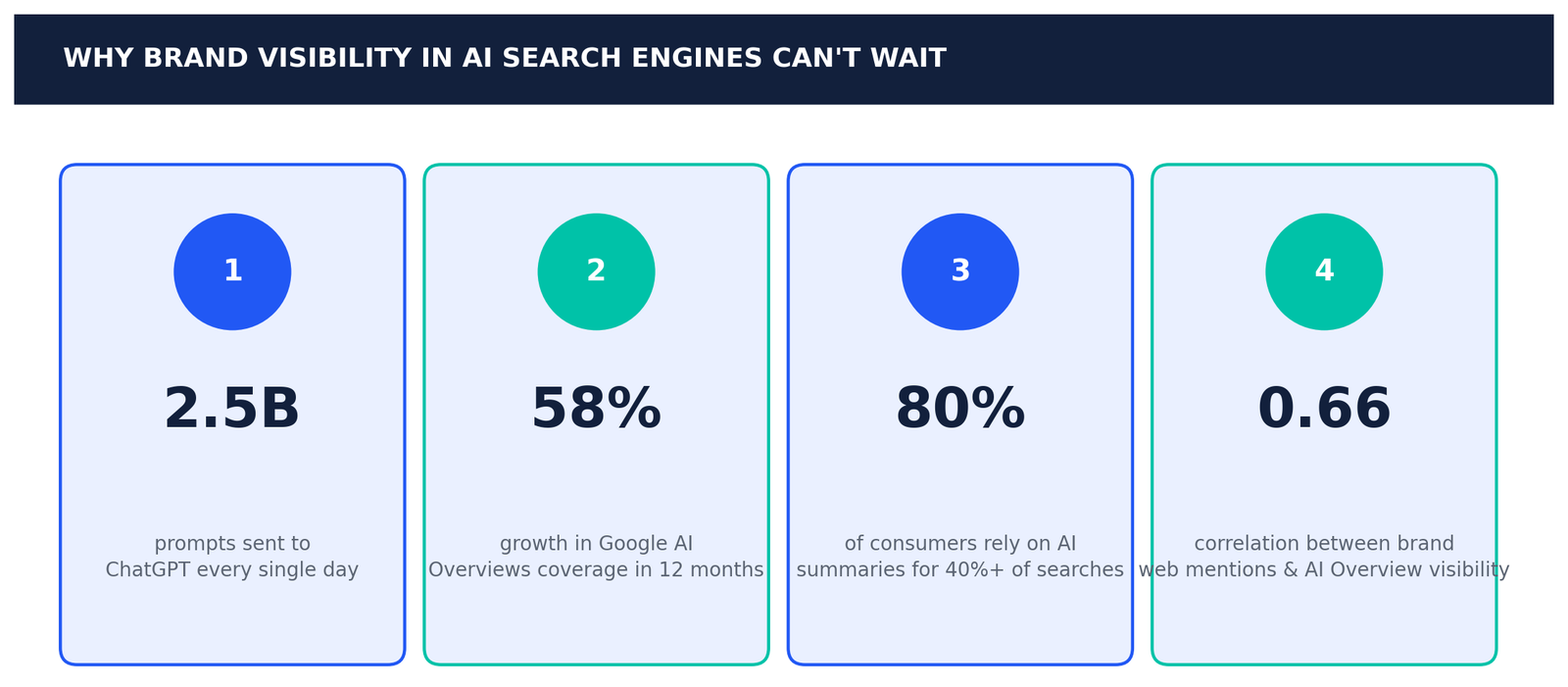
This shift is already massive. ChatGPT alone fields roughly 2.5 billion prompts a day, and Google’s AI Overviews expanded coverage by 58% in a single year. A large share of consumers now lean on AI-generated summaries for a meaningful chunk of their searches, often forming an opinion before they ever click through to a website.
That’s the problem this guide solves. You’ll learn exactly how to improve brand visibility in AI search engines using a repeatable, 7-step AI strategic visibility framework — what signals actually influence AI recommendations, which mistakes quietly sabotage otherwise good content, and how to measure whether any of it is working. No recycled theory — just the mechanics, explained clearly enough to action this week.
How to Improve Brand Visibility in AI Search: 2026 Strategies and a Repeatable Framework
Quick Answer: The AI Strategic Visibility Framework at a Glance
If you only have two minutes, here’s the short version. Each step below feeds the next — skipping the technical layer, for example, undermines everything built on top of it.
What Does Brand Visibility in AI Search Engines Actually Mean?
Before optimizing for it, it helps to define it precisely. Brand visibility in AI search engines isn’t one metric — it’s the combined strength of three distinct signals AI systems generate when they answer a question in your category:
- Mentions — your brand is named in an AI response, with or without a clickable link. This is the widest, most common form of visibility.
- Citations — your content is directly referenced as the source behind a claim, usually with a link. This signals the model considers your page authoritative enough to lean on.
- Recommendations — your brand appears inside a curated shortlist (“the best tools for X are…”). This is the highest-value outcome because it places you in the buyer’s actual consideration set.
Together, these create a new competitive metric: share of voice inside AI answers. Because a typical AI response surfaces only three to five brands per query, you’re no longer competing for position four on page one — you’re competing for one of a handful of seats at the table, and the brands left out don’t get a consolation prize.
Why AI Search Is Rewriting the Rules of Discovery
Traditional SEO optimized for ranking a page. AI search optimizes for answering a question — and it does this using two mechanics worth understanding, because they explain almost every tactic in this guide.
Retrieval-Augmented Generation (RAG)
Most AI search features — including Google’s AI Overviews — don’t invent answers from thin air. They retrieve real, current pages from a search index, then generate a response grounded in that retrieved content. This is exactly why the fundamentals of technical SEO and crawlability still apply: if your page can’t be retrieved, it can’t be cited, no matter how well-written it is.
Query Fan-Out
A single question triggers a cluster of related, silent queries behind the scenes. Someone asking “best project management software for a 10-person team” might implicitly trigger fan-out queries around pricing, integrations, and alternatives — and your brand needs a credible answer waiting for each branch, not just the headline query.
If you want the official mechanics straight from the source, it’s worth understanding how to optimise for Google AI Overviews — since AI Overviews still run on Google’s core ranking and retrieval systems, not a separate algorithm.
The 4 Signals That Decide Whether AI Recommends Your Brand
AI models don’t rank pages the way traditional search does. Instead, they weigh confidence signals to decide whether your brand is credible enough to mention. Four signals matter most:
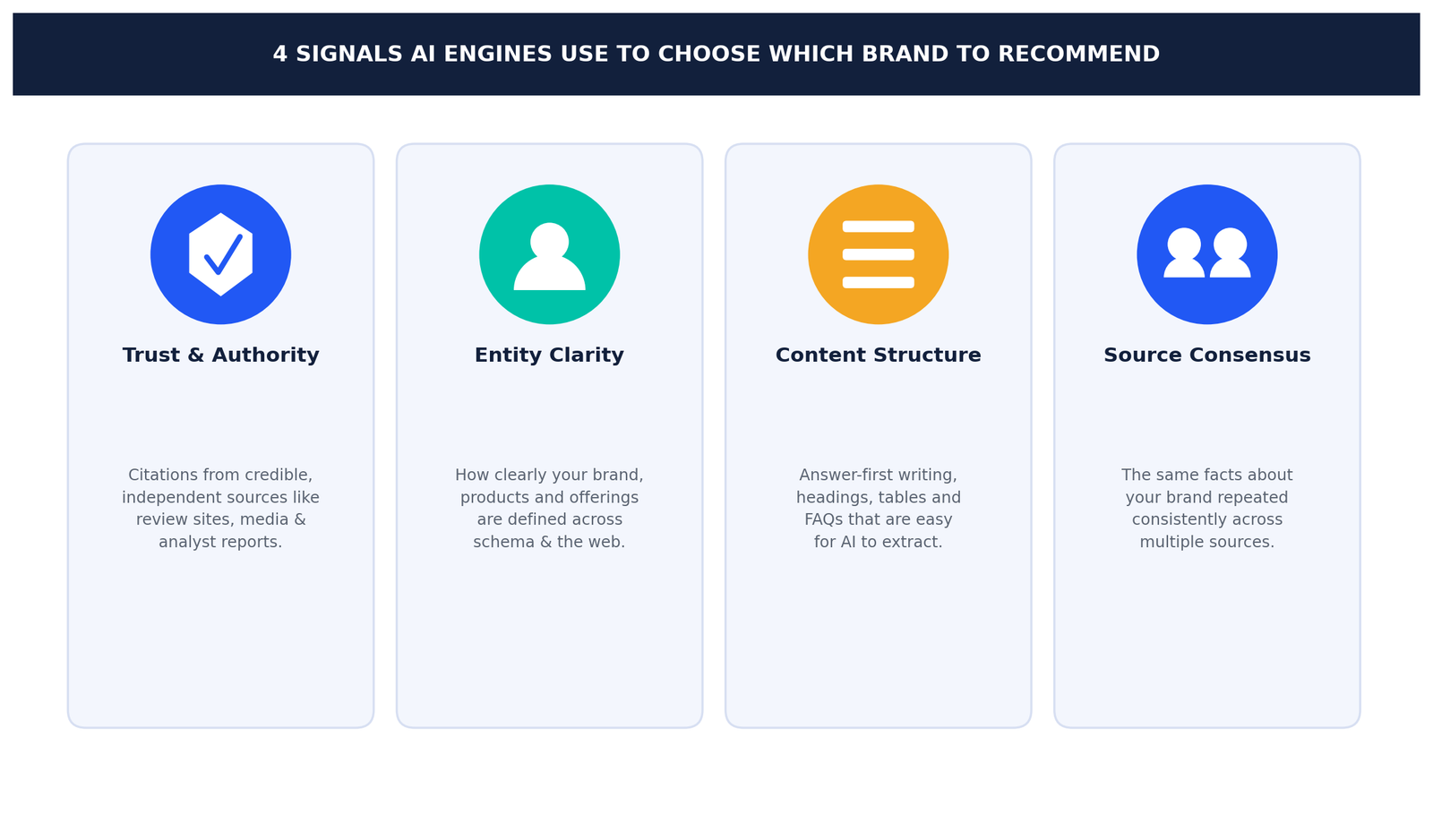
- Trust & authority — citations from independent, credible sources: review platforms, analyst reports, and reputable media outweigh anything you say about yourself.
- Entity clarity — how unambiguously your brand, products, and category are defined through schema markup, a maintained knowledge-panel presence, and consistent naming.
- Content structure — whether your pages are written to be extracted: clear headings, short answer-first paragraphs, tables, and definitions instead of dense narrative blocks.
- Source consensus — the same facts about your brand repeated consistently across multiple independent sources, which is far harder to fake than a single glowing testimonial.
Notice what’s missing from that list: keyword density. AI models understand synonyms and intent well enough that stuffing exact-match phrases adds little. What moves the needle is being genuinely easy to verify.
How to Improve Brand Visibility in AI Search Engines: The 7-Step Strategies & Framework
This is the operational core of the guide — a sequence you can run quarter over quarter. If you’d rather have a specialist team execute this end-to-end, this is precisely the work covered by AI SEO optimisation services, but every step below is fully doable in-house.
 Step 1 — Audit Your Current AI Footprint
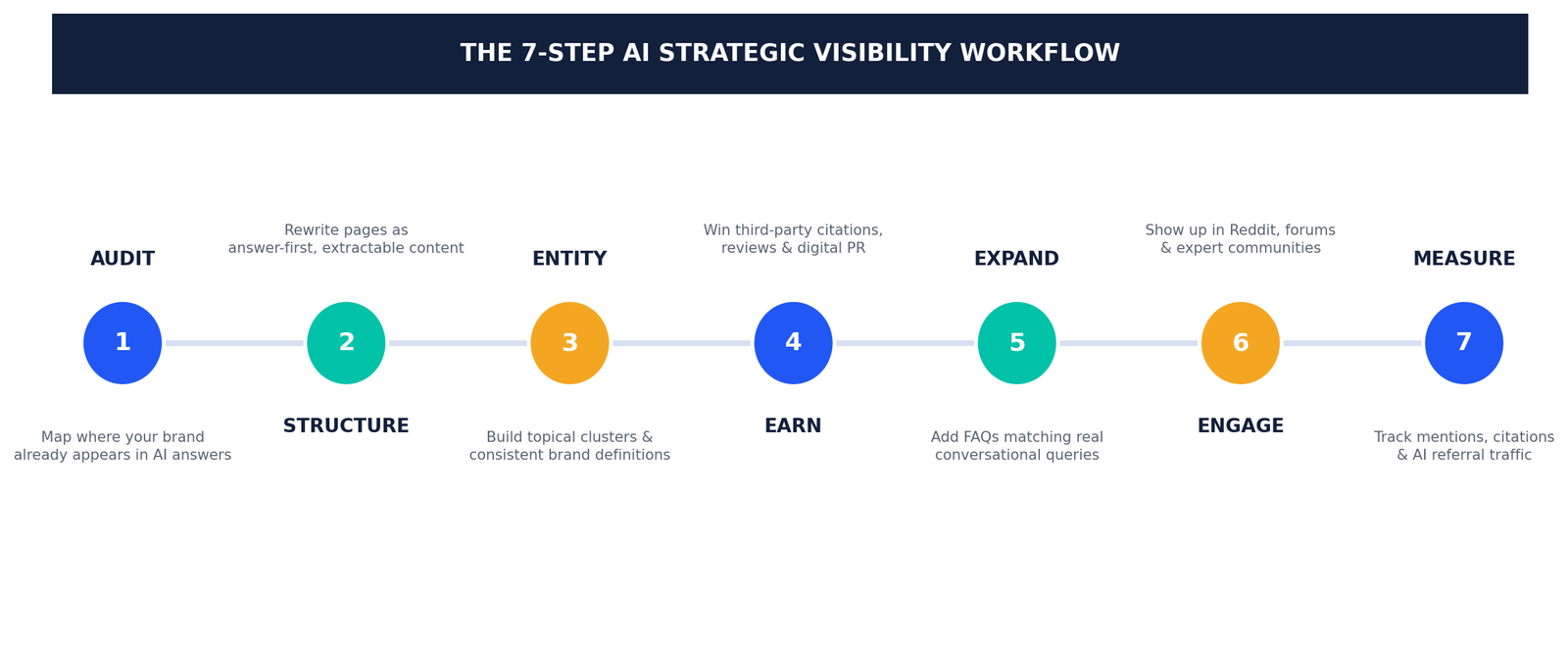 Step 1 — Audit Your Current AI Footprint
You can’t improve a number you haven’t measured. Start with two parallel audits:
- Output audit: Run 20–50 real buyer-intent prompts across ChatGPT, Gemini, Perplexity, and Copilot in incognito mode. Log whether your brand appears, in what position, and what competitors show up instead.
- Input audit: Check your server logs for AI crawler activity (GPTBot, ClaudeBot, Google-Extended, PerplexityBot) and confirm none are accidentally blocked in robots.txt — a surprisingly common, entirely avoidable mistake.
Repeat this monthly. AI answers shift with model updates, so a single snapshot tells you almost nothing about a trend.
Step 2 — Structure Content So AI Can Actually Extract It
Long, narrative pages are hard for AI models to quote cleanly. Rewriting for extractability is one of the fastest wins available, and it’s the exact focus of our companion guide on how to optimize content for AI search engines.
- Answer the core question in the first 40–80 words of each section — don’t bury the answer under three paragraphs of context.
- Use descriptive H2/H3 headings that mirror how people actually phrase questions.
- Convert comparisons, steps, and definitions into tables and numbered lists instead of prose.
- Avoid hiding key information inside tabs, accordions, or JavaScript-only components AI crawlers may not render.
- Add specific numbers and data points — AI systems preferentially extract concrete, quotable facts over vague claims.
Step 3 — Build Entity Authority Through Topical Clusters
AI visibility rewards brands that are clearly understood as an entity, not just ranked for isolated keywords. Instead of one page trying to cover everything, build a cluster: one authoritative pillar page plus supporting articles on adjacent questions, all interlinked with descriptive anchor text.
- Give every core product, service, and concept its own dedicated page rather than folding it into a general overview.
- Keep your brand name, category description, and value proposition worded consistently across your site, LinkedIn, review profiles, and press mentions.
- Add Organization, Person, and Product schema so the relationships between your brand and its offerings are machine-readable.
Step 4 — Earn Third-Party Citations and Reviews
This is the step most brands underinvest in, and it’s usually the one with the highest payoff. AI models weigh independent validation far more heavily than owned-channel claims.
- Prioritize being featured in comparison articles, “best of” lists, and industry roundups — these are disproportionately referenced by AI systems.
- Keep review profiles (G2, Capterra, Trustpilot, industry-specific platforms) active, and make sure reviews render as crawlable HTML, not JavaScript-only widgets.
- Pitch original research, proprietary data, or a genuinely informed opinion to journalists and industry publications — recycled takes rarely earn a citation.
- Maintain accurate, current information anywhere your brand has a public profile — outdated details erode the consensus AI is looking for.
Step 5 — Expand FAQ and Conversational Coverage
People phrase questions to AI very differently than they type into a search box — longer, more specific, and closer to natural speech. Build content that mirrors this directly, which pairs well with dedicated guidance on writing content for AI Overviews.
- Write FAQs that answer one specific, real buyer question each — not generic filler.
- Build comparison content (“X vs. Y”) since AI systems reference these heavily when a user is deciding between options.
- Cover use-case-specific scenarios, not just broad category definitions.
- Update FAQs quarterly as buyer language and product details evolve.
Step 6 — Show Up Where AI Already Looks: Communities
Reddit threads, niche forums, and Q&A platforms are cited by AI systems far more often than most brands expect, especially for recommendation-style questions. Genuine, non-promotional participation from real team members — sharing data, answering questions honestly, engaging over time — builds exactly the kind of consensus signal AI models trust. Drive-by links and thinly veiled self-promotion tend to do the opposite.
Step 7 — Measure, Attribute, and Iterate
Close the loop by connecting visibility signals to business outcomes. Track these four metrics monthly, using a fixed prompt set so results are comparable month over month:
6 Mistakes That Quietly Kill AI Strategic Visibility
Most brands that struggle here aren’t lazy — they’re applying outdated assumptions to a system that works differently. Watch for these specifically:
- Treating it as an SEO side project — AI visibility spans content, PR, product, and analytics; siloing it under one team caps its impact.
- Blocking AI crawlers by accident — robots.txt rules written years ago sometimes block GPTBot or ClaudeBot without anyone noticing.
- Hiding proof behind JavaScript — reviews or FAQs that only render client-side are effectively invisible to most AI retrieval systems.
- Publishing thin pages for every query variation — this dilutes authority and can trigger scaled-content spam policies rather than earning more citations.
- Chasing inauthentic mentions — manufactured buzz is easier for both search engines and AI systems to detect and discount than most brands assume.
- Never connecting visibility to revenue — without attribution, AI visibility work is the first budget line cut when priorities shift.
Frequently Asked Questions
1. What is brand visibility in AI search engines?
It’s how often, and how prominently, AI platforms like ChatGPT, Gemini, and Perplexity mention, cite, or recommend your brand when someone asks a relevant question. Unlike traditional search, which surfaces ten results, AI search typically names only three to five brands per answer — so inclusion matters far more than position.
2. How is AI strategic visibility different from traditional SEO?
Traditional SEO optimizes for ranking a page on a results list. AI strategic visibility optimizes for being trusted enough to be quoted, summarized, or recommended inside a single generated answer — which depends more on structure, entity clarity, and third-party consensus than on backlinks and keyword targeting alone.
3. How long does it take to improve brand visibility in AI search engines?
Most brands see measurable movement within 60–120 days of consistent effort, though technical fixes (like unblocking a crawler) and strong new proof content can produce earlier wins. Momentum compounds — brands that stop after one optimization sprint tend to lose ground within a quarter.
4. Do customer reviews really affect AI search visibility?
Yes, significantly. AI systems reference customer reviews across a large share of their responses, but only when those reviews are crawlable — visible in a page’s HTML rather than locked inside a JavaScript-only widget. Fresh reviews also carry more weight than older ones.
5. Can small businesses compete with large brands in AI search?
Yes. AI models weigh authority, clarity, and consensus more heavily than brand size or budget. A smaller company with strong reviews, well-structured content, and genuine community presence can out-cite a larger competitor whose signals are weaker or inconsistent.
6. Is traditional SEO still relevant if I’m optimizing for AI search?
Completely. Google has confirmed that AI Overviews run on the same core Search ranking and retrieval systems as traditional results — a page still needs to be indexed, crawlable, and genuinely useful before it can ever be surfaced or cited by AI features.
Make AI Visibility a System, Not a Sprint
AI isn’t replacing search — it’s compressing it into a single, high-stakes answer, and the brands that get cited consistently are the ones that treat visibility as an ongoing system rather than a one-off project. Start with the audit, fix the technical and structural basics, then layer in third-party proof and measurement. Each step in this framework reinforces the next, and the compounding effect is exactly why brands that start now will still be the ones AI recommends a year from today.
If your current content isn’t showing up in AI answers yet, the fastest next step is usually the simplest one: pick five real buyer questions, ask them to ChatGPT and Gemini this week, and see exactly where you stand.