Social Media Marketing
Key Takeaways
- Engagement is every measurable interaction — likes, comments, shares, saves, clicks and DMs — and in 2026 the deeper signals (shares and saves) matter far more than likes.
- Benchmarks vary wildly by platform: TikTok averages around 3.70%, LinkedIn company pages around 5.20%, while Instagram (~0.48%) and Facebook (~0.15%) keep sliding.
- LinkedIn is the only major platform where engagement is rising — up roughly 8% year over year.
- Video dominates: posts with video reportedly earn up to 1,200% more shares than text and image posts combined.
- Engagement now feeds AI search visibility — the trust and demand signals it creates influence how often AI Overviews and assistants surface your brand.
Introduction
Here is the uncomfortable truth most dashboards hide: you can gain followers every month and still be invisible. What tells a platform your content deserves to be seen is engagement — the likes, comments, shares, saves and clicks that prove real people cared enough to react. In 2026, algorithms lean on those signals harder than ever, and so do the AI systems now answering people’s questions.
This guide pulls together genuine 2026 benchmark data, breaks down how engagement behaves on each platform, and gives you ten tactics you can act on this week. Whether you are trying to understand what is engagement on social media for the first time or fine-tuning a mature strategy, you will leave with numbers to aim for and a clear plan to hit them.
KEY POINT
Not all interactions are equal — shares and saves pull far more weight than a quick like. Think of engagement as a ladder of effort: a like takes half a second, a comment takes thought, and a share puts someone’s own reputation on the line.
What Is Social Media Engagement?
If you have ever searched for a simple social media engagement definition, that is it in one line. But the useful version goes a step further: engagement is the currency platforms use to decide what to amplify. Every reaction is a tiny vote, and the posts that collect the most votes — especially the high-effort ones like comments and shares — get pushed to more feeds.
It helps to picture engagement as a ladder of effort. A like takes half a second. A comment takes thought. A share puts someone’s own reputation on the line. The higher up the ladder an interaction sits, the stronger the signal — which is why a post with 50 thoughtful comments often outperforms one with 500 silent likes.
REMEMBER
The six core interaction types — likes, comments, shares, saves, clicks and DMs — range from the lightest signal to the strongest. A post with 50 thoughtful comments often outperforms one with 500 silent likes.
Why Does Social Engagement Matter So Much in 2026?
Buffer’s analysis of millions of posts makes the point clearly: the channels that win attention in 2026 are the ones built for interaction. Their data shows LinkedIn document carousels reaching a median engagement rate near 21.77% — roughly three times the reach of standard image or video posts — while short video keeps outperforming almost everything on TikTok and Instagram. Picking the right channel is half the battle.
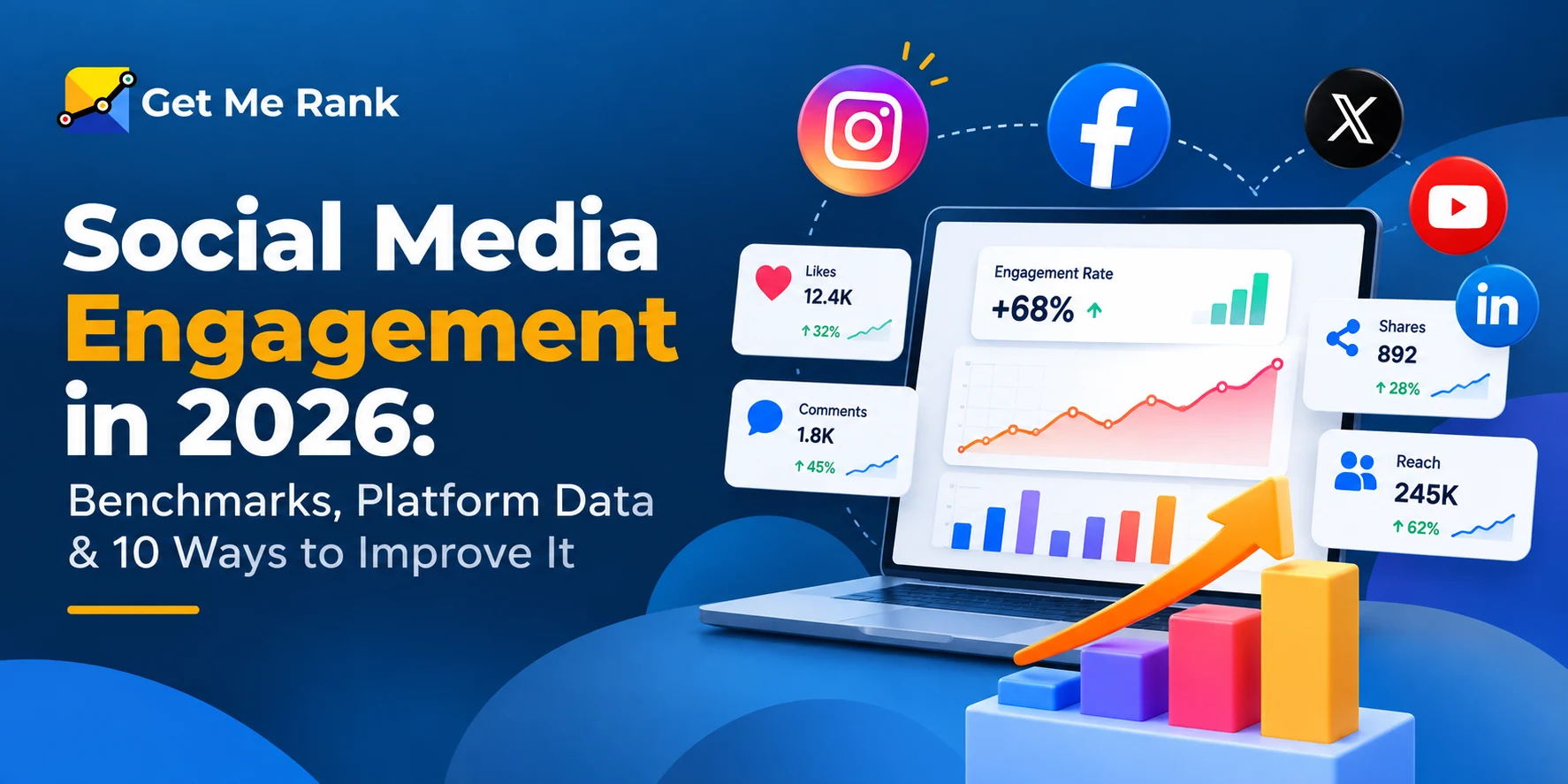
Social Media Engagement in 2026: Benchmarks, Platform Data & 10 Ways to Improve It
Four reasons engagement should sit at the centre of your strategy
- It unlocks free reach. Strong early interaction tells the algorithm to show your post to people who don’t follow you yet — the cheapest growth there is.
- It builds trust and authority. An active comment section signals a real, credible brand. This is the social proof that turns first-time viewers into followers.
- It drives measurable business outcomes. Strong social media customer engagement shortens the path from discovery to enquiry — engaged audiences click, DM and buy at far higher rates.
- It compounds. Every reply, save and share feeds the next post’s performance, so consistent engagement creates a snowball rather than a one-off spike.
This is also where consistency becomes a resourcing question. Keeping a reliable posting rhythm and replying fast is hard to sustain in-house, which is why many growing brands lean on a dedicated social media marketing service to keep the cadence steady while the strategy scales.
GETMERANK TIP
Consistency is the biggest variable most brands underestimate. A strong post once a month gets buried; a good post three times a week builds momentum the algorithm rewards.
10 Ways to Improve Your Engagement on Social Media in 2026
Ten tactics that match how platforms reward content in 2026.
1. Hook in the first two seconds
On video, the opening frame decides everything — lead with the payoff, a bold claim or a question, not a slow intro. People decide whether to keep watching before your brand name even appears, so skip the “Hey guys, welcome back” and open on the result: the finished room, the surprising number, the mistake everyone makes. A strong hook lifts watch time, and watch time is what tells the algorithm to push the video further.
2. Reply to every comment, fast
Responding within the first hour can multiply reach, because early back-and-forth tells the feed your post is alive. Treat your comment section like a conversation, not a noticeboard. Ask a follow-up question back, pin the best comment to spark a thread, and reply with a sentence rather than an emoji — each reply counts as an interaction and invites the next one. Brands that answer quickly also train their audience to expect a response, which keeps people coming back to comment again.
3. Post native video and Reels
Short-form video earns the most interaction across almost every platform — and uploading natively (not a link) is what the algorithm rewards. A YouTube or external link buried in a caption gets throttled because platforms want people to stay put. Shoot vertical, keep it under 30 seconds for the first few, and repurpose one idea into a Reel, a TikTok and a LinkedIn clip instead of making three from scratch.
4. Lean into carousels and short-form
Swipeable carousels keep people on your post longer; on LinkedIn, document carousels are among the highest-engagement formats available. Each swipe is a micro-commitment that signals interest, so structure them like a mini-story — a hook slide, three to five value slides, and a clear closing slide. A simple “tip per slide” format often outperforms a polished brochure, because it’s easy to consume and easy to save for later.
5. Ask questions and run polls
A direct question or a one-tap poll lowers the effort to respond — the easiest way to turn silent viewers into commenters. The trick is to ask something people actually have an opinion on: “Which would you pick?” beats “What do you think?” every time. Polls on Stories and LinkedIn also give you free audience research you can turn into your next post.
6. Use creator and user-generated content
Authentic, creator-led content consistently out-engages polished brand ads because it feels like a recommendation, not a pitch. A short clip of a real customer using your product builds more trust than a studio shoot — and it’s cheaper to produce. Reposting tagged content, running a simple hashtag, or sending products to micro-creators keeps a steady flow of material that your audience relates to.
7. Post when your audience is online
Check your analytics for peak active hours and schedule around them — the same post can double its engagement purely on timing. The first 30 to 60 minutes after you publish set the tone for how far a post travels, so posting into a quiet window wastes good content. Look at your own account’s “most active times” rather than a generic best-time chart, because every audience is different.
8. Add captions and on-screen text
Most feeds autoplay on mute, so captions keep people watching — and longer watch time feeds straight back into reach. Burned-in text also makes your content accessible and lets people follow along at work or on a commute without sound. Put your core message on screen in the first frame so the point lands even for someone who never taps unmute.
9. Tell stories, not announcements
A narrative with tension and a payoff holds attention; a flat update gets scrolled past. Give people a reason to feel something. “We launched a new service” is an announcement; “A client almost walked away — here’s what changed their mind” is a story people finish and share. Even product posts work better when they open with the problem a real person had before the solution shows up.
10. Track, learn and double down
Review your top posts monthly, find the common thread, and make more of what already works. Engaging on social media is a feedback loop, not a guessing game. Look past likes to saves, shares and comments — they reveal what genuinely resonated. Once you spot a winning format or topic, repeat it in new variations rather than chasing a brand-new idea every time; consistency with what works beats constant reinvention.
PRO TIP
Don’t chase a brand-new idea every week. Find your top-performing format, repeat it in new variations, and let consistency with what works beat constant reinvention.
Engagement vs. Reach vs. Impressions: What’s the Difference?
These three metrics get mixed up constantly, and the confusion leads to bad decisions — like celebrating a post that reached 100,000 people but earned twelve interactions. Here is how they relate and when each one matters.
| Metric | What It Measures | When It Matters |
|---|---|---|
| Engagement | Interactions — likes, comments, shares, saves, clicks | When you need to know if content resonated |
| Reach | Unique people who saw your post | When you need to know how far it spread |
| Impressions | Total times your post appeared (includes repeat views) | When you need to know total exposure or ad frequency |
What Influences How Much People Engage?
Engagement is never random. When a post underperforms, the cause almost always traces back to one of a handful of levers you control:
- Content format. Video and carousels consistently beat static images and text-only posts for interaction.
- Relevance. Content built around your audience’s real questions and pain points earns far more response than generic posts.
- Timing and frequency. Posting when followers are active — and consistently enough to stay top of mind — lifts every other metric.
- Emotion and storytelling. Posts that make people laugh, nod, or feel seen get shared; neutral posts get ignored.
- Response speed. How fast and warmly you reply shapes whether people bother to interact again.
How Does Engagement Differ Across Social Media Platforms?
Comparing a 0.15% Facebook rate to a 3.70% TikTok rate and concluding Facebook is “broken” is a classic mistake. They are simply different games. Here is how the major platforms behave in 2026.
| Platform | Avg. Engagement Rate | Trend | What Wins |
|---|---|---|---|
| TikTok | ~3.70% | Still the engagement leader | Entertaining, trend-led short video |
| ~5.20% | Rising (~+8% YoY) | Insight-led documents and carousels | |
| ~0.48% | Slipping as feeds get crowded | Reels and saves | |
| ~0.15% | Flat for years | Groups, events and local community posts | |
| X (Twitter) | Under 0.1% | Lowest of the majors | Real-time replies and threads |
DID YOU KNOW
LinkedIn is the only major platform where engagement is rising — up roughly 8% year over year. Company pages there now average around 5.20%, making it one of the strongest organic channels available.
Content Types That Can Encourage Engagement in 2026
- Short-form video & Reels — the highest-interaction format across almost every platform, with video posts earning dramatically more shares than static content.
- Carousels & documents — multi-slide posts hold attention and, on LinkedIn, routinely top the engagement charts.
- Creator and UGC videos — authentic, people-first clips that feel like a recommendation and consistently out-perform polished ads.
- Polls, questions & interactive stickers — one-tap formats that make responding effortless.
- Behind-the-scenes & founder stories — human, unpolished content that builds the trust likes alone never will.
HIGHLIGHT
Posts with video reportedly earn up to 1,200% more shares than text and image posts combined. Short-form video isn’t optional anymore — it’s the format every platform is built to reward.
How to Measure Social Media Engagement
Tracking engagement properly means choosing the right denominator for the question you are asking. All three framings are valid; they just answer different things.
- By followers — interactions ÷ total followers × 100. Best for tracking your own account’s growth over time.
- By reach — interactions ÷ people reached × 100. The fairest view of how the people who saw it actually responded.
- By impressions — interactions ÷ impressions × 100. The strictest number, useful for paid and ad reporting.
Whichever you pick, stay consistent so your trend line means something — and always compare against the right platform benchmark, never a blanket “good” number.
IMPORTANT
Start with engagement rate by reach, plus your share and save counts. Reach-based rate shows how well content resonates with the people who see it, and shares/saves are the strongest growth signals.
How Does Social Engagement Impact AI Search Visibility?
This is the part most engagement guides still miss. As search shifts toward AI Overviews and chat-based assistants, the line between social performance and search visibility is blurring fast. Here is how the two connect.
- Authority signals. A brand with active, engaged audiences reads as trusted and alive — the same E-E-A-T cues that shape what AI Overviews cite.
- Fresh, quotable content. Posts people save and share get re-surfaced and referenced more often, feeding AI answers with your own words.
- Branded demand. Engaged audiences search your name and products, and those branded queries teach AI systems to associate you with your category.
- Conversational data. Comments and Q&A create the natural-language context AI uses to match your content to the questions people actually ask.
The overlap is only growing, which is why Social media SEO has become a core part of serious content strategy — treating social signals and search as one connected system rather than two separate channels.
Where GetMeRank Fits In
At GetMeRank, we treat engagement as a growth engine, not a vanity score. Our teams pair content and community strategy with AI-search optimisation so your social presence builds authority that compounds — across feeds and in the AI answers your customers now rely on.
READY TO GROW?
Stop chasing vanity metrics. Book a free strategy call and we’ll show you how to turn social engagement into real reach, trust, and AI search visibility.
Frequently Asked Questions
1. What is a good engagement rate in 2026?
It depends entirely on the platform. As a rough guide: TikTok 4%+, LinkedIn 3%+, Instagram 2%+, and Facebook anything above 0.1% is solid. Always compare against the platform benchmark, not a single universal figure.
2. What is engagement on social media, in simple terms?
It’s any action people take on your content beyond just viewing it — liking, commenting, sharing, saving, clicking or messaging. Each one is a signal that your post connected with someone.
3. Which engagement metric should I track first?
Start with engagement rate by reach, plus your share and save counts. Reach-based rate shows how well content resonates with the people who see it, and shares/saves are the strongest growth signals.
4. How is social media customer engagement different from reach?
Reach is how many unique people saw your post; customer engagement is how many actually interacted. Reach is exposure, engagement is response — and only response moves the needle on trust and sales.
5. Can engagement really affect my visibility in AI search?
Indirectly, yes. Engagement builds authority, freshness and branded-search demand — the exact signals AI Overviews and assistants lean on when deciding which brands and content to surface.
Conclusion
Followers are a headline; interaction is the story underneath. In 2026, strong social media engagement is what earns reach, builds trust, and increasingly shapes whether AI search puts your brand in front of the right people. Focus on the signals that carry real weight — comments, shares and saves — match your content to how each platform rewards it, and measure against the right benchmark.
Do that consistently, and engagement stops being a number you report and becomes the engine that drives everything else.