Paid Advertising
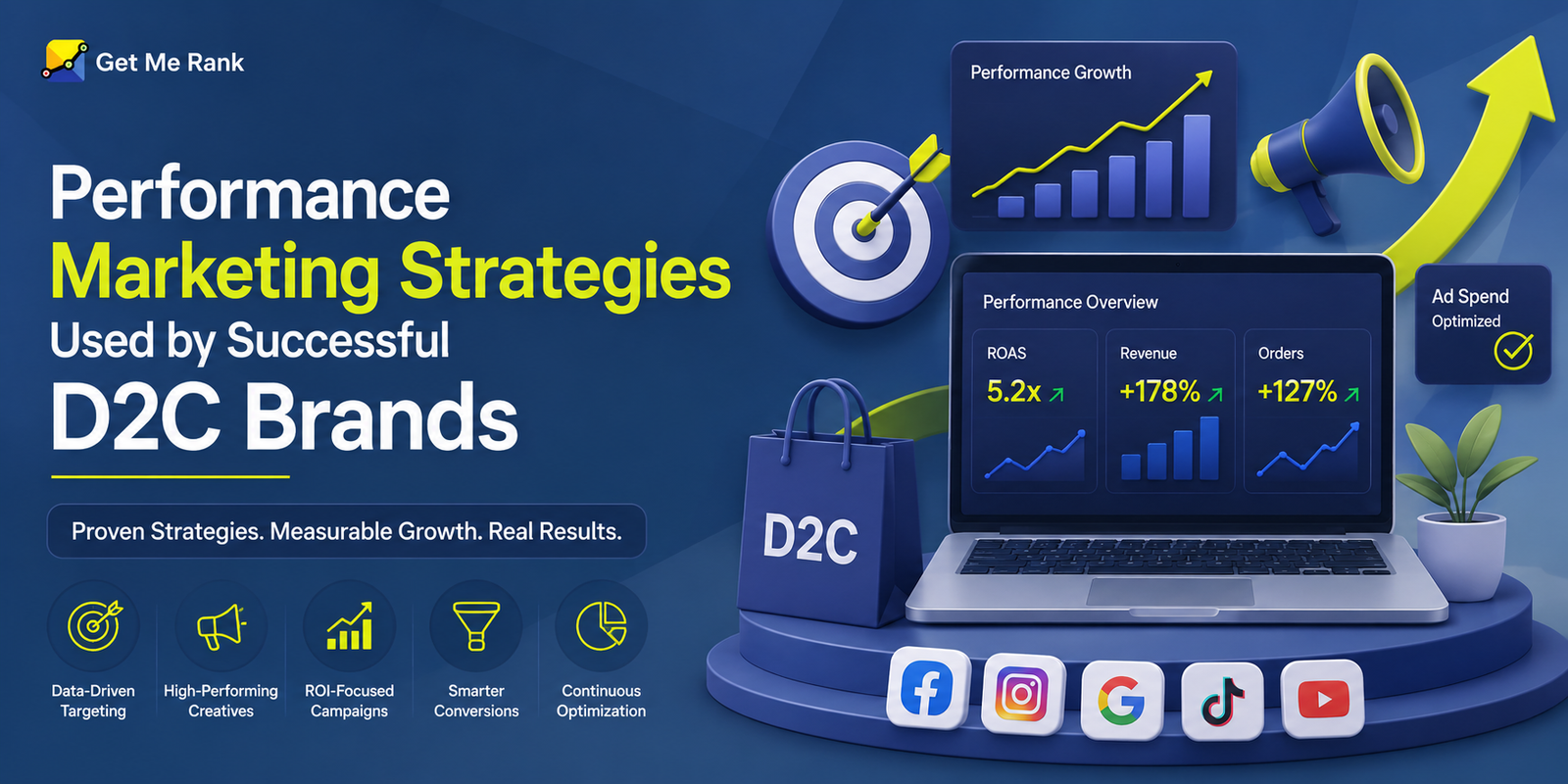
Every category has its breakout D2C brand — the one that seemed to appear from nowhere and dominate a niche within a couple of years. What rarely gets discussed is that behind almost every one of those stories is the same thing: a disciplined, data-backed set of performance marketing strategies, refined relentlessly over dozens of small iterations rather than one lucky campaign.
This post breaks down exactly what the highest-growth D2C brands do differently — from unit economics and channel selection to creative testing systems and retention — so you can borrow the parts that fit your own business and build a real D2C growth strategy, rather than guessing. In short, this is a practical performance marketing strategy for D2C brands who want results, not theory.
What Separates a Successful D2C Brands Marketing Strategy From the Rest
For every D2C brand that scales into a household name, many more spend the same ad budget and stall out. The difference isn’t the size of the budget — it’s the system behind it. A successful D2C marketing strategy treats performance marketing strategy as a discipline with four non-negotiables:
- They know their unit economics cold before they scale spend
- They build tracking infrastructure that survives platform and privacy changes
- They treat creative as a constantly-refreshed asset, not a one-time production
- They fund retention as seriously as acquisition
Everything below is a closer look at how that plays out in practice, along with the ranges we typically see across accounts — treat these as general benchmarks to sanity-check your own numbers against, not universal targets.
Nailing Unit Economics Before Spending on Ads
Getting your customer acquisition cost (CAC) math right before you scale spend is non-negotiable. The brands that scale profitably calculate their numbers before they touch an ad account, not after:
- Average Order Value (AOV): total revenue divided by number of orders
- Gross margin: (AOV – cost of goods sold) ÷ AOV
- Break-even CAC: the maximum you can spend to acquire a customer without losing money — roughly AOV × gross margin
- Target CAC: typically break-even CAC × 0.6–0.7, leaving room for overhead and profit
The metric that matters more than any single ROAS number is contribution margin — revenue minus cost of goods, shipping, and ad spend. A campaign can report a strong ROAS and still be quietly unprofitable once fulfillment costs are factored in. Brands that scale well check contribution margin at the campaign level, not just blended ROAS across the whole account.
Building Tracking Infrastructure That Actually Works
Direct-to-consumer performance marketing lives and dies by data quality, and this has only gotten harder since iOS tracking restrictions and cookie deprecation took hold. You can’t optimize what you can’t measure. High-performing D2C brands typically run:
- Browser-side pixel tracking plus server-side conversion APIs, so tracking survives ad blockers and iOS limitations
- A properly configured analytics platform (like GA4) with full e-commerce event tracking
- Consistent UTM parameters across every campaign, so attribution doesn’t fall apart across channels
- A unified customer data layer connecting ad platforms, website behavior, and CRM/email data
This infrastructure is unglamorous, but it’s the difference between making decisions on real data versus guessing based on platform-reported numbers that are often incomplete.
Ads for Ecommerce in 2026: Is It Actually Still Working?
Short answer: yes, but direct-to-consumer performance marketing has changed shape over the last few years, and the channels doing the heavy lifting for D2C brands — and why — have shifted.
- Meta Ads (Facebook & Instagram): Still the highest-volume channel for most D2C brands. Advantage+ Shopping campaigns tend to perform well specifically for brands with a solid creative library and clean pixel/CAPI data — the algorithm needs both to work well.
- Google Shopping & Performance Max: Strong for high-intent buyers who already know roughly what they want, particularly in categories with large SKU catalogs like fashion, jewelry, and home goods.
- YouTube Ads: Still underused by most D2C brands, but effective as a warm-up layer — building familiarity before a cold audience ever sees a Meta retargeting ad.
- Email & SMS/WhatsApp automation: Consistently one of the highest-ROI channels most brands under-invest in. Cart-recovery flows, post-purchase sequences, and loyalty campaigns can add meaningful incremental revenue with no additional media spend.

The honest caveat: none of these work well in isolation anymore. Meta’s automated campaign types need creative and data inputs to perform; Google captures intent but doesn’t create it; retention channels only work if there’s an acquisition engine feeding them new customers. Whether ads are “actually working” depends less on the channel itself and more on whether the inputs — creative, tracking, and retention infrastructure — are in place underneath it.
Channel Strategy: Where Successful D2C Brands Actually Spend
Rather than spreading budget evenly across every platform, successful D2C brands assign each channel a specific job. Getting channel allocation right is one of the clearest signals of a mature D2C marketing strategy, and it’s the backbone of any solid D2C growth strategy:
- Meta (Facebook/Instagram) typically carries the largest share of spend for younger D2C brands — often somewhere in the 45–70% range — because it’s the strongest discovery engine, reaching people who don’t yet know they want the product.
- Google Search and Shopping usually take the next largest share, capturing existing intent from people already searching for a solution. Brand-term campaigns in particular tend to deliver the highest ROAS in the whole account, since they’re protecting demand that already exists.
- Influencer and creator content functions less as pure brand awareness these days and more as a content engine — creator content gets repurposed directly into paid ad creative, and frequently outperforms polished, studio-produced ads.
- Email and WhatsApp/SMS carry a small slice of the budget but disproportionate return, since there’s no ongoing media cost to reach an existing subscriber.
Budget mix shifts by stage. Early-stage brands typically over-index on Meta while they find product-market fit; as they scale, spend diversifies across Google, influencer, and retention channels to reduce dependence on any single platform.
Performance Marketing Strategies for D2C Brands: What a Full-Funnel System Actually Includes
A single-channel win — a good week on Meta, a lucky viral post — doesn’t scale a D2C brand on its own. Building the right performance marketing strategy for D2C brands means running a connected system where every channel plays a defined role and feeds the next:
- Paid social (Meta, TikTok, Pinterest): Drives discovery and net-new demand. The focus should be contribution margin and creative testing structure, not chasing a headline ROAS number that ignores fulfillment cost.
- Search & Shopping (Google Ads, Performance Max): Captures demand that already exists. Feed quality and margin-aware bid structure matter more here than raw budget.
- Email & SMS (retention): Protects and compounds revenue from customers already acquired. This is usually one of the highest-ROI line items in a D2C budget because there’s no incremental media cost.
- SEO & content: Builds a channel that doesn’t scale linearly with ad spend, reducing long-term dependence on paid acquisition.
- CRO & landing page optimization: Multiplies the value of traffic you’re already paying for — often the fastest lever to pull when CAC is rising faster than you can fix it with targeting alone.
The point of running these together isn’t variety for its own sake — it’s that a conversion-rate improvement from CRO lowers effective CAC across every paid channel simultaneously, and a retention lift raises the ceiling on how much you can profitably spend to acquire in the first place. Full-funnel isn’t a bigger service list; it’s fewer blind spots.
The Creative Testing Systems Behind High-Growth Brands
Ask any team running a high-growth D2C ad account what’s driving performance in 2026, and creative — not targeting — is almost always the answer. Creative is often the single biggest lever inside high-performing performance marketing campaigns. Modern ad platforms handle most of the audience-finding work automatically; the brand’s job is to keep feeding the algorithm fresh, high-performing creative, which is the real engine behind most D2C brands performance marketing accounts.
A useful framework many high-growth brands run is a 3-2-2 structure: three new creative concepts in active testing, two proven winners still running, and two new concepts already in production — so the account is never dependent on a single ad and is always discovering the next winner before the current ones fatigue.
The formats that consistently perform across stages:
- UGC-style videos for cold prospecting — they read as authentic, not like an ad
- Product demos for the consideration stage, showing the product actually solving the problem
- Testimonials and before/after content for conversion
- Unboxing content, which works across almost every stage
- Founder-story content, which builds brand connection rather than driving immediate conversion
Creative fatigue is real and fast — refreshing every 2–4 weeks is a common baseline among brands that maintain consistent performance.
D2C Performance Marketing Case Study Examples From the Field
The D2C performance marketing case study patterns below are illustrative composites based on common patterns across the category — not disclosures about any specific brand or client.
Case pattern 1 — Community over cold reach. A mid-sized apparel brand shifted a large share of its acquisition budget away from broad paid reach and toward creator and community-driven content — user-generated challenges, ambassador programs, and content designed to be shared rather than just viewed. Paid media became an amplifier for content that was already resonating organically, rather than the sole source of new audience discovery. The result was a lower blended CAC, because paid spend was reinforcing demand instead of manufacturing it from a cold start every time.
Case pattern 2 — Differentiated offer reduces reliance on media spend. A challenger brand entering a category with an entrenched, higher-priced incumbent built a try-before-you-buy mechanic into the purchase flow. Beyond removing purchase friction, the mechanic doubled as organic content, since customers shared their experience unprompted. Combined with early public-relations investment, this meant paid acquisition had a much easier job once it started — the audience already understood the value proposition before an ad ever reached them.
Case pattern 3 — Fixing creative fatigue instead of chasing new audiences. A brand in a highly competitive, saturated category noticed declining returns despite stable targeting. The diagnosis wasn’t the audience — it was creative fatigue setting in faster than the team could produce new assets. The fix was creative velocity: moving from monthly to weekly refresh cycles, generating multiple hooks and formats from the same source footage, and prioritizing short-form, mobile-first cuts. Performance recovered without any change to targeting.
The pattern across all three: the fix rarely came from finding a “better audience.” It came from fixing a structural gap — content strategy, offer design, or creative throughput — that no amount of targeting precision could solve on its own.
Retargeting and the Full-Funnel Approach
Only a small fraction of visitors — often cited around 2–3% — convert on their very first visit to a D2C site. Brands that treat that number as fixed are leaving the other 97%+ on the table. A full-funnel approach typically layers:
- Prospecting campaigns to reach new, cold audiences
- Consideration retargeting for people who engaged but didn’t purchase (dynamic catalog ads work well here)
- Cart-abandonment recovery via retargeting ads, email, and SMS/WhatsApp combined
- Post-purchase retargeting for cross-sell, replenishment, and subscription upsell
Recovering warm, already-interested visitors is consistently cheaper than acquiring new cold traffic, which is why mature D2C brands performance marketing teams dedicate a meaningful, protected slice of budget to retargeting rather than treating it as an afterthought.
Retention as a D2C Growth Strategy, Not an Afterthought
As acquisition costs climb across nearly every category, the brands still growing profitably are the ones extracting more value from customers they already have, rather than only chasing new ones. In practice that means:
- Welcome email/SMS series for new subscribers
- Automated post-purchase flows — review requests, replenishment reminders, cross-sells
- Loyalty or subscription programs that reward repeat purchases
- WhatsApp or SMS for high-open-rate promotional and retention messaging
Email and owned-channel marketing is routinely one of the highest-ROI line items in a D2C budget, precisely because there’s no ongoing media cost once someone is on the list.
Scaling Without Killing ROAS
Scaling is where a lot of brands with a genuinely profitable formula still get it wrong, usually by moving too fast. Well-structured performance marketing campaigns scale in increments, not overnight, which protects ROAS while budgets grow. A more durable approach:
- Horizontal scaling first: new creative variations of proven winners, new audiences using existing creative, new placements, and eventually new channels
- Vertical scaling gradually: raising budgets on winning campaigns in modest increments every few days rather than doubling overnight, and letting the learning phase complete before judging results
- Duplicating winners at higher budgets instead of editing live ad sets, to avoid resetting the algorithm’s learning
- Accepting some ROAS softening when scaling — a modest dip is normal and doesn’t necessarily signal a problem
The brands that scale sustainably treat a ROAS dip as expected friction, not a fire alarm — as long as it stays within a normal range and contribution margin remains healthy.
Choosing the Right Kind of Performance Marketing Support
Not every brand needs the same setup, or the same kind of D2C performance marketing agency. What matters is matching support to your actual bottleneck:
| Best fit when… | What to watch for | |
| Single-channel specialist | You have one clear, isolated bottleneck (e.g., Meta creative fatigue) and strong performance everywhere else | Blind spots outside that one channel — a fix on Meta won’t help if checkout conversion is the real leak |
| In-house or freelance generalist | You’re very early-stage, budget is limited, and you need broad coverage over deep specialization | Bandwidth is finite — expect slower iteration across every channel at once |
| Full-funnel partner | Growth has stalled despite decent ROAS, or acquisition and retention feel disconnected | Takes more setup time upfront, since tracking and systems need to be unified before optimization can start |
Rather than comparing providers by reputation or size, the more useful diagnostic is: what’s actually capping your growth right now — acquisition efficiency, conversion rate, or retention? That answer tells you which row above fits, regardless of who you end up working with.
Common Mistakes Even Funded Brands Make
- Scaling budget too fast. Large overnight increases routinely crash performance before the algorithm can adjust.
- Chasing revenue while ignoring unit economics. Growing top-line sales while losing money on every order isn’t a strategy — it’s a countdown.
- Letting creativity go stale. Running the same ad set for months quietly erodes conversion rates well before it becomes obvious in the topline numbers.
- Skipping retargeting. Treating the first-visit conversion rate as the whole story leaves the majority of interested traffic unconverted.
- Over-relying on discounts. Training an audience to only buy on sale is efficient in the short term and corrosive to margin and brand value over time.
- Neglecting retention. Pouring the entire budget into acquisition while repeat purchase rate stagnates caps lifetime value and keeps CAC pressure permanently high.
Trends Shaping the Next Wave
Every trend below feeds back into how you’ll refine your performance marketing strategy going forward.
- AI-assisted creative production is compressing the time from concept to a dozen tested variations, fueling the “creative velocity” approach that fixes fatigue faster than manual production ever could.
- Advantage+ and Performance Max-style automated campaign types are shifting more of the targeting work to the algorithm, which raises the relative importance of creative quality as the main lever brands still control directly.
- First-party data activation continues to separate brands with strong CRM/email infrastructure from those still reliant on broad platform targeting.
- Community and content-driven growth is increasingly blending with pure performance media, rather than sitting in a separate “branding” budget.
Action Checklist
Use this checklist to turn the performance marketing strategies above into action:
- [ ] Calculate break-even CAC and target CAC before increasing any ad spend
- [ ] Confirm server-side tracking is live alongside browser pixels
- [ ] Assign each channel a specific funnel role instead of spreading budget evenly
- [ ] Run a rolling creative testing cadence (e.g., 3-2-2 framework)
- [ ] Build or audit retargeting campaigns for cart abandoners and engaged non-purchasers
- [ ] Set up post-purchase retention flows (email/SMS) before scaling acquisition further
- [ ] Scale winning campaigns in modest increments, not by doubling overnight
- [ ] Review contribution margin weekly, not just blended ROAS
Conclusion
The common thread across every successful D2C brand’s playbook isn’t a secret channel or a growth hack. It’s a system: sound unit economics, real tracking, constant creative iteration, full-funnel retargeting, and retention treated as a genuine growth lever rather than an afterthought. Whether you’re building this D2C performance marketing strategy in-house or evaluating a D2C performance marketing agency to help, the goal is the same — copy the system, not just whichever tactic made headlines last quarter.
FAQs
1. What is D2C performance marketing?
It’s a data-driven approach where D2C brands pay for and optimize campaigns based on measurable outcomes — customer acquisition cost (CAC), ROAS, LTV — instead of impressions or reach. A strong D2C performance marketing strategy blends paid ads, CRO, and retention into one connected system rather than running each in isolation.
2. How much does D2C performance marketing typically cost?
Costs scale with ad spend and scope. Smaller retainer-based engagements often start in the low thousands per month, while full-funnel programs covering paid media, SEO, and CRO together cost more. Ad spend itself is always separate from the management fee.
3. How long does it take to see results?
Early signals in ROAS and conversion rate usually show up within the first couple of months. Stable CAC and meaningful LTV gains typically take longer, since retention and repeat-purchase data need time to accumulate.
4. What’s the difference between full-funnel and single-channel support?
Single-channel support (just Meta, or just Google) optimizes one lever in isolation. Full-funnel support connects paid media, retention (email/SMS), and CRO so gains in one area — like a better landing page — compound acquisition results instead of sitting separately.
5. Can small or early-stage D2C brands benefit from this?
Yes, but with a caveat: optimization needs data. Very low ad spend or order volume means algorithms and testing take longer to produce reliable signals, so early-stage brands should expect a longer learning phase before results stabilize.
6. should I prioritize when choosing a partner?
Match the partner’s strength to your actual bottleneck. If ads are inefficient, prioritize CRO and testing rigor. If growth has stalled despite decent ROAS, prioritize a full-funnel partner who can also fix retention and LTV — not just media buying.