Real EstateSEO
Key Takeaways
- Most sites don’t lose rankings to a penalty — they lose leads to small, fixable real estate SEO mistakes that quietly add up.
- The biggest offenders are broad keywords, thin location pages, and a neglected Google Business Profile — all costly, all fixable.
- Speed and mobile aren’t optional: 70%+ of property searches are on a phone, and a slow page bleeds both rankings and leads.
- Technical gaps and missing schema can erase months of work without anyone noticing.
- The newest mistake is having no plan for AI Overviews — the answers buyers increasingly read before they click.
- Fix the quick wins first, then build the compounding ones — order matters more than speed.
Introduction
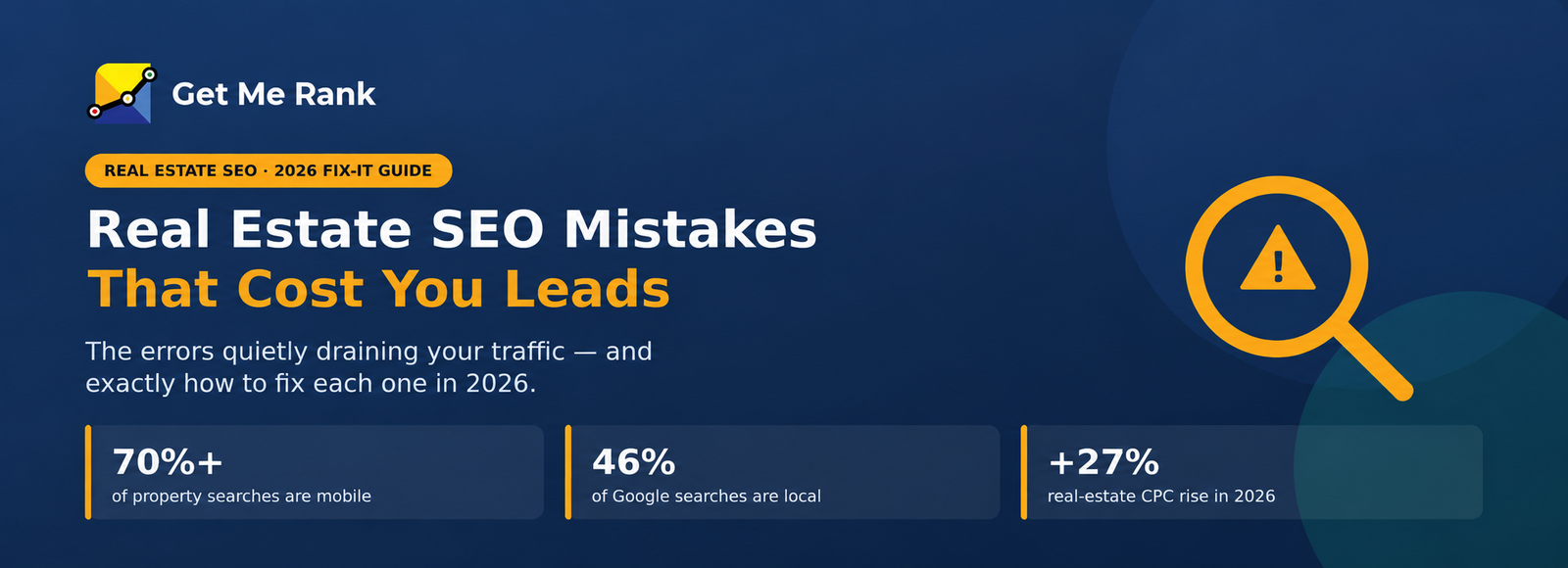
Here’s the uncomfortable truth about most real estate websites: they look great and still bring almost no leads. It’s rarely a dramatic Google penalty. It’s a handful of quiet, ordinary errors — a page targeting the wrong search, a listing copied from a portal, a profile no one has touched in a year — that together make a beautiful site nobody ever sees. Over years of auditing developer and agent websites, our team sees the same real estate SEO mistakes again and again.
Short answer:
The most common real estate SEO errors are chasing broad keywords over buyer intent, publishing thin or duplicate location pages, neglecting your Google Business Profile, ignoring mobile speed, and having no plan for AI search. Each one quietly sends ready buyers to a competitor — and each one is fixable.
9 Real Estate SEO Mistakes Costing You Leads (and How to Fix Them)
Below are the nine mistakes that cost the most, what each one is really costing you, and exactly how to fix it. Whether you handle SEO yourself or work with a team, this is the checklist to audit your own site against today.
DID YOU KNOW
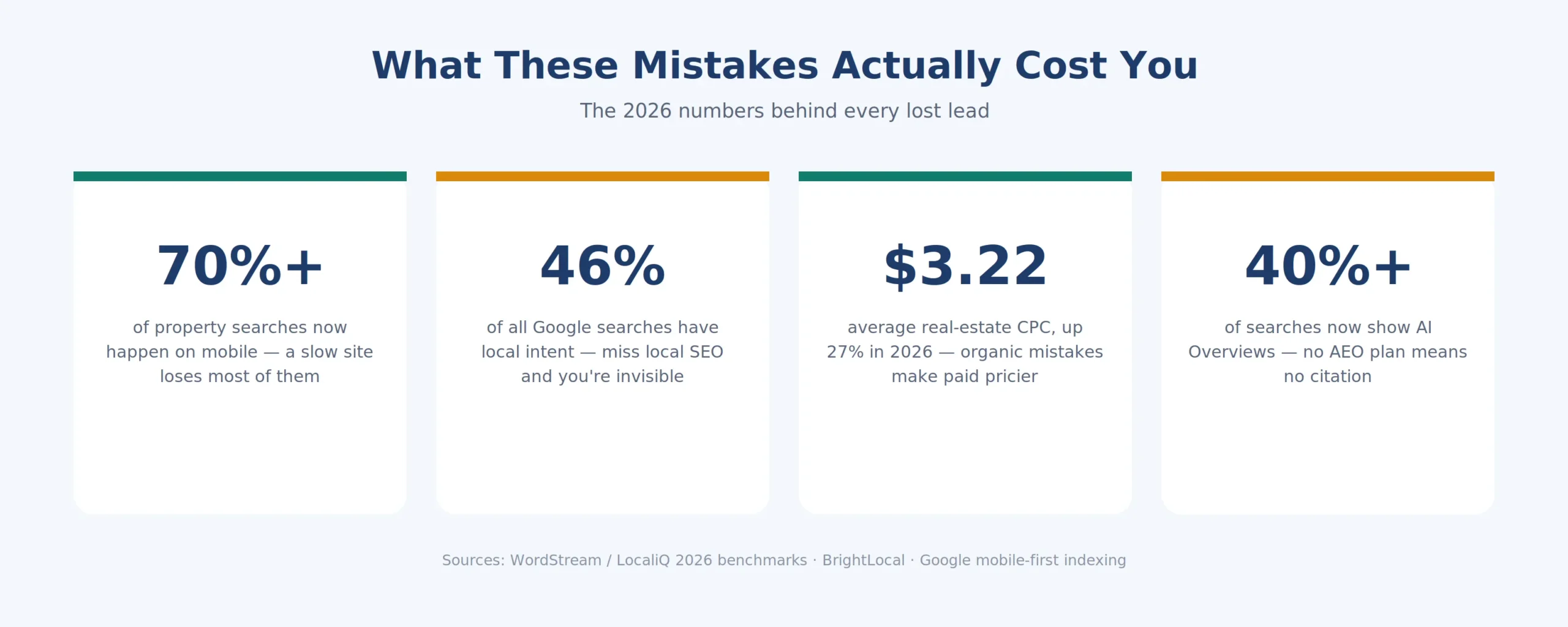
Real estate had the biggest cost-per-click rise of any industry in 2026 — up 27% to about $3.22. Fixing your organic mistakes isn’t just about traffic; it makes every paid click cheaper too.
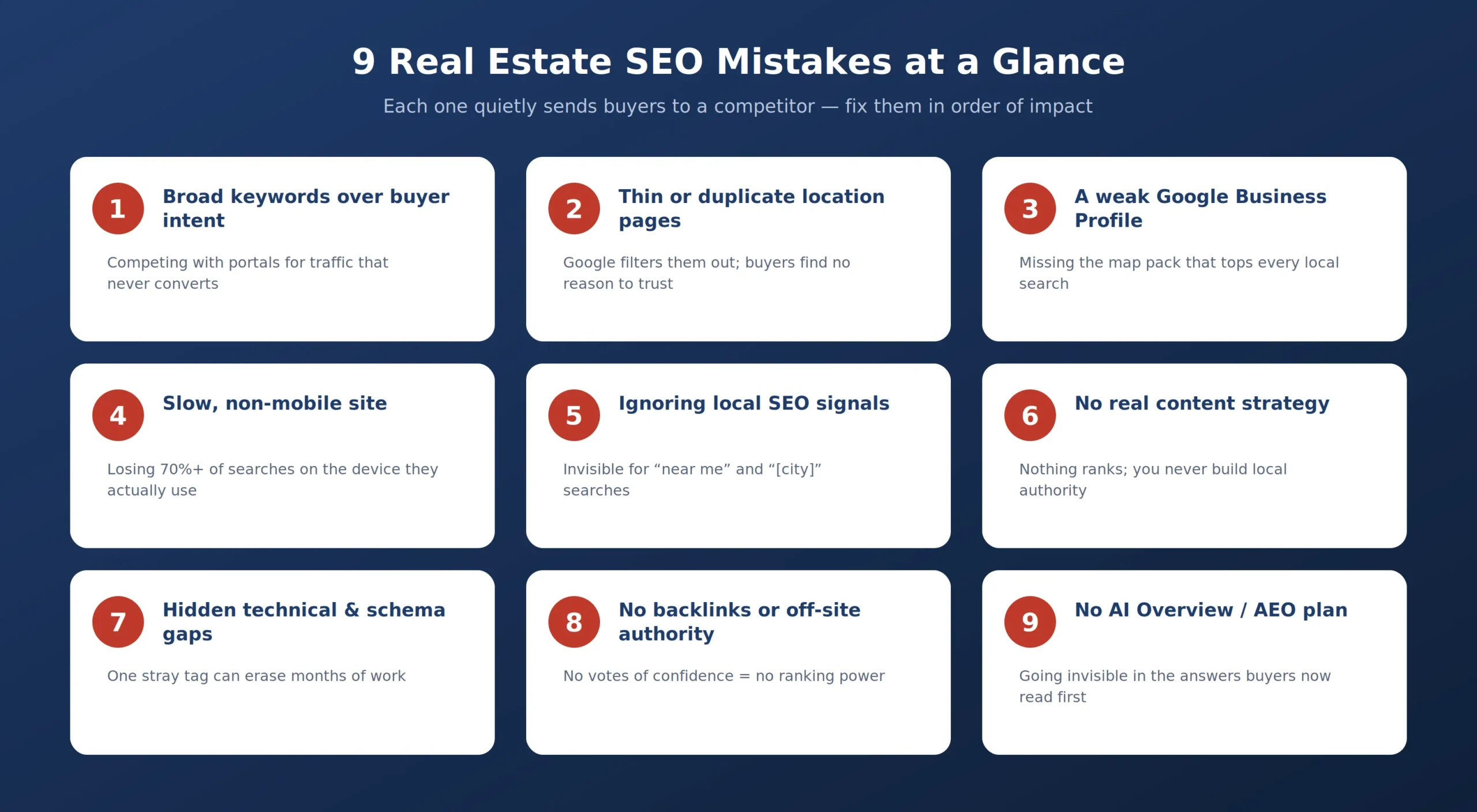
All 9 Real Estate SEO Mistakes at a Glance
Here’s the full list before we dig into each one. These are the common SEO errors real estate websites run into most often — and if you only fix a few, start at the top, because they’re ordered roughly by how much they cost.
What Do These Mistakes Actually Cost You?
Short answer:
Lost leads, wasted spend, and invisibility. Most real estate website SEO problems share one symptom: your site isn’t seen when it matters. With 70%+ of searches on mobile, 46% carrying local intent, and AI Overviews on a growing share of results, an unoptimised site simply isn’t there — and the leads go straight to competitors who got the basics right.
Mistake, Cost, and Fix: The Quick-Reference Table
Skim this table to spot your own gaps fast, then read the detail on any that apply to you.
| The mistake | What it costs you | The fix |
|---|---|---|
| Broad keywords over intent | Traffic that never converts | Target location + type + budget terms |
| Thin / duplicate location pages | Filtered out of results | Write deep, unique locality pages |
| Weak Google Business Profile | Miss the local map pack | Complete it; keep NAP consistent; get reviews |
| Slow, non-mobile site | Lose 70%+ mobile searchers | Compress, load in <3s, go mobile-first |
| Ignoring local SEO | Invisible for “near me” | Local content, citations, reviews |
| No content strategy | Nothing ranks; no authority | Locality & buyer guides in topic clusters |
| Technical & schema gaps | Months of work erased | Crawl/index checks + Article/FAQ/local schema |
| No backlinks | No ranking power | Earn local links & digital-PR mentions |
| No AI Overview / AEO plan | Invisible in AI answers | Direct answers, real data, entity signals |
The Mistakes Explained (and How to Fix Each One)
1. Chasing broad keywords instead of buyer intent
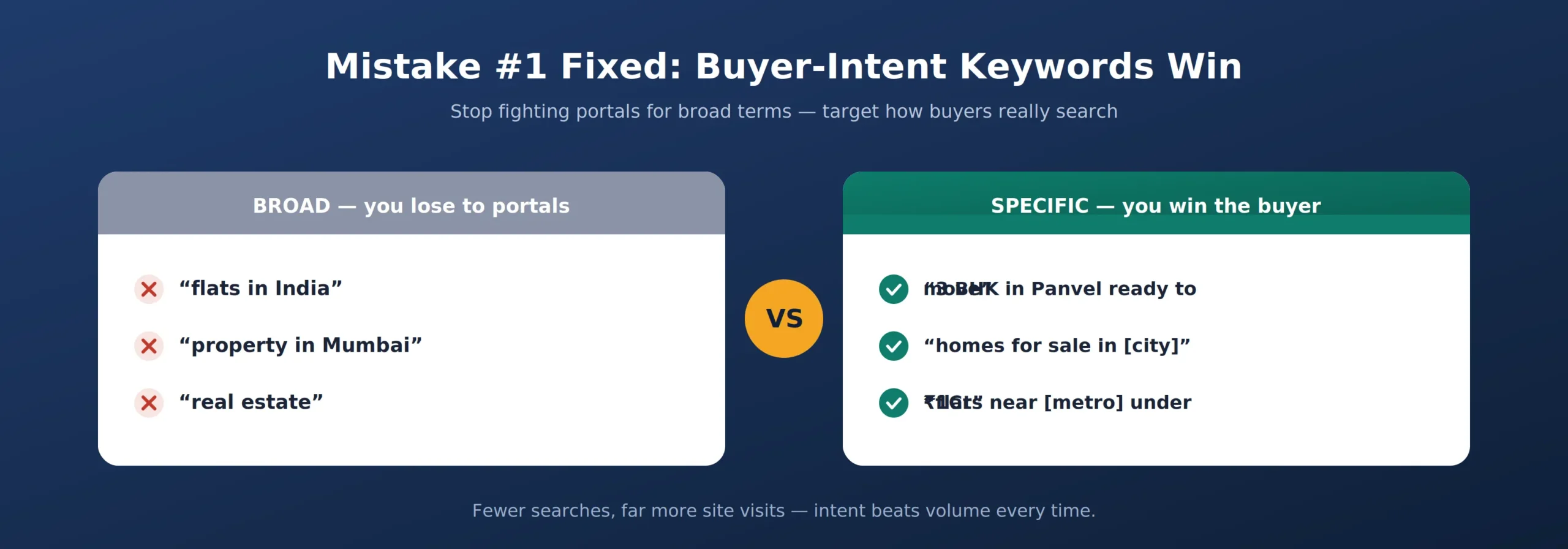
The most common mistake is targeting wide, generic terms the big portals already own. A page built around “flats in India” competes with 99acres and loses — and even if it ranks, that traffic rarely buys. Real buyers search with specifics: location, configuration, and budget together, like “3 BHK in Panvel ready to move.”
The fix: target those exact, high-intent searches. Fewer visitors, far more site visits.
2. Thin or duplicate location pages
Location pages are the heart of real estate SEO, and most are far too thin — or worse, one template with the area name swapped. Google spots duplication instantly and filters those pages out.
The fix: make each page genuinely its own, with real local depth — price ranges, connectivity, schools, the buyer it suits, and honest pros and cons. One real page beats ten copies.
3. A weak or neglected Google Business Profile
An incomplete or outdated profile is the single most common local mistake, and it decides whether you appear in the map pack that sits above every local search. Too many developers claim a profile once and never touch it.
The fix: complete every field, keep your name, address, and phone identical everywhere, add real photos, post regularly, and gather reviews steadily.
PRO TIP
The Google Business Profile drives roughly a third of local-pack ranking weight on its own. Finishing yours is the fastest, cheapest ranking win on this entire list.
4. A slow site that isn’t built for mobile
More than seven in ten property searches happen on a phone, and a buyer comparing projects won’t wait for a slow site. Huge, uncompressed images are the usual culprit, and anything over three seconds bleeds both rankings and leads.
The fix: compress images, clean the code, and test on a real phone — because Google ranks the mobile version of your site first.
5. Ignoring local SEO signals
Real estate is all about location, yet many sites never optimise for it. Buyers search “homes for sale in [city]” and “real estate agent near me,” and if you’re not built for those, you’re invisible to the people closest to buying.
The fix: put neighbourhood names in your titles and content, build local citations, and earn steady Google reviews. Pair this with SEO for real estate fundamentals and the local gains compound.
6. No real content strategy
If you’re not publishing helpful content, you rank for almost nothing and never build authority.
The fix: write for the buyer — neighbourhood guides, market updates, buyer and seller walkthroughs — organised into clusters around a locality or need. Cover the topic fully and the rankings follow, because Google now rewards depth over repetition.
7. Hidden technical and schema problems
The quiet killers sit behind the scenes: a stray noindex tag, a broken canonical, a missing sitemap, or a pile of 404s can erase months of work without anyone noticing. Missing schema is a softer version of the same gap.
The fix: run a regular technical check — confirm pages are crawlable and indexed, repair broken links, and add Article, FAQ, and local-business schema so search engines read your pages cleanly.
8. No backlinks or off-site authority
Backlinks are votes of confidence, and many real estate sites have almost none, which caps how well they can ever rank.
The fix: earn quality local links — get featured in local news and market roundups, partner with mortgage brokers and inspectors, and publish shareable market reports. One link from a reputable local source beats dozens of low-quality ones.
9. No plan for AI Overviews (and no tracking)
The newest mistake is ignoring AI search. AI Overviews now appear on a large share of the locality and investment questions buyers ask, and they cut clicks sharply. A site with no plan to be cited slowly goes invisible — and if you’re not tracking performance, you won’t even notice.
The fix: write pages AI can lift (a direct answer up top, real numbers, clean structure, mentions across trusted sites), and set up GA4 and Search Console so you can see what’s working.
Which Mistakes Should You Fix First?
Short answer:
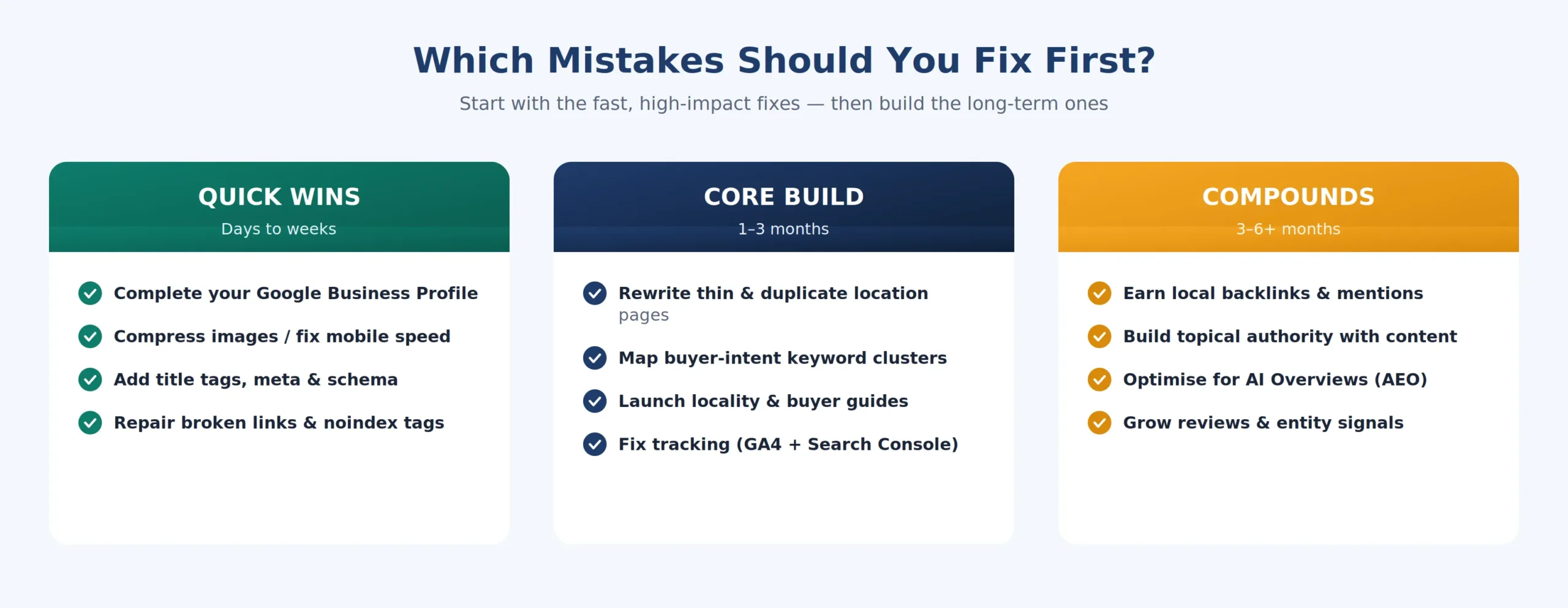
Start with the quick wins — complete your Google Business Profile, fix mobile speed, add schema, and repair broken tags — because they move the needle in days. Then rebuild thin pages and keyword targeting over one to three months, and grow links, content authority, and AI visibility over the following months.
How GetMeRank Fixes These SEO Mistakes for Real Estate Sites
Fixing common SEO errors real estate websites make isn’t one big project — it’s dozens of small, exact tasks that quietly slip when you’re busy selling. That’s where an experienced team earns its keep. GetMeRank audits real estate sites end to end — keyword and page structure, local search, technical health, links, and AI readiness — and ties every fix to leads, not vanity rankings.
Because our real estate marketing experts run real estate ppc and lead generation for real estate alongside SEO, the fixes don’t stop at rankings — they feed a full funnel that turns organic visibility into booked site visits, with transparent reporting on source, cost per lead, and ROI.
Stop Losing Leads to Fixable SEO Mistakes
Every mistake on this list is quietly handing a buyer to a competitor who got the basics right. The good news is that all of them are fixable — and most show movement within weeks. If you’d rather have experts find and fix them for you, that’s exactly what we do.
WANT TO KNOW WHICH MISTAKES ARE COSTING YOU LEADS?
GetMeRank will audit your site for these real estate SEO mistakes and hand you a prioritised fix plan tied to leads, not vanity metrics.
Book your free real estate SEO audit today.
FAQs About Real Estate SEO Errors
Q. What is the most common real estate SEO mistake?
Targeting broad, generic keywords the big portals dominate instead of the specific searches buyers actually make — a configuration, locality, and budget together. Even when a broad page ranks, the traffic rarely converts, so you get visitors but few site visits.
Q. Why do real estate location pages fail to rank?
Usually because they’re thin or duplicated. A short page with little detail, or one copied across areas with only the name changed, gives Google nothing to trust and often gets filtered out. Strong location pages carry real depth on price, connectivity, and lifestyle.
Q. How do real estate website SEO problems hurt lead generation?
They make your site invisible at the moment buyers are searching. Slow pages, weak local signals, and missing content mean you don’t appear for high-intent searches, so ready buyers find competitors instead — and you never even see the lost lead.
Q. Does relying on property portals hurt my SEO?
Leaning only on portals is risky because listings expire and you never own the audience. Portals are a useful channel, but your own site — built on lasting pages like locality and buyer guides — is what gathers authority and brings steady leads over time.
Q. How does AI search change real estate SEO?
AI Overviews now answer many property questions at the top of the page and reduce clicks to normal results. The new goal is to be the source cited inside those answers, which means leading with a direct answer, using real data, and earning mentions across trusted sites. Our experts always optimise your content through our AI Real estate SEO factors as well.
Q. How long does it take to fix these SEO mistakes?
Technical fixes and profile cleanup can show movement within a few weeks. New content and location pages usually need three to six months for real impact. Consistency matters more than speed, since the gains compound over time.
Q. Can I fix these SEO errors myself or should I hire an expert?
You can handle the basics — profile cleanup, image compression, unique descriptions — yourself. Technical SEO, schema, link building, and AI-search optimisation are where an experienced real estate SEO team usually delivers faster, better results.
Conclusion
None of these real estate SEO mistakes is dramatic on its own — that’s exactly why they’re so costly. They slip quietly, one by one, until a good-looking site brings almost no leads. But the reverse is just as true: fix the quick wins this week, rebuild your pages and keywords over the next quarter, and grow your authority and AI visibility from there, and you’ll steadily pull ahead of competitors still making the same errors.
Audit your site against these nine today — and when you want experts to find and fix every one, GetMeRank is ready to help.