
Paid Advertising
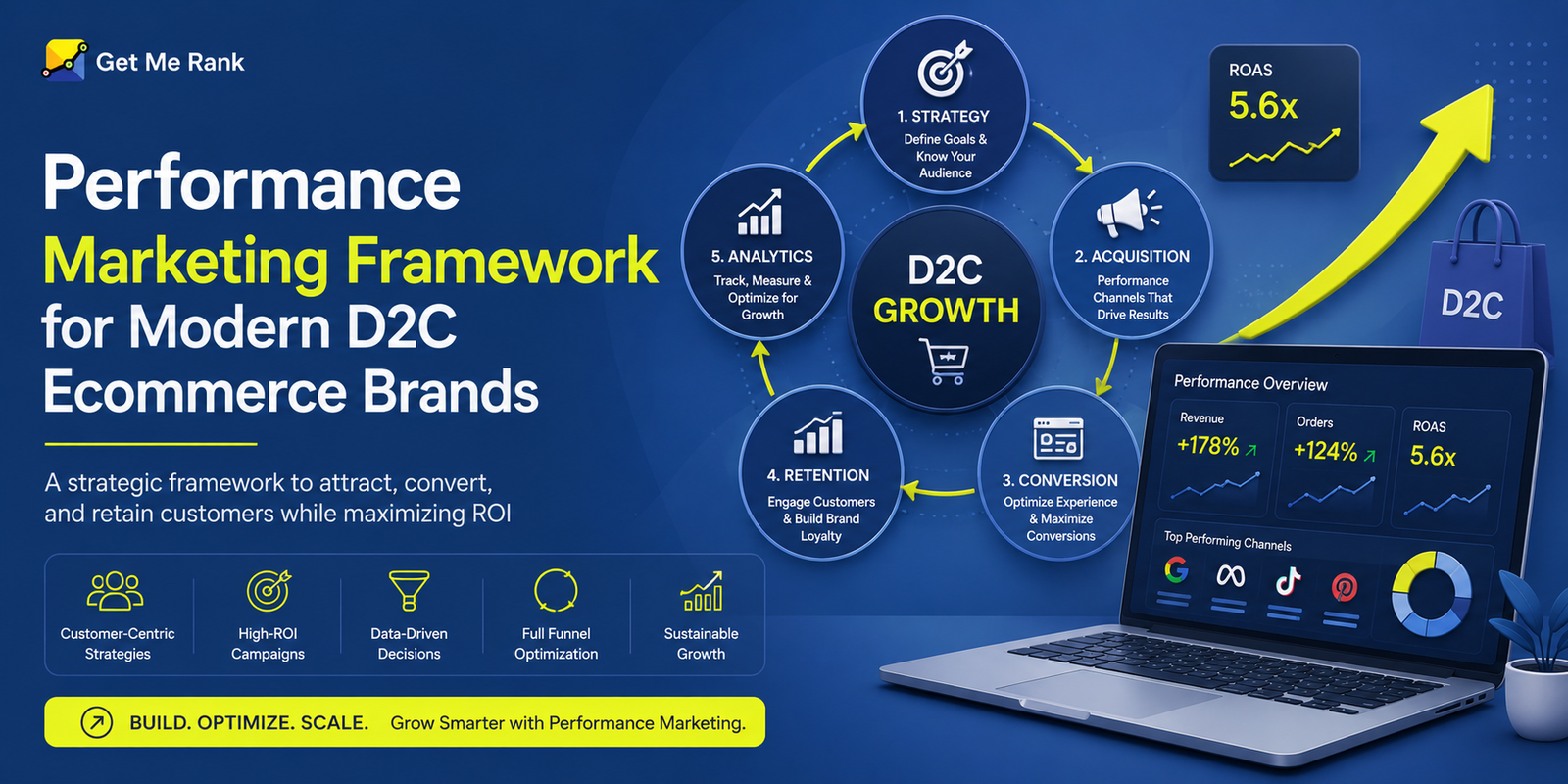
Most D2C ecommerce brands don’t struggle because they lack ad budget — they struggle because they don’t have a repeatable performance marketing framework guiding where that budget goes. Without one, spend drifts toward whatever channel got attention last quarter, KPIs get judged inconsistently, and growth becomes unpredictable.
This guide lays out a complete performance marketing framework for modern D2C ecommerce brands: the participants that make it work, the metrics that matter, the frameworks and models used to run it, and a practical D2C performance marketing strategy you can apply directly, whether you’re building this in-house or briefing a performance marketing agency.
What is a Performance Marketing Framework?
A performance marketing framework is a structured system for planning, executing, and measuring marketing activity where every dollar spent is tied to a measurable outcome — a click, a lead, or a sale — rather than to broad exposure. It’s the operating model behind a performance marketing strategy: the roles, the metrics, the budget logic, and the review cadence that turn scattered campaigns into a coordinated, accountable system.
For D2C ecommerce brands specifically, this framework has to account for something traditional retail advertising doesn’t: the brand owns the entire customer relationship, with no retail partner absorbing part of the acquisition cost. That single difference is what makes a performance marketing strategy for D2C brands fundamentally more data-dependent than brand advertising for a wholesale business — it’s also why direct-to-consumer performance marketing is judged so heavily on hard numbers like CPA and ROAS rather than brand recall alone.
Put simply, direct-to-consumer performance marketing treats every channel as accountable for its own return, since there’s no retail margin cushioning a weak campaign.
Core Elements of Performance Marketing Frameworks
Every performance marketing framework runs through four participants working together to generate measurable outcomes.
- Advertisers: These are the businesses — in this case, D2C ecommerce brands — that want to promote products or services and generate specific results such as leads, purchases, or app installs.
- Publishers: Publishers promote the advertiser’s offerings through the platforms where their audience already spends time: blogs, websites, social channels, and mobile apps. In a D2C context, this ranges from an affiliate blog reviewing a product category to an influencer posting on Instagram or YouTube.
- Networks: Networks such as Impact or CJ manage the tracking infrastructure that records conversions and attributes them transparently across channels and publishers, so advertisers know which activity actually produced a sale rather than guessing.
- Managers or Agencies: Internal marketing teams or an external performance marketing agency oversee campaign strategy, day-to-day optimization, and performance reporting, keeping the other three participants coordinated toward the same revenue goals.
In this system, advertisers typically pay only when a specific action is completed — a sale, a lead, or a click, depending on the chosen campaign model — which is what separates performance marketing from traditional impression-based advertising.
A performance marketing framework also depends on clearly defined KPIs, most commonly:
- Cost Per Acquisition (CPA)
- Return on Ad Spend (ROAS)
- Customer Lifetime Value (LTV)
These metrics measure the real revenue impact of marketing activity rather than focusing only on clicks or impressions. For Indian D2C brands in particular, an effective framework also has to account for regional language preferences, mobile-first user behavior, and highly diverse customer demographics across markets.
How Does Performance Marketing Work?
At its core, performance marketing works on a pay-for-outcome model. An advertiser sets a target action — a purchase, a signup, an app install — and only pays publishers or platforms once that action is completed and verified through tracking.
The mechanics typically follow this sequence:
- A publisher or ad platform places the advertiser’s creative in front of a relevant audience.
- A potential customer clicks through and takes an action on the advertiser’s site or app.
- Tracking pixels or network attribution confirm the action happened and tie it back to the specific channel, campaign, or publisher responsible.
- The advertiser pays based on the agreed model — cost per click, cost per lead, or cost per acquisition — and the resulting data feeds back into future budget decisions.
This closed loop — spend, track, attribute, reinvest — is what makes performance marketing measurable in a way traditional advertising rarely is, and it’s the same loop that underpins every performance marketing campaign run within a broader D2C strategy.
Growth Marketing vs. Performance Marketing
The two terms get used interchangeably, but they aren’t the same discipline.
Performance marketing focuses on paid, trackable channels — search, social ads, affiliate, display — optimized against direct-response metrics like CPA and ROAS. It answers the question: is this specific spend generating a specific, measurable return?
Growth marketing takes a wider view, testing across the entire customer lifecycle — product experience, onboarding, referrals, pricing, retention loops — not just paid acquisition. It answers a broader question: what levers, paid or unpaid, actually move sustainable growth?
In practice, the strongest D2C marketing strategy treats performance marketing as one major input into a larger growth marketing effort — performance channels drive predictable, measurable acquisition, while growth marketing experiments extend beyond paid media into product and retention.
What are Performance Marketing Metrics?
A performance marketing framework is only as reliable as the metrics used to evaluate it. The core set every D2C brand should track:
| Metric | What It Shows |
| CTR (Click-Through Rate) | Whether creative and targeting are relevant enough to earn attention |
| CPA (Cost Per Acquisition) | What it costs to acquire one customer through a specific channel |
| ROAS (Return on Ad Spend) | Whether a channel’s revenue justifies its share of the budget |
| LTV (Customer Lifetime Value) | Whether customers from a channel stay valuable beyond the first purchase |
| Conversion Rate | The share of visitors who complete the desired action |
Judging every channel purely on immediate CPA or ROAS understates the value of awareness-stage spend — which is why LTV has to sit alongside acquisition metrics in any serious evaluation.
How Performance-Based Costs Are Calculated (CPM/CPC/CPL/CPA)
- CPM (Cost Per Mille) — the cost to reach one thousand impressions, most relevant for awareness-stage spend where visibility, not immediate action, is the goal.
- CPC (Cost Per Click) — the cost each time someone clicks an ad, useful for gauging traffic efficiency, though a cheap click means little if it doesn’t convert.
- CPL (Cost Per Lead) — the cost to generate one qualified lead, such as an email signup or quiz completion, common among D2C brands that nurture prospects before the first purchase.
- CPA (Cost Per Acquisition) — the cost to generate one completed sale, and ultimately the metric that decides whether a channel earns its place in the mix.
No single figure tells the full story on its own. A mature performance marketing strategy for D2C brands always reads these costs together rather than in isolation, since a channel with a high CPC but low CPA can outperform one with cheap clicks that rarely convert.
5 Steps for Creating a Marketing Performance Management Framework
- Audit current performance — review every channel’s CPA, ROAS, and LTV contribution to see what’s actually working versus what’s absorbing budget without return.
- Define KPIs per channel and per journey stage — awareness-stage channels shouldn’t be judged by the same yardstick as decision-stage channels.
- Set a governance and reporting cadence — weekly for active campaigns, monthly for the overall channel mix, so underperforming spend doesn’t run unchecked.
- Standardize attribution and tracking — build consistent tracking across networks and platforms before scaling any channel, not after.
- Review and reallocate on a fixed schedule — treat the budget split as a living plan, shifting spend toward proven channels and away from consistently weak ones.
Core Frameworks and Approaches in Performance Marketing
A few structural approaches show up repeatedly in mature performance marketing campaigns:
- Full-funnel frameworks — mapping awareness, consideration, decision, and retention stages to specific channels, so every dollar has a defined job.
- Test-and-scale frameworks — validating a channel with a small, controlled budget before committing significant spend.
- Attribution-first frameworks — building tracking and measurement infrastructure before launching new channels, rather than retrofitting it later.
- Retention-integrated frameworks — treating email, SMS, and loyalty programs as part of the same system as paid acquisition, not a separate function.
The Challenger Framework: Reimagining Performance Marketing
The Challenger approach reframes performance marketing away from pure efficiency optimization and toward deliberate disruption. Instead of simply defending an established channel mix, a Challenger-style performance marketing framework actively looks for underpriced or underused channels competitors haven’t scaled yet, and pushes harder into them before costs rise.
This means treating a portion of budget as intentionally exploratory — not just the “test” slice of a standard split, but a mandate to challenge assumptions about which channels “should” work for the category. For D2C brands competing against larger, better-funded players, this approach can open up efficient acquisition in channels that seem crowded on the surface but are underexploited at the segment or audience level.
Building a Strong D2C Performance Marketing Strategy
A structured process for assembling a D2C performance marketing strategy:
- Audit current channel performance to separate revenue-generating channels from budget-absorbing ones.
- Map each channel to a customer journey stage rather than treating all channels as interchangeable.
- Set a starting budget split using historical performance, adjusting for channels with limited data.
- Test one new channel at a time so results can be attributed clearly.
- Review the mix monthly, shifting spend toward proven performers.
Performance Marketing Channels for D2C (Mapped to Customer Journey)
- Awareness — programmatic, display, and influencer content introduce the brand to new audiences.
- Consideration — social advertising builds familiarity through repeated exposure.
- Decision — search advertising and affiliate marketing convert high-intent visitors into buyers.
- Retention — email and SMS re-engage existing customers and drive repeat purchases.
Running coordinated performance marketing campaigns across these stages — rather than treating each channel as a standalone effort — is what turns a channel list into an actual strategy.
Budget Allocation Across Channels
A practical starting split:
- ~60% to the channel with the strongest proven return — usually search or retargeting.
- ~25% to a discovery channel such as social or influencer content, to keep the funnel filled.
- ~15% to experimental channels being tested for future inclusion.
This isn’t a permanent rule — it’s a starting point that should shift as real performance data accumulates, reassessed quarterly as part of any ongoing D2C marketing strategy.
First-Party Data as the Foundation
First-party data — purchase history, email engagement, on-site behavior — sharpens every channel in the framework at once. It lets search and social campaigns build lookalike audiences from real high-value customers, and lets email and SMS segment messaging by actual behavior instead of generic list membership. As third-party cookies decline further, brands with strong first-party infrastructure keep every channel in their performance marketing framework efficient even as broader targeting options shrink.
Retention Strategy as a Profit Multiplier
Acquisition spend pays off once; retention spend pays off repeatedly. Email and SMS carry no per-message acquisition cost, so every repeat purchase they drive is more profitable than the first sale. Cart recovery flows, post-purchase sequences, and loyalty segmentation turn a single transaction into a longer relationship — lowering blended CPA across the entire performance marketing framework over time.
Winning Strategies That Actually Work
- Anchor budget to proven channels, not favorite ones — let CPA and ROAS data decide where the majority share goes.
- Treat retention as core spend, not a side project — owned channels compound in a way paid acquisition never does.
- Run one controlled test at a time — parallel, unattributed tests are the fastest way to waste a testing budget.
- Pair internal teams with specialist help where it counts — many brands keep retention in-house and hand paid acquisition to a dedicated D2C performance marketing agency with deeper channel-specific expertise.
- Revisit the framework itself, not just the budget split — as CPMs, platforms, and attribution rules change, the framework needs periodic re-evaluation, not just the numbers inside it.
Case Study
Illustrative example: A D2C apparel brand had built its acquisition almost entirely around social media advertising, with no meaningful search or email presence. As that single channel became saturated, acquisition costs climbed steadily.
The brand introduced search advertising for high-intent terms, added an email flow for cart recovery and post-purchase follow-up, and shifted part of its social budget toward retargeting rather than pure discovery. Within four months, blended acquisition cost declined, and a meaningful share of revenue began coming from repeat customers through the newly built email channel — reducing dependence on any single platform.
Setting Up Your Campaigns
- Define one primary KPI per channel before launch — CPA for decision-stage channels, reach or CPM for awareness-stage channels.
- Build tracking and attribution first, not after the campaign goes live.
- Start with a small, controlled budget on any new channel before scaling.
- Segment creative by journey stage rather than reusing the same ad across every touchpoint.
- Set a review cadence — weekly for active tests, monthly for the overall framework.
Trends for 2026
- AI-driven budget allocation is shifting spend across channels in near real time based on predictive performance signals.
- Social commerce is blurring the line between social advertising and direct sales, shortening the path from discovery to purchase.
- First-party data infrastructure is becoming a prerequisite for efficient targeting across every paid channel.
- Agency specialization is increasing, with brands splitting retention in-house and handing paid acquisition to a specialized performance marketing agency.
Common Mistakes to Avoid
- Relying on a single channel leaves a brand exposed to cost increases or algorithm changes on that platform.
- Ignoring owned channels leaves repeat revenue unclaimed even after acquisition spend has already paid for the customer once.
- Adding several new channels at once makes it impossible to tell which one is actually driving results.
- Keeping the same budget split indefinitely ignores that channel performance shifts over time.
- Judging every channel by the same metric unfairly penalizes awareness-stage spend that isn’t meant to convert immediately.
Action Checklist
Before rebuilding the framework
- [ ] Audit current spend and revenue by channel
- [ ] Map each existing channel to a customer journey stage
- [ ] Identify any channel absorbing budget without a clear return
While testing the strategy
- [ ] Add no more than one new channel at a time
- [ ] Set a starting budget split based on proven performance
- [ ] Track CPA and ROAS separately for each channel
For ongoing optimization
- [ ] Review the full framework monthly
- [ ] Build or strengthen at least one owned channel (email or SMS)
- [ ] Reassess the budget split quarterly as data accumulates
FAQs
What is a performance marketing framework?
It’s a structured system of participants, metrics, and budget rules that ties marketing spend to measurable outcomes like sales or leads, rather than impressions alone.
Do I need all channels in my mix right away?
No — most brands start with two or three and add channels gradually as each is validated.
How is performance marketing different from growth marketing?
Performance marketing focuses on paid, trackable acquisition channels; growth marketing looks across the full customer lifecycle, including product and retention.
How do I know if a channel deserves more budget?
Compare its CPA and ROAS against other channels over a full testing cycle, not just a single week or campaign.
Should I hire a performance marketing agency or build this in-house?
It depends on team bandwidth and channel complexity. Many D2C brands keep retention in-house and hand paid acquisition to a specialized D2C performance marketing agency with existing channel expertise and tooling.
Conclusion
A strong performance marketing framework isn’t about running every available channel — it’s about defining clear roles for advertisers, publishers, networks, and managers, funding each channel based on proven return, and keeping retention built into the same system as acquisition. D2C ecommerce brands that treat their framework as something to test and rebalance continually are the ones that stay resilient as channel costs and algorithms shift through 2026.
D2C marketing strategy D2C Performance Marketing Agency D2C performance marketing strategy Direct-to-consumer performance marketing Performance Marketing Performance Marketing Agency Performance Marketing Campaigns Performance Marketing Framework Performance Marketing Strategy performance marketing strategy for D2C