
Paid Advertising
Meta is once again reshaping how advertisers manage delivery. A growing number of accounts are now seeing a notice inside Ads Manager warning that the ability to exclude placements, platforms, devices, and operating systems at the ad-set level is going away. The rollout is gradual and no firm date has been confirmed, but the direction is unmistakable: Meta wants its automated systems, not the advertiser, to decide where each ad runs.
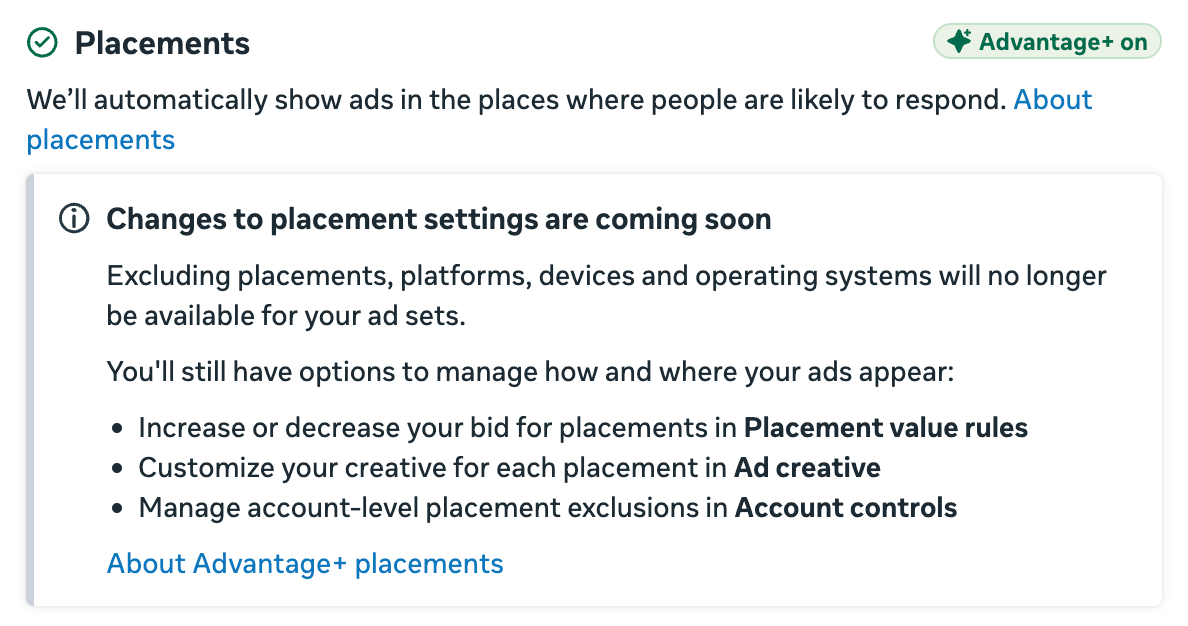
For teams that have built their process around trimming placements by hand, this is a meaningful shift. It is not, however, the end of placement control altogether — and understanding that difference is what separates a panicked reaction from a sound one.
What is actually changing
Until now, the Placements section inside an ad set let advertisers decide precisely where ads could and couldn’t appear. You could switch off individual placements, exclude whole platforms, limit delivery to mobile or desktop, or restrict by operating system.
Meta is removing those exclusion options from the ad set. Once the change reaches your account, you will no longer be able to:
Meta Is Removing Placement Controls From Ad Sets
- Remove individual placements, such as an in-stream video slot, a Reels surface, or the Audience Network
- Exclude an entire platform — for example, running only on Instagram by switching Facebook off
- Restrict delivery to mobile or desktop devices
- Restrict delivery by operating system, such as iOS or Android
In short, the granular, campaign-by-campaign delivery decisions many advertisers have relied on for years are being consolidated into Meta’s automated delivery engine.
Is Meta removing manual placements completely?
No — and it’s worth being precise here. The change targets exclusions at the ad-set level. It does not strip every lever from the platform, and it is not landing in every account on the same day. Some advertisers already see the notice; others won’t for a while, and no universal cut-off date has been published.
A fairer way to describe it: Meta is narrowing manual, ad-set-level placement control and handing more of that decision to automated delivery. Two meaningful controls remain, covered further down.
Why Meta is pushing in this direction
This isn’t an isolated tweak. It’s the latest step in a multi-year move toward automation. Over the past couple of years, Meta has steadily retired manual levers: detailed targeting exclusions were removed, automated placement options were promoted as the default, and warnings began appearing whenever advertisers switched placements off. Some campaign types were even allowed to spend a small slice of budget on “excluded” placements to demonstrate those surfaces could still contribute. Placement exclusions are simply the next lever to go.
The logic from Meta’s side is consistent. Its systems are built to find the cheapest qualifying result across every available surface, and every manual exclusion narrows the pool the algorithm can draw from. Remove the exclusions, and Meta gains maximum flexibility to place each impression wherever its models predict the best outcome.
That reframes the advertiser’s job. The central question shifts from “Where should my ads appear?” to “What outcome do I want Meta to optimise toward?” — and that distinction only grows in importance as more manual controls disappear.
What you can still control
Losing ad-set exclusions doesn’t leave you without options. Two levers remain, and they work differently from each other.
Value rules
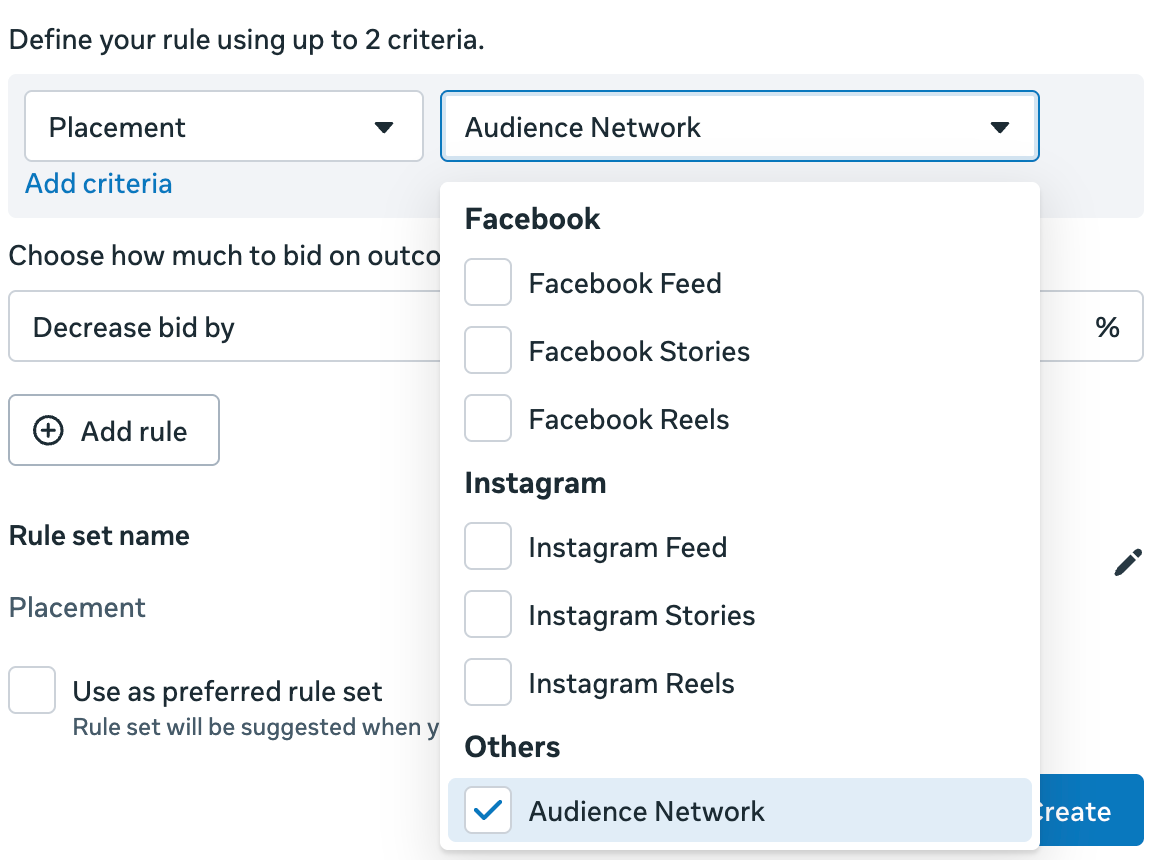
Value rules let you tell Meta that certain contexts are worth more — or less — to your business, and adjust how aggressively it bids accordingly. Rather than switching a placement off, you signal that a conversion in a given context deserves a higher or lower bid. Before treating them as a drop-in replacement, understand the limits:
- They adjust bids; they do not fully exclude a placement. A placement you bid down can still receive delivery.
- Only a limited set of placements — currently around seven — are eligible for placement-level bid adjustments.
- You can adjust bids by device (mobile versus desktop) and by mobile operating system.
- There is no direct value rule for an entire platform, though you can raise or lower bids on platform-specific placements to lean toward Facebook or Instagram.
Used well, value rules let you layer in business knowledge Meta doesn’t have — say, that a certain surface tends to produce lower-value customers — on top of its optimisation. Used carelessly, they backfire: bidding a placement down purely because of its reputation, rather than your own data, tends to raise costs without improving results.
Account-level placement controls
For genuine, standing restrictions, account-level controls are the stronger tool. Inside Advertising Settings, under Account Controls, you can set placement rules that apply across the entire ad account rather than a single ad set.
The scope is the key difference. An ad-set exclusion only ever affected one campaign setup. An account-level control applies everywhere and keeps applying — even to new campaigns built with automated placements. That makes it the right home for exclusions driven by:
- Brand safety
- Compliance obligations
- Client or business policy
- A specific surface you must never appear on
There’s a further advantage worth knowing. Ad-set exclusions have historically leaked: an option to allow limited spending on excluded placements could route a small share of budget — commonly cited at around 5% — to surfaces you thought you’d switched off. Account-level controls aren’t subject to that leak, so when a placement genuinely must stay off, the account level is the cleaner block.
Why conversion signals matter more than ever?
As Meta takes over more of the delivery decision, the quality of the signal you feed it becomes the thing you most control. Consider two campaigns. One is optimised for link clicks, so Meta hunts for the cheapest clicks it can find. The other is optimised for qualified leads, giving Meta a far more useful picture of what a valuable action looks like.
That gap matters, because a cheap click isn’t necessarily valuable, a cheap lead isn’t necessarily qualified, and a low-cost conversion isn’t necessarily a profitable customer. When you could exclude placements by hand, a weak optimisation goal was survivable — you’d simply prune the surfaces that delivered junk. With that lever gone, the optimisation goal and the conversion data behind it are doing far more of the work, and weak signals now cost you more than they used to.
Should you still watch placement performance?
Absolutely. Losing the ability to exclude a placement is not a reason to stop analysing it. Keep reviewing the full picture, not just the cheap-traffic metrics — CPM, CPC, and CTR, but also conversion rate, cost per qualified lead, customer acquisition cost, revenue, return on ad spend, and lead quality.
Here’s why the cheap numbers mislead. Consider two placements (figures illustrative):
| Metric | Placement A | Placement B |
|---|---|---|
| Cost per click | $5 | $15 |
| Leads | 20 | 10 |
| Qualified leads | 2 | 7 |
| Customers | 1 | 5 |
On cost per click alone, Placement A looks like the clear winner. Follow the funnel down to customers, though, and Placement B is producing five times the business. Judged on cheap traffic, you’d back the wrong horse – which is exactly why delivery should be evaluated on cost per valuable outcome, not cost per click.
A note on Audience Network
Audience Network is the placement that most often triggers this conversation, and it deserves a clear-eyed approach rather than a reflex exclusion. When campaigns are optimised for top-of-funnel actions like link clicks or landing-page views, inexpensive surfaces can generate a flood of low-cost actions that never turn into real business. That’s a genuine risk, and it’s the strongest historical case for excluding a placement.
But it’s a case about the objective as much as the placement. When a campaign is optimised toward a meaningful conversion, Meta has a much better signal for judging whether Audience Network is actually contributing. The right move is to evaluate it against your real objective and your downstream numbers – not to switch it off on reputation.
What to do before the change reaches your account
If you still have the old controls, use the window to prepare rather than to squeeze out a few more manual exclusions.
Document a baseline
Record your current setup while you still can: existing placement exclusions, campaign objectives, placement-level spend and conversions, cost per conversion, revenue, and lead quality. This gives you a benchmark to compare against once automated delivery takes over, so you can tell whether performance actually changed or just felt like it did.
Separate performance exclusions from business restrictions
Not every exclusion exists for the same reason. Some placements are switched off because someone believed they underperformed; others are off because of brand safety, compliance, or a client mandate. Treat these differently. A performance-based exclusion can often be released to the algorithm and tested. A hard business restriction needs to be rebuilt at the account level so it survives the change.
How to adapt: a practical checklist
The goal isn’t to recreate the old level of manual control. It’s to strengthen the inputs that make automated delivery work in your favour.
- Fix your optimisation goal. Optimise toward the outcome that actually matters. If you want sales, optimise for purchases. If you want qualified leads, feed qualified-lead signals wherever you can. The clearer the goal, the more useful Meta’s automation becomes.
- Strengthen conversion tracking. Automation is only as good as the data behind it. Audit your pixel, Conversions API, lead and purchase events, CRM integration, and offline conversion signals. Gaps in tracking translate directly into poor optimisation.
- Build creative for every surface. If Meta decides where ads run, your creative has to work everywhere. Prepare vertical formats for Reels and Stories, feed-friendly formats, and clear mobile-first headlines and calls to action. One format won’t perform equally across every placement.
- Measure downstream, not just at the click. For lead generation, follow the journey all the way: impression to click to lead to qualified lead to appointment to customer to revenue. The further down you can measure, the better you can judge whether automated delivery is producing real value.
- Don’t cut a placement just because it looks expensive. A higher CPC or CPM isn’t proof of a poor placement. If it brings better customers or higher revenue, the higher upfront cost may be entirely justified. Judge on cost per valuable outcome.
Where this is heading
The direction is clear: more automation, fewer manual controls. Automated placement distribution already spreads ads across eligible surfaces based on your objective, and removing ad-set exclusions is the next step in the same journey — alongside a broader consolidation that has recently begun retiring individual placements entirely from the eligible pool for some campaigns.
Meta’s longer-term vision, stated openly by its leadership, is a system where a business supplies an objective and a budget and the platform handles targeting, placement, and increasingly creative. You don’t have to love that vision to plan around it. The advertisers best positioned for it are the ones who stop spending their energy on where ads appear and redirect it toward what Meta is optimising for.
Is this good or bad for advertisers?
There isn’t one answer — it depends on how you’ve been working. If your process leans heavily on manual placement pruning, the change will feel restrictive; the quick “this surface isn’t working, switch it off” move is going away. If you already run automated placements with conversion-focused optimisation, you’re largely where Meta is pushing everyone, and the impact will be smaller. And if you’ve been buying cheap traffic on loose objectives, this is your prompt to tighten conversion tracking and objectives before the safety net of manual exclusions disappears.
The bottom line
Meta is gradually removing manual placement, platform, device, and operating-system exclusions at the ad-set level. The rollout is staggered and no universal date has been confirmed, but the trajectory isn’t in doubt.
This doesn’t mean control is gone. Value rules let you steer bids, and account-level controls still enforce genuine restrictions across the account — more reliably, in fact, than ad-set exclusions ever did. What changes is where your effort should go. As Meta increasingly decides where your ads appear, your job is to master what it optimises toward: sharper objectives, cleaner conversion data, stronger creative for every surface, and better first-party signals. Get those right, and automated delivery is far more likely to work for you than against you.