Real Estate
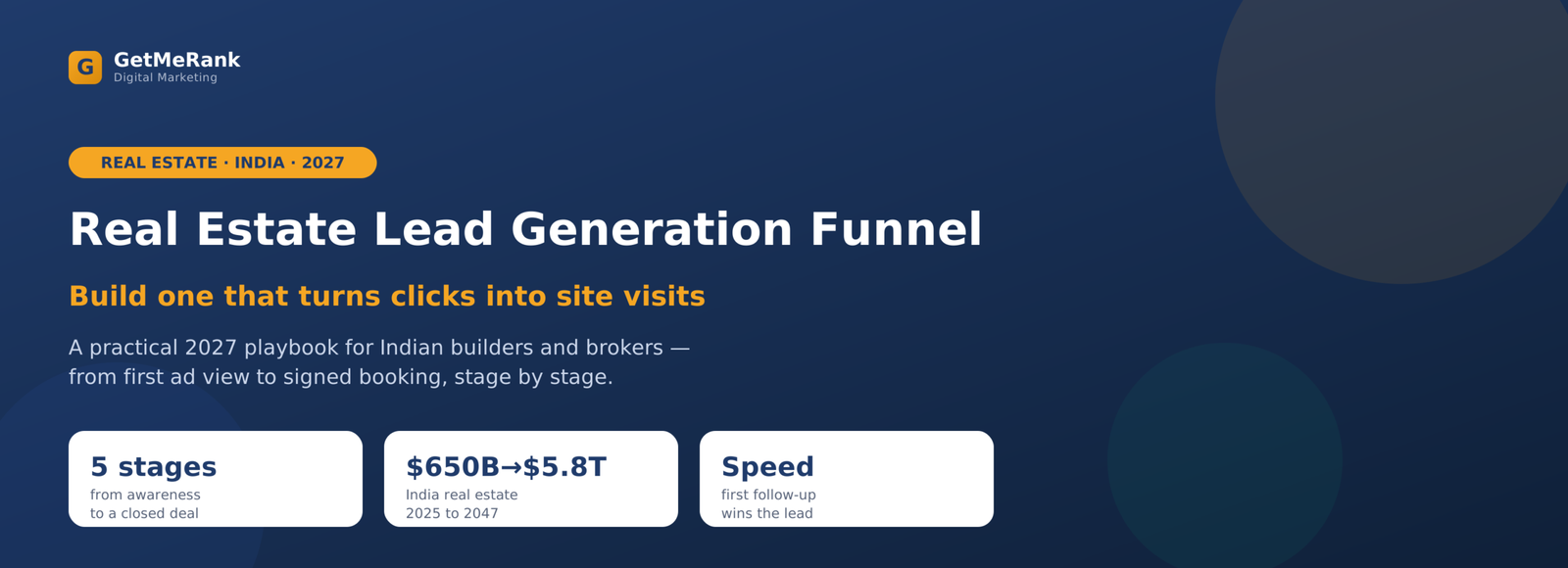
A stage-by-stage playbook for Indian builders and brokers — how to turn ad clicks and portal enquiries into booked site visits and closed deals, not a pile of cold leads.
Key Takeaways
- A real estate lead funnel is the journey from a buyer’s first ad view to a signed booking — across five stages: awareness, capture, nurture, site visit, and close.
- Most funnels leak at follow-up. Leads go cold in minutes, so speed and nurturing matter more than raw lead volume.
- The site visit is the real goal. In Indian real estate, nothing converts until you get feet on the property.
- India’s market is set to grow from about ₹60 lakh crore (US$650 billion) in 2025 toward ₹536 lakh crore (US$5.8 trillion) by 2047. The buyers are there; your funnel is how you win them.
- AI is the 2027 upgrade: instant responses, smart lead scoring and always-on nurturing turn the same five stages into a machine.
Introduction
Here’s a problem almost every Indian developer and broker knows too well: the ads are running, the leads are coming in, and yet bookings stay flat. Marketing spend keeps climbing while the gap between a click and a sale gets wider. The missing piece is rarely more leads — it’s a real estate lead generation funnel that actually carries a buyer from curiosity to commitment.
This guide breaks that funnel down into five clear stages, shows you exactly where leads leak out, and gives you a step-by-step way to plug the holes. We’ll cover the channels that work in India, the metrics that matter, and how AI is quietly rewriting the whole process for 2027. Whether you’re a solo broker or a large builder, you’ll leave with a blueprint you can act on this week.
Quick reference: the funnel at a glance
| Stage | The job | Main tools |
|---|---|---|
| 1. Awareness | Get discovered | SEO, Google & Meta ads, portals |
| 2. Capture | Turn clicks into leads | Landing pages, forms, WhatsApp |
| 3. Nurture | Build trust & qualify | Drip messages, calls, retargeting |
| 4. Site visit | Get feet on site | Booked visits, tours, reminders |
| 5. Close | Book & refer | Negotiation, paperwork, referrals |
Five stages, one goal — move the right buyers steadily toward a booking.
What Is a Real Estate Lead Generation Funnel?
SHORT ANSWER
A real estate lead funnel is the step-by-step path a potential buyer takes from first discovering your project to booking it. It filters a large audience down to a few serious buyers, stage by stage, so your team spends time on the people most likely to purchase.
Picture a wide mouth at the top and a narrow spout at the bottom. Thousands of people might see your ad; a few hundred click; a few dozen enquire; a handful visit the site; and a few actually book. Each stage of this lead generation funnel for real estate is deliberately narrower — and your job is to move as many of the right people down it as possible, while quietly filtering out the ones who were never going to buy.
Real Estate Lead Generation Funnel: How to Build One That Converts in 2027 (India)
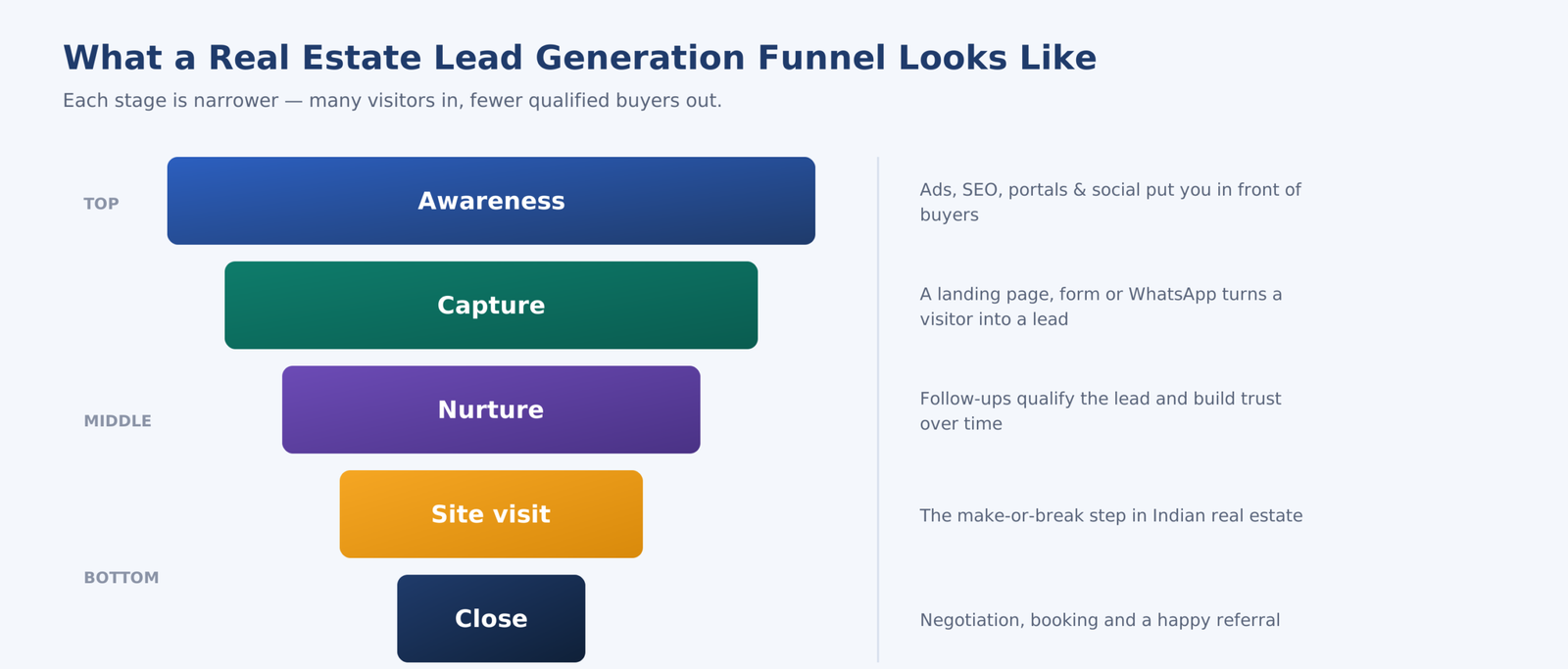
The classic funnel shape, mapped to the real estate buyer’s journey.
Why Do Most Real Estate Funnels Leak?
SHORT ANSWER
Because leads fall out between stages — usually from slow follow-up, no nurturing, poor-quality traffic, or a funnel that never pushes for a site visit. The leak, not the lead count, is what caps your bookings.
Across Indian real estate, marketing budgets have surged, but conversion hasn’t kept pace. The industry even has a name for it — the “lead-to-sale gap.” The clicks arrive and then go nowhere. Here are the four places a funnel usually springs a leak:
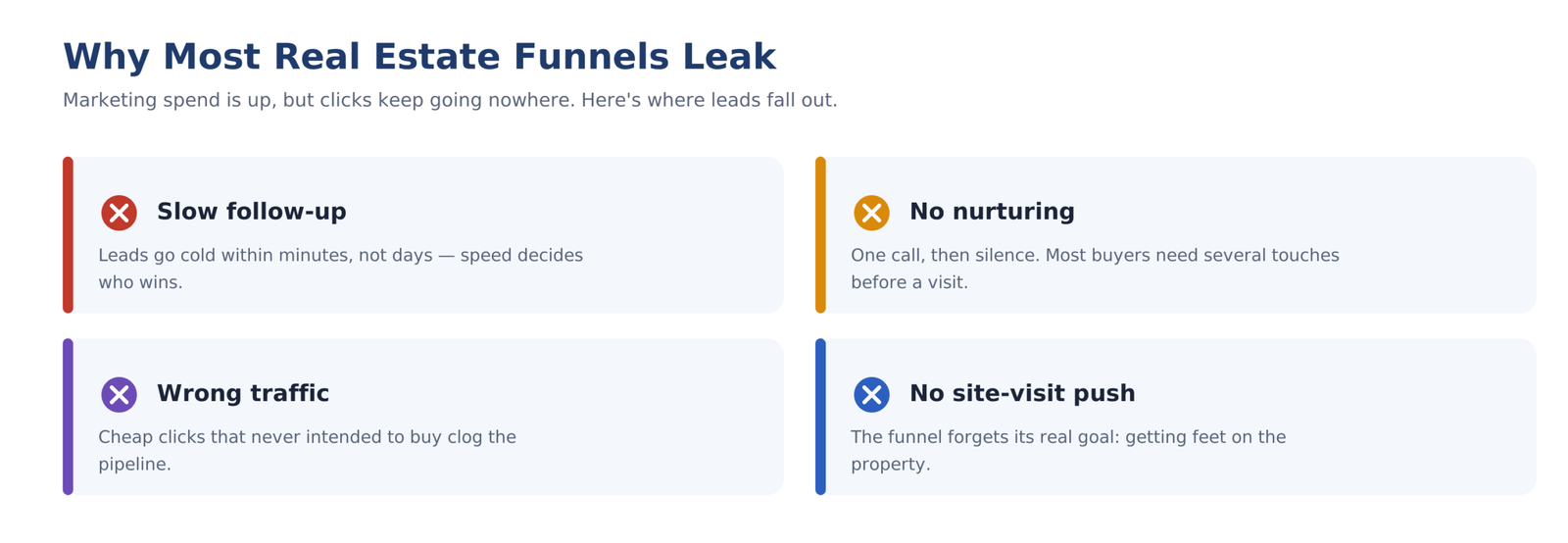
The four most common leak points between a click and a booking.
- Slow follow-up. A lead that isn’t contacted within minutes often goes cold — and a competitor who called first wins it.
- No nurturing. One call and then silence. Most buyers need several touches before they’re ready to visit.
- Wrong traffic. Cheap clicks from people who never intended to buy clog the pipeline and waste your team’s time.
- No site-visit push. The funnel forgets its one real job in real estate: getting a buyer physically onto the property.
The 5 Stages of a Real Estate Lead Generation Funnel
SHORT ANSWER
Awareness (get discovered), capture (turn clicks into leads), nurture (build trust and qualify), site visit (get feet on site), and close (book and refer). Each stage has a single, clear job.
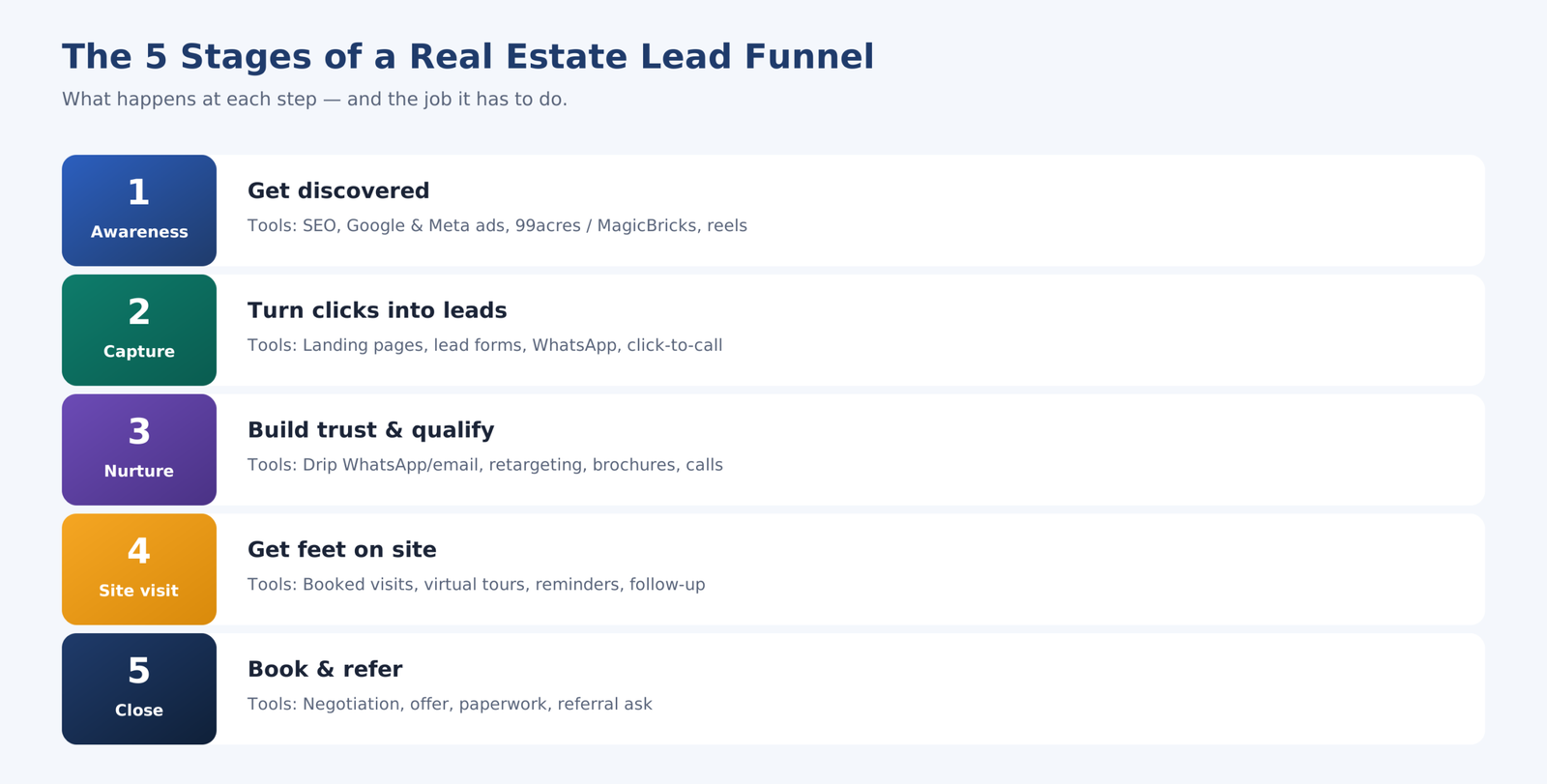
What happens at each stage of the funnel, and the tools that power it.
These five stages aren’t just labels — each is a filter with one job. Awareness casts the widest net; capture turns attention into a contactable lead; nurture separates serious buyers from casual browsers; the site visit converts interest into real intent; and close seals the deal. Because every stage feeds the next, the one that performs worst quietly caps everything below it — a funnel is only ever as strong as its leakiest point.
1. Awareness
Buyers discover your project through search, ads, portals, and social. Strong SEO for realtors keeps you visible for the exact localities and projects people search.
Objective: To make potential buyers aware of your real estate project.
This is the first stage, where people discover your project through different marketing channels.
- SEO: Optimise your website for searches such as “2 BHK flats in Lucknow” or “luxury apartments in Noida” to attract organic traffic. You can also check out our Real Estate SEO Services.
- Paid Ads: Run Google, Facebook, and Instagram advertisements to reach people interested in buying property.
- Social Media: Share project images, videos, location highlights, and construction updates.
- Property Portals: List your projects on platforms like 99acres, Magicbricks, and Housing.com.
Key Metrics: Website traffic, ad reach, impressions, and click-through rate.
2. Capture
A fast landing page, a simple form or a WhatsApp click turns an anonymous visitor into a named lead you can contact.
Objective: To collect contact information from interested visitors.
Once people discover your project, the next step is to encourage them to share their details so your sales team can contact them.
- Landing Pages: Create project-specific pages highlighting pricing, location, amenities, and configurations.
- Enquiry Forms: Collect basic details such as name, phone number, budget, and property preferences.
- WhatsApp Integration: Allow visitors to directly enquire about the project through WhatsApp.
- Call-to-Actions (CTAs): Use buttons like “Download Brochure”, “Get Price Details” and “Book a Site Visit”.
- CRM Integration: Store and organise all incoming leads for effective follow-ups.
Key Metrics: Number of leads, cost per lead (CPL), and landing page conversion rate.
3. Nurture
Sequenced follow-ups — WhatsApp, calls, retargeting — build trust and separate serious buyers from browsers.
Objective: To build trust, understand buyer requirements, and identify serious prospects.
Not every person who enquires is ready to purchase immediately. Lead nurturing helps maintain communication and move interested prospects closer to a buying decision.
- WhatsApp Follow-ups: Share brochures, price lists, floor plans, and project updates.
- Phone Calls: Understand the buyer’s budget, preferred location, and property requirements.
- Email Marketing: Send project information, offers, and relevant updates.
- Retargeting Ads: Show advertisements again to people who previously visited your website or interacted with your project.
- Lead Qualification: Identify serious buyers based on their budget, purchase timeline, and level of interest.
Key Metrics: Qualified leads, follow-up response rate, and lead-to-qualified-lead conversion rate.
4. Site visit
The make-or-break stage. Booked visits, reminders, and virtual tours get the buyer onto the property.
Objective: To encourage qualified leads to visit the property and experience the project.
This stage allows potential buyers to evaluate the property physically and understand whether it matches their expectations.
- Visit Scheduling: Coordinate with interested leads and book suitable site visit appointments.
- Reminders: Send WhatsApp or SMS reminders to reduce missed appointments.
- Property Tours: Show sample flats, amenities, construction quality and project surroundings.
- Virtual Tours: Offer video walkthroughs and virtual visits to buyers who cannot visit physically.
- Post-Visit Follow-ups: Collect feedback, resolve concerns and understand the buyer’s purchase interest.
Key Metrics: Site visits booked, actual visits completed and lead-to-site-visit conversion rate.
5. Close
Negotiation, booking and paperwork — followed by a referral ask that feeds the top of the funnel again.
Objective: To convert interested prospects into confirmed property bookings.
At this stage, the sales team works towards finalising the deal by addressing the buyer’s remaining concerns and completing the booking process.
- Negotiation: Discuss pricing, offers, payment plans, and other commercial terms.
- Inventory Confirmation: Confirm the availability of the buyer’s preferred property.
- Booking: Complete the booking process and collect the applicable booking amount.
- Documentation: Coordinate agreements, paperwork, and necessary legal formalities.
- Referrals: Encourage satisfied customers to recommend the project to friends and family, generating new leads.
Key Metrics: Number of bookings, lead-to-sale conversion rate, cost per acquisition, and revenue generated.
HIGHLIGHT
The real estate sales funnel is a loop, not a line. A happy buyer at the “close” stage becomes a referral source that refills “awareness” — which is why the cheapest leads you’ll ever get come from the last stage, not the first.
How Do You Build a Property Lead Funnel, Step by Step?
SHORT ANSWER
Define your buyer, pick two or three channels, build a fast landing page, set up instant follow-up, nurture toward a site visit, then track and scale what works. Start focused rather than everywhere at once.
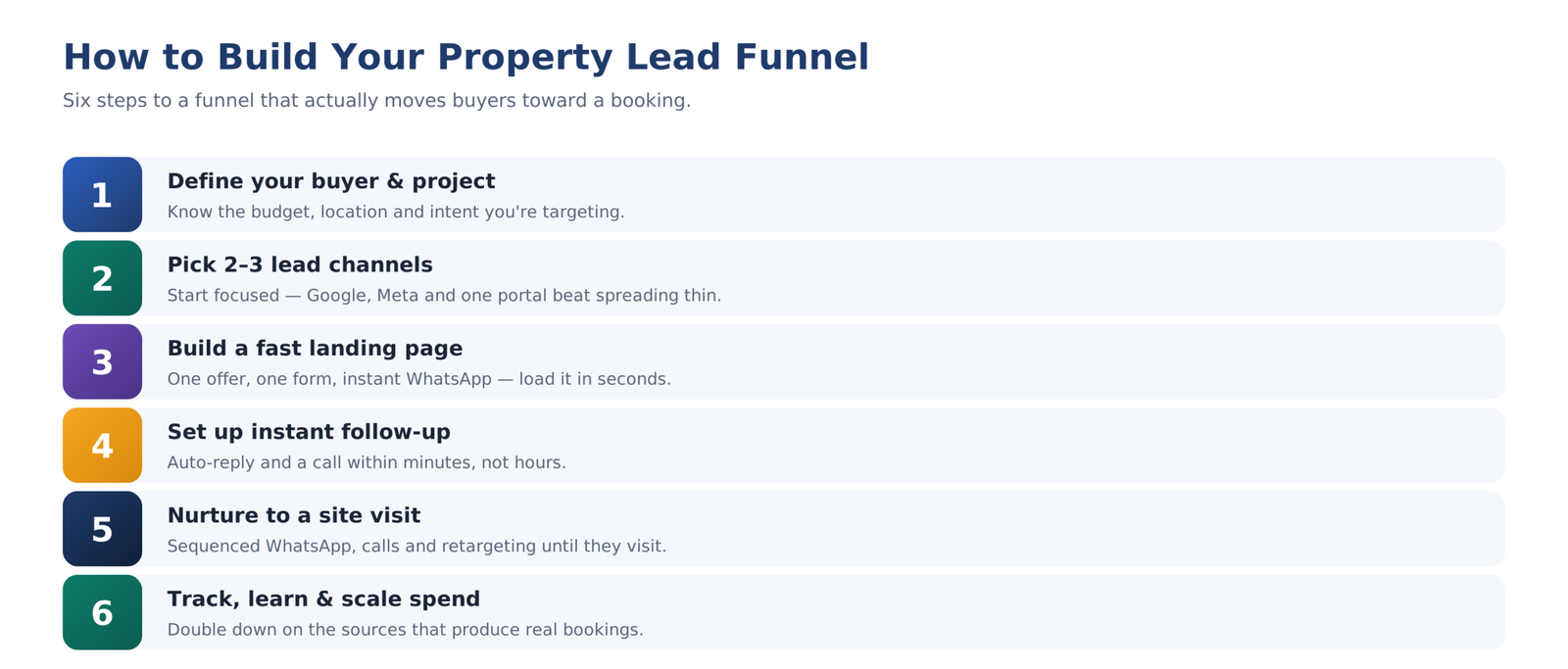
Six steps to a property lead funnel that moves buyers toward a booking.
- Define your buyer and project. Be clear on the budget, location, and intent you’re targeting before you spend a rupee.
- Pick two or three lead channels. Google, Meta, and one portal beat spreading your budget thin across everything.
- Build a fast landing page. One offer, one form, instant WhatsApp — and make sure it loads in a couple of seconds on mobile.
- Set up instant follow-up. An automatic reply plus a human call within minutes, not hours.
- Nurture toward a site visit. Sequence WhatsApp, calls, and retargeting with one aim: getting them to visit.
- Track, learn, and scale spend. Put more money into the sources producing real bookings, and cut the rest.
PRO TIP
Reaching a new lead within the first five minutes can lift your chance of connecting with them several times over. In Indian real estate, where a buyer enquires on multiple projects at once, the builder who responds first usually gets the site visit.
Which Channels Feed the Funnel in India?
SHORT ANSWER
Property portals (99acres, MagicBricks, Housing.com), Google and local SEO, Meta and Google Ads, WhatsApp, and referrals or channel partners. Each pulls a different kind of buyer, so the strongest funnels use several together.
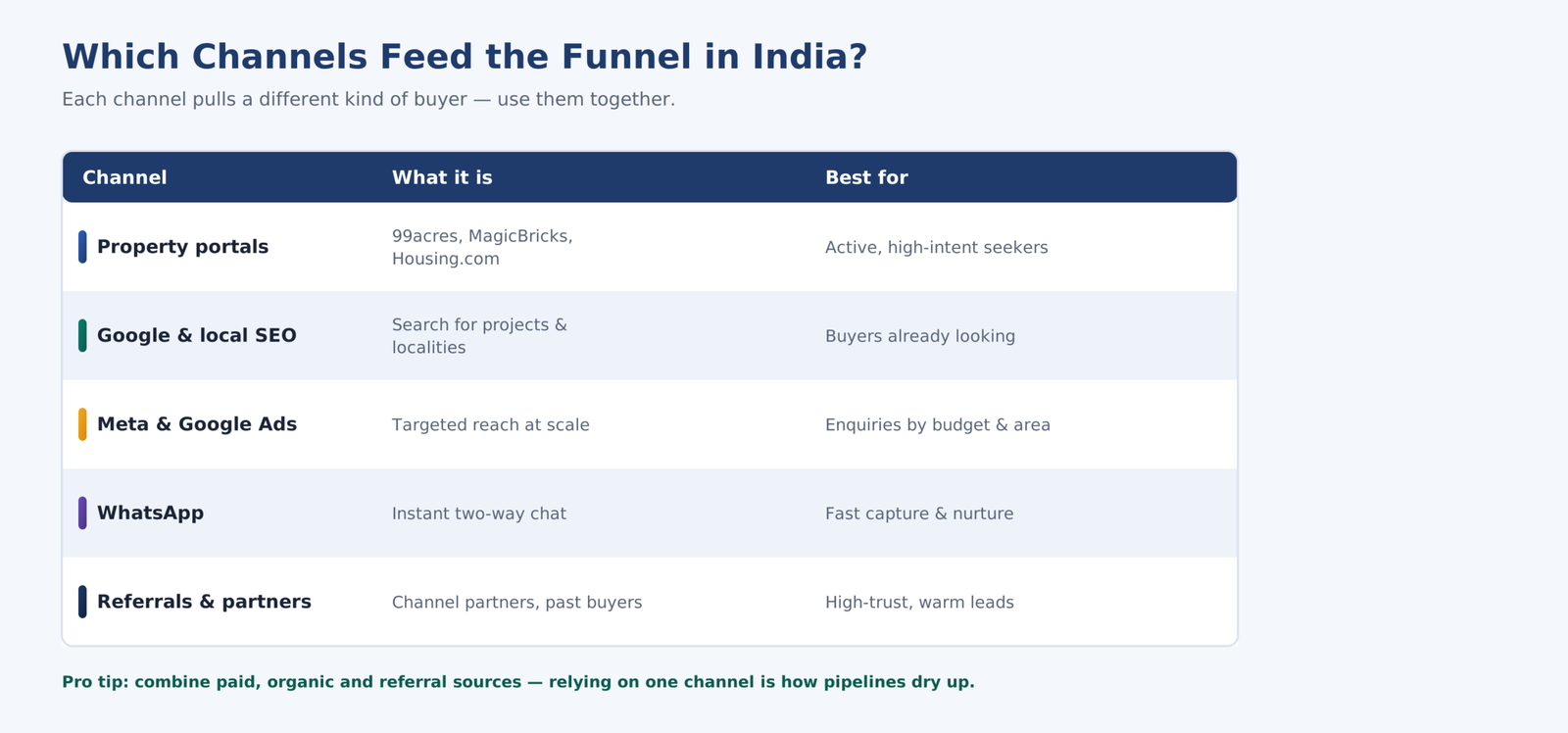
The main channels that feed an Indian real estate funnel, and what each is best at.
Portals bring active, high-intent seekers. Search and performance marketing for real estate capture buyers by budget and location at scale. WhatsApp handles instant two-way conversations, and referrals deliver the warmest leads of all. The mistake is leaning on a single source — when one channel dips, the whole pipeline dries up. The smartest approach is to treat your channels as a portfolio — portals and ads for immediate volume, SEO and content for leads that compound over time, and referrals as the low-cost layer that grows every time you deliver a project well.
How Do You Fix a Leaking Conversion Funnel?
SHORT ANSWER
Call leads within five minutes, nurture across multiple channels, qualify before your sales team invests time, and make the site visit as easy as possible to book. These fixes lift bookings without spending more on ads.
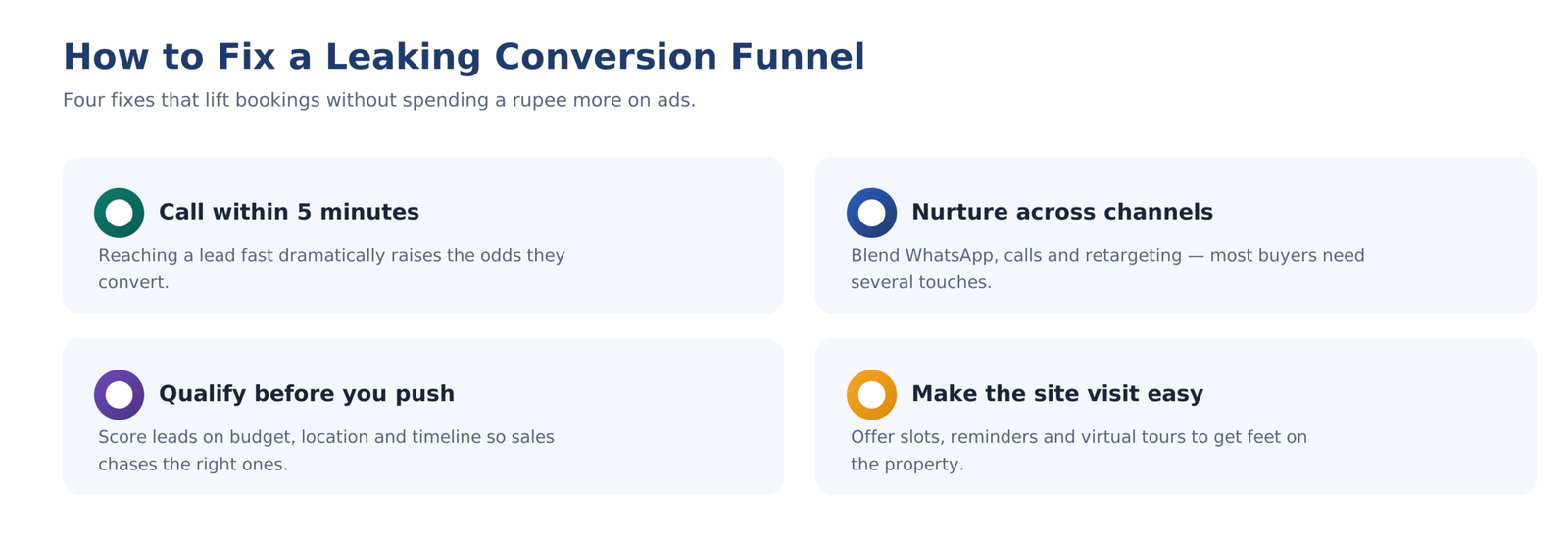
None of these fixes need a bigger ad budget — they simply stop you wasting the leads you already pay for. In practice, the biggest gains come from the first two: calling faster and following up across more channels. A buyer who feels remembered and gets a quick, helpful reply is far more likely to agree to a visit, even for a project they were only mildly curious about at first.
- Respond in minutes. Speed-to-lead is the single biggest lever most teams ignore.
- Nurture across channels. Blend WhatsApp, calls, and retargeting — few buyers convert on the first touch.
- Qualify early. Score leads on budget, location, and timeline so your team chases the right ones.
- Make visiting effortless. Offer slots, send reminders, and use virtual tours to get buyers on site.
Which Funnel Metrics Should You Track?
SHORT ANSWER
Track cost per lead, lead-to-site-visit rate, site-visit-to-booking rate, and overall cost per booking. These four numbers tell you exactly which stage of the funnel is winning and which is leaking.
The trap most teams fall into is chasing the cheapest lead instead of the cheapest booking. A channel can deliver leads at half the price and still be your worst performer if those leads never visit or buy. Watching all four numbers together — and following them down to cost per booking — shows you clearly where to spend more, where to fix the process, and where to stop pouring money.
- Cost per lead (CPL). What you pay to capture one enquiry — useful, but never the whole story.
- Lead-to-site-visit rate. The clearest sign your nurturing and qualification are working.
- Site-visit-to-booking rate. Where your on-ground sales and project value prove themselves.
- Cost per booking. The number that actually matters — it ties marketing spend to real revenue.
RECOMMENDATION
Stop judging campaigns on cost per lead alone. A channel with a higher CPL but far more site visits and bookings is the better investment. Always follow the money down to cost per booking.
How Is AI Upgrading the Funnel in 2027?
SHORT ANSWER
AI keeps the same five stages but makes them faster and always-on: instant lead responses, smart lead scoring, round-the-clock nurturing, and predictive ad spend that shifts budget to whatever is actually producing bookings.
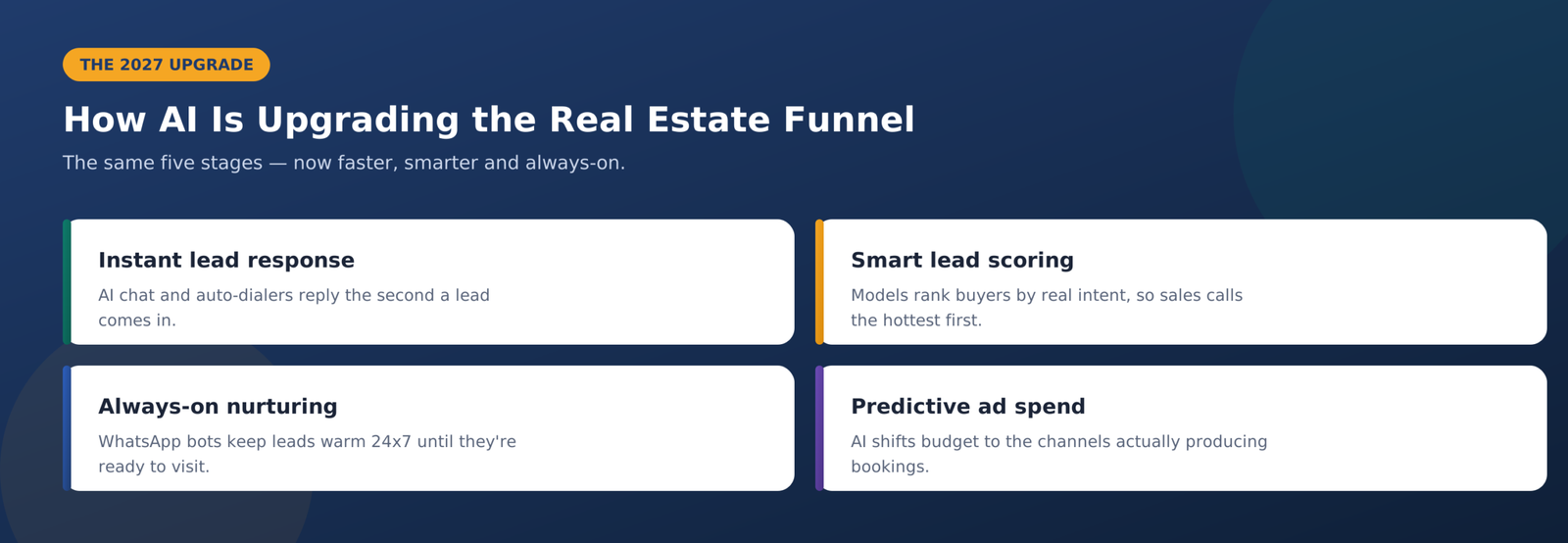
The builders pulling ahead in 2027 aren’t reinventing the funnel — they’re automating its weakest points. AI chat answers a lead the second it arrives, scoring models flag the hottest buyers for a human call, and WhatsApp bots keep everyone else warm until they’re ready to visit. Meanwhile, spend quietly flows toward the channels that convert. It’s the same journey, just far less of it left to chance. For a mid-sized developer, that can be the difference between a sales team drowning in cold enquiries and one that spends its time only with buyers who are genuinely ready to visit.
Where GetMeRank Fits In
Building all of this in-house takes time most property teams don’t have. That’s where we come in. GetMeRank designs and runs complete real estate lead generation services in India — from traffic and landing pages to instant follow-up and CRM — all engineered around one outcome: more booked site visits, not just more leads.
Frequently Asked Questions
Q. What is a real estate lead funnel in simple terms?
A. It’s the path a buyer takes from first seeing your project to booking it — attract, capture, nurture, visit and close. A good funnel moves the right people through each stage while filtering out those who won’t buy.
Q. What’s the most important stage of the funnel?
A. The site visit. In Indian real estate, buyers rarely commit without seeing the property, so every earlier stage should be built to drive one booked visit.
Q. How many leads do I need to get one booking?
A. It varies by project, price and city, so track your own ratios. Focus less on raw lead volume and more on your lead-to-site-visit and site-visit-to-booking rates — that’s where bookings are won or lost.
Q. Which channel gives the best real estate leads in India?
A. There’s no single winner. Portals bring high-intent seekers, ads scale reach, and referrals are the warmest. The best results come from combining paid, organic and referral sources.
Q. How does AI improve a real estate funnel?
A. It removes the delays humans can’t avoid — instant responses, 24×7 nurturing, and lead scoring that points your team at the hottest buyers first, so fewer leads slip through the cracks.
Conclusion
A real estate lead generation funnel isn’t a marketing buzzword — it’s the difference between paying for clicks and actually filling your project. Get the five stages right, fix the leaks between them, keep your eye on booked site visits rather than vanity lead counts, and let AI handle the speed humans can’t. Do that, and your marketing spend finally starts showing up in your sales.
Start with one fix this week: faster follow-up is usually the highest-impact place to begin — and build from there.