
Ecommerce Management
Key Takeaways
- The barcode on Myntra product packaging is a GS1 EAN-13 — a 13-digit global ID, not Myntra’s internal code.
- Barcode number vs Myntra product code: the EAN is yours and global; the Myntra product code is created inside Myntra when your catalogue is approved.
- One unique barcode per SKU. Every size-and-colour variant needs its own EAN — a shirt in 3 colours × 5 sizes needs 15 codes.
- Getting a GS1 India prefix takes about 7–10 working days, after which you generate your EANs.
- Most rejections are avoidable — mismatched codes, duplicate EANs and unscannable labels cause the majority of failed inbounds.
Introduction
If you sell on Myntra, few small details cause as much quiet pain as barcodes. Get them right and your stock glides through the fulfilment centre; get them wrong and a whole carton bounces back, costing you a fresh inbound appointment and days of lost sales. Yet most guides treat product barcoding as an afterthought — when it quietly decides whether a carton clears the warehouse or bounces straight back.
This guide fixes that — treating barcodes on your Myntra listings as the make-or-break detail they really are. We’ll explain what the barcode actually is, clear up the constant confusion between your barcode number and your Myntra product code, and walk through setting up barcodes step by step — plus the label specs and mistakes that decide whether your stock passes quality check. It’s written for sellers, but buyers will also learn how to verify a product is genuine.
Quick reference: barcode number vs Myntra product code
| Feature | Barcode number (EAN) | Myntra product code |
|---|---|---|
| What it is | A 13-digit GS1 EAN you own | Myntra’s own style / SKU ID |
| Scope | Global — works anywhere | Only inside Myntra |
| Where it comes from | Issued via GS1 India | Created when your catalogue is approved |
| Lives on | The physical product label | Your Myntra catalogue |
Two different identifiers — your label must carry the EAN and map to the Myntra SKU.
What Is a Barcode on Myntra Product Packaging?
SHORT ANSWER
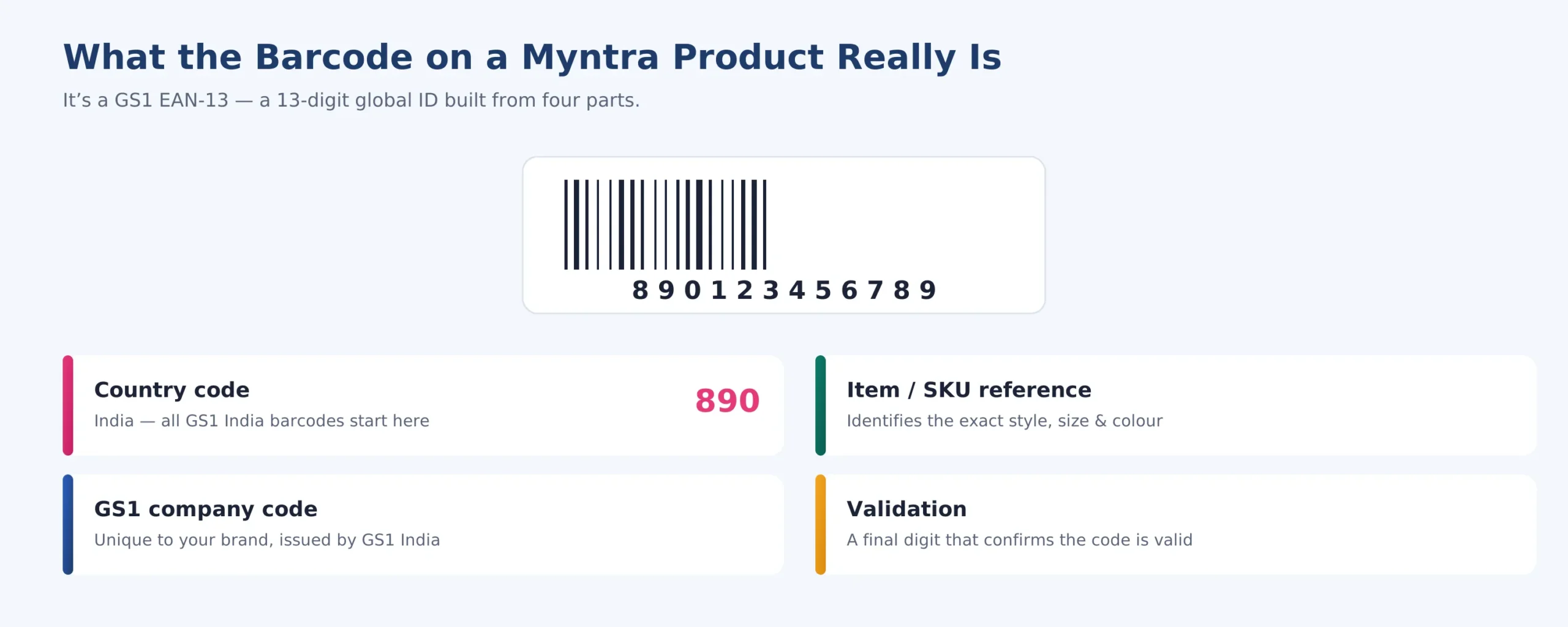
It’s a GS1 EAN-13 — a 13-digit, machine-readable code that uniquely identifies one product variant. It carries a GTIN (Global Trade Item Number) and lets Myntra’s systems track that exact item from inbound to delivery.
Those 13 digits aren’t random. An EAN-13 is built from four parts: the country code (890 for India), a company prefix unique to your brand, a product reference that identifies the specific style, size and colour, and a final check digit that confirms the code is valid.
Barcode on Myntra Product: The 2026 Seller’s Guide to EANs That Clear QC
Myntra Product Code vs Barcode Number: What’s the Difference?
SHORT ANSWER
The barcode number is your global EAN-13; the Myntra product code is Myntra’s internal style/SKU ID. Your physical label carries the EAN, and that EAN must map to the correct Myntra SKU in your approved catalogue.
This is where most sellers slip up. The barcode number and the Myntra product code are not interchangeable — one is your identifier for the outside world, the other is Myntra’s identifier inside its own warehouse. If the label says one thing and the catalogue says another, the item fails scan at the dock.
HIGHLIGHT
Keep them straight: the EAN is yours and global; the product code is Myntra’s and internal.
Where Do You Find the Barcode on Myntra Product Listings and Packaging?
SHORT ANSWER
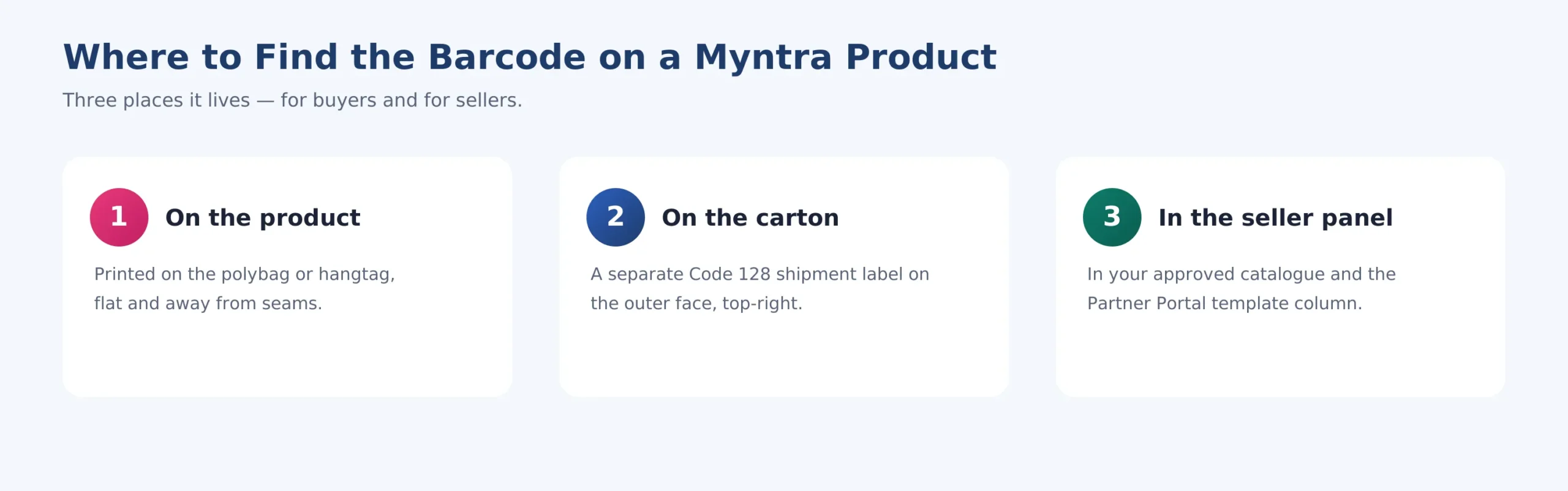
On the product, it’s printed on the polybag or hangtag. On the shipping carton, it’s a separate Code 128 label. As a seller, you’ll find and manage your EANs inside your approved catalogue in the Myntra Partner Portal.
- On the product. The item barcode sits flat on the polybag or hangtag, away from seams so it scans cleanly.
- On the carton. A separate Code 128 shipment label goes on the outer face, near the top-right, for the dock team to scan.
- In the seller panel. Your EANs live in the Partner Portal catalogue template and your approved catalogue download.
Why Does Myntra Need a Barcode on Every Product?
SHORT ANSWER
Barcodes let Myntra identify, track and ship the exact right item at scale — cutting errors, speeding up processing, and reducing counterfeits. No valid barcode usually means no successful inbound.
- Accurate inventory. Each scan tells Myntra exactly what’s in stock and where it sits, from storage to dispatch.
- Faster order processing. Scanning beats manual lookups, so your orders move through picking and packing quicker.
- Fewer wrong-item returns. A unique code per variant means the customer gets the exact size and colour they ordered.
- Counterfeit protection. A registered GTIN ties the product to a real, verifiable brand owner.
PRO TIP
A single mislabelled carton can trigger a full return and a new inbound appointment — often several days of lost selling time. One minute spent scanning a sample before dispatch saves all of it.
How to Set Up Barcodes for Myntra
SHORT ANSWER
On the product, it’s printed on the polybag or hangtag. On the shipping carton, it’s a separate Code 128 label. As a seller, you’ll find and manage your EANs inside your approved catalogue in the Myntra Partner Portal.
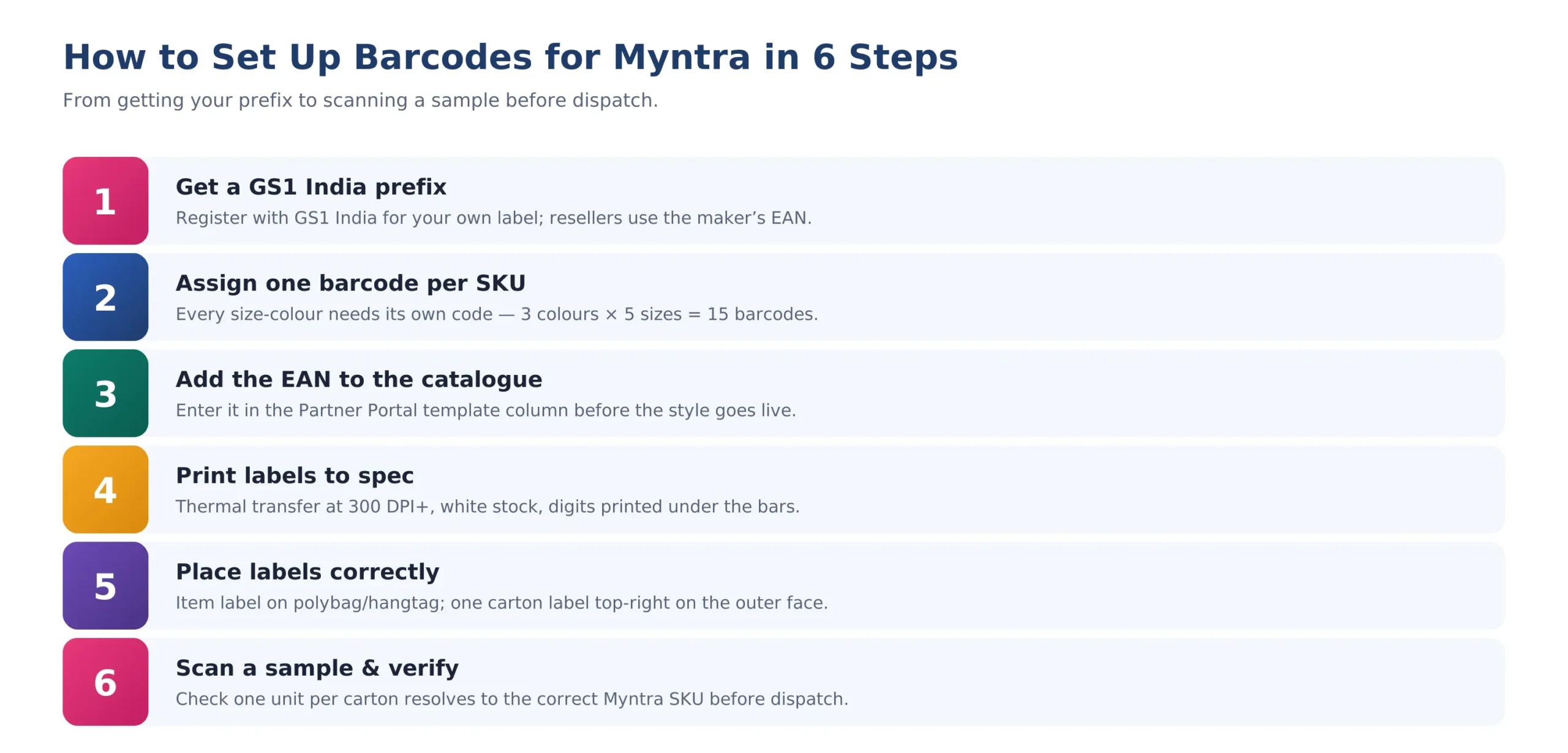
1. Get a GS1 India prefix
If you sell your own label, register with GS1 India for a company prefix; resellers of branded goods use the manufacturer’s existing EAN.
2. Assign one barcode per SKU
Every size-and-colour combination needs its own EAN — three colours across five sizes means fifteen distinct codes.
3. Add the EAN to your catalogue
Enter each code in the designated column of the Partner Portal template before the style goes live; codes added later need a catalogue revision.
4. Print labels to spec
Use a thermal-transfer printer at 300 DPI or better, on plain white stock, with the digits printed under the bars.
5. Place labels correctly
Put the item label flat on the polybag or hangtag, and one carton label on the outer face near the top-right.
6. Scan a sample and verify
Before dispatch, scan one unit from each carton and confirm it resolves to the correct Myntra SKU.
If this is your first catalogue, it’s worth keeping a reliable Myntra seller Guide open alongside the Partner Portal so each field and template column is filled exactly as Myntra expects.
What Are the Barcode Label Requirements That Pass QC?
SHORT ANSWER
Thermal-transfer print at 300 DPI or better, plain white stock with no gloss over the bars, human-readable digits underneath, a clear quiet zone on both sides, and nothing overlapping the code.
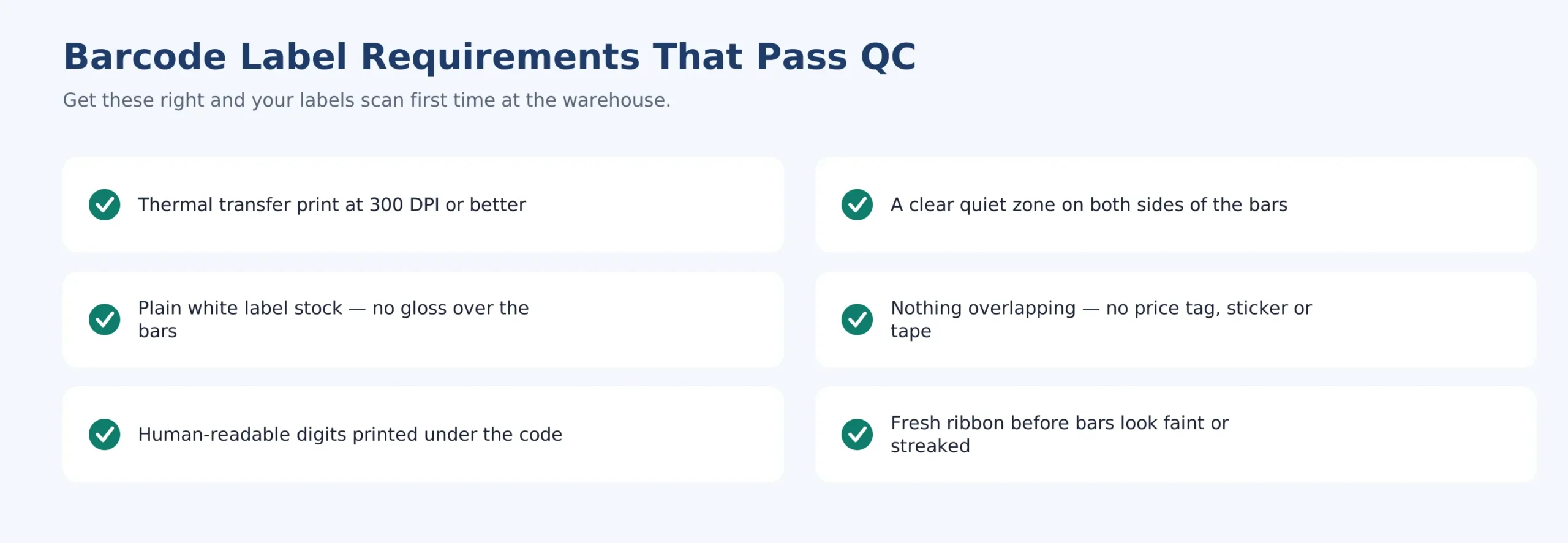
- Print quality. Thermal transfer at 300 DPI or higher; replace the ribbon before bars look faint or streaked.
- Label stock. Plain white, with no gloss lamination over the bars that could cause glare.
- Readability. Always print the human-readable digits beneath the barcode as a fallback.
- Quiet zone. Leave clear space on both sides, and make sure no price tag, sticker or tape overlaps the code.
What Barcode Mistakes Get Myntra Stock Rejected?
SHORT ANSWER
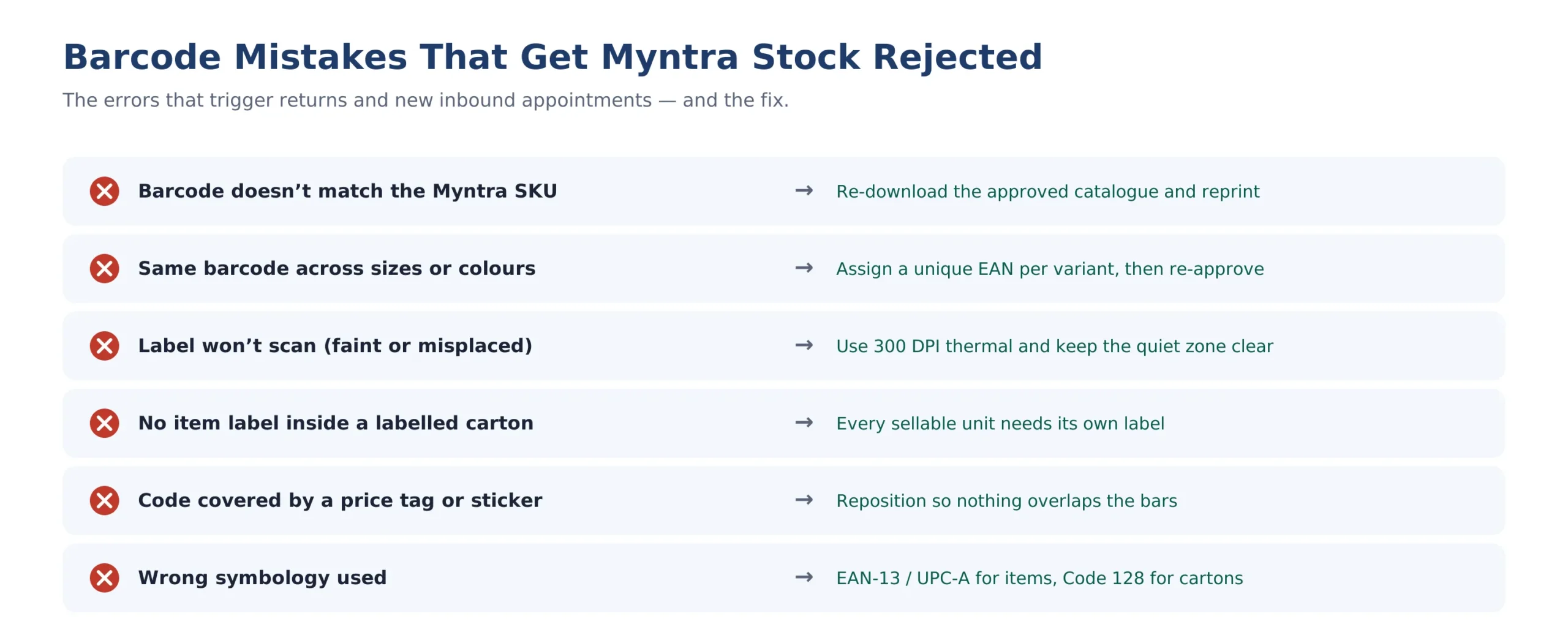
The big ones: a barcode that doesn’t match the Myntra SKU, the same code reused across variants, unscannable labels, missing item labels inside a carton, and using the wrong symbology.
How Do You Check a Myntra Barcode Number Is Genuine?
SHORT ANSWER
Scan it with GS1 India’s free Smart Consumer app or enter the number on their GTIN validation page, then confirm the details match the product listed on Myntra. If nothing is registered, treat it as suspect.
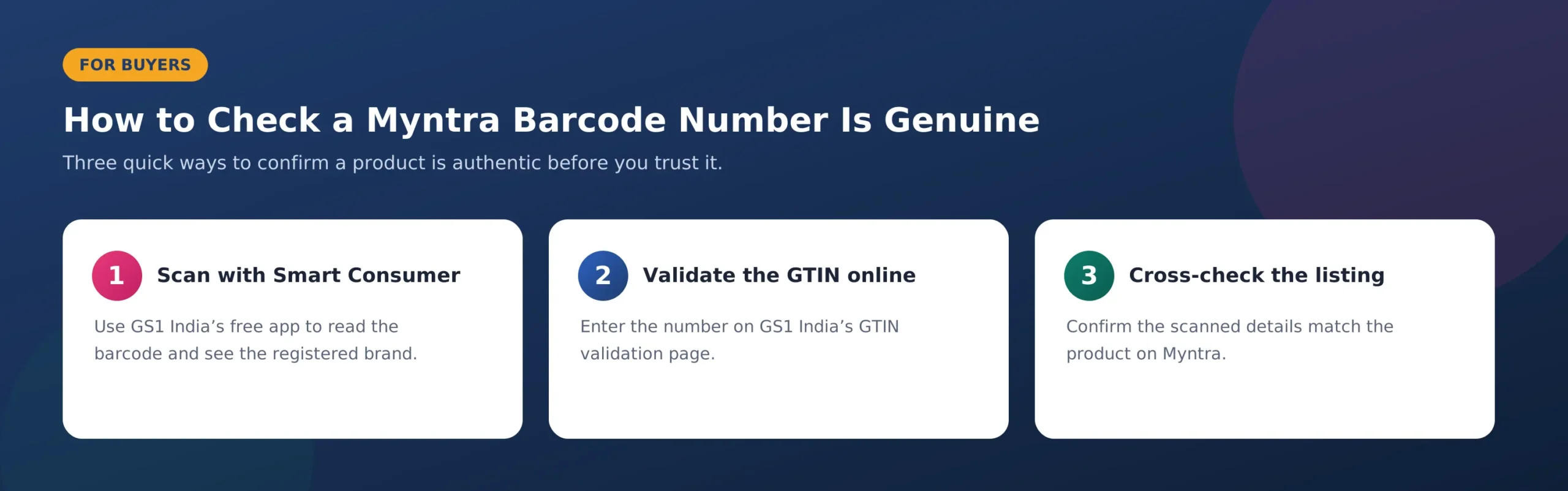
This matters for buyers worried about fakes, and for sellers doing their own quality checks. Verifying a myntra barcode number takes seconds and confirms the product is tied to a real, registered brand.
Where GetMeRank Fits In
Barcodes are a small part of a much bigger job: running a Myntra catalogue that actually sells. At GetMeRank, we manage Myntra accounts end to end — cataloguing, barcode and SKU setup, inventory, listing optimisation and growth — so your stock clears QC the first time and your styles get seen by the right shoppers.
Need Help Managing Your Myntra Catalogue?
Frequently Asked Questions
1. Is the Myntra barcode number the same as the product code?
No. The barcode number is your global EAN-13, while the product code is Myntra’s internal style/SKU ID. Your label carries the EAN, which must map to the correct Myntra product code.
2. Do I need a separate barcode for every size and colour?
Yes. Each variant is a distinct SKU and needs its own unique EAN. Reusing one code across sizes or colours is a common cause of rejection.
3. How do I get a barcode for my brand?
Register with GS1 India for a company prefix, then generate your EANs. Allotment usually takes about 7–10 working days. Resellers of branded goods use the manufacturer’s existing EAN instead.
4. What barcode format does Myntra use?
EAN-13 (or UPC-A where a brand already carries UPCs) for individual items, and Code 128 for the shipment label on outer cartons.
5. What happens if my barcode won’t scan?
The carton can be rejected, forcing a return and a new inbound. Usually it’s a print-quality or placement issue — use a 300 DPI thermal printer and keep the quiet zone clear.
Conclusion
Handled properly, the barcode on Myntra product packaging is simply plumbing — invisible when it works, expensive when it doesn’t. Assign one accurate EAN per SKU, map it to the right Myntra product code, print to spec, and scan a sample before dispatch, and the whole process quietly disappears into the background where it belongs.
Set it up carefully once, build a simple checklist, and every inbound after that gets faster, cleaner and far less stressful.