Marketing
Key takeaways
• Start with Search. It reaches people who are already looking for care. Add Performance Max or video later, once conversion data is steady.
• Budget from patient value, not guesswork. Many single-location primary care practices start around $1,500 to $4,000 a month. Competitive specialties often need $5,000 to $15,000.
• Health is a restricted category. Google limits ad personalization based on health conditions, so remarketing tips from other industries often do not apply.
• Keep patient details out of your tracking. Count calls and form submissions. Never pass diagnoses or form answers to an ad platform.
• One service, one landing page. Matching the ad to the page lowers cost and lifts bookings.
Google Ads for Doctors: A Practical 2026 Guide to Getting More Booked Appointments
• Plan for a 90-day ramp. Leads can start within weeks, but real optimization takes two to three months.
Why do some practices fill their schedules with ads while others burn the budget?
Picture two clinics on the same street. Both run ads. One books a steady stream of new patients. The other pays for clicks, gets a few calls from people looking for free care, and quietly pauses the account after three months.
The difference is rarely the budget. It is the setup: which searches trigger the ad, where the click lands, and whether anyone tracks what happens next. That is what makes Google Ads for doctors different from running ads for a pizza shop. Patients search with urgency, the rules are tighter, and one careless tracking tag can create a privacy problem.
This guide covers what matters: how the ads work, which campaign types to use, how to stay inside Google’s health policies and HIPAA expectations, what to budget, and what to measure. At Get Me Rank, we run paid search and SEO under one roof, so we see where practices lose money and where they win. We will point out both.
What does the whole process look like at a glance?
Seven steps, usually three to four weeks from kickoff to launch. Here is the workflow we follow, with the output you should have at each stage.
| Step | What you do | What you end up with | Typical timing | Who is involved |
|---|---|---|---|---|
| 1 | Set one goal | One service, one location, one target cost per booked appointment | Days 1 to 3 | Practice owner |
| 2 | Check policy and privacy | A tracking plan that excludes patient details, and a list of what Google allows | Days 3 to 7 | Ad specialist, compliance contact |
| 3 | Build keywords | Booking-intent keywords by service, plus a negative keyword list | Week 1 | Ad specialist |
| 4 | Write ads | Responsive Search Ads with factual, specific headlines | Weeks 1 to 2 | Ad specialist, practice owner |
| 5 | Build landing pages | One page per service with a phone number and booking form up top | Weeks 2 to 3 | Web team |
| 6 | Launch with tracking | Clean data on calls and form submissions | Weeks 3 to 4 | Ad specialist |
| 7 | Optimize | Falling cost per booked appointment over time | Day 30 to 90 and beyond | Everyone |
Do Google Ads for doctors actually work?
SHORT ANSWER
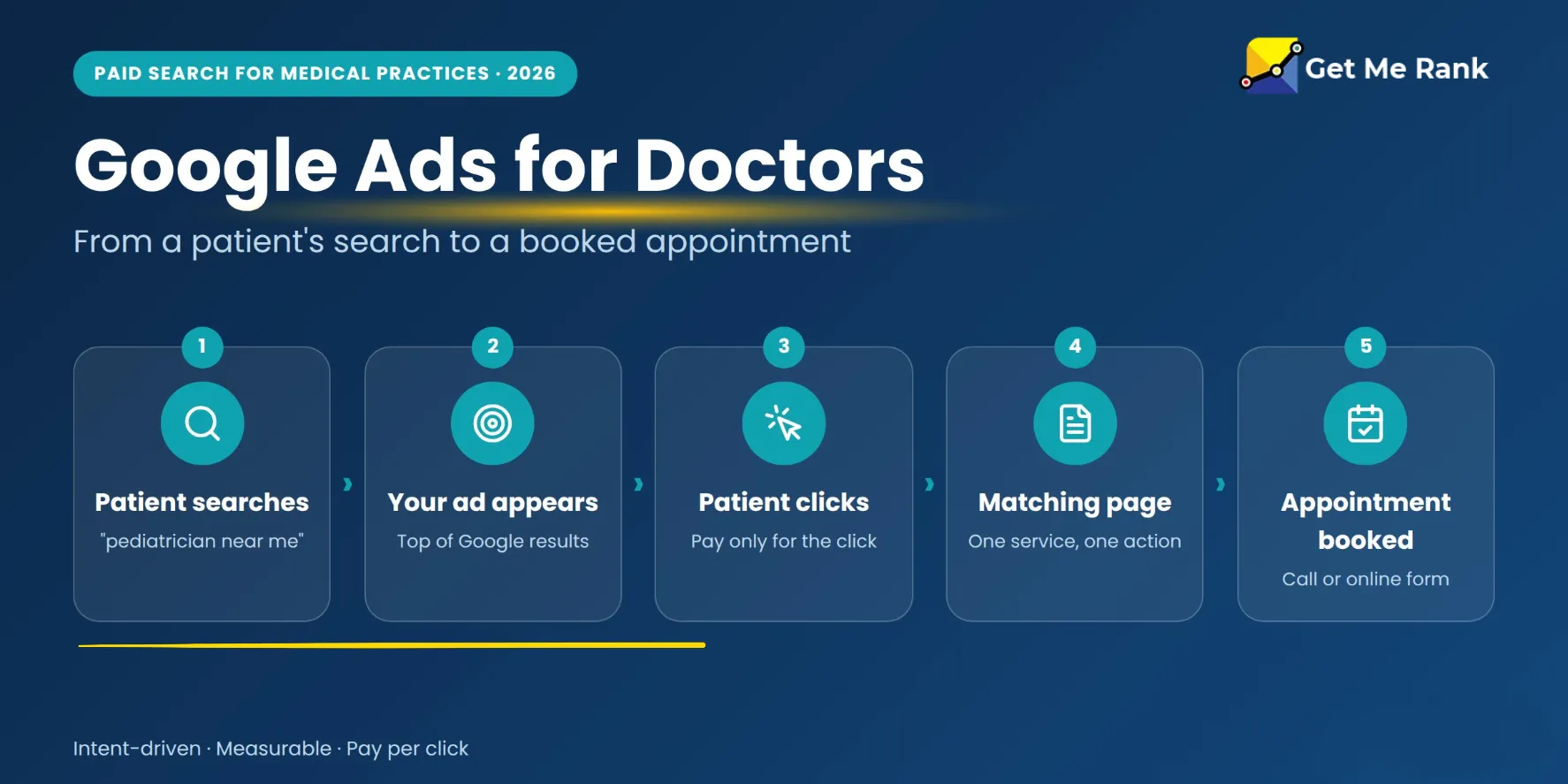
Yes, when your keywords show booking intent and your page makes booking easy. Someone searching “dermatologist accepting new patients” is choosing a provider today. Someone scrolling social media usually is not.
That timing is the whole advantage. Search ads are “pull” marketing: the patient raises a hand first. Social ads “push” a message at people who were not thinking about you. Both have a place, but for filling next week’s schedule, search intent is hard to beat.
What do the numbers say? Sources disagree, partly because each defines a “lead” and a “physician” differently. Here is how the published 2026 figures compare:
| Metric | All industries (Estimation 2026) | Physicians and healthcare (published estimates) |
|---|---|---|
| Cost per click | $5.42 | $4.76 $5 to $12 for general terms Specialty median of $32 |
| Conversion rate | 8.18% | 11.6% to 12.43% |
| Cost per lead | $66.69 | $40.04 to $56.83 |
Use these as a sanity check, not a promise. Your city, specialty and phone-answering habits move the result more than any average.
REAL-WORLD EXAMPLE
A two-doctor family practice runs ads for “family doctor” across its whole metro area. Clicks come from 25 miles away and from people searching “free clinic.” After tightening to “family doctor accepting new patients” within a 7-mile radius, and adding “free,” “jobs” and “salary” as negative keywords, total clicks fall, but a larger share of them call. Fewer clicks, more patients.
Which Google Ads campaign type should a medical practice start with?
SHORT ANSWER
Search. It targets people typing a need into Google. Other campaign types reach people who are not looking yet, which makes them harder to measure and easier to waste money on.
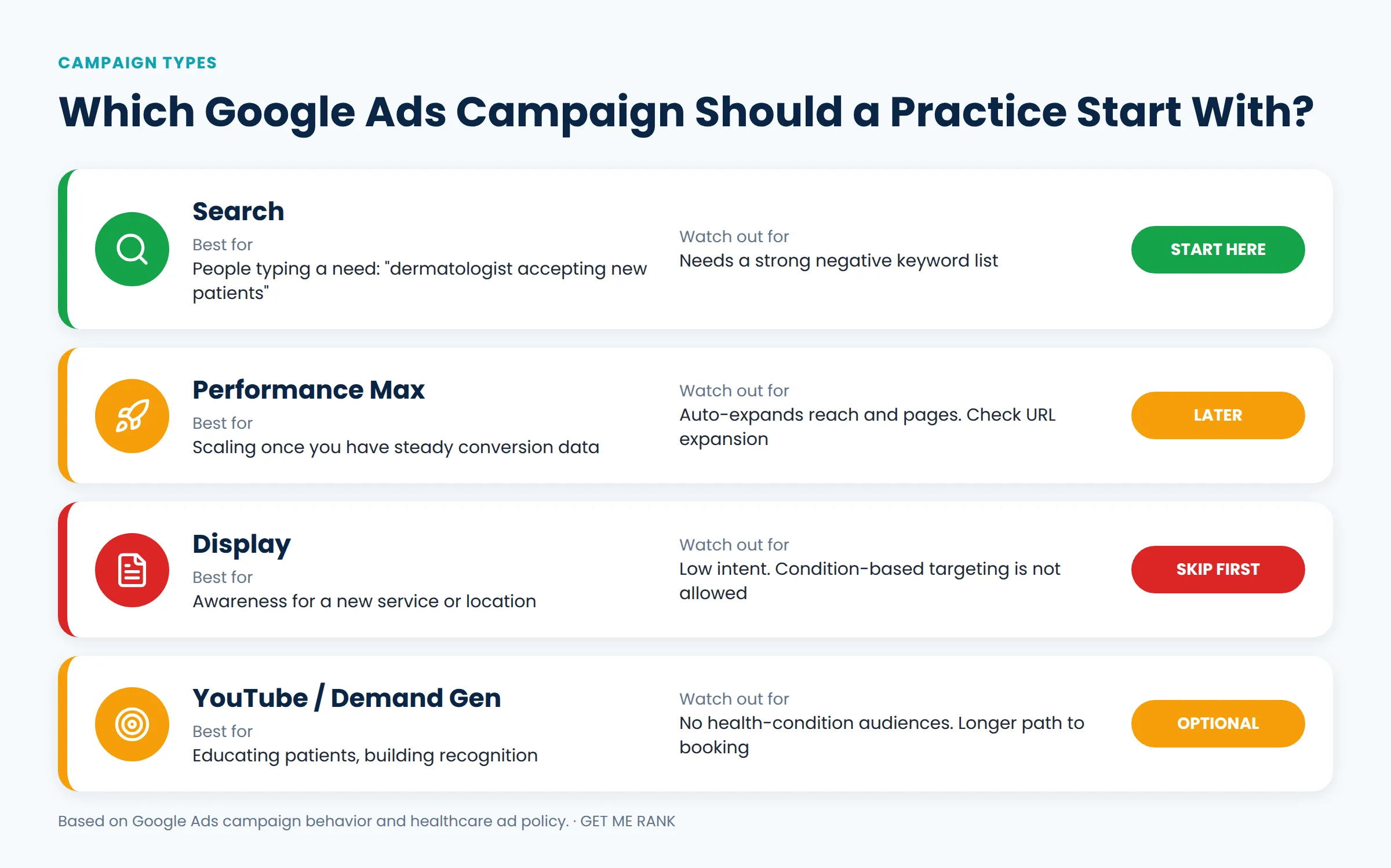
Google keeps nudging advertisers toward automated formats like Performance Max and AI-powered match types. They can work well once an account sends 30 to 50 conversions a month, which is the volume smart bidding. Before that, tighter manual control keeps spend predictable and your data readable.
One setting deserves a look in any automated campaign: final URL expansion. It lets Google send people to pages you did not choose. For a medical site, that could mean a patient lands on an old blog post about a diagnosis instead of your booking page. Turn it off, or at least review where traffic actually goes.
Are Google Ads for physicians different from other industries?
SHORT ANSWER
Yes. Health is a sensitive category. Google restricts personalized ads based on health conditions, a few services need certification, and HIPAA shapes how you track patients.
What do Google’s health ad rules actually say?
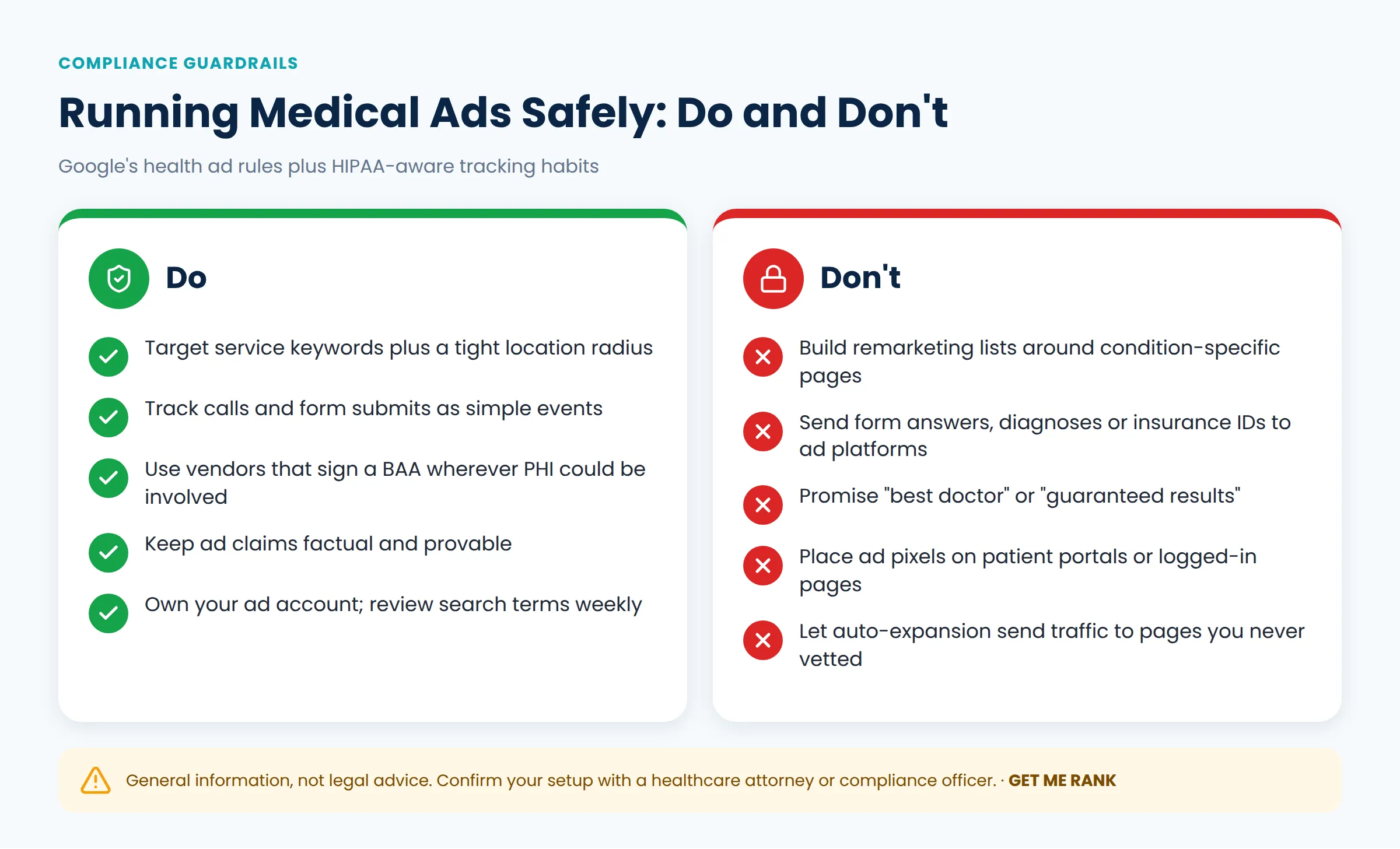
Google’s Personalized Advertising policy bars using health conditions, chronic-condition treatments and similar sensitive information to personalize ads. In practice, you cannot build a remarketing list of people who viewed your “diabetes care” page and follow them around the web.
That surprises people, because many guides recommend remarketing for every practice. Whether any audience-based targeting is allowed for your practice depends on how Google classifies the page and the audience, so do not assume. Ask your ad specialist to show you the exact policy wording before anything goes live.
A separate Healthcare and Medicines policy covers prescription drugs, online pharmacies, and some telehealth and addiction-treatment services, which need Google certification before ads can run. An in-person primary care or specialty practice usually faces fewer limits, but check first and plan for review time.
Where does HIPAA come in?
Google does not offer a Business Associate Agreement for Google Ads, according to several healthcare marketing vendorS. So the safest habit is simple: do not send protected health information (PHI) to the ad platform in the first place.
The legal picture shifted in 2024. In American Hospital Association v. Becerra, a federal court in Texas vacated part of HHS guidance on tracking technologies, specifically the idea that an IP address paired with a visit to a public webpage is automatically PHI. HHS later dropped its appeal. That helps, but it is not a green light. Ad platforms pair identifiers with intent, and private “wiretap” lawsuits over website trackers continue. Have your attorney review your setup. This guide is general information, not legal advice.
PRO TIP
Ask whoever builds your tracking one question: “Exactly what gets sent to Google when a patient books?” If the answer includes form fields, condition names or insurance details, stop and fix it before spending another dollar.
How do you set up Google Ads for medical practice campaigns?
SHORT ANSWER
Pick one service and one location, group keywords tightly, write specific ads, send clicks to a matching page, and track calls and bookings before launch.
• Choose one goal. “New-patient visits for sports medicine within 8 miles” beats “more patients.” A narrow goal tells you what to bid on and how to judge the result.
• Build keyword groups by service. Separate groups keep ads relevant, which helps Quality Score and lowers cost per click. Focus on searches that sound like booking, not research.
• Add negative keywords on day one. Block terms such as free, jobs, salary, residency, symptoms and how to. Review the search terms report weekly and add anything that wastes spend.
• Write specific, provable ads. Responsive Search Ads let you load up to 15 headlines and 4 descriptions. Mix your specialty, your location and one patient benefit.
• Set location targeting tightly. Most new patients live within 5 to 10 miles. Use a radius around the clinic and choose the option for people physically in or regularly in that area.
• Add assets. Call, location, sitelink and structured snippet assets (Google’s newer name for extensions) make the ad larger and give patients more ways to act.
• Set up tracking before launch. Count tracked calls and form submissions. Skip anything that captures what the patient typed.
Which keywords should you bid on?
| Search type | Example | Use it? |
|---|---|---|
| Booking intent | “pediatrician accepting new patients near me” | Yes, this is your core |
| Urgent need | “urgent care open now” plus your city | Yes |
| Service plus city | “knee pain specialist” plus your city | Yes |
| Research | “what causes high blood pressure” | No. It educates but rarely books |
| Job seekers | “nurse practitioner jobs” | Add as a negative keyword |
What does good medical ad copy look like?
Generic copy earns generic results, and unprovable claims can get ads disapproved. Specific and factual wins on both counts.
| Weak | Stronger |
|---|---|
| “Compassionate Care. Book Today!” | “Board-Certified Cardiologist in Dallas” |
| “The Best Doctor in Town” | “20 Years in Sports Medicine” |
| “Guaranteed Results” | “Same-Day Appointments Available” |
What should a landing page for medical ads include?
SHORT ANSWER
One service and one clear action. Put a tappable phone number or booking form at the top, then credentials, insurance, reviews and fast mobile loading.
Sending ad traffic to your homepage is the most common and costly mistake we see. A homepage has ten jobs. A landing page has one.
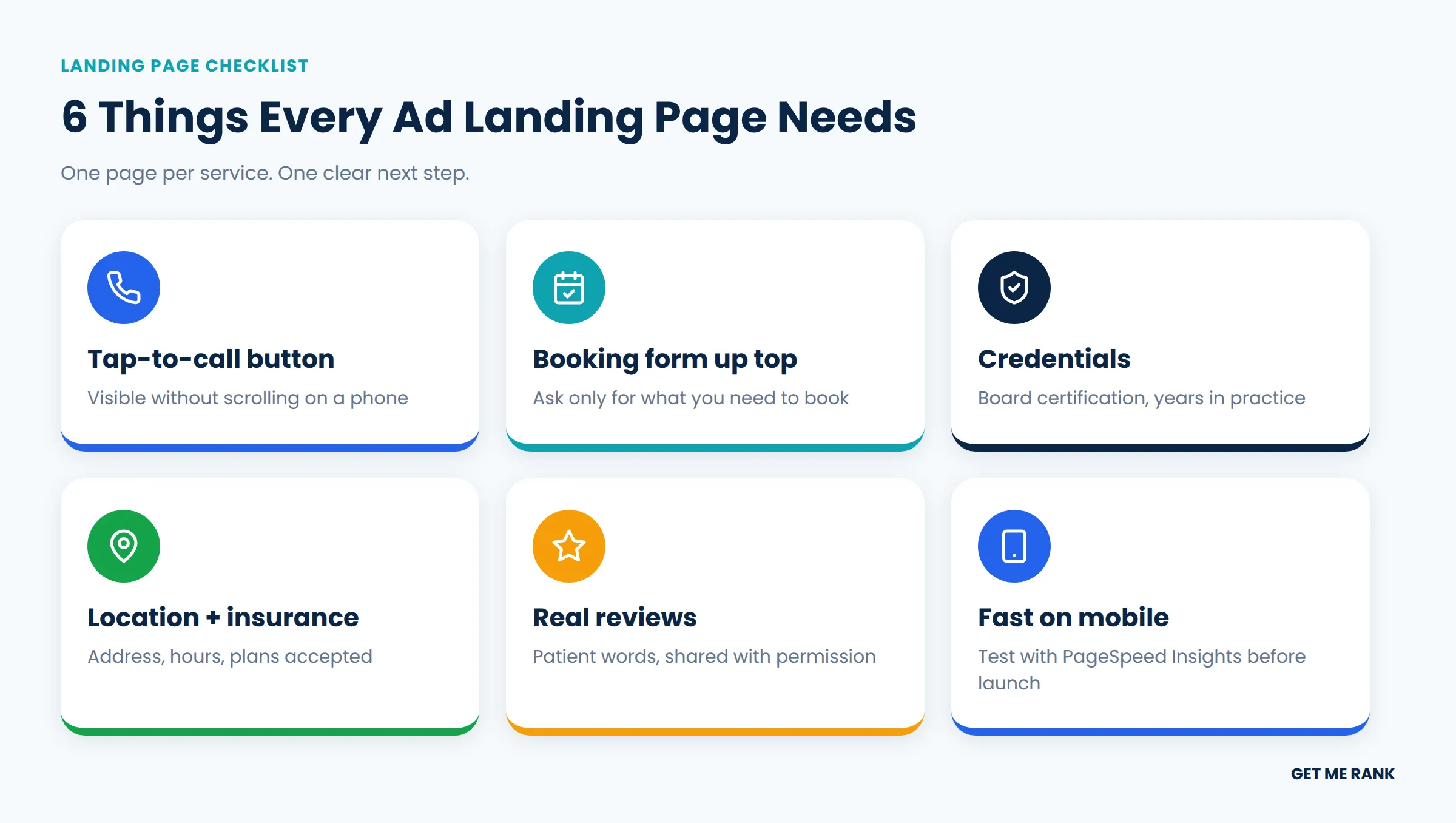
• Match the headline to the ad. If the ad says “same-day sports medicine appointments,” the page should say it too.
• Make the phone number tappable. Most patients searching on a phone will call before they fill out anything.
• Keep forms short and secure. Name, phone and preferred time are usually enough. Do not ask patients to describe symptoms in a form that feeds an ad platform.
• Show insurance and hours. “Do you take my plan?” is one of the most common reasons a patient bounces.
• Use reviews with permission. If a testimonial identifies a patient, get written authorization first.
• Test speed before launch. Run the page through Google’s PageSpeed Insights and fix slow images first.
Should your practice choose ads or SEO first?
SHORT ANSWER
Ads for speed, SEO for staying power. Most practices need both. If the schedule is empty today, start with ads while organic rankings build.
| Factor | Google Ads | SEO |
|---|---|---|
| Time to first patients | Days to weeks | Often several months |
| Cost model | Pay per click. Stops when the budget stops | Ongoing effort. Results keep compounding |
| Best for | Launching a service, filling an empty schedule | Long-term trust and local visibility |
| Control | High. Target by radius, hour and device | Lower. Depends on rankings |
Ads rent visibility. Organic search builds it. A reliable SEO service company will improve the same service pages your ads send traffic to, so paid and organic strengthen each other.
There is a newer reason to invest in both. More patients now ask AI search tools for recommendations. The signals that help there, clear service pages, visible credentials, consistent listings and real reviews, are the same ones that lift your ad landing pages.
How much should you budget for Google Ads for doctors?
SHORT ANSWER
Many single-location primary care practices start around $1,500 to $4,000 a month. Competitive specialties often need $5,000 to $15,000. The right number comes from what a new patient is worth to you.
| Practice type | Common starting range | |
|---|---|---|
| Single-location primary care | $1,500 to $4,000 per month | Estimated Number |
| Specialty practice in a competitive market | $5,000 to $15,000 per month | Estimated Number |
| Each service or location you want to grow | $2,000 to $5,000 per month | Estimated Number |
| Elective and cosmetic procedures | Top of the ranges above | Estimated Number |
Start with a budget you can sustain for 90 days. Pausing at week three throws away the learning period you already paid for.
PRO TIP
Set your target as cost per booked appointment, not cost per click. A $12 click that books beats a $3 click that never calls.
What should you track to know your ads are working?
SHORT ANSWER
Booked appointments and phone calls first. Clicks and impressions are supporting details, not results.
• Conversion rate. The share of clicks that become a call or booking request.
• Cost per booked appointment. Total spend divided by appointments, the number your budget decisions should rest on.
• Call answer rate and speed to callback. This is the leak most practices never measure. If the front desk misses calls from ads, you pay for clicks that go nowhere.
• Lead-to-patient rate. How many leads actually show up and become patients.
• Search terms report. The list of real queries that triggered your ads. Review it weekly.
| How often | What to review |
|---|---|
| Weekly | Search terms, call log, missed calls, spend pacing |
| Monthly | Bids, ad tests, landing page changes, cost per booked appointment |
| Quarterly | Budget by service, new locations, retiring weak campaigns |
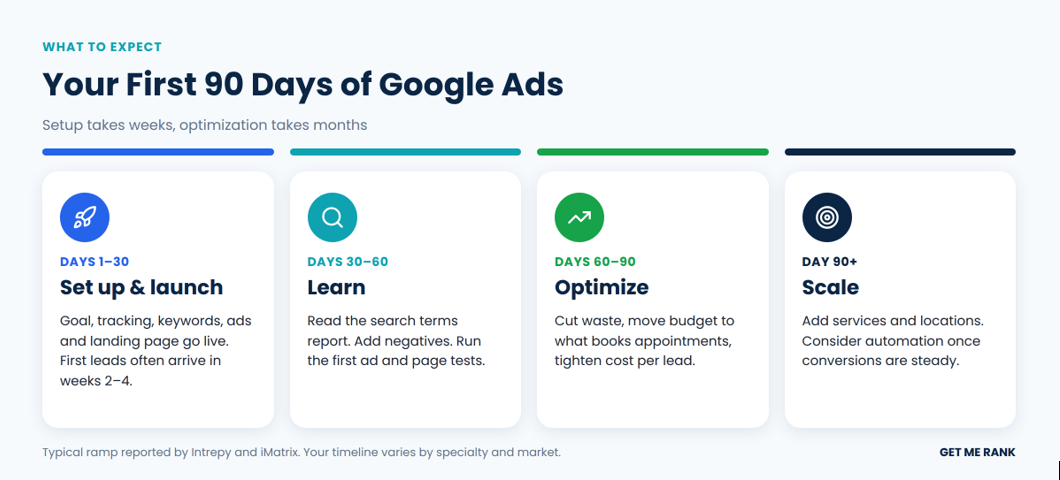
Be wary of anyone who promises a fixed number of patients in month one. Setup typically takes under a month, leads often start in the first few weeks, and it takes around 90 days to gather enough data to optimize well.
What mistakes waste the most ad budget?
Most Google Ads for medical practice accounts leak money in the same handful of places. Here is each leak, with the fix:
• Sending everyone to the homepage. Fix: one landing page per service.
• Running broad match without negatives. Fix: start with phrase and exact match, then expand carefully.
• Launching without conversion tracking. Fix: set up calls and forms before the first click, or Google optimizes toward clicks instead of patients.
• Copying remarketing tips that ignore health policy. Fix: confirm what is allowed before building audiences.
• Accepting every automated recommendation. Fix: review each one and ask whether it serves your goal or just raises spend.
• Bidding on symptom research terms. Fix: block them with negatives and answer those questions through your blog and SEO.
• Ignoring nights and weekends. Fix: add online booking or an answering service so after-hours calls are not lost.
Should you run Google Ads yourself or hire an agency?
SHORT ANSWER
A single-specialty practice that can review the account every week can start in-house. Multi-location groups, competitive specialties and anyone spending $5,000 or more a month usually do better with specialist help.
| In-house | Specialist agency | |
|---|---|---|
| Cost | Staff time, no management fee | Management fee on top of ad spend |
| Compliance know-how | You build it yourself | Should come with the team |
| Speed to results | Slower while you learn | Faster setup, less trial and error |
| Best for | One location, one specialty, a hands-on manager | Several locations, high competition, larger budgets |
Get Me Rank was founded in 2017 and has a team of 50-plus specialists across performance marketing, SEO and creative. For healthcare accounts, we start with policy and tracking checks before any ad goes live, then plan the landing pages together with the ads rather than after them.
If you would rather hand off the day-to-day, our performance marketing services cover search ads, landing page testing and reporting in one workflow. That matters for Google Ads for medical practice owners who want one accountable team instead of three vendors.
What should you ask any agency before you sign?
• Will you sign a BAA, or do you keep PHI out of ad platforms entirely?
• What exactly does your conversion tracking send to Google?
• Who owns the ad account? (It should be you.)
• How do you handle health-policy disapprovals?
• Will you report on booked appointments, not just clicks?
• What happens if results stall after 90 days?
Frequently asked questions
Can doctors advertise on Google?
Yes. Most in-person practices face few restrictions. Prescription drugs, online pharmacies, and some telehealth and addiction-treatment services need Google certification first. Always follow Google’s Healthcare and Medicines policy and your state’s advertising rules.
Is Google Ads HIPAA compliant?
Not by itself. Google does not offer a Business Associate Agreement for Google Ads, so keep protected health information out of the platform. That means no diagnoses, form answers or insurance IDs in tracking. Have an attorney review your setup.
How much does a new patient cost through Google Ads?
Divide your cost per lead by your lead-to-patient rate. At the $56.83 physician benchmark and a 40% lead-to-patient rate, that is roughly $142 per new patient. Your real number depends on your specialty, market and how fast you answer calls.
How long until ads bring in patients?
Many campaigns produce first leads within two to four weeks. Expect 60 to 90 days of data before optimization really pays off. Anyone promising a fixed patient count in month one is guessing.
Are Google Ads for physicians better than social media ads?
They do different jobs. Search captures people already looking for care, so it usually fills the schedule faster. Social builds awareness and works well for reminders and education. Many practices use both, starting with search.
Can I retarget my website visitors?
Be careful. Google restricts personalized ads based on health conditions, so condition-specific remarketing is typically not allowed. Ask your specialist to check the current policy, and rely on search ads, your own patient communications and local SEO instead.
Which keywords should physicians avoid?
Avoid broad research queries like “what causes high blood pressure,” plus “free” and job-related terms. Add them as negative keywords on day one so your budget goes to people trying to book.
Do Google Ads for physicians need special approval?
Usually not for in-person practices, but certain categories do. Telehealth that prescribes, online pharmacies and addiction-treatment services need certification. Check Google’s current policy before you launch so ads are not paused mid-campaign.
The bottom line
Google Ads for doctors work best when four things line up: keywords that signal booking intent, a landing page built for one action, tracking that protects patient privacy, and a budget based on what a new patient is worth. Get those right, and paid search becomes one of the most predictable ways to fill a schedule. Get them wrong, and it becomes an expensive lesson.
Start small, measure booked appointments, and review the search terms every week. Then scale what works.