AI Marketing
Key Takeaways
- AI Max is not a new campaign type — it’s an AI optimization layer you toggle on inside your existing Search campaigns, combining search term matching, asset optimization, and new controls.
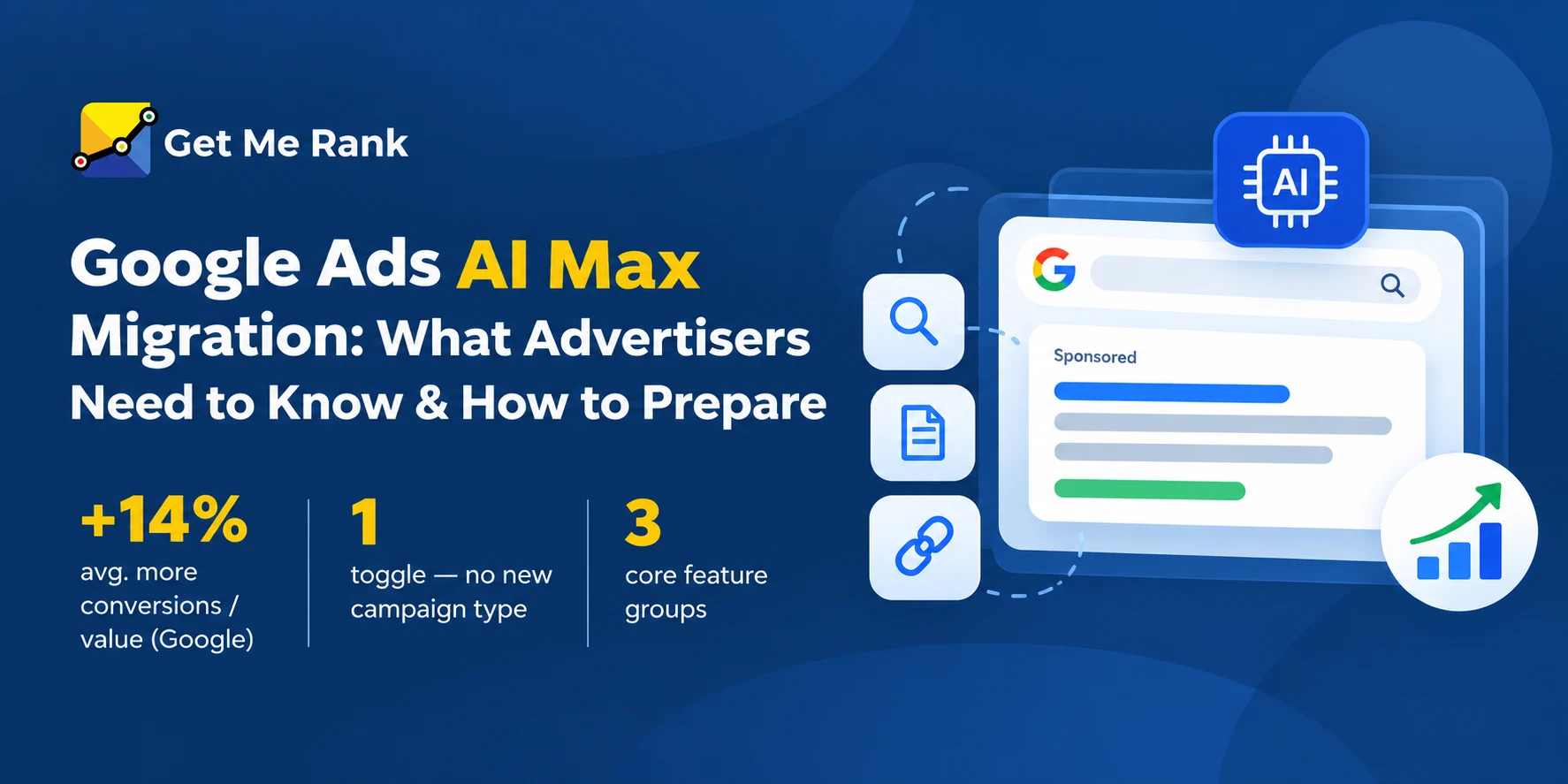
- Google reports advertisers who switch on AI Max see an average ~14% lift in conversions or conversion value at a similar CPA or ROAS.
- Migration is only safe on foundations already in place: conversion tracking, conversion-based Smart Bidding, and a budget that isn’t capped.
- Don’t flip every feature on at once. Pilot on one campaign, enable features one at a time, and measure against a clean baseline.
- The steps most advertisers skip — URL exclusions and brand controls — are exactly where migrations go wrong.
- Expect a 1–2 week learning period, then judge results over 2–4 weeks before rolling out account-wide.
Introduction
If you run Google Ads, you’ve probably seen the prompt: “Enable AI Max for this Search campaign.” It looks like a simple toggle — and technically it is. But behind that switch sits the biggest shift to Search campaigns since Smart Bidding, and turning it on carelessly can quietly change where your ads show, what they say, and which pages they send people to.
Short answerAI Max migration means switching your existing Google Ads Search campaigns from manual, keyword-led targeting to Google’s AI-driven optimization layer. Done right — on solid foundations, in phases, measured against a baseline — it typically lifts conversions. Done blind, it can waste spend on the wrong queries and pages.
This guide walks through what AI Max actually is, why the migration matters now, an 8-step playbook to do it safely, how long results take, and the mistakes that sink most rollouts.
Pro tipBefore you touch the toggle, take a screenshot (or export) of the last 30–60 days of campaign performance. That’s your baseline — without it, you’ll never know whether AI Max actually helped.
What Is Google Ads AI Max?
Short answerAI Max is a suite of AI-powered features you enable inside an existing Search campaign. It expands your reach beyond your keywords, generates tailored ad copy, and sends clicks to the most relevant landing page — while giving you brand and location controls to keep it on the rails.
Launched by Google in May 2025, AI Max is an optimization layer, not a separate campaign type. It bundles three groups of features:
1. Search term matching
Uses broad match plus “keywordless” technology to find relevant, high-performing queries you’d miss with your current keyword list — learning from your existing keywords, creatives, and landing pages.
2. Asset optimization
Two parts that work together: text customization (formerly Automatically Created Assets) generates headlines and descriptions from your ads, landing pages, and generative AI; and final URL expansion sends users to the best-matching page on your site — much like Dynamic Search Ads.
Google Ads AI Max Migration: What Advertisers Need to Know & How to Prepare
3. Controls & reporting
Brand controls, URL inclusions/exclusions, locations of interest, and richer search-term and asset-level reporting — the guardrails that make the automation safe to use.
Average Search performance: Standard vs AI Max (indexed conversions, similar CPA/ROAS)
Standard Search
100
With AI Max
114
Illustrative index based on Google’s reported ~14% average lift in conversions / conversion value. Your results will vary by account.
Why AI Max Migration Matters Now
Short answerSearch behaviour is shifting from keywords to natural-language, long-tail queries, and Google is steadily moving its Search stack toward AI. Migrating on your terms — with controls set — beats being defaulted in later without them.
Keyword lists can’t keep up with how people actually search now. AI Max is Google’s answer: match on intent, generate copy per query, and route to the right page automatically. The advertisers who win are the ones who migrate deliberately rather than reactively.
May 2025
AI Max launched at Google Marketing Live
+14%
avg. conversion / value lift (Google)
Off
by default — you choose when to switch on
2–4 wks
to evaluate against a clean baseline
Planning an AI Max migration?
Get Me Rank can pilot, measure, and roll it out across your account — without the guesswork.
The 8-Step AI Max Migration Playbook
Migrating well is a process, not a toggle. Follow these in order.
1. Confirm your foundations before you switch anything on
AI Max leans on Google’s automation, so it only works if the automation has what it needs. Check these first.
Anatomy of an AI Max–ready Search campaign
✓
Accurate conversion tracking — clean, deduplicated conversions with correct values.
✓
Conversion-based Smart Bidding — Maximize Conversions/Value or a tCPA/tROAS target.
✓
A budget that isn’t capped — AI Max won’t perform on a budget-limited campaign.
✓
Strong assets — enough quality headlines/descriptions for text customization to build on.
✓
A negative keyword list — carried over and ready to expand.
2. Pick the right pilot campaign
Don’t migrate the whole account on day one. Choose one or two campaigns with steady conversion volume and healthy budget — enough signal to learn quickly, but not your single most business-critical campaign.
3. Enable features one at a time
Start with search term matching, measure, then layer in asset optimization. Enabling everything at once makes it impossible to tell what moved the numbers. Here’s the shift AI Max represents:
| The old way | With AI Max |
|---|---|
| Manual keyword lists & match types | Search term matching (broad + keywordless) |
| Manually written RSAs | Text customization (AI-generated copy) |
| One fixed final URL / DSA | Final URL expansion to the best page |
| Manual location targeting | Locations of interest |
4. Set your brand controls and locations of interest
Before traffic scales, tell AI Max how to treat your brand terms and which locations matter. This stops brand queries and out-of-area searches from being handled in ways you didn’t intend.
5. Add URL inclusions and exclusions
This is the step most advertisers skip — and the one that causes the most regret.
HighlightFinal URL expansion can send clicks to any relevant page on your site. Exclude pages you never want to advertise (careers, policy pages, out-of-stock, thin content) before you turn it on — not after you’ve paid for the clicks.
6. Keep your negatives — and mine the new search terms
Broader matching means new queries. Carry over your negative keyword list, then check the search-terms report every few days in the first weeks and add negatives for anything irrelevant.
7. Strengthen your assets for text customization
AI-generated copy is only as good as what it learns from. Feed it clear, benefit-led headlines and accurate landing-page content. For compliance-heavy or brand-sensitive messaging, review generated assets closely.
Get Me Rank tipKeep a short “words to avoid” and brand-voice note alongside the campaign. It gives text customization guardrails and saves you from off-brand or non-compliant copy slipping into live ads.
8. Measure against your baseline, then scale
Compare the pilot to the baseline you saved in step 1 — on conversions and value at a similar CPA/ROAS, not on clicks or impressions. Once a campaign proves out, roll AI Max out to the next batch. Migration is a rollout, not a single switch.
Should You Migrate All at Once or Phase It?
Short answerPhase it. A pilot-first rollout protects revenue, isolates what’s working, and gives you a clean before/after — the only responsible way to migrate an account that’s driving real sales.
| Approach | Best for | Risk |
|---|---|---|
| Phased rollout (recommended) | Accounts with meaningful spend/revenue; agencies managing client budgets | Low — issues are caught on one campaign, not all |
| All-at-once | Very small accounts, or brand-new builds with no baseline to protect | High — no clean baseline, hard to attribute changes |
How Long Until AI Max Improves Performance?
Short answerExpect a 1–2 week learning period as bidding and matching recalibrate, then a fair read on performance over 2–4 weeks. Don’t judge results mid-learning.
Week 0
Baseline & enable
Save 30–60 days of data, enable on the pilot campaign.
Weeks 1–2
Learning period
Matching & bidding recalibrate. Expect fluctuation — don’t over-react.
Weeks 2–4
Evaluate
Compare to baseline on conversions/value at similar CPA/ROAS.
Week 4+
Scale
Roll out to the next campaigns; keep mining search terms.
Common Mistakes That Sink AI Max Migrations
- Enabling every feature at once — with no baseline, you can’t tell what helped or hurt.
- Migrating a budget-limited campaign — AI Max needs room to explore; a capped budget starves it.
- No conversion tracking or value data — the AI optimizes toward whatever you measure; measure nothing accurate and it optimizes toward noise.
- Skipping URL exclusions — final URL expansion then spends on pages you never wanted to promote.
- Dropping negative keywords — broader matching without negatives invites irrelevant, wasteful clicks.
- Judging results during the learning period — early swings are normal; decisions need 2–4 weeks.
- Ignoring brand controls — brand traffic gets handled in ways that inflate cost or blur reporting.
- Weak assets — thin headlines and vague landing pages produce weak AI-generated copy.
Conclusion
AI Max migration isn’t something to fear or to rush. It’s a genuine step up for Search campaigns — Google’s own data points to meaningful conversion gains — but the upside only shows up when the foundations are right and the rollout is deliberate. Get your tracking, bidding, and budget in order; pilot on one campaign; enable features one at a time; set the brand and URL controls most people skip; and measure against a clean baseline before you scale.
Do that, and AI Max becomes an easy win rather than a risky toggle. If you’d rather have it handled end-to-end, that’s exactly the kind of migration our performance team runs every week.
FAQs About Google Ads AI Max Migration
Is AI Max a new campaign type?
No. AI Max is an optimization layer you switch on inside an existing Search campaign — not a separate campaign type like Performance Max. You keep your campaign; you’re upgrading how it targets and creates ads.
Does AI Max cost extra?
There’s no separate fee for AI Max. You pay your normal ad costs; AI Max changes how those clicks are targeted and served, not how you’re billed.
Will AI Max replace Dynamic Search Ads?
AI Max’s final URL expansion works much like DSAs and is Google’s more advanced evolution of that approach. If you rely on DSAs, plan to test migrating that functionality into AI Max.
Do I need Smart Bidding for AI Max to work?
Yes — features like search term matching, final URL expansion, and text customization require conversion-based Smart Bidding to function effectively, so accurate conversion tracking is essential.
How much budget do I need?
There’s no fixed minimum, but AI Max won’t perform on a budget-limited campaign. If a campaign is capped, Google will flag it — free up budget before enabling.
Can I turn AI Max off after migrating?
Yes. You can toggle AI Max (or individual features) off. Note that URL inclusions/exclusions are ignored when the related settings are switched off, so review your controls if you disable features.
How is AI Max different from Performance Max?
Performance Max is its own campaign type spanning all Google inventory. AI Max stays within Search and keeps you in your Search campaign with more control. Many advertisers run both.
How soon will I see results?
Allow a 1–2 week learning period, then evaluate over 2–4 weeks against your pre-migration baseline. Judge on conversions and value at a similar CPA/ROAS.