
Digital Strategy
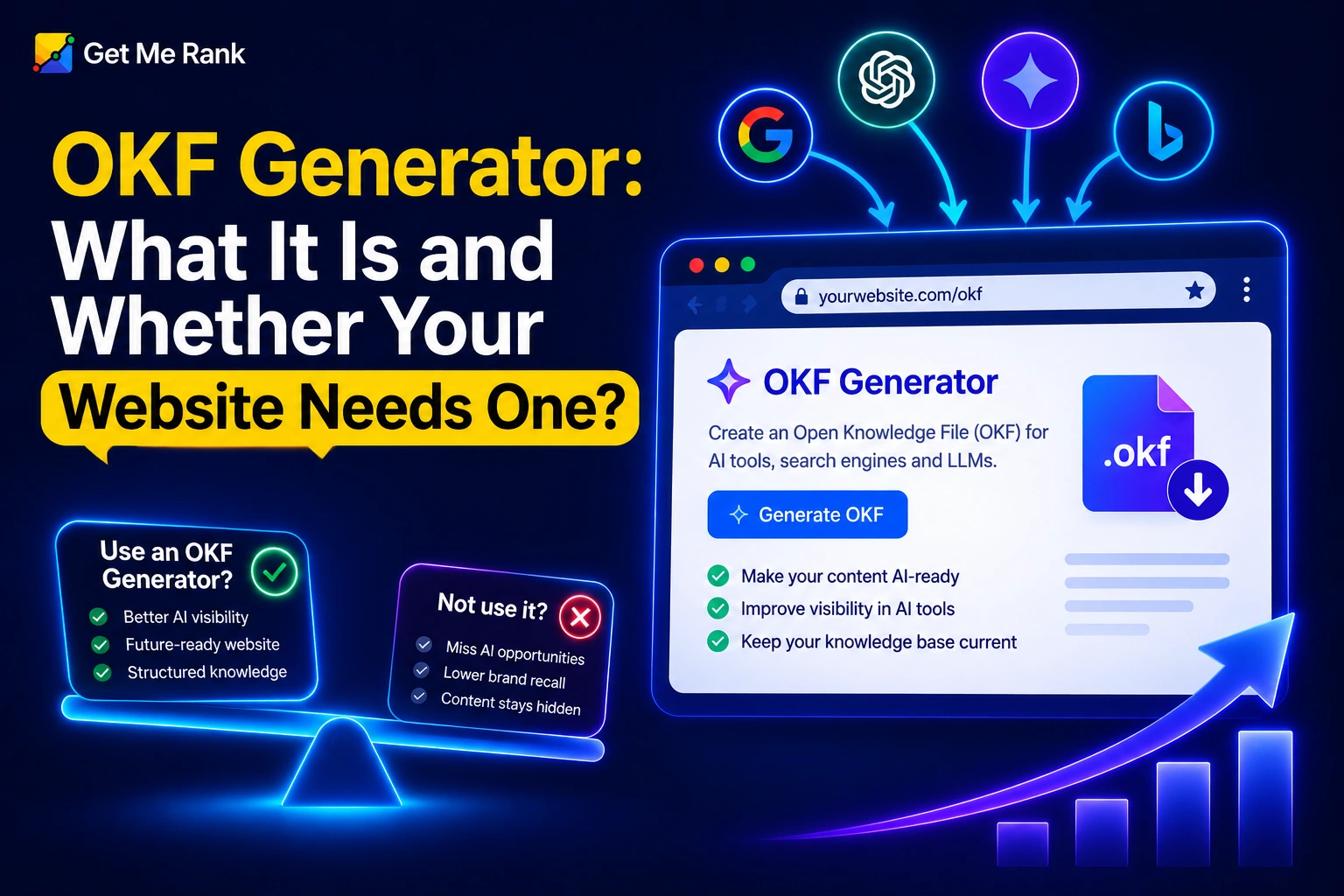
Every few months, a new format arrives that promises to future-proof your website for AI. The latest is the Open Knowledge Format (OKF), and with it a wave of “OKF generator” tools that turn your site into a bundle of Markdown files with a single click. The pitch is tempting: get ahead of AI search, make your content agent-ready, and win a head start on everyone who waits.
OKF is a real and well-built specification. Google Cloud introduced it on 12 June 2026 and shipped an updated version (v0.2) on 25 July 2026. But being real is not the same as being useful for your business, right now. This article makes the honest case against rushing into an OKF generator, so you can decide with clear eyes instead of fear of missing out.
To be fair from the start: OKF is not a scam and it is not useless. For a narrow set of teams it solves a genuine problem. For most website owners, though, an OKF generator is a solution looking for a problem you probably do not have yet.
First, What an OKF Generator Actually Does
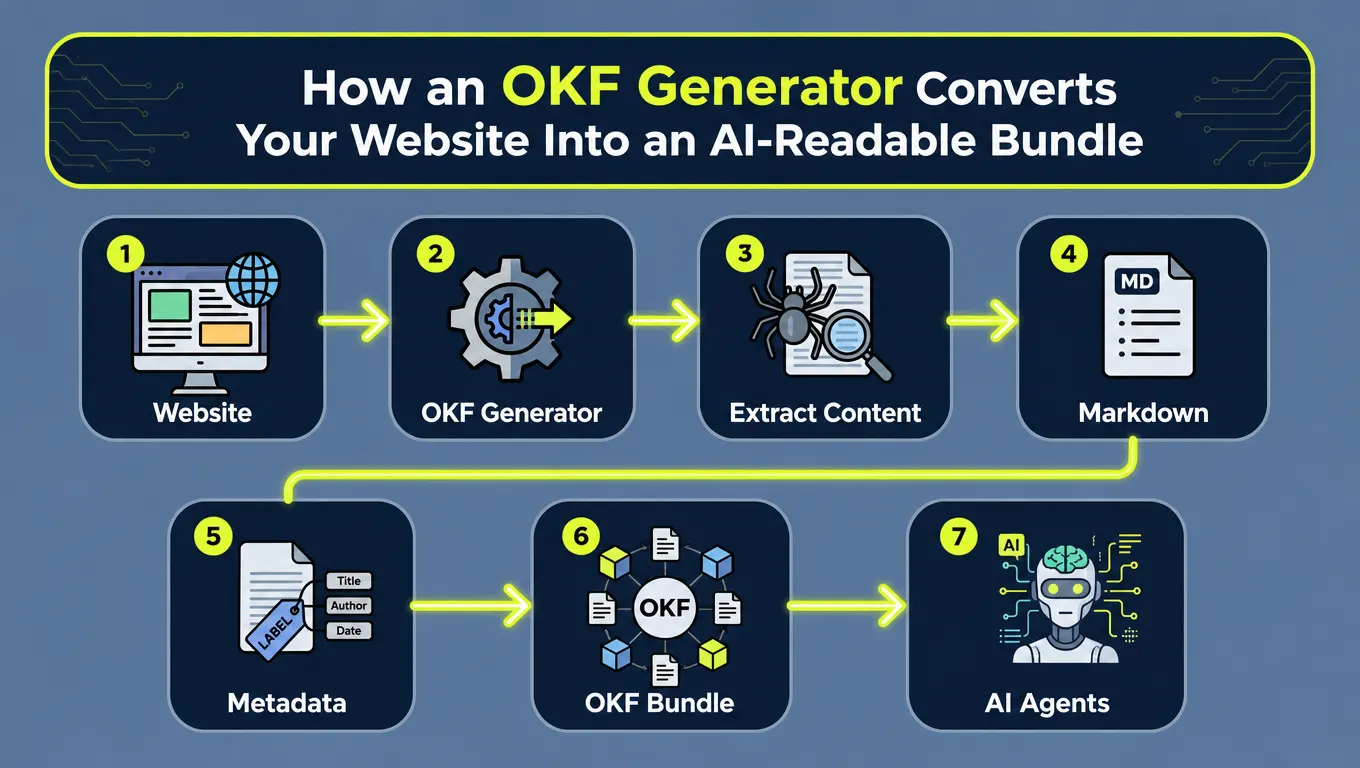
An OKF generator reads your website and turns each page into a clean Markdown file with a small block of metadata on top, then links those files together into a folder called a bundle. The idea is that an AI agent could read this tidy version of your site instead of wading through your HTML, menus, and scripts.
OKF Generator: What It Is and Whether Your Website Needs One?
Nothing here is wrong. The problem is not the format. The problem is the gap between what these tools produce and what actually happens to it afterwards. That gap is where most of the value quietly disappears.
1. Nothing Goes Looking For Your Bundle
This is the single biggest reason to pause. You can generate a perfect OKF bundle, publish it neatly at /okf/, and then wait. And wait. Because right now, no search crawler, no answer engine, and no AI agent automatically goes looking for it. There is no widely used rule that tells machines your bundle exists, the way a sitemap or robots file does.
In plain terms: you can build the library, but nobody has the address. The people implementing OKF have said this openly, and it remains the honest state of things. A file that nothing requests cannot help you, no matter how well it is formatted.
| The hard truth: An OKF bundle is not discovered on its own. Publishing one and expecting AI traffic is like printing brochures and leaving them in a locked cupboard. |
2. It Is a Draft, Not a Finished Standard
OKF is young. It went from v0.1 to v0.2 in roughly six weeks, and Google itself described the first version as a starting point rather than a finished standard. That is healthy for an early specification, but it is a poor reason to reorganise your content strategy around it today.
When you build on a moving target, you take on rework. Fields get renamed, expectations shift, and the bundle you generate this quarter may need regenerating next quarter. Early adoption makes sense when the upside is large and proven. Here, the upside is neither.
3. It Was Built for Data Teams, Not Marketing Websites
OKF came out of Google Cloud’s data team and ships inside a data product. Its natural home is internal knowledge: tables, metrics, datasets, APIs, and runbooks that a company’s own AI agents need to read reliably. That is a real and sensible use case.
Pointing an OKF generator at a marketing website is a repurposing of the format, not its intended job. It can be done, and some tools do it well, but you are borrowing a tool designed for one problem and hoping it helps with another. Hope is not a strategy.
4. It Does Nothing Proven For Your Rankings or AI Visibility
This is where the marketing around OKF generators gets loose. Let us be precise:
- OKF is not a Google ranking signal, and Google’s search systems do not read your bundle to rank your site.
- No evidence generating a bundle increases AI Overview visibility.
- There is no evidence it earns you citations in ChatGPT, Gemini, or other tools.
- There is no measured traffic lift attached to simply having a bundle.
Any tool or agency promising “rank higher with OKF” or “get cited by AI” is selling certainty that does not exist. The honest position is that OKF may become useful for agent workflows over time, not that it moves your numbers this week.
5. Auto-Generation Creates Real Risks
A generator’s whole appeal is speed: one click, dozens of files. But speed at scale multiplies whatever is wrong at the source.
A generator organises information; it does not check whether that information is correct, current, or safe to publish. That review still lands on a person, which quietly erases the time the tool was supposed to save.
6. It Is One More Thing to Maintain
Every artifact you publish is a promise to keep it up to date. Your website already needs maintenance. Add a bundle, and you now have a second copy of your content that can drift out of sync with the first. When your services change, your prices change, or your story changes, you have two places to fix instead of one.
For a large team with automation, that is manageable. For most businesses, it is another quiet chore with no clear payoff attached, and chores without payoff are the ones that get abandoned.
7. You Probably Have Better-Supported Options Already
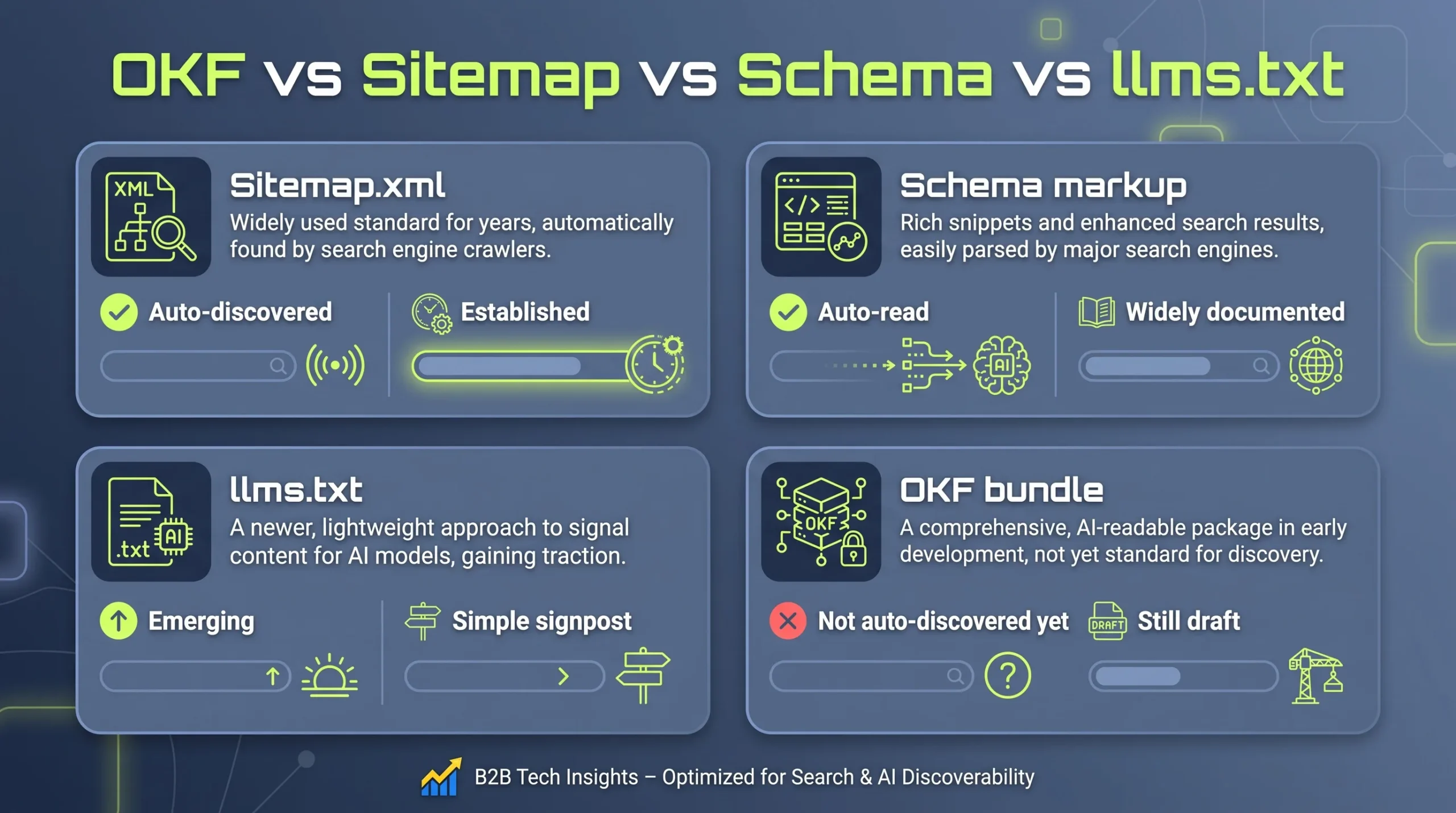
Before adding a brand-new, undiscovered layer, it is worth asking what is already working. Most of the machine-readable web has more support and more history than OKF does.
If your crawlability, content quality, internal linking, technical SEO, structured data, and business information are not already in good shape, an OKF bundle will not rescue you. It sits on top of the basics; it does not replace them.
When an OKF Generator Might Genuinely Be Worth It
A fair case against is not a blanket “never.” There are situations where OKF earns its place:
- You are building your own AI agents or RAG systems against your own knowledge, and they keep getting definitions or data sources wrong. This is exactly what OKF was made for.
- You are a data-heavy or documentation-heavy organisation with metrics, tables, and runbooks that internal tools need to read consistently.
- You have the engineering capacity to keep a bundle accurate and to experiment without expecting a traffic return.
If that is you, treat OKF as a small, low-cost experiment on your own internal knowledge, not as a website-wide SEO play. If that is not you, there is no urgency.
What to Do Instead, Right Now
If your real goal is to be visible in AI search, your time is better spent on things that are already proven to matter:
- Make sure your site is crawlable and indexable.
- Publish genuinely helpful, accurate, well-structured content.
- Get your internal linking and site structure clean.
- Fix technical SEO issues that hold pages back.
- Add and maintain correct structured data (schema).
- Build genuine authority through mentions and quality links.
- Keep your business information accurate and consistent everywhere.
Do these well and you are already ahead of most sites in both classic search and AI answers. OKF, if it matures and gets real discovery support, can be added later as a small extra layer. It is a nice-to-have, not a foundation.
| Not sure where to spend your effort? Get Me Rank will give you a straight answer about what actually moves AI visibility for your site, not whatever is trending this month. |
Final Thoughts
OKF is a thoughtful format with a sensible purpose, and it may well matter more as AI agents spread. But an OKF generator, pointed at a normal website, mostly produces a tidy file that nothing asks for and no data proves helps. The urgency around it is marketing, not evidence.
The honest advice is simple. Do not spend real time and money chasing an unproven, undiscovered layer while your fundamentals need work. Get the basics right first. If OKF grows up and earns real support, adding it later will be a small job, and you will not have wasted a season betting on a draft.
Frequently Asked Questions
1. Are OKF generators a scam?
No. The format is real and well-built, and the tools do what they claim. The problem is the gap between generating a bundle and getting any benefit from it, since nothing currently goes looking for your bundle and there is no proven ranking or visibility gain.
2. Will an OKF generator improve my Google rankings?
There is no evidence that it will. OKF is not a ranking signal, and Google’s search systems do not read your bundle to rank your site. Treat any tool promising higher rankings through OKF with real caution.
3. Will it get my site cited by ChatGPT or Gemini?
Not on its own. No major AI tool automatically fetches OKF bundles today, and there is no measured lift in citations from simply publishing one. Being cited still comes from clear, credible, well-structured content.
4. Is OKF completely useless?
No. For teams building their own AI agents against internal knowledge, or for data-heavy organisations, OKF can genuinely help. The point of this article is that most marketing websites are not that case, at least not yet.
5. Is it bad to publish an OKF bundle?
Not inherently, but it carries small risks: stale or duplicate files, accidental exposure of private information, and the ongoing job of keeping it in sync with your site. If you do it, review everything before publishing.
6. Should I ignore OKF entirely then?
You do not have to ignore it; just do not build your strategy on it. Keep an eye on whether real discovery support arrives and whether AI tools start reading bundles. If that happens, revisit it as a low-cost add-on.
7. What should I do instead?
Focus on the basics that already work: crawlability, helpful content, clean internal linking, technical SEO, correct schema, genuine authority, and accurate business information. These help you in both classic and AI search today.